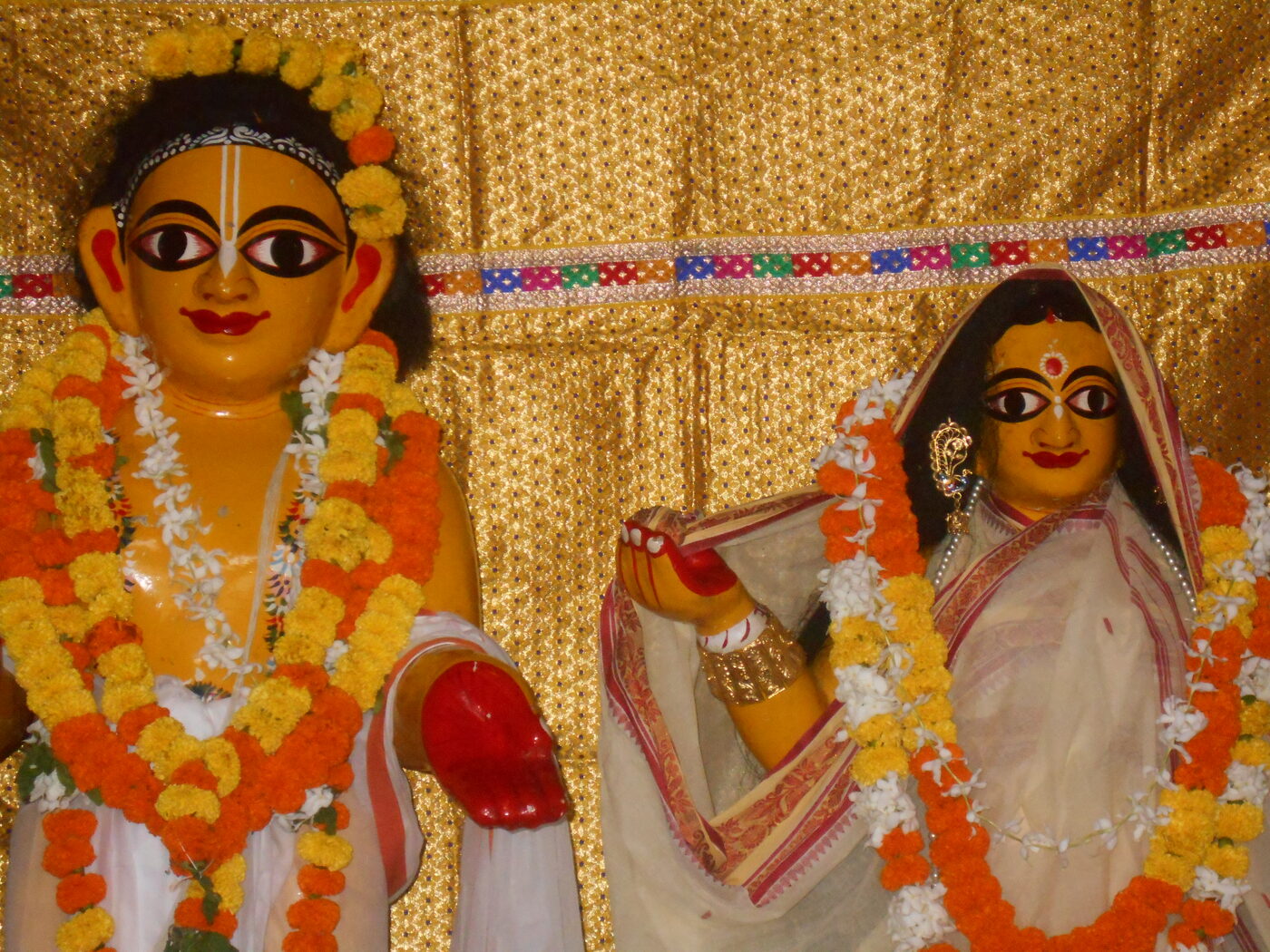
Srimati Sita Thakurani
The Wife Whom Mahaprabhu Called Mother
Also known as Sita Devi, Sitadevi, Sri Sita, Sita Thakurani
“May You be blessed with a long duration of life.”
Her blessing over the infant Sri Chaitanya Mahaprabhu, spoken just before she named Him Nimai, Sri Chaitanya-charitamrita, Adi-lila 13.117.
Srimati Sita Thakurani was the wife of Sri Advaita Acharya, one of the most senior associates of Sri Chaitanya Mahaprabhu. Yet all through Bengal she is honoured for her own devotion and character, not only as her husband's wife. Sri Chaitanya-charitamrita introduces her, the very first time she appears in the story, as a woman "worshiped by the whole world." Her whole life, read carefully, shows why that was never empty praise.
| Detail | Description |
|---|---|
| Relationship | Wife of Sri Advaita Acharya |
| Father | Nrsimha Bhaduri, of a respected Nadia-district family |
| Married | At Phuliya Nagar; the couple then made their home at Shantipura, Nadia |
| Sons | Acyutananda, Krishna Mishra, Gopala and others; Acyutananda became a noted devotee |
| Identity | Yogamaya, the Supreme Lord's own potency, appearing as Advaita Acharya's wife (Gaura-ganoddesha-dipika 86) |
| Best known for | Naming the infant Chaitanya Mahaprabhu "Nimai"; a lifetime of cooking, hospitality and service to Him |
| Samadhi | Shantipura, Nadia, beside Sri Advaita Acharya's own samadhi |
This page traces her own side of the story. The fuller household story is already told on Sri Advaita Acharya's page and on Sita Thakurani and the Family at Shantipura, so it is not repeated here. That story includes the naming of the infant Lord, the family at Shantipura, the sons, and the difficult division that later split the family. Here we look instead at her own character, her direct bond with Sri Chaitanya Mahaprabhu, and what the tradition honestly says about her place as a devotee and a teacher, including the gaps in the record.
A Daughter of Nadia, A Wife at Shantipura #
Sita Thakurani was the daughter of Nrsimha Bhaduri. Bengali Vaishnava tradition places her marriage to Advaita Acharya at Phuliya Nagar. After that the couple settled at Shantipura on the Ganges. Beyond this, little is recorded. No birth year survives for her, and nothing is written about her life before marriage. Most Bengali women of the fifteenth century are remembered in this way, through their homes and their devotion, not through personal life stories. We say this plainly and do not invent details that are not in the sources.
But from her very first mention, the sources do record how highly she was honoured. Sri Chaitanya-charitamrita calls her jagat-pujita arya, "worshiped by the whole world, the most advanced and cultured lady," in the same line that gives her name. Gaudiya theology goes further. According to Gaura-Ganoddesha-Dipika, Sita Thakurani is Yogamaya herself. Yogamaya is the Lord's own potency that arranges His pastimes and, when needed, hides them. Here that potency appears in human form as Advaita Acharya's wife. The same text names Sri, remembered in the tradition as her sister, as another manifestation of that same potency. Sita Thakurani is remembered as one of four leading women devotees around Sri Chaitanya Mahaprabhu. The others are Sachi Devi (Mahaprabhu's mother), Vishnupriya Devi and Malini Devi (the wife of Srivasa Thakura). The tradition treats the devotion of these women as carrying real authority, not simply as a reflection of their husbands' devotion.
The verse of Kavi Karnapura's Gaura-ganoddesha-dipika (verse 86) reads:
yogamāyā bhagavatī gṛhiṇī tasya sāmpratam
sītā-rūpeṇāvatīrṇā śrī-nāmnā tat-prakāśataḥ
"The Supreme Lord's yogamaya potency appeared in Lord Caitanya's pastimes as Sri Sita-devi, the wife of Lord Advaita Acarya." (Gaura-ganoddesha-dipika 86)
The closing words of the verse, śrī-nāmnā tat-prakāśataḥ, add that Sri appeared as her manifestation (prakasha).
The Blessing That Named a Lord #
On the day Sri Chaitanya Mahaprabhu was born, Sita Thakurani was among the first outside His immediate family to see Him. She came from Shantipura with a palanquin full of gifts. She blessed the newborn child with fresh grass and paddy placed on His head, saying, "May You be blessed with a long duration of life." Then, afraid that evil spirits might target a child praised so openly, she gave Him the protective name Nimai, after the bitter nimba tree. The full story of that day, and all it meant for the household at Shantipura, is told on Sri Advaita Acharya's own page. Here one simpler point matters. Her very first recorded act toward the Lord was a mother's blessing. That vatsalya-prema, that parental love, went on to shape her relationship with Him for the rest of her life.
Mother To The Lord Himself #
Sri Chaitanya Mahaprabhu is remembered as calling Sita Thakurani Mother, and receiving from her the same warmth He received from Sachi Devi herself. Sri Chaitanya-charitamrita records a small but striking proof of how important her care was to Him. After Mahaprabhu accepted the sannyasa order, He wandered for three days, half-conscious in spiritual ecstasy, until He came into Advaita Acharya's arms at Shantipura. There it was Sita Thakurani's cooking, and no one else's, that broke His three-day fast. That day, and the tradition's report of her yearly visits to Him at Jagannatha Puri, are told in full on Mother of All Vaishnavas.
A Diksha-Guru, Not Only a Wife #
One specific point can be checked in the sources. Sita Thakurani gave diksha, and the sources name her disciples. She was not honoured only as Advaita Acharya's wife. The record for this is narrow, but it is real, and the sources can be named. Prema-vilasa (vilasa 24) of Nityananda Dasa states that she gave the krishna-mantra to her two servants, Nandini and Jangali. Gaura-ganoddesha-dipika (text 89) identifies those two with Jaya and Vijaya, the gatekeepers of Vaikuntha. Their discipleship to her is recorded again in Haridasa Dasa's Gaudiya-vaishnava-abhidhana and in the Sita-charitra of Lokanatha Dasa. The tradition also remembers that she took real leadership in the Vaishnava community after Advaita Acharya's disappearance. But no source describes in any detail how she did this. In a separate account, the young Virabhadra, Nityananda Prabhu's son, came to her looking for a guru. She sent him elsewhere instead of accepting that role herself. Both stories are told in full on Daily Devotion and Legacy.
The other side must be said just as plainly. No surviving source names Sita Thakurani's own guru. She is nowhere described as anyone's formal disciple. She is also not recorded as receiving diksha from Advaita Acharya. Theirs was a marriage, not a guru-disciple relationship. This silence is not true of her alone. It is the same for Jahnava Mata and Hemalata Thakurani. Among the great Gaudiya Vaishnavis, only Gangamata Goswamini, who lived a full century later, has an initiating guru whom the sources actually name. But the sources do show that the tradition treated Sita Thakurani as fit to initiate others. This rests on the principle Sri Chaitanya Mahaprabhu gave to all His followers: yare dekha, tare kaha 'krishna'-upadesha, amara ajnaya guru hana tara' ei desha, "instruct everyone you meet to follow the orders of Lord Krishna... in this way become a spiritual master" (Chaitanya-charitamrita, Madhya-lila 7.128).
Remembered Today #
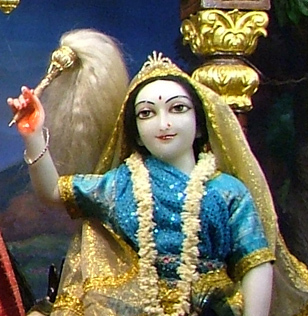
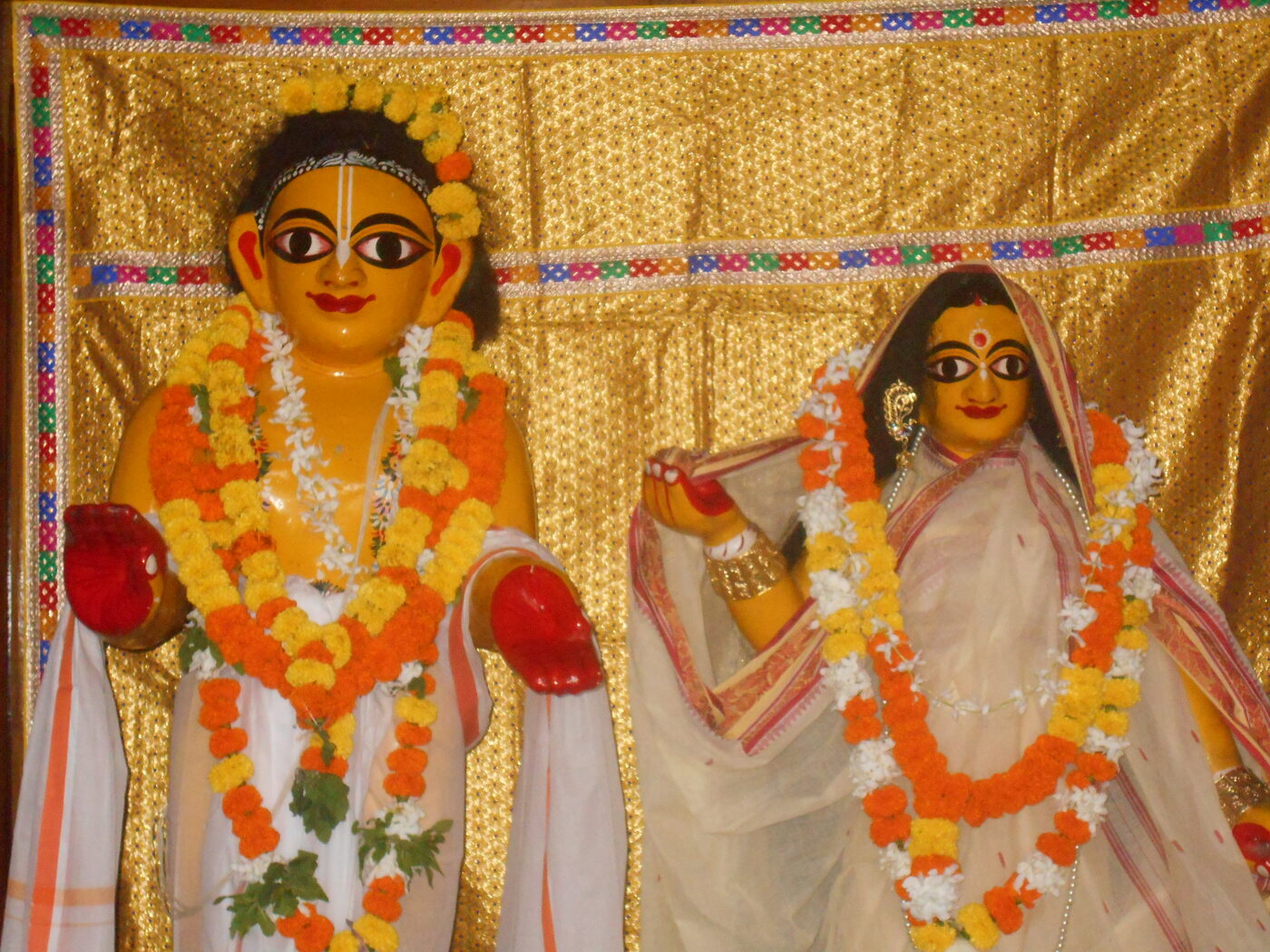
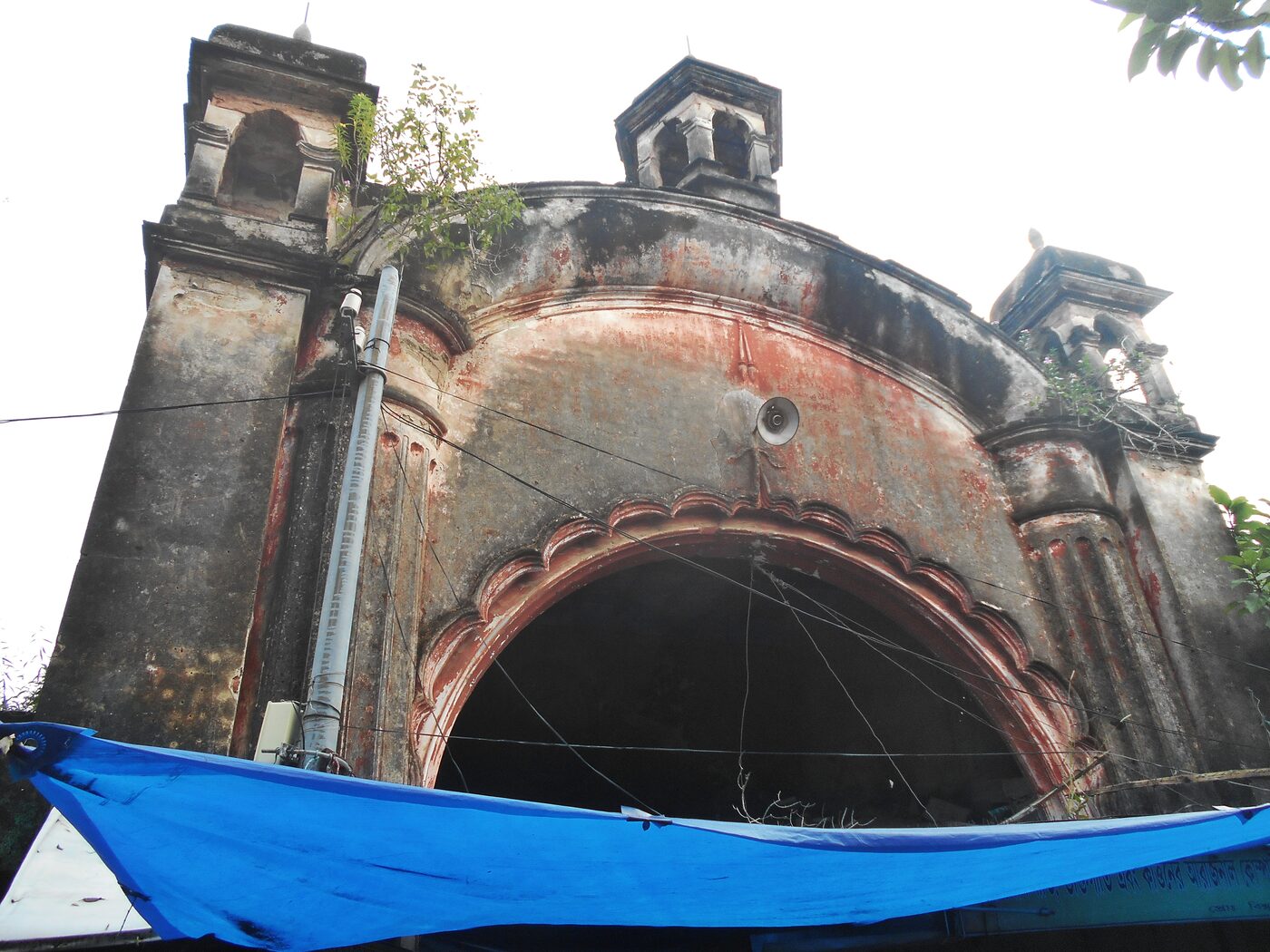
Sita Thakurani's samadhi stands at Shantipura beside her husband's. Wooden Deities of the couple are worshiped today at the Sitanath Advaita Mandir in Nabadwip. In Gaudiya Vaishnava literature, old and new, she is one of the tradition's clearest examples of a woman honoured for who she herself was. She is honoured for her own devotion, her own hospitality, and her own place at the Lord's side, not only for whose wife she was.
Scriptural evidence
Quoted in the text above:
- Verse 86 Gaura-ganoddesha-dipika
Further verses:
advaita-ācārya-bhāryā, jagat-pūjitā āryā, nāma tāṅra 'sītā ṭhākurāṇī'
ācāryera ājñā pāñā, gela upahāra lañā, dekhite bālaka-śiromaṇi
Word for word
advaita-ācārya-bhāryā: the wife of Advaita Ācārya; jagat-pūjitā: worshiped by the whole world; āryā: the most advanced cultured lady; nāma: name; tāṅra: her; sītā ṭhākurāṇī: mother Sītā; ācāryera ājñā pāñā: taking the order of Advaita Ācārya; gela: went; upahāra lañā: taking presentation; dekhite: to see; bālaka-śiromaṇi: the topmost child.
One day shortly after Lord Chaitanya Mahaprabhu was born, Advaita Acharya's wife, Sitadevi, who is worshipable by the whole world, took her husband's permission and went to see that topmost child with all kinds of gifts and presentations.
From the purport: Purport excerpt: "It appears that Advaita Acharya had two different houses, one at Shantipura and one at Navadvipa... from Advaita's old paternal house in Shantipura, Sita came to Navadvipa to present gifts to the newborn child."
The verse that introduces Sita Thakurani by name, and the specific phrase ("worshiped by the whole world") that the epithet and quick-facts above draw on directly.
durvā, dhānya, dila śīrṣe, kaila bahu āśīṣe, cirajīvī hao dui bhāi
ḍākinī-śāṅkhinī haite, śaṅkā upajila cite, ḍare nāma thuila 'nimāi'
Word for word
durvā: fresh grass; dhānya: paddy; dila śīrṣe: placed on the head; kaila bahu āśīṣe: gave much blessing; cira-jīvī hao: become long-lived; dui bhāi: two brothers; ḍākinī-śāṅkhinī: ghosts and witches; haite: from; śaṅkā upajila cite: doubt grew in the heart; ḍare: out of fear; nāma thuila: kept the name; nimāi: Nimai.
She blessed the newborn child by placing fresh grass and paddy on His head and saying, "May You be blessed with a long duration of life." But being afraid of ghosts and witches, she gave the child the name Nimai.
From the purport: Purport excerpt: "Because of all the antiseptic effects of the nima tree and because Lord Chaitanya was born beneath a nima tree, Sita Thakurani gave the Lord the name Nimai. Later in His youth He was celebrated as Nimai Pandita... although His real name was Vishvambhara."
Her own recorded blessing, used as the quote on the main record, and the verse in which she names the infant Lord.
- Sri Chaitanya-charitamrita, Adi-lila 13: The Advent of Lord Sri Chaitanya Mahaprabhu (Bhaktivedanta VedaBase)
- Sri Chaitanya-charitamrita, Madhya-lila 3: Lord Sri Chaitanya Mahaprabhu's Stay at the House of Advaita Acharya
- Sita Thakurani and the Family at Shantipura (Advaita Acharya, nandgramdham.org)
- Sita Thakurani - Biography (gaudiyahistory.iskcondesiretree.com)
- Jagadananda Das (Jan Brzezinski), "Women Saints in Gaudiya Vaishnavism"
- Female Diksa Guru — ISKCON GBC (historical examples: Sita Thakurani gave krishna-mantra to Nandini and Jangali, per Prema-vilasa vilasa 24)
Frequently asked
When was Srimati Sita Thakurani born?
Srimati Sita Thakurani appeared Not recorded in Not recorded; her father Nrsimha Bhaduri's family were of Nadia district, Bengal.
When and where did Srimati Sita Thakurani disappear?
Srimati Sita Thakurani disappeared Not recorded in the available sources; tradition describes her living to an old age and taking on leadership after Advaita Acharya's own disappearance at Traditionally Shantipura, Nadia, where her samadhi stands beside Sri Advaita Acharya's.
What are the main pastimes of Srimati Sita Thakurani?
The pastimes covered here include: Her Life and Marriage to Advaita Acharya, Mother of All Vaishnavas, Daily Devotion and Legacy.