His years selling firewood near Mathura, his service to visiting Vaishnavas, his reunions with Rupa and Sanatana Goswami, and the samadhi that remembers him today.
Mathura and Vrindavana, following Sri Chaitanya Mahaprabhu's instruction at Varanasi
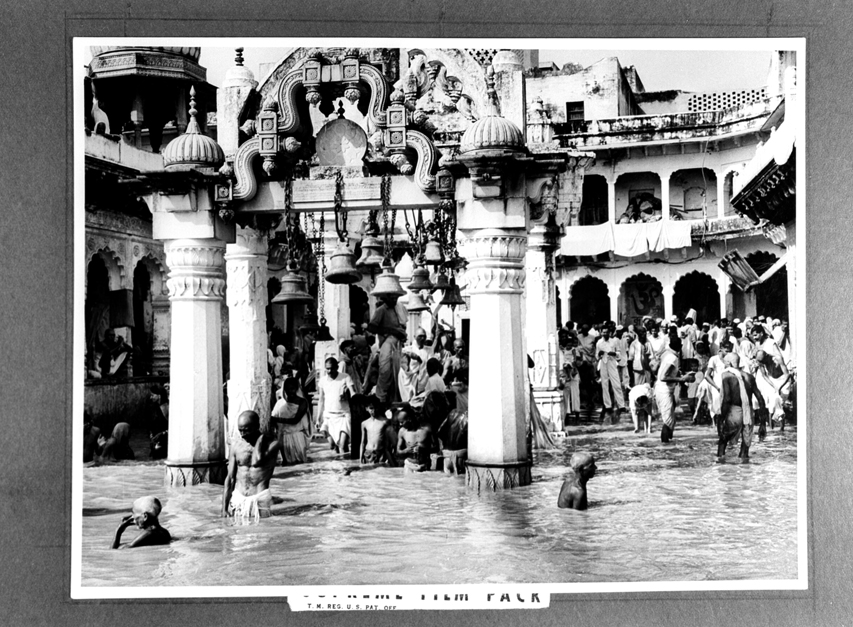
Vishram Ghat on the Yamuna at Mathura, photographed in 1949 -- close to Dhruva-ghata, the bank of the Yamuna where Subuddhi Raya met Rupa Goswami, and the area where he lived selling firewood and serving visiting Vaishnavas.commons.wikimedia.org · Public domain
Reading tools
Subuddhi Raya's journey from Varanasi to Vrindavana followed one of the standard pilgrim routes of the day, through Prayaga (modern Allahabad), Ayodhya and Naimisaranya, before he finally reached Mathura and settled nearby. He appears to have stayed in the area a long time. By the time Rupa Goswami reached Mathura on his own journey to Vrindavana, Subuddhi Raya was already a known and settled figure there. He met Rupa Goswami on the bank of the Yamuna at a spot called Dhruva-ghata.
The life Subuddhi Raya built for himself in Mathura was one of real hardship, taken on willingly. He earned his living gathering dry wood from the forest and carrying it into the city to sell. He received only five or six paise for each load. Chaitanya-charitamrita records that he spent just one paisa of that on food for himself: fried chickpeas. He left whatever remained with a local merchant for safekeeping. As Srila Prabhupada's purport notes, there was no banking system in that era like the one that exists today. Merchants regularly held people's extra cash for them in this way.
Chaitanya-charitamrita seems most interested in what he did with those small savings. Subuddhi Raya used them to serve other Vaishnavas, especially fellow Bengalis who arrived in Mathura unused to the local diet of wheat chapatis and rotis. He supplied them with yogurt to help their digestion, gave them cooked rice, and even arranged oil massages for them. Chaitanya-charitamrita says simply that whenever he came across a very poor Vaishnava, he used his own money to feed him. He was a man surviving on one paisa's worth of chickpeas a day, yet he still found a way to be the one who fed others.
When Rupa Goswami arrived, Subuddhi Raya's affection for him showed itself in action rather than words. He personally guided Rupa Goswami through all twelve of Vrindavana's traditional forests, and Rupa Goswami stayed in his company for a full month before finally leaving to search for his elder brother, Sanatana Goswami. Srila Prabhupada's purport to this episode also gives a detail that ties Subuddhi Raya's whole story together. It notes that Rupa Goswami had himself been a minister in the government of Husain Shah, and that Subuddhi Raya was known to Husain Shah for exactly the reason told in Life and Service Before His Trial. This was because, as a boy, the future Nawab had been Subuddhi Raya's own servant.
Later, Sanatana Goswami himself reached Mathura. He had traveled there by the public road, following Sri Chaitanya Mahaprabhu's order. He too met Subuddhi Raya, who told him all the news of his younger brothers Rupa and Anupama. Chaitanya-charitamrita adds a small, human detail here. Subuddhi Raya and Sanatana Goswami had known each other personally from before either man had accepted the renounced order, back in their working days in Bengal. Because of that old friendship, Subuddhi Raya now showed him real warmth and affection. But Sanatana Goswami was already deep in the discipline of his new life, and he was hesitant to fully accept this affection.
Gaudiya Vaishnava memory places Subuddhi Raya among the rasika Vaishnavas of Vrindavana. Along with Raghunatha Bhatta Goswami and Kashishvara Pandit, he belonged to the devotional community that grew up around the dhama. The tradition also has its own account of his eternal identity within Krishna's pastimes. This account names him as the gopa Guna-chuda, also called Shubhananda. It is offered here honestly as devotional tradition, not as settled history. His samadhi survives today in Vrindavana's "64 Samadhis" (Chaunsath Samadhi) area near the Radha Govinda Temple. According to the Bhakta-mala, it was one of the very first three samadhis established there, alongside those of Raghunatha Bhatta Goswami and Kashishvara Pandit. Unlike many later memorial samadhis in that same garden, it is also said to contain his actual body, not just a symbolic marker. No known source records the year of his death. The sources record only that he spent his last years exactly as Sri Chaitanya Mahaprabhu had told him to, chanting the holy names in Krishna's own land.
pāñā ājñā: getting this order; rāya: Subuddhi Rāya; vṛndāvanere calilā: went toward Vṛndāvana; prayāga: Allahabad; ayodhyā: Ayodhyā (the kingdom of Lord Rāmacandra); diyā: through; naimiṣāraṇye āilā: came to Naimiṣāraṇya (a place near Lucknow).
Thus receiving the order from Śrī Caitanya Mahāprabhu to go to Vṛndāvana, Subuddhi Rāya left Vārāṇasī and went through Prayāga, Ayodhyā and Naimiṣāraṇya toward Vṛndāvana.
śuṣka-kāṣṭha āni’: collecting dry wood from the forest; rāya: Subuddhi Rāya; vece: sells; mathurāte: at Mathurā; pāṅca chaya: five or six; paisā: paise; haya: are; eka eka bojhāte: in exchange for each load of dry wood.
Subuddhi Rāya would collect dry wood in the forest and take it to the city of Mathurā to sell. For each load he would receive five or six paise.
āpane: personally; rahe: lives; eka paisāra: of one paisa’s worth; cānā: fried chick-peas; cābāiyā: chewing; āra: the balance; paisā: four or five paise; bāṇiyā-sthāne: in the custody of a merchant; rākhena: keeps; dhariyā: depositing.
Earning his livelihood by selling dry wood, Subuddhi Rāya would live on only one paisa’s worth of fried chick-peas, and he would deposit whatever other paise he had with some merchant.
From the purport: Purport excerpt: "In those days there was no banking system like the one now found in Western countries. If one had excess money, he would deposit it with some merchant, usually a grocer."
duḥkhī vaiṣṇava: a poverty-stricken Vaiṣṇava; dekhi’: seeing; tāṅre: to him; karāna bhojana: gives food for eating; gauḍīyā āile: when a Bengali Vaiṣṇava came to Mathurā; dadhi: yogurt; bhāta: cooked rice; taila-mardana: massaging mustard oil on the body.
Subuddhi Rāya used to spend his savings to supply yogurt to Bengali Vaiṣṇavas who came to Mathurā. He also gave them cooked rice and oil massages. When he saw a poverty-stricken Vaiṣṇava, he would use his money to feed him.
From the purport: Purport excerpt: "Most of the devotees of Lord Caitanya at that time were Gauḍīyas and Oriyās, inhabitants of Bengal and Orissa... Therefore as soon as Subuddhi Rāya saw a Bengali Vaiṣṇava arriving in Mathurā, he would try to supply him with cooked rice."
rūpa-gosāñi: Rūpa Gosāñi; āile: when he came to Mathurā; tāṅre: unto him; bahu: much; prīti: love; kailā: showed; āpana-saṅge lañā: taking Rūpa Gosvāmī personally with him; dvādaśa vana: the twelve forests of Vṛndāvana; dekhāilā: showed.
When Rūpa Gosvāmī arrived at Mathurā, Subuddhi Rāya, out of love and affection for him, wanted to serve him in so many ways. He personally took Rūpa Gosvāmī to see all the twelve forests of Vṛndāvana.
From the purport: Purport excerpt: "Śrīla Rūpa Gosvāmī had been a minister in the government of Hussain Shah, and Subuddhi Rāya was also known to Hussain Shah because, as a boy, the Shah had been Subuddhi Rāya's servant."
mathurāte: at Mathurā; subuddhi-rāya: Subuddhi Rāya; tāhāre mililā: met him; rūpa-anupama-kathā: news about his younger brothers, Rūpa Gosvāmī and Anupama; sakali: everything; kahilā: described.
When Sanātana Gosvāmī met Subuddhi Rāya at Mathurā, Subuddhi Rāya explained everything about his younger brothers Rūpa Gosvāmī and Anupama.
Subuddhi Raya meets Sanatana Goswami at Mathura and tells him news of his younger brothers Rupa and Anupama.
সুবুদ্ধি-রায় বহু স্নেহ করে সনাতনে ।
ব্যবহার-স্নেহ সনাতন নাহি মানে ॥ ২১৩ ॥
subuddhi-rāya bahu sneha kare sanātane
vyavahāra-sneha sanātana nāhi māne
Word for word
subuddhi-rāya: Subuddhi Rāya; bahu: much; sneha: affection; kare: does; sanātane: unto Sanātana Gosvāmī; vyavahāra-sneha: love and affection because of a previous relationship; sanātana: Sanātana Gosvāmī; nāhi māne: was hesitant to accept.
Subuddhi Rāya and Sanātana Gosvāmī had known each other before accepting the renounced order. Therefore Subuddhi Rāya showed much affection to Sanātana Gosvāmī, but Sanātana Gosvāmī hesitated to accept his sentiments and affections.
Our editorial team comprises trained devotees and researchers of the Hare Krishna Movement, Kota, who follow this same disciplic tradition in daily practice. Every biography is carefully researched, fact-checked against Vedic scriptures, and cites its sources.
Reviewed by
Temple & Scriptural Research Team
Each biography undergoes a detailed review by our senior devotees and scriptural researchers to verify factual accuracy and ensure alignment with Vaishnava philosophy and Srila Prabhupada's teachings.