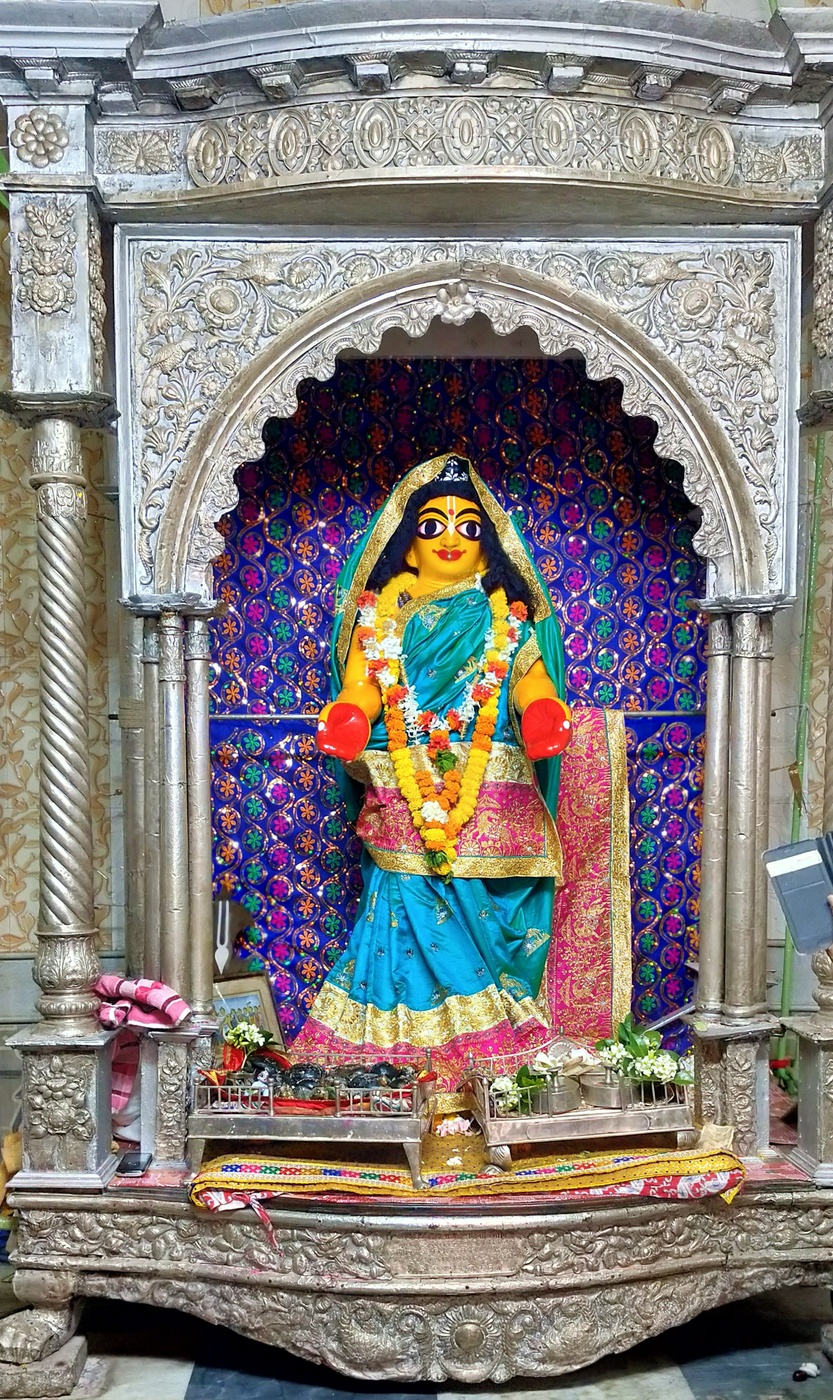
Gaudiya Vaishnava literature returns most often to what Vishnupriya Devi did with the rest of her life. This is also the part where several independent sources truly agree with one another on details, not only in general. The Advaita-prakasha, Narahari Chakravarti's Bhakti-ratnakara, and Nityananda Dasa's Prema-vilasa were written by different authors, at different times and for different purposes. Yet all three describe the same daily discipline in close detail. So their agreement should be treated as significant, even though none of them is Sri Chaitanya-charitamrita or Chaitanya-Bhagavata.
| Detail | Description |
|---|---|
| Daily seclusion | Left the house only to bathe in the Ganges with Sachi Devi; otherwise seen by no one, not even most devotees, beyond a glimpse of her feet |
| Chanting practice | One grain of rice set aside each time she chanted the complete Hare Krishna maha-mantra once, using two clay pots refreshed each day |
| Reported duration of chanting | Roughly nine hours daily, according to Prema-vilasa |
| Food | Cooked and ate only the rice collected that day, after first offering it to her Deity of Mahaprabhu |
| Sleep | About three hours a night, often on the bare ground |
| Independent witness named in the sources | Srinivasa Acharya, who is said to have visited her daily and reported on her condition |
Never Seen, Never Heard #
The Advaita-prakasha describes how, after Mahaprabhu's departure, she practically withdrew from ordinary life. Every morning she went with Sachi Devi to bathe in the Ganges. For the rest of the day she stayed inside. In a manner of speaking, she allowed neither the sun nor the moon to see into her room. In plain words, she kept indoors and out of sight. Devotees who came to the house were allowed, at most, to see her feet. Her voice, the tradition holds, was heard by almost no one. In the earliest period she ate only what Sachi Devi's kitchen sent as prasada. Later, once her own discipline was established, she ate only what she herself had prepared from her counted rice. This is the general picture the sources agree on. Her grief was not shown outwardly. It was turned completely into a private, unbroken practice.
Two Clay Pots And Nine Hours Of Japa #
Prema-vilasa is a work by Nityananda Dasa associated with the disciples of Jahnava Devi. It gives the most exact description of her actual method. Each day, two new clay pots were brought to her: one filled with uncooked rice grains, the other left empty. Every time she chanted the whole maha-mantra once, its sixteen names "Hare Krishna Hare Krishna Krishna Krishna Hare Hare, Hare Rama Hare Rama Rama Rama Hare Hare," she would pick up a single grain of rice from the full pot and place it in the empty one. She continued in this way, the text says, until three o'clock each afternoon. Elsewhere Prema-vilasa describes this chanting session as lasting roughly nine hours. In the evening she cooked whatever rice had collected by then. The tradition adds that this cooked rice was soaked with her own tears. It was the only food she offered to her Deity of Mahaprabhu, and afterward the only food she ate herself.
We should be honest about what this practice actually means in numbers. Popular retellings sometimes reduce it to something vaguer, such as "she ate one grain of rice a day." That is not quite what the sources describe. She ate the rice her chanting had earned that day. Even at a modest pace of chanting for nine hours, this could reasonably come to a very small meal, but not literally a single grain. The sources are clear on these points. The meal was extremely limited. It was entirely tied to how much she had chanted. And she never treated it as ordinary food, only as an offering shared with her Deity.
Srinivasa Acharya's Testimony #
Bhakti-ratnakara names a specific, independent witness to all this, Srinivasa Acharya. Narahari Chakravarti says that Srinivasa Acharya came to see her every day and personally observed her condition. Here is what he reported, in the text's own words: "She had completely renounced sleep, and if ever she closed her eyes, it would be while lying on the bare ground. Her bodily lustre, which had formerly glowed more brilliantly than gold, had become dull, and she was as thin as the waning moon on its fourteenth day... No one understood how she could remain alive." A visitor who reported daily on her physical decline is a different kind of source from a devotional summary written generations later. Also, even among the later Chaitanya biographies, Bhakti-ratnakara is generally regarded as a serious and fairly careful historical work for the generation after Mahaprabhu's own associates.
What The Numbers Suggest #
Temple tradition at Nabadwip today holds that Vishnupriya kept this discipline for roughly eighty years. She had been left behind at sixteen, and she disappeared at about ninety-six. No source, including Srila Prabhupada's own writing, confirms that exact span apart from the temple and pilgrimage-guide tradition that preserves it. Srila Prabhupada states simply that she "bore the separation of the Lord throughout her life," without giving an age or a year. So this is what we can honestly say. The nature of her practice, how severe it was, and how consistently independent early sources describe it are well recorded. But the exact number of years is a later devotional tradition. It is believable and widely repeated, but it cannot be called a settled historical fact.
Gaudiya siddhanta does not treat separation from Krishna as a lesser stage of devotion but as one of its highest, and Mahaprabhu Himself expressed exactly this pain of separation in His own words, in the seventh verse of the Siksastaka: "O Govinda, feeling Your separation, I consider a moment to be like twelve years. Tears flow from My eyes like torrents of rain, and I see the entire world as void." Vishnupriya Devi's life, lived out over decades in separation from her husband, showed this same pain not in words but in unbroken practice.
