Srimati Vishnupriya Devi
The Wife Who Waited a Lifetime in Separation
The complete life, on one page: The main biography and every pastime page, in order, in one place
Introduction
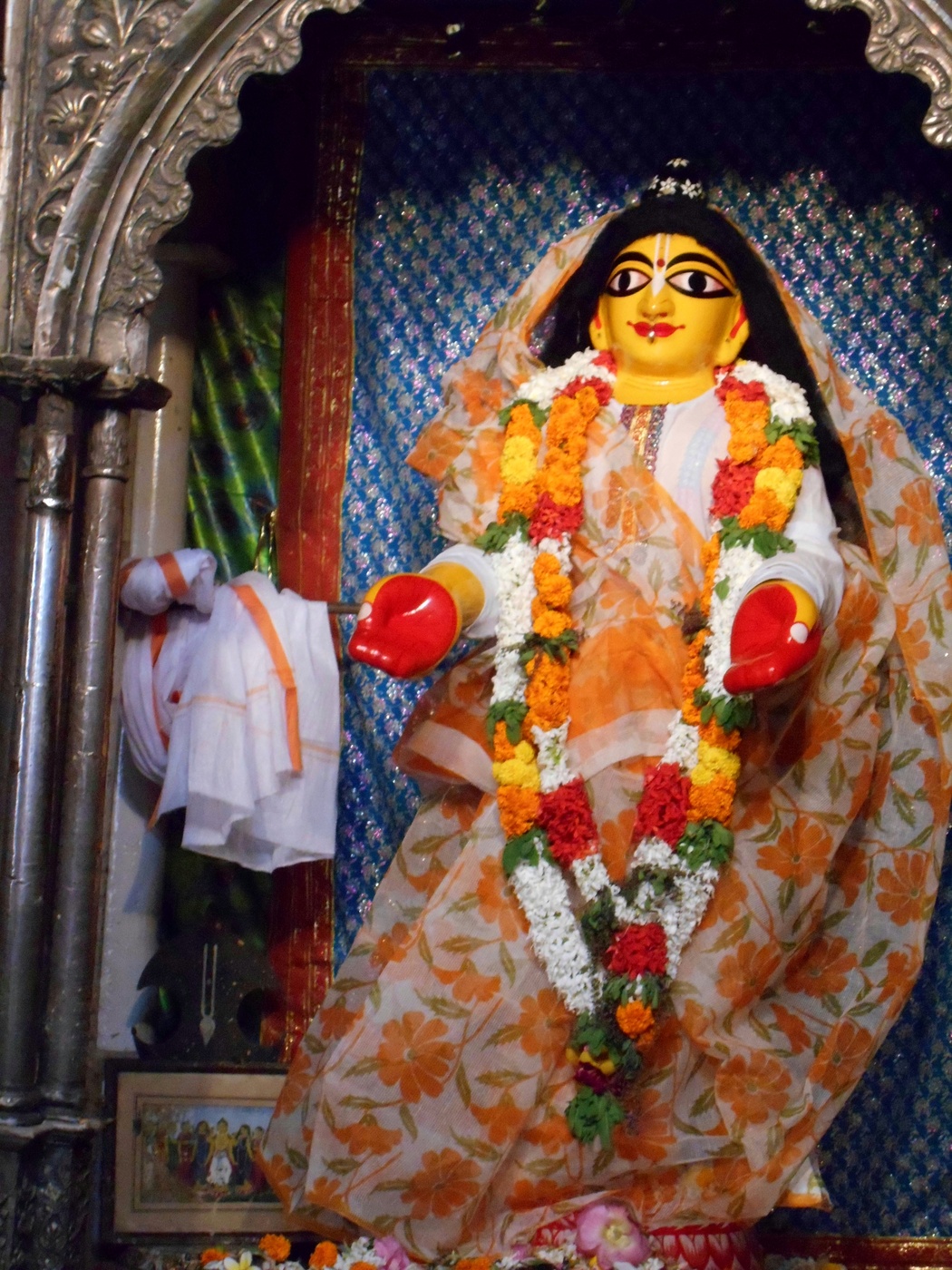
Srimati Vishnupriya Devi was the second wife of Sri Chaitanya Mahaprabhu, married to Him a few years before He gave up household life altogether and accepted the sannyasa order. The story of that marriage is already told in full on Mahaprabhu's own page, in Marriage and Household Life, so it is not repeated here. That page tells how His first wife Lakshmipriya died, how Sachi Devi chose Vishnupriya as a second bride, and what the household at Navadwip actually looked like. This page tells Vishnupriya Devi's own story instead. She was a girl of about sixteen, left behind when her husband left home at night to become a sannyasi. After that she lived on for decades in one of the most austere devotional disciplines recorded anywhere in Gaudiya Vaishnava literature.
| Detail | Description |
|---|---|
| Relationship | Second wife of Sri Chaitanya Mahaprabhu |
| Father | Sanatana Mishra, the raja-pandita (court scholar) of Navadwip |
| Married | At Navadwip, a few years before Mahaprabhu's sannyasa; the wedding expenses were borne by Buddhimanta Khan |
| Left behind | At about sixteen years of age, when Mahaprabhu accepted sannyasa at twenty-four |
| Identity | Bhu-shakti, the Lord's potency as Bhu-devi, called jagan-mata, mother of the universe (Gaura-ganoddesha-dipika 47-48) |
| Best known for | Roughly eighty years of austere bhajana in separation, and worship of a Deity of Mahaprabhu that is still served today near Nabadwip |
Scriptural evidence for the introduction (3)
তবে বিষ্ণুপ্রিয়া–ঠাকুরাণীর পরিণয় ।
তবে ত' করিল প্রভু দিগ্বিজয়ী জয় ॥
tabe viṣṇupriyā-ṭhākurāṇīra pariṇaya
tabe ta' karila prabhu digvijayī jaya
Word for word
tabe: after this; viṣṇupriyā: Viṣṇupriyā; ṭhākurāṇīra: of the goddess of fortune; pariṇaya: marriage; tabe ta': thereafter; karila: did; prabhu: the Lord; dig-vijayī: the champion; jaya: conquer.
Then Lord Chaitanya married Vishnupriya, the goddess of fortune, and thereafter He conquered a champion of learning named Keshava Kashmiri.
The one verse in Sri Chaitanya-charitamrita itself that records her marriage, and the source of the epithet "goddess of fortune" applied to her in the biography.
His second wife was Srimati Vishnupriya Devi, who bore the separation of the Lord throughout her life because the Lord took the order of sannyasa (renunciation) at the age of twenty-four, when Srimati Vishnupriya was barely sixteen years old.
Not a purport on a specific verse but Srila Prabhupada's own summary, in his general Introduction to Srimad-Bhagavatam, of Vishnupriya's age and the fact of her lifelong separation; the single most authoritative primary-source statement available on both points.
श्री सनातन मिश्रोऽयं पुरा सत्राजितो नृपः ।
विष्णुप्रिया जगन्माता यत्कन्या भूस्वरूपिणी ॥
उक्ता प्रसङ्गात्कलिना श्रीचैतन्यविधूदये ।
भुवोऽंशरूपां परमं च विष्णुप्रियां
विदित्वा परिणीय कान्ताम् ॥
śrī sanātana miśro’yaṁ purā satrājito nṛpaḥ
viṣṇupriyā jagan-mātā yat-kanyā bhū-svarūpiṇī
uktā prasaṅgāt kalinā śrī-caitanya-vidhūdaye
bhuvo’ṁśa-rūpāṁ paramaṁ ca viṣṇupriyāṁ
viditvā pariṇīya kāntām
The same person who formerly appeared as King Satrajit appeared in Lord Caitanya's pastimes as Sanatana Misra. Sanatana Misra's daughter was Srimati Visnupriya, and she was the incarnation of the Lord's Bhu-sakti, who is the mother of the entire universe. That Srimati Visnupriya is an incarnation of Bhu-devi is described in the Sri Caitanya-candrodaya-nataka, where Kali says: "Understanding that Srimati Visnupriya was the incarnation of Bhu-devi, Lord Caitanya accepted her hand in marriage."
Kavi Karnapura names Vishnupriya Devi as Bhu-shakti, mother of the universe, and her father Sanatana Mishra as King Satrajit; verse 48 cites his Chaitanya-chandrodaya-nataka for the same point. Sanskrit: diacritic edition of the Gaura-ganoddesha-dipika; English translation as published at bvmlu.org.
Chapter 1
Marriage and the Parting
A brief background on the marriage, and the last night before Mahaprabhu left the household for good
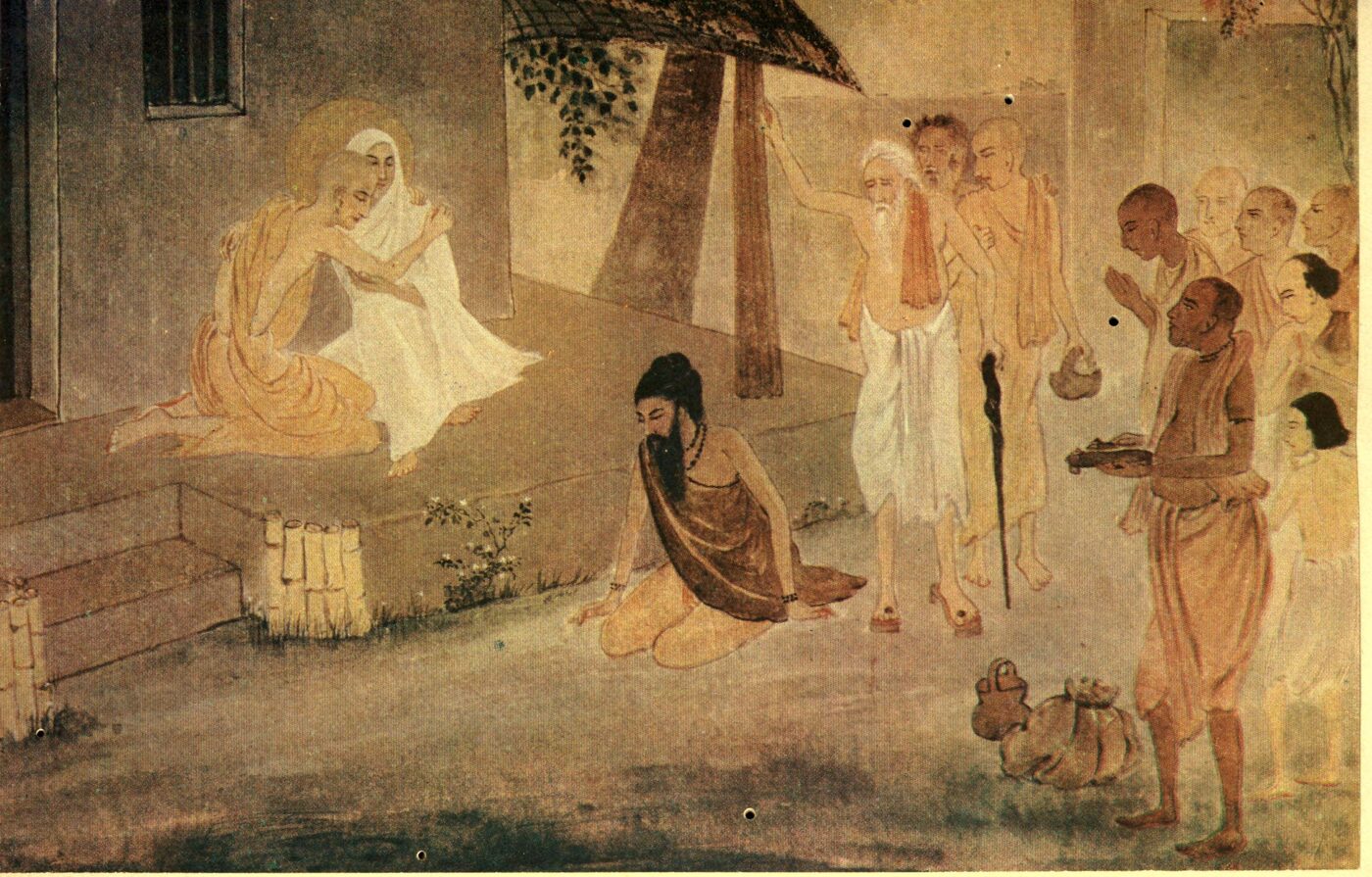
Vishnupriya Devi's own story, in the sources that survive, really begins on the night before her husband left her. The marriage itself is told in full on His own page, in Marriage and Household Life, so it is not repeated here. That page tells how Sachi Devi chose her, how Sri Chaitanya Mahaprabhu came to Sanatana Mishra's house in a wedding palanquin, and what the few years of their household life looked like. This page tells instead the part of the story that belongs to her: the conversation she had with Him once she learned what He intended to do, and the morning she woke to find Him gone.
| Detail | Description |
|---|---|
| Her father | Sanatana Mishra, raja-pandita of Navadwip (some Prema-vilasa tradition names her grandfather Durga Das Mishra instead) |
| Wedding funded by | Buddhimanta Khan, a wealthy well-wisher of the family |
| Household | A few years at Navadwip, ending when Mahaprabhu accepted sannyasa at twenty-four |
| Key source | Chaitanya-mangala by Locana Dasa Thakura, which alone among the major biographies records a direct conversation between them the night before He left |
| Her age at the parting | About sixteen |
A Household Of A Few Years #
All accounts agree that the years Vishnupriya spent as Mahaprabhu's wife looked ordinary from the outside, and were few. By this time He was already the most admired young scholar in Navadwip. He defeated learned pandits in debate and ran His own school. She kept His house alongside His mother, Sachi Devi. She had known and served Sachi Devi since her own girlhood days at the Ganges bathing ghat. Nothing in the record suggests any quarrel or disappointment in this period. The household matters to her own story for a simple reason. It was real and ordinary, and because of what came next, it was brief.
"Tell Me It Isn't True" #
Rumors of Mahaprabhu's intention to accept sannyasa reached the household before He announced it Himself. Locana Dasa Thakura's Chaitanya-mangala preserves what happened when Vishnupriya finally asked Him directly. "Tell me, O Prananatha," she said, using an epithet meaning Lord of my life, "is it true the rumor I heard, that You will take sannyasa and leave me? If I lose Your association I might as well end my life by drinking poison." The text describes His answer as gentle, compassionate words. He told her that she was as dear to Him as life itself, and that there was no need to worry. But He also said that the only real truth in this world was Krishna and the Vaishnavas. Every other relationship, such as father, mother, husband or wife, was in the end an illusory designation. He told her not to lament, and to fulfil the real meaning of her own name, Vishnupriya, "dear to Vishnu," by keeping Krishna always in her heart.
The text then records something striking. Mahaprabhu showed her His four-armed form, the form of Vishnu Himself, so that she could see directly who her husband really was. It removed her immediate grief, the text says, but not her attachment. By her own choice, she continued to regard Him as her husband and not only as God. Falling at His feet, she said she had nothing without His service. He embraced her with His eyes and made her a promise: "I shall travel here and there. But wherever I go, I shall always remain at your place." At last she understood that His independence could not be argued with, and she gave Him her answer: "You must do what makes You happy, my Lord. Let no one be an obstacle to Your divine mission."
We should be clear about what kind of source this conversation comes from. Neither Sri Chaitanya-charitamrita nor Chaitanya-Bhagavata records this exchange. It survives only in Chaitanya-mangala, a later biographical work. It is known here through an English translation published on gaudiyahistory.iskcondesiretree.com, and it has not been checked against the original Bengali text. So it is reported here as part of the tradition of devotional writing. It is not an episode independently confirmed in the two earlier and more widely studied biographies.
The Morning She Searched For Him #
Mahaprabhu left the house at night and walked, largely alone, toward Katwa to accept sannyasa there. The fuller account of that departure and of the sannyasa ceremony itself is given in Accepting the Sannyasa Order of Life on His own page. A devotional song by Vasudeva Ghosh, preserved and translated on thegaudiyatreasuresofbengal.com, describes what followed from Vishnupriya's side. She woke to find the bed where He had rested empty. With her hair and clothes in disorder, she ran to Sachi Devi's door. Then the two of them went out into the street together, lighting a lamp in the dark and calling His name, Nimai, Nimai, until the neighbors of Navadwip woke and joined the search. A passerby finally told them he had seen Vishvambhara walking alone toward Kantaka Nagara, the town also known as Katwa. Again, this is a devotional composition, not a scriptural verse, and it is given here as one.
No Message Ever Came #
It should be said plainly what the surviving sources do not contain. After He left Navadwip that night, no verse in Sri Chaitanya-charitamrita or Chaitanya-Bhagavata describes any further direct message passing from Mahaprabhu to Vishnupriya Devi. No episode in the wider later literature describes one either. In their last conversation He promised her that wherever He went, He would remain at her side the moment she held Him in her heart. On the evidence available, that promise appears to be the last word she is recorded as receiving from Him in person. For the rest of her long life, she lived out everything that followed on the strength of that one promise alone.
Scriptural evidence for this chapter (5)
Give your daughter to Vishvambhara Pandit; it is a perfect combination. She alone is worthy of such a divine husband, while he deserves such a pious and chaste wife. Just as Krishna and Rukmini were worthy of each other, so are Vishnupriya and Nimai Pandit.
Kashinatha Pandita's words proposing the match to Sanatana Mishra; Chaitanya-Bhagavata has no standalone English corpus online, so this is reported from the secondary translation on gaudiyahistory.iskcondesiretree.com rather than a primary-text check.
Whoever hears about the holy pastime of the Lord's marriage will be liberated from his bondage to this world. Lakshmi sat beside the Lord and the house of Sachi was filled with light.
Cited here as the text's own framing of the marriage as a transcendental rather than ordinary event; reported via secondary translation, as Chaitanya-Bhagavata has no standalone English corpus online.
"Tell me, O Prananatha, is it true the rumor I heard that You will take sannyasa and leave me? If I lose Your association I might as well end my life by drinking poison." ... "I shall travel here and there. But wherever I go, I shall always remain at your place." ... "You must do what makes You happy my Lord. Let no one be an obstacle to Your divine mission."
The central source for the account given here of their last night together; Chaitanya-mangala has no standalone English corpus online, so this is reported via the secondary translation published on gaudiyahistory.iskcondesiretree.com, and does not appear in this form in Sri Chaitanya-charitamrita or Chaitanya-Bhagavata.
The earth splits from the sound of Vishnupriya's crying: the birds and beasts, even the trees and stones shed tears when they heard it. Falling to the ground she would lament, crying out, "Why does my sinful life not end?" In separation, her breath was like fire, drying her lips, and her body trembled constantly.
Locana Dasa Thakura's description of the days immediately after Mahaprabhu's departure, cited via secondary translation as Chaitanya-mangala has no standalone English corpus online.
On not finding Mahaprabhu upon the sacred bed, where He had been resting for the last night, a thunderbolt struck Srimati Vishnupriya Devi... Weeping incessantly, and not caring for her untied hair and loosened dress, she hurried to relate the news to her mother-in-law, Saci Mata.
A devotional composition, not a scriptural verse, translated and published with credit on thegaudiyatreasuresofbengal.com; reported here as devotional song tradition describing the morning of the discovery, not as an episode from Sri Chaitanya-charitamrita or Chaitanya-Bhagavata.
Chapter 2
A Life of Separation and Austerity
The rice-grain discipline, the vow of near-silence, and what several independent sources agree she did every day for decades
Gaudiya Vaishnava literature returns most often to what Vishnupriya Devi did with the rest of her life. This is also the part where several independent sources truly agree with one another on details, not only in general. The Advaita-prakasha, Narahari Chakravarti's Bhakti-ratnakara, and Nityananda Dasa's Prema-vilasa were written by different authors, at different times and for different purposes. Yet all three describe the same daily discipline in close detail. So their agreement should be treated as significant, even though none of them is Sri Chaitanya-charitamrita or Chaitanya-Bhagavata.
| Detail | Description |
|---|---|
| Daily seclusion | Left the house only to bathe in the Ganges with Sachi Devi; otherwise seen by no one, not even most devotees, beyond a glimpse of her feet |
| Chanting practice | One grain of rice set aside each time she chanted the complete Hare Krishna maha-mantra once, using two clay pots refreshed each day |
| Reported duration of chanting | Roughly nine hours daily, according to Prema-vilasa |
| Food | Cooked and ate only the rice collected that day, after first offering it to her Deity of Mahaprabhu |
| Sleep | About three hours a night, often on the bare ground |
| Independent witness named in the sources | Srinivasa Acharya, who is said to have visited her daily and reported on her condition |
Never Seen, Never Heard #
The Advaita-prakasha describes how, after Mahaprabhu's departure, she practically withdrew from ordinary life. Every morning she went with Sachi Devi to bathe in the Ganges. For the rest of the day she stayed inside. In a manner of speaking, she allowed neither the sun nor the moon to see into her room. In plain words, she kept indoors and out of sight. Devotees who came to the house were allowed, at most, to see her feet. Her voice, the tradition holds, was heard by almost no one. In the earliest period she ate only what Sachi Devi's kitchen sent as prasada. Later, once her own discipline was established, she ate only what she herself had prepared from her counted rice. This is the general picture the sources agree on. Her grief was not shown outwardly. It was turned completely into a private, unbroken practice.
Two Clay Pots And Nine Hours Of Japa #
Prema-vilasa is a work by Nityananda Dasa associated with the disciples of Jahnava Devi. It gives the most exact description of her actual method. Each day, two new clay pots were brought to her: one filled with uncooked rice grains, the other left empty. Every time she chanted the whole maha-mantra once, its sixteen names "Hare Krishna Hare Krishna Krishna Krishna Hare Hare, Hare Rama Hare Rama Rama Rama Hare Hare," she would pick up a single grain of rice from the full pot and place it in the empty one. She continued in this way, the text says, until three o'clock each afternoon. Elsewhere Prema-vilasa describes this chanting session as lasting roughly nine hours. In the evening she cooked whatever rice had collected by then. The tradition adds that this cooked rice was soaked with her own tears. It was the only food she offered to her Deity of Mahaprabhu, and afterward the only food she ate herself.
We should be honest about what this practice actually means in numbers. Popular retellings sometimes reduce it to something vaguer, such as "she ate one grain of rice a day." That is not quite what the sources describe. She ate the rice her chanting had earned that day. Even at a modest pace of chanting for nine hours, this could reasonably come to a very small meal, but not literally a single grain. The sources are clear on these points. The meal was extremely limited. It was entirely tied to how much she had chanted. And she never treated it as ordinary food, only as an offering shared with her Deity.
Srinivasa Acharya's Testimony #
Bhakti-ratnakara names a specific, independent witness to all this, Srinivasa Acharya. Narahari Chakravarti says that Srinivasa Acharya came to see her every day and personally observed her condition. Here is what he reported, in the text's own words: "She had completely renounced sleep, and if ever she closed her eyes, it would be while lying on the bare ground. Her bodily lustre, which had formerly glowed more brilliantly than gold, had become dull, and she was as thin as the waning moon on its fourteenth day... No one understood how she could remain alive." A visitor who reported daily on her physical decline is a different kind of source from a devotional summary written generations later. Also, even among the later Chaitanya biographies, Bhakti-ratnakara is generally regarded as a serious and fairly careful historical work for the generation after Mahaprabhu's own associates.
What The Numbers Suggest #
Temple tradition at Nabadwip today holds that Vishnupriya kept this discipline for roughly eighty years. She had been left behind at sixteen, and she disappeared at about ninety-six. No source, including Srila Prabhupada's own writing, confirms that exact span apart from the temple and pilgrimage-guide tradition that preserves it. Srila Prabhupada states simply that she "bore the separation of the Lord throughout her life," without giving an age or a year. So this is what we can honestly say. The nature of her practice, how severe it was, and how consistently independent early sources describe it are well recorded. But the exact number of years is a later devotional tradition. It is believable and widely repeated, but it cannot be called a settled historical fact.
Gaudiya siddhanta does not treat separation from Krishna as a lesser stage of devotion but as one of its highest, and Mahaprabhu Himself expressed exactly this pain of separation in His own words, in the seventh verse of the Siksastaka: "O Govinda, feeling Your separation, I consider a moment to be like twelve years. Tears flow from My eyes like torrents of rain, and I see the entire world as void." Vishnupriya Devi's life, lived out over decades in separation from her husband, showed this same pain not in words but in unbroken practice.
Scriptural evidence for this chapter (4)
Every morning, she would go for her bath in the Ganges with mother Sachi, after which she spent the entire day inside the house, never allowing the moon or the sun to see her form. Not even the devotees were allowed to see anything more than her feet, nor would anyone ever hear her voice.
Describes the daily seclusion that framed her chanting discipline; reported via the secondary summary on gaudiyahistory.iskcondesiretree.com, as Advaita-prakasha has no standalone English corpus online.
Every day she would place two clay pots on either side of her, one filled with uncooked rice, the other empty. Each time she completed one mantra of sixteen names and thirty-two syllables, she would joyfully place a grain of rice into the empty container. She would chant in this way until three o'clock in the afternoon, and then would take whatever rice had accumulated and cook it... drenching it with her tears before she offered it to the Lord.
The most exact and specific description available of her daily rice-and-japa discipline; reported via secondary translation, as Prema-vilasa has no standalone English corpus online.
Every day Srinivas would come to see her. He observed her daily activities, which are beyond description. She had completely renounced sleep, and if ever she closed her eyes, it would be while lying on the bare ground. Her bodily luster, which had formerly glowed more brilliantly than gold, had become dull and she was as thin as the waning moon on its fourteenth day... No one understood how she could remain alive.
An eyewitness-style report attributed to Srinivasa Acharya, preserved by Narahari Chakravarti; reported via secondary translation, as Bhakti-ratnakara has no standalone English corpus online.
My Lord Govinda, because of separation from You, I consider even a moment a great millennium. Tears flow from My eyes like torrents of rain, and I see the entire world as void.
Mahaprabhu's own Siksastaka verse 7, His own words on the pain of separation from Krishna. It is cited here because Gaudiya theology holds vipralambha (separation) among the highest expressions of prema. This point is directly relevant to Vishnupriya Devi's own decades of separation.
Chapter 3
Worship and Legacy
The Deity she had carved after a dream, the footwear Mahaprabhu gave her, and the temple that still serves them at Nabadwip today
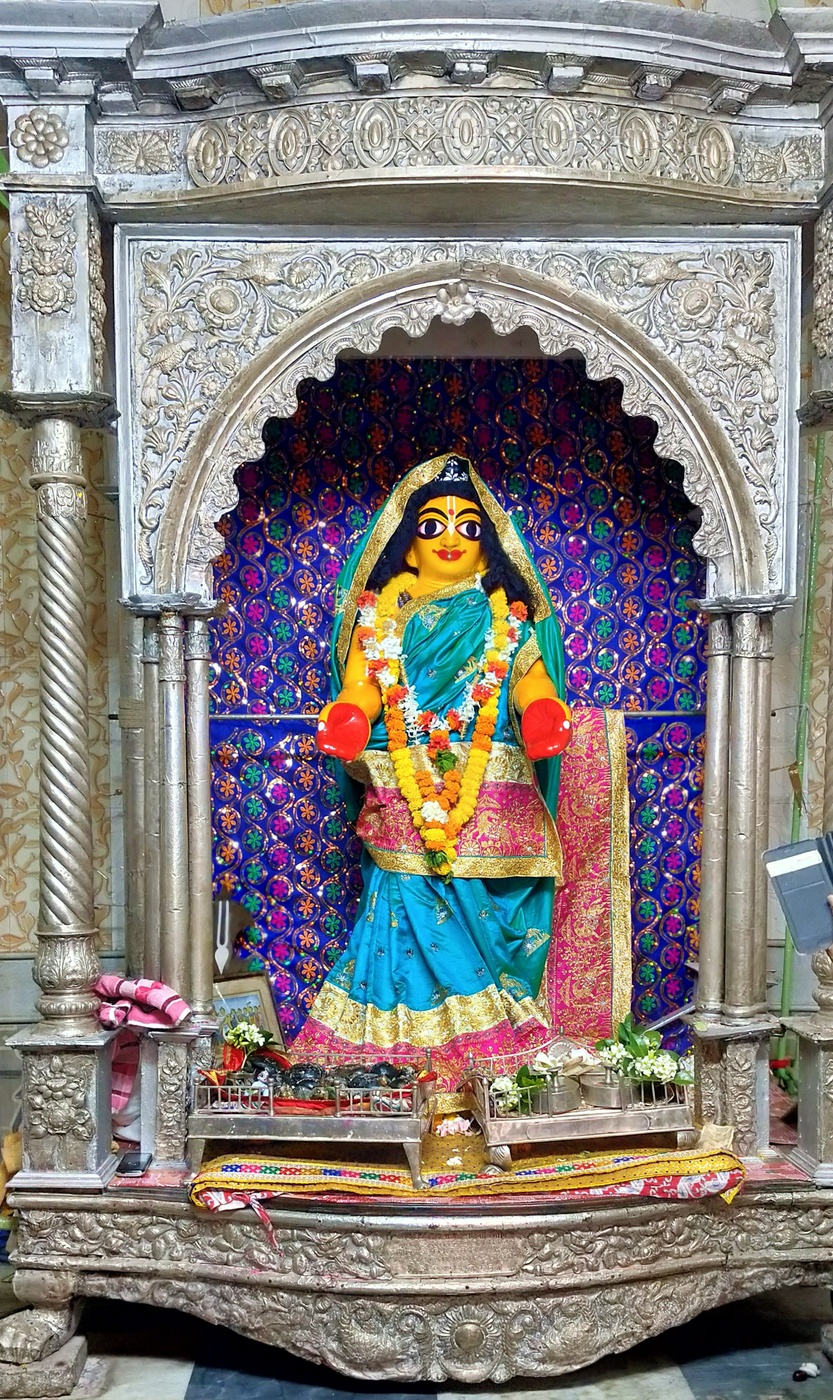
Gaudiya Vaishnava tradition remembers Vishnupriya Devi for one more specific act, beyond her austerity. Devotional literature credits her with being the first person to establish worship of a Deity of Gauranga, that is, of Chaitanya Mahaprabhu Himself, in His own visible form. Murari Gupta was a contemporary of Mahaprabhu who wrote one of the earliest biographical accounts of His life. Later Gaudiya literature quotes him describing the theology behind this worship directly. According to him, Krishna came to His beloved wife in an expansion form, to remain by her side as the Mahaprabhu Deity. In this way she, herself the goddess of fortune in human form, could go on serving Him constantly.
| Detail | Description |
|---|---|
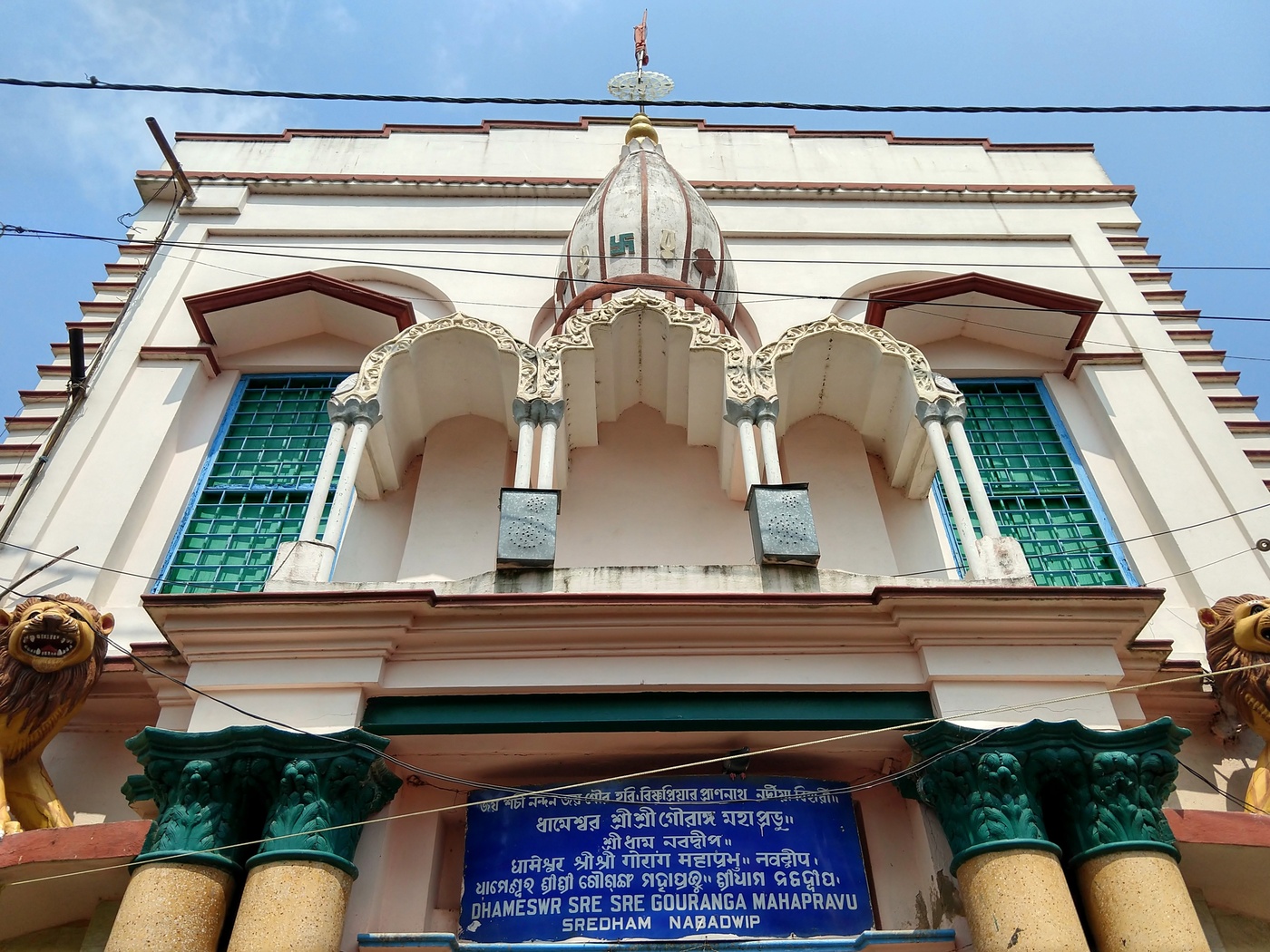
| The Deity | A neem-wood image of Chaitanya Mahaprabhu, known today as Dhameswar Mahaprabhu |
| Origin | Carved by the sculptor Nabinananda Acharya, on instructions Vishnupriya reportedly received in a dream |
| Also worshiped alongside it | A pair of paduka (wooden footwear), traditionally said to have been Mahaprabhu's own personal gift to her |
| Current location | Sri Dhameswar Mahaprabhu Temple, also called Mahaprabhu Bari, in Koladvipa, one of the nine islands of Navadwip |
| Site significance | Stands on the site of Sanatana Mishra's own household compound; his descendants still maintain the daily worship |
| Her appearance day | Traditionally observed on Vasanta Panchami / Magh-shukla Panchami, alongside the worship of Sarasvati by others on the same date |
A Deity Carved From A Dream #
The tradition gives specific details about how the image came to be made, even if those details cannot be independently confirmed outside devotional sources. Vishnupriya is said to have received instructions in a dream to have a Deity of her husband carved. She is said to have asked Nabinananda Acharya, a sculptor fairly well known in the area, to carve it in neem wood. Devotees who describe the finished image today say it has a strikingly gentle expression, with its arms stretched outward as though reaching toward whoever stands before it. Alongside the Deity, she is said to have kept and worshiped a pair of Mahaprabhu's own paduka, given to her personally before He left. If this is accurate, the paduka would be the one physical object in her story that can be traced directly back to Mahaprabhu Himself, not to a devotional image made afterward.
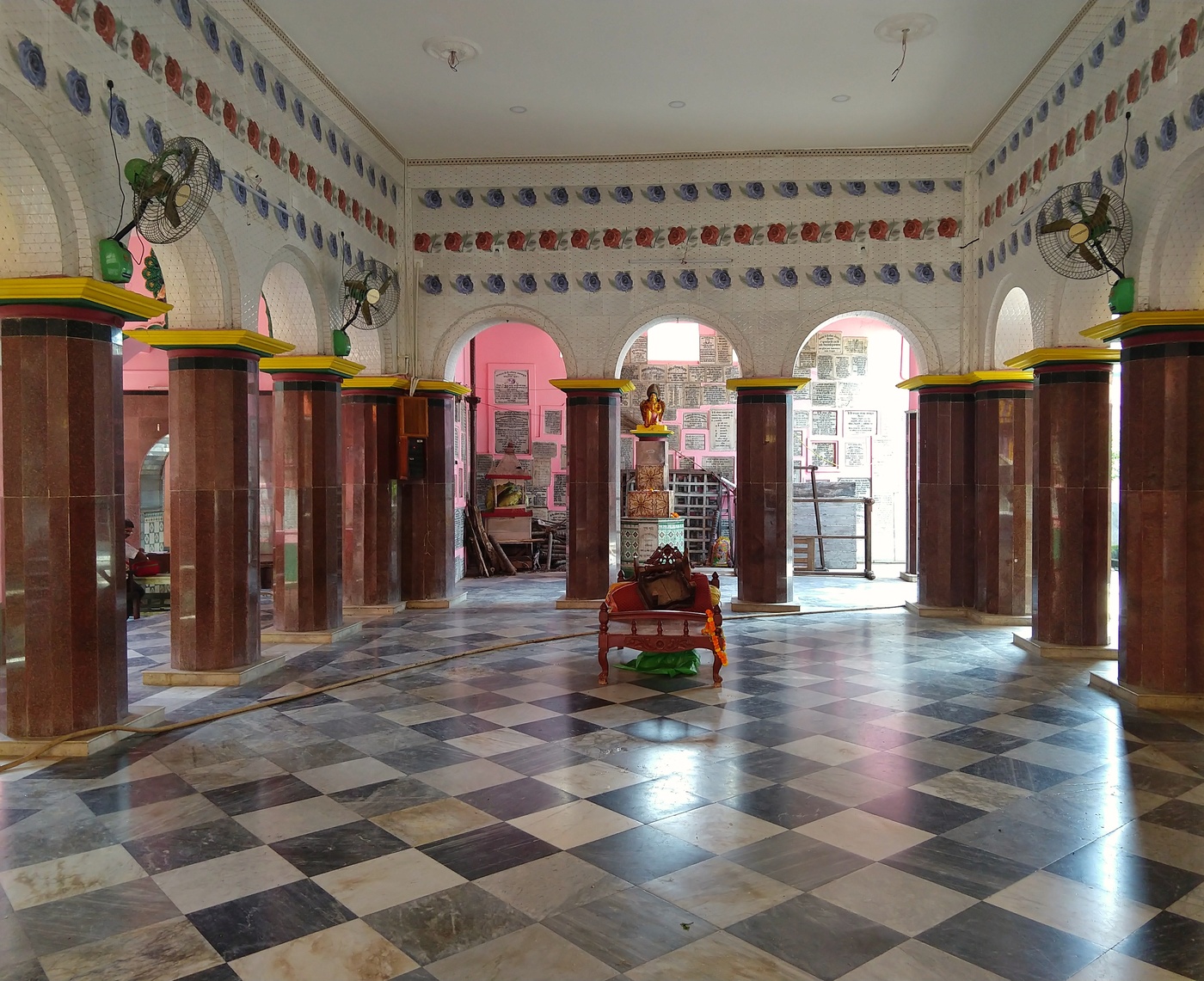
Gaudiya devotional writers have compared her act to a story about Lord Ramachandra. He had taken a vow to have only one wife. So, it is said, He performed a sacrifice using a golden image of Sita instead of marrying again, after Sita had been sent away to live in the forest. The comparison presents Vishnupriya's Deity worship as the same kind of faithfulness, made visible. She did not treat her husband's absence as an ending. Instead, she made an image of Him the center of everything she did for the rest of her life.
From Her House To Koladvipa #
According to the temple's own tradition, the Deity and the paduka stayed in Vishnupriya's own household worship for as long as she lived. After her disappearance, care of the Deity passed to a cousin. He kept it at his own residence on the eastern bank of the Ganges, likely near the original site of Sanatana Mishra's family compound. Eventually the river wore away the land and that residence was lost. This often happened to riverside settlements in this part of Bengal. The family then moved across the river to Kuliya-grama, on the western bank, a place better known today simply as Navadwip. Vamsivadana Thakura was one of the two devotees (with Ishana Thakura) who had cared for Vishnupriya and Sachi Devi in their later years. Some accounts credit Vamsivadana Thakura with formally establishing the Deity's worship at its present location. The family that maintains the temple today still speaks of Mahaprabhu, in their own family terms, as their honored son-in-law. It is the same relationship that began with Sanatana Mishra giving his daughter's hand at that first wedding, and it has been kept alive across five centuries.
One further tradition is recorded in the Sri Navadvipa-Dhama-Mahatmya and preserved on some pilgrimage-guide sites. It presents the Deity's later history as the fulfilment of an old prophecy: that four hundred years after Mahaprabhu's appearance, worship of this particular image would be restored to its highest standard. The prophecy is reported here only as it survives in that secondary source. It is not independently confirmed, since no primary Gaudiya scriptural text available to us contains it.
Remembered As Mother Of The Universe #
Gaudiya theology uses its highest language when it speaks of Vishnupriya Devi's identity. The Gaura-Ganoddesha-Dipika is the traditional list that identifies who each of Mahaprabhu's associates had been in Krishna's own pastimes. According to it, she is Bhu-sakti: the Lord's own potency as the earth, and, in that role, "the mother of the universe." The same text identifies her father, Sanatana Mishra, as King Satrajit from Krishna-lila. In this way it also presents her marriage to Mahaprabhu as a reflection of Krishna's marriage to Satyabhama. The tradition makes similar theological claims elsewhere. For instance, it identifies Sita Thakurani as Yogamaya. Like those claims, this is a statement of who the tradition understands Vishnupriya Devi to be at the deepest level. It is not a claim that can be checked against an outside historical record, and it is presented here with that understanding.
Alongside Sachi Devi, Sita Thakurani, and Malini Devi (the wife of Srivasa Thakura), Vishnupriya Devi is remembered as one of four leading women devotees who gave strength to Mahaprabhu's mission during His own lifetime. What sets her apart within that group is simply how long her own part of the story continued after His visible mission ended. For decades she kept a single, unbroken discipline. She was sustained by the promise she received that night in Navadwip, that wherever He went, He would remain wherever she kept Him in her heart.
Scriptural evidence for this chapter (3)
প্রকাশরূপেণ নিজপ্রিয়ায়াঃ সমীপমাসাদ্য নিজাং হি মূর্তিম্ ।
বিধায় তস্যাং স্থিত এষ কৃষ্ণঃ সা লক্ষ্মীরূপা চ নিষেবতে প্রভুম্ ॥
prakāśa-rūpeṇa nija-priyāyāḥ
samīpam āsādya nijaṁ hi mūrtim
vidhāya tasyāṁ sthita eṣa kṛṣṇaḥ
sā lakṣmī-rūpā ca niṣevate prabhum
Krishna came to His beloved wife in this expansion form to remain by her side as the Mahaprabhu Deity. Thus she, the incarnation of the goddess of fortune, was able to serve Him constantly.
The earliest-cited theological statement of why Vishnupriya's Deity worship is understood as Krishna Himself remaining present with her, not merely an image made in His memory. It is taken from a secondary translation.
sri-sanatana-misro 'yad pura satrajito nrpa
vishnupriya jagan-mata yat-kanya bhu-svarupini
He who was King Satrajit in Krishna-lila was Sanatana Mishra in Chaitanya-lila. The mother of the universe, the incarnation of the Lord's Bhu-sakti, is his daughter Vishnupriya.
The specific verse behind the tradition that Vishnupriya Devi is Bhu-sakti, "mother of the universe," and that her father Sanatana Mishra was King Satrajit in Krishna's own pastimes; reported via secondary translation, as Gaura-Ganoddesha-Dipika has no standalone English corpus online.
Four hundred years after Lord Gauranga's appearance... the worship of the Deity will be restored to the highest standard.
A prophecy connected to the Dhameswar Mahaprabhu Deity, reported as it survives on a pilgrimage-guide secondary source rather than confirmed against the primary Bengali text of Sri Navadvipa-Dhama-Mahatmya.
Closing
A Marriage Already Told On His Page #
Sanatana Mishra was a respected and wealthy brahmana of Navadwip. He was learned enough to hold the title raja-pandita. Sachi Devi noticed his daughter at the Ganges bathing ghat and chose her as a bride for her son. Sri Chaitanya-charitamrita records the marriage in a single verse: "Then Lord Chaitanya married Vishnupriya, the goddess of fortune, and thereafter He conquered a champion of learning named Keshava Kashmiri." Chaitanya-Bhagavata tells it more fully and festively, with Buddhimanta Khan paying every expense of the ceremony. The sources disagree on one small point about her family. Most sources name Sanatana Mishra as her father. But the Prema-vilasa tradition preserves a note that some people considered her grandfather, Durga Das Mishra, to be her actual father instead. No source settles the question, so it is reported here instead of being quietly decided either way.
Srila Kavi Karnapura's Gaura-ganoddesha-dipika (verse 47) tells who the bride and her father were:
śrī sanātana miśro’yaṁ purā satrājito nṛpaḥ
viṣṇupriyā jagan-mātā yat-kanyā bhū-svarūpiṇī
"The same person who formerly appeared as King Satrajit appeared in Lord Caitanya's pastimes as Sanatana Misra. Sanatana Misra's daughter was Srimati Visnupriya, and she was the incarnation of the Lord's Bhu-sakti, who is the mother of the entire universe." (Gaura-ganoddesha-dipika 47)
In the next verse (48) he points to his own play, the Chaitanya-chandrodaya-nataka, where Kali says: "Understanding that Srimati Visnupriya was the incarnation of Bhu-devi, Lord Caitanya accepted her hand in marriage."
The Night Before Sannyasa #
Sri Chaitanya-charitamrita and Chaitanya-Bhagavata both pass quickly over the household years to the events that were important for the sampradaya later. But a later work, Locana Dasa Thakura's Chaitanya-mangala, records something neither of those two texts does. It gives a direct, long conversation between Mahaprabhu and Vishnupriya Devi on the night before He left. She had heard the rumor that He intended to take sannyasa and asked Him directly whether it was true. She said that she would rather drink poison than lose His association. He answered gently. He told her that only Krishna and the Vaishnavas were real, that every other relationship in this world is a temporary designation, and that she should hold Him in her heart instead of clinging to Him as a husband alone. Then, the text says, He showed her His four-armed form. Seeing it did not really take away her grief. Instead, it changed it. By her own choice, she still went on regarding Gaurahari as her husband, and she asked only that He do what made Him happy.
- Sri Chaitanya-charitamrita, Adi-lila 16.25 (Bhaktivedanta VedaBase)
- Srimad-Bhagavatam, Introduction, A.C. Bhaktivedanta Swami Prabhupada (Bhaktivedanta VedaBase)
- Marriage and Household Life (Sri Chaitanya Mahaprabhu, nandgramdham.org)
- Vishnupriya Devi - Biography (gaudiyahistory.iskcondesiretree.com), excerpted from Sri Chaitanya: His Life & Associates by Srila Bhakti Ballabh Tirtha Maharaj
- Vishnupriya Devi (gaudiyahistory.iskcondesiretree.com)
- Vishnupriya devi - Biography, Sri Dhameswar Mahaprabhu Temple (The Gaudiya Treasures of Bengal)
- Sri Dhamesvara Temple (Mahaprabhu Bari) (Sri Navadwipa Mandala Parikrama)
