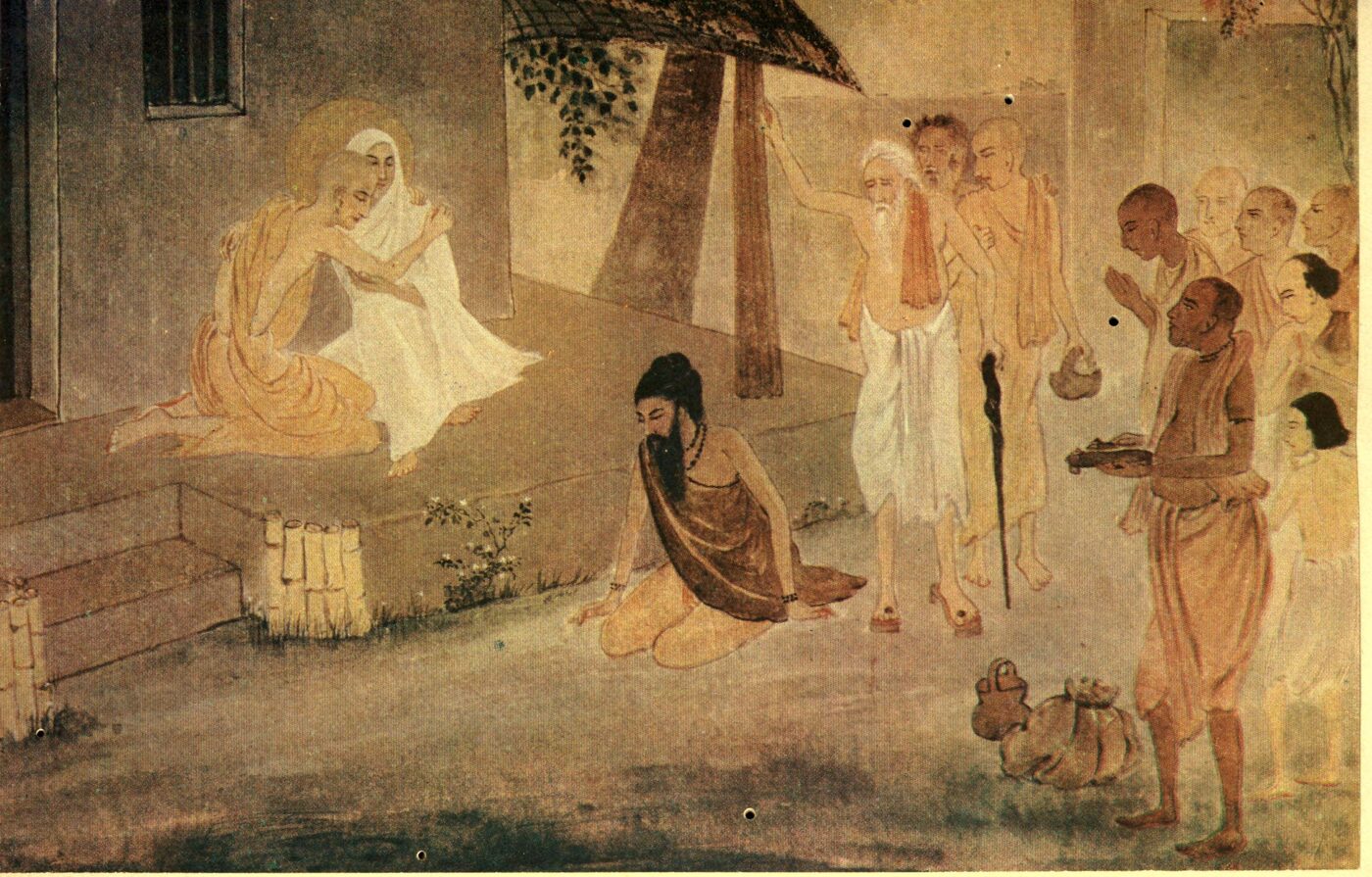
Vishnupriya Devi's own story, in the sources that survive, really begins on the night before her husband left her. The marriage itself is told in full on His own page, in Marriage and Household Life, so it is not repeated here. That page tells how Sachi Devi chose her, how Sri Chaitanya Mahaprabhu came to Sanatana Mishra's house in a wedding palanquin, and what the few years of their household life looked like. This page tells instead the part of the story that belongs to her: the conversation she had with Him once she learned what He intended to do, and the morning she woke to find Him gone.
| Detail | Description |
|---|---|
| Her father | Sanatana Mishra, raja-pandita of Navadwip (some Prema-vilasa tradition names her grandfather Durga Das Mishra instead) |
| Wedding funded by | Buddhimanta Khan, a wealthy well-wisher of the family |
| Household | A few years at Navadwip, ending when Mahaprabhu accepted sannyasa at twenty-four |
| Key source | Chaitanya-mangala by Locana Dasa Thakura, which alone among the major biographies records a direct conversation between them the night before He left |
| Her age at the parting | About sixteen |
A Household Of A Few Years #
All accounts agree that the years Vishnupriya spent as Mahaprabhu's wife looked ordinary from the outside, and were few. By this time He was already the most admired young scholar in Navadwip. He defeated learned pandits in debate and ran His own school. She kept His house alongside His mother, Sachi Devi. She had known and served Sachi Devi since her own girlhood days at the Ganges bathing ghat. Nothing in the record suggests any quarrel or disappointment in this period. The household matters to her own story for a simple reason. It was real and ordinary, and because of what came next, it was brief.
"Tell Me It Isn't True" #
Rumors of Mahaprabhu's intention to accept sannyasa reached the household before He announced it Himself. Locana Dasa Thakura's Chaitanya-mangala preserves what happened when Vishnupriya finally asked Him directly. "Tell me, O Prananatha," she said, using an epithet meaning Lord of my life, "is it true the rumor I heard, that You will take sannyasa and leave me? If I lose Your association I might as well end my life by drinking poison." The text describes His answer as gentle, compassionate words. He told her that she was as dear to Him as life itself, and that there was no need to worry. But He also said that the only real truth in this world was Krishna and the Vaishnavas. Every other relationship, such as father, mother, husband or wife, was in the end an illusory designation. He told her not to lament, and to fulfil the real meaning of her own name, Vishnupriya, "dear to Vishnu," by keeping Krishna always in her heart.
The text then records something striking. Mahaprabhu showed her His four-armed form, the form of Vishnu Himself, so that she could see directly who her husband really was. It removed her immediate grief, the text says, but not her attachment. By her own choice, she continued to regard Him as her husband and not only as God. Falling at His feet, she said she had nothing without His service. He embraced her with His eyes and made her a promise: "I shall travel here and there. But wherever I go, I shall always remain at your place." At last she understood that His independence could not be argued with, and she gave Him her answer: "You must do what makes You happy, my Lord. Let no one be an obstacle to Your divine mission."
We should be clear about what kind of source this conversation comes from. Neither Sri Chaitanya-charitamrita nor Chaitanya-Bhagavata records this exchange. It survives only in Chaitanya-mangala, a later biographical work. It is known here through an English translation published on gaudiyahistory.iskcondesiretree.com, and it has not been checked against the original Bengali text. So it is reported here as part of the tradition of devotional writing. It is not an episode independently confirmed in the two earlier and more widely studied biographies.
The Morning She Searched For Him #
Mahaprabhu left the house at night and walked, largely alone, toward Katwa to accept sannyasa there. The fuller account of that departure and of the sannyasa ceremony itself is given in Accepting the Sannyasa Order of Life on His own page. A devotional song by Vasudeva Ghosh, preserved and translated on thegaudiyatreasuresofbengal.com, describes what followed from Vishnupriya's side. She woke to find the bed where He had rested empty. With her hair and clothes in disorder, she ran to Sachi Devi's door. Then the two of them went out into the street together, lighting a lamp in the dark and calling His name, Nimai, Nimai, until the neighbors of Navadwip woke and joined the search. A passerby finally told them he had seen Vishvambhara walking alone toward Kantaka Nagara, the town also known as Katwa. Again, this is a devotional composition, not a scriptural verse, and it is given here as one.
No Message Ever Came #
It should be said plainly what the surviving sources do not contain. After He left Navadwip that night, no verse in Sri Chaitanya-charitamrita or Chaitanya-Bhagavata describes any further direct message passing from Mahaprabhu to Vishnupriya Devi. No episode in the wider later literature describes one either. In their last conversation He promised her that wherever He went, He would remain at her side the moment she held Him in her heart. On the evidence available, that promise appears to be the last word she is recorded as receiving from Him in person. For the rest of her long life, she lived out everything that followed on the strength of that one promise alone.
