Viśrāma-ghāṭa
विश्राम-घाट
- What it is
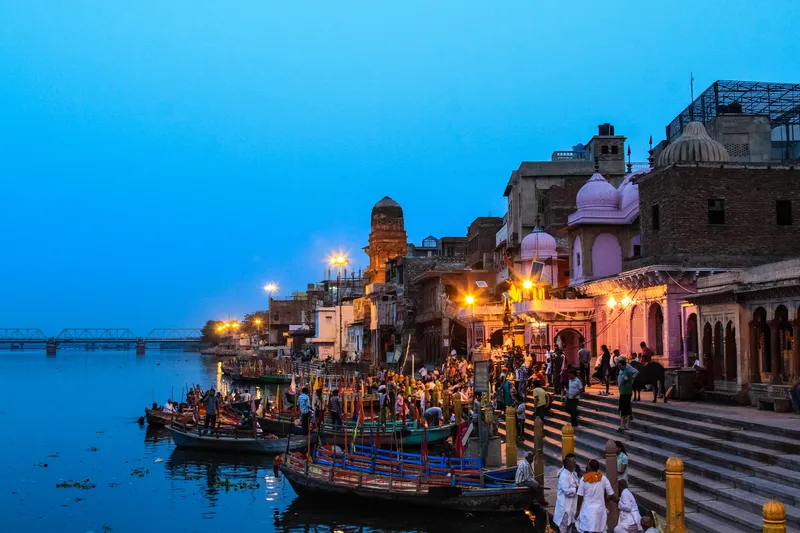
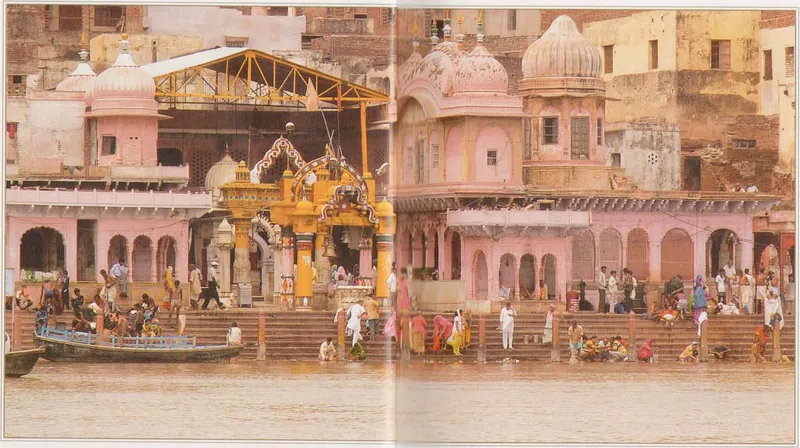
- Viśrāma-ghāṭa is the bathing place on the Yamunā that the 2007 guidebook calls the principal ghāṭa of Mathurā.
- Visiting
- According to the guidebooks, pilgrims take the vow (saṅkalpa) for the Vraja-maṇḍala parikramā at Viśrāma-ghāṭa, through a Vaiṣṇava or a Vrajavāsī priest, and complete the parikramā here; Śrī …
In short
Viśrāma-ghāṭa is the bathing place on the Yamunā that the 2007 guidebook calls the principal ghāṭa of Mathurā. Scripture calls it Viśrānti-tīrtha, the tīrtha of "rest".[1 +5] The Varāha Purāṇa praises it again and again: it is known in the three worlds, the holiest of Mathurā's countless tīrthas, and its name comes from the Lord's taking rest there.[1 +4] Śrīla Jīva Gosvāmī and the Bhakti-ratnākara say that Kṛṣṇa rested here after killing Kaṁsa.[11 +4] When Śrī Caitanya Mahāprabhu came into Mathurā He bathed here first, and the ācāryas who followed Him to Vraja bathed here too.[5 +5] According to the guidebooks, pilgrims still begin and end the Vraja-maṇḍala parikramā here.[20 +5]
Key facts
| Kind | ghāṭa |
|---|---|
| Region · area | Mathurā |
| Also part of | Yamunā |
| Ācāryas | Śrī Caitanya Mahāprabhu, Śrīla Kṛṣṇadāsa Kavirāja Gosvāmī, Śrīla Śrīnivāsa Ācārya, Śrīla Narottama dāsa Ṭhākura, Śrīla Rāghava Paṇḍita Gosvāmī of Govardhana |
Why it is glorified
In its list of Mathurā's tīrthas the Varāha Purāṇa names Viśrānti right after Avimukta.
Viśrānti in the Purāṇas
In its list of Mathurā's tīrthas the Varāha Purāṇa names Viśrānti right after Avimukta. The tīrtha called Viśrānti is known in the three worlds, the Lord tells the Earth goddess; one who bathes there reaches His world, and no sacrifice, austerity or meditation gives the result of a bath at Viśrānti (summarised here, not translated).[1 +1]
तथात्र मुञ्चते प्राणान्मम लोकं स गच्छति ।। विश्रान्तिसंज्ञकं नाम तीर्थं त्रैलोक्यविश्रुतम् ॥ 34 ॥ यस्मिन्स्नातो नरो देवि मम लोकं प्रपद्यते ।। सर्वतीर्थेषु यत्स्नानं सर्वतीर्थेषु यत्फलम् ॥ 35 ॥ तत्फलं लभते देवि दृष्ट्वा देवं गतश्रमः ।। न च यज्ञैर्न तपसा न ध्यानैर्न च संयमैः ॥ 36 ॥ तत्फलं लभते स्नातो यथा विश्रान्तिसंज्ञके ।। कालत्रयं तु वसुधे यः पश्यति गतश्रमः ॥ 37 ॥ कृत्वा प्रदक्षिणे द्वे तु विष्णुलोकं स गच्छति ।।
tathātra muñcate prāṇānmama lokaṁ sa gacchati
viśrāntisaṁjñakaṁ nāma tīrthaṁ trailokyaviśrutam
34
yasminsnāto naro devi mama lokaṁ prapadyate
sarvatīrtheṣu yatsnānaṁ sarvatīrtheṣu yatphalam
35
tatphalaṁ labhate devi dṛṣṭvā devaṁ gataśramaḥ
na ca yajñairna tapasā na dhyānairna ca saṁyamaiḥ
36
tatphalaṁ labhate snāto yathā viśrāntisaṁjñake
kālatrayaṁ tu vasudhe yaḥ paśyati gataśramaḥ
37
kṛtvā pradakṣiṇe dve tu viṣṇulokaṁ sa gacchati ||
Later the same Purāṇa counts the tīrthas of Mathurā and calls Viśrānti holier than the holy, the best of them all.[8] It describes Mathurā as a lotus with Keśava in the whorl, and gives the eastern petal to the Deity of Viśrānti, whose sight brings liberation.[16 +2] At sunrise, it says, the Lord's splendour is always at Viśrānti, at midday at Dīrgha-viṣṇu and later in the day at Keśava, and seeing Viśrānti gives the same result as offering piṇḍa, the oblation to the ancestors, at Gayā.[29]
The Skanda Purāṇa, in a survey of holy places, promises that a bath here with offerings to the ancestors lifts them from hell and brings the bather to Viṣṇu's world, and that a bath here destroys even a sin committed at the place unknowingly (summarised here, not translated):[2]
विश्रांतितीर्थे विधिवत्स्नात्वा कृत्वा तिलोदकम् ।। पितॄनुद्धृत्य नरकाद्विष्णुलोकं प्रगच्छति ॥ 33 ॥ यदि कुर्यात्प्रमादेन पातकं तत्र मानवः ।। विश्रांते स्नानमासाद्य भस्मीभवति तत्क्षणात् ॥ 34 ॥
viśrāṁtitīrthe vidhivatsnātvā kṛtvā tilodakam
pitṝnuddhṛtya narakādviṣṇulokaṁ pragacchati
33
yadi kuryātpramādena pātakaṁ tatra mānavaḥ
viśrāṁte snānamāsādya bhasmībhavati tatkṣaṇāt || 34 ||
The Nārada Purāṇa calls Viśrānti the jewel of tīrthas and begins its round of Mathurā's tīrthas here, with twelve to the south and twelve to the north.[31] Read more: The twenty-four ghāṭas of Mathurā → The Varāha Purāṇa begins and ends its walk round Mathurā with a bath at Viśrānti, and a verse on the Ardhacandra, the half-moon bend of the river, says that cremation at Viśrānti makes even a donkey four-armed.[7 +4]
Śrīla Rūpa Gosvāmī gathers these and other verses in his Mathurā-māhātmya under a heading on the glory of Viśrānti, from the Skanda, Saura, Padma and Ādi-varāha Purāṇas, and names Viśrānti first among the great tīrthas of Mathurā.[36 +6] The Varāha Purāṇa also tells that after Śatrughna had killed the demon Lavaṇa, Lord Rāma came to Mathurā for a festival, and that a bath was taken and a great festival held at Viśrānti; and at the end of the Garga-saṁhitā the sage Garga goes to the Yamunā at the tīrtha called Viśrānti and gives all his wealth to the brāhmaṇas of Mathurā.[4 +1]
Why it is called Viśrānti
The Varāha Purāṇa has a chapter on the glory of Viśrānti. A brāhmaṇa of Ujjayinī who had turned thief died and became a rākṣasa, a man-eating demon. He begged a travelling brāhmaṇa for the merit of a bath the brāhmaṇa had taken at Viśrānti, and explained how he knew the place: in a Viṣṇu temple he had heard its glory read out day after day, and with it the reason for its name. Vāsudeva, the lord of the world, takes rest there, and so it is called Viśrānti. As soon as the brāhmaṇa gave him the merit of one bath, the rākṣasa was freed (summarised here, not translated).[9 +1]
कस्मिंश्चिदथ कालेन गतोऽहं विष्णुमन्दिरम् ।। तस्याग्रे तिष्ठते विप्रो वाचको वेदपारगः ॥ 26 ॥ विश्रान्तितीर्थमाहात्म्यं श्रावयन्स दिनेदिने ।। तस्य श्रवणमात्रेण मम भक्तिर्हृदिस्थिता ॥ 27 ॥ सा संज्ञा च श्रुता तत्र विश्रान्तेश्च मयाऽनघ ।। वासुदेवो महाबाहुर्जगत्स्वामी जनार्दनः ॥ 28 ॥ विश्रामं कुरुते तत्र तेन विश्रान्तिसंज्ञिता ।। राक्षसस्य वचः श्रुत्वा विप्रो वचनमब्रवीत् ॥ 29 ॥ एकस्नानस्य हि फलं तव दत्तं च राक्षस ।। विप्रे चेत्युक्तमात्रे च मोक्षावासमवाप सः ॥ 167.30 ॥
kasmiṁścidatha kālena gato'haṁ viṣṇumandiram
tasyāgre tiṣṭhate vipro vācako vedapāragaḥ
26
viśrāntitīrthamāhātmyaṁ śrāvayansa dinedine
tasya śravaṇamātreṇa mama bhaktirhṛdisthitā
27
sā saṁjñā ca śrutā tatra viśrānteśca mayā'nagha
vāsudevo mahābāhurjagatsvāmī janārdanaḥ
28
viśrāmaṁ kurute tatra tena viśrāntisaṁjñitā
rākṣasasya vacaḥ śrutvā vipro vacanamabravīt
29
ekasnānasya hi phalaṁ tava dattaṁ ca rākṣasa
vipre cetyuktamātre ca mokṣāvāsamavāpa saḥ
167.30 ||
Other verses give the name other reasons: another Varāha verse speaks of the rest of pilgrims who come to Mathurā after wandering through all the tīrthas, and a verse that Śrīla Rūpa Gosvāmī and the Bhakti-ratnākara quote from the Saura Purāṇa says that this tīrtha gives people rest from the toil of wandering in the desert of worldly life.[7 +4] An Ādi-varāha verse that Śrīla Rūpa Gosvāmī places here speaks of the place where Hari rested.[39 +1] The accounts of who rests here differ (see below).
Divine pastimes
Kṛṣṇa's rest after killing Kaṁsa
Śrīmad-Bhāgavatam (10.44.38) tells that after Kṛṣṇa had killed Kaṁsa, He dragged the body along the ground, as a lion drags an elephant, in full view of everyone. It names no place to which the body was taken.[48 +3]
|| 10.44.38
taṁ samparetaṁ vicakarṣa bhūmau harir yathebhaṁ jagato vipaśyataḥ
hā heti śabdaḥ su-mahāṁs tadābhūd udīritaḥ sarva-janair narendra ||
As a lion drags a dead elephant, the Lord then dragged Kaṁsa’s dead body along the ground in full view of everyone present. O King, all the people in the arena tumultuously cried out, “Oh! Oh!”
Translation: Śrīla Prabhupāda's disciples (BBT)Śrīla Prabhupāda explains, in a purport on Uddhava's summary of the same pastime, why the body was dragged (a general passage; it names no place):[51]
General teaching (does not name the place)“Just to convince them that They had actually killed Kaṁsa, Kṛṣṇa and Baladeva pulled Kaṁsa’s dead body along the ground to encourage them.”
Śrīla Prabhupāda, Śrīmad-Bhāgavatam, 3.3.1, purport · vedabase.io
The Gosvāmīs name the place. In Śrīla Jīva Gosvāmī's Gopāla-campū, Kṛṣṇa drags Kaṁsa's huge body by the hair with His left hand and, followed by Nanda and Vasudeva amid rejoicing crowds, attains rest at Viśrānti-tīrtha; a hymn in the same chapter hails Him as the one who dragged Kaṁsa towards Viśrānti.[11 +4] Commenting on the Bhāgavatam, Śrīla Sanātana Gosvāmī and Śrīla Jīva Gosvāmī say that the dragging made a great ditch, known in Mathurā as Kaṁsa-khāta and Kaṁsa-nadī, which in their own time could still be seen, reaching as far as Viśrānti-tīrtha (summarised here, not translated).[53 +2]
The Bhakti-ratnākara twice calls this the place where Kṛṣṇa rested after killing Kaṁsa.[14 +1] Śrīla Locana dāsa Ṭhākura's Caitanya-maṅgala says that Kaṁsa was dragged through the middle of the village, making the Kaṁsa-khāla, and that the ghāṭa is called Viśrānti because Kṛṣṇa relieved His fatigue there.[56 +1] The Bhāgavatam adds that Kṛṣṇa then had the funeral rites performed, without naming a place; where the body was taken and where the rites were done, the sources tell differently (see below).[58 +1] Read more: How Kṛṣṇa killed Kaṁsa in the wrestling arena →
The bath after Dantavakra
Śrīla Prabhupāda explains Kṛṣṇa's return to Vraja in the Kṛṣṇa book (chapter 46); his explanation is given on the page of Pūñcharī. Śrīmad-Bhāgavatam (10.78) tells that Kṛṣṇa killed Dantavakra with His club and then entered His capital, Dvārakā.[60 +2] The Padma Purāṇa puts the fight at the gate of Mathurā on the Yamunā's bank and says that Kṛṣṇa then crossed the Yamunā and went to Nanda's Vraja for two months; Śrīla Rūpa Gosvāmī explains that "crossing" as a bath, since after killing a wicked person it is fitting to go to Vraja after bathing.[63 +2] Śrīla Jīva Gosvāmī's Gopāla-campū sets that bath at Viśrānti: eager to go to Vraja, Kṛṣṇa came to the place where He had so often found rest, bathed there and resolved never to use His weapon again.[52 +5]
Traditional accounts
On Yama-dvitīyā, also called Bhaiyā-dūja, the second day of the bright fortnight of Kārttika, thousands of brothers and sisters …
Yama-dvitīyā
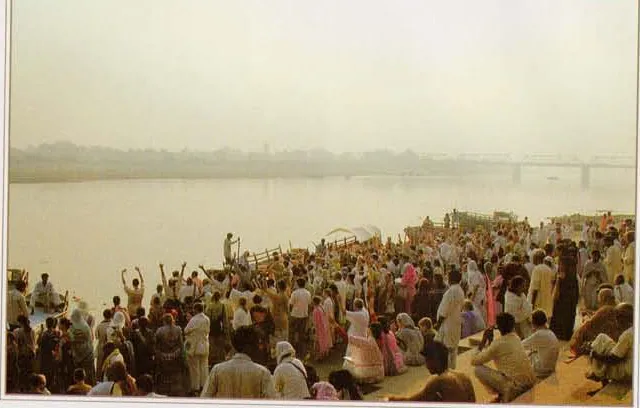
On Yama-dvitīyā, also called Bhaiyā-dūja, the second day of the bright fortnight of Kārttika, thousands of brothers and sisters bathe at Viśrāma-ghāṭa, according to two guidebooks, which say that a bath in the Yamunā on that day is most glorious here.[21 +2] The Skanda Purāṇa tells the story of the day without naming a ghāṭa: the Yamunā fed her brother Yama, and Yama promised that whoever bathes in the Yamunā and eats at his sister's house on that day will not come to his abode (summarised here, not translated).[67] Śrīmad-Bhāgavatam (6.6.40) calls the two the twins Yamarāja and the river Yamunā.[21 +1]
In Kṛṣṇa's own pastimes Śrīla Viśvanātha Cakravartī Ṭhākura sets the festival of the bhrātṛ-dvitīyā meal on the Yamunā's bank on the day after the first Govardhana-pūjā, and Śrīla Prabhupāda's Kṛṣṇa book also puts the ceremony of Bhrātṛ-dvitīyā between the Govardhana-pūjā and Indra's rain; neither names a ghāṭa.[69 +2] Śrīla Sanātana Gosvāmī, commenting on the Bhāgavatam, says that the Yamunā came down to earth because she could not bear the suffering that her brother Yama's punishment brings to sinners (summarised here, not translated).[72]
The Yamunā-Yamarāja Mandira
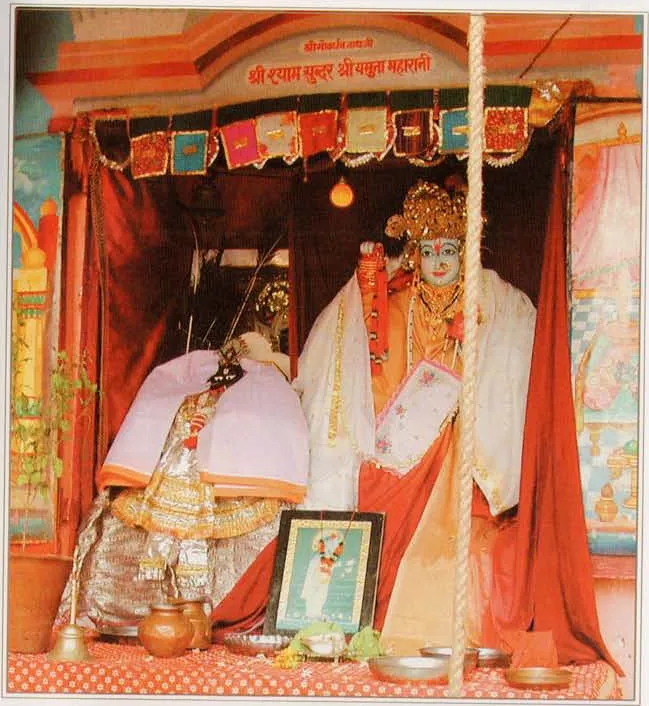
The Yamunā-Yamarāja Mandira of Mathurā is named after the river Yamunā and her brother Yamarāja, the lord of death. The undated parikramā notes Mathurā list a temple of this name after Viśrāma-ghāṭa, but no source says where it stands or which Deities it holds.[21 +1] Under the heading of this temple the notes repeat what Śrī Vraja-maṇḍala Parikramā (2007) says of the bath on Yama-dvitīyā at Viśrāma-ghāṭa (above).[21 +2] The 2007 guidebook's photograph at the ghāṭa shows a shrine with Deities of Śrī Śyāmasundara and Yamunā-devī; neither book says that this shrine is the Yamunā-Yamarāja temple.[21]
In the Sixth Canto of Śrīmad-Bhāgavatam, Saṁjñā, the wife of the sun-god Vivasvān, gives birth to twins, Yama and Yamī; Śrīla Prabhupāda's translation calls them Yamarāja and the river Yamunā. The verse does not mention Mathurā or any temple.[21 +4]
vivasvataḥ śrāddhadevaṃ saṃjñāsūyata vai manum / mithunaṃ ca mahābhāgā yamaṃ devaṃ yamīṃ tathā / saiva bhūtvātha vaḍavā nāsatyau suṣuve bhuvi
Saṁjñā, the wife of Vivasvān, the sun-god, gave birth to the Manu named Śrāddhadeva, and the same fortunate wife also gave birth to the twins Yamarāja and the river Yamunā. Then Yamī, while wandering on the earth in the form of a mare, gave birth to the Aśvinī-kumāras.
Translation: Śrīla A.C. Bhaktivedanta Swami PrabhupādaIn the Tenth Canto, where the Yamunā gives way to Vasudeva as he carries the newborn Kṛṣṇa, Śrīla Prabhupāda's word meanings call her the younger sister of Yamarāja.[73 +2] Śrīla Rūpa Gosvāmī's Yamunāṣṭaka opens by praising the Yamunā, daughter of the sun, as the one who saves people from going to the city of her brother Antaka, the ender, that is, Yama. In his commentary Śrīla Baladeva Vidyābhūṣaṇa explains Antaka as Dharmarāja, her elder brother (summarised here, not translated).[76]
bhrātur antakasya pattane ’bhipatti-hāriṇī
prekṣayāti-pāpino ’pi pāpa-sindhu-tāriṇī
nīra-mādhurībhir apy aśeṣa-citta-bandhinī
māṁ punātu sarvadāravinda-bandhu-nandinī
The Skanda Purāṇa tells how the day got its name. On the second day of the bright half of Kārttika, long ago, the Yamunā fed and honoured Yama in her own house. When he offered her a boon, she asked three things of him: a meal at her house every year, freedom from hell for sinners on that day, and happiness for all who are fed by their sisters on it (summarised here, not translated).[67 +4]
भुक्त्वा यमोऽपि भगिनीमलंकारैः समर्चयत् ।। नानावस्त्रैस्ततः प्राह वरं वरय भामिनि ।। इति तद्वचनं श्रुत्वा यमुना वाक्यमब्रवीत् ॥ 49 ॥ ।।यमुनोवाच ।। ।। प्रतिवर्षं समागच्छ भोजनार्थं तु मद्गृहे ॥ 2.4.11.50 ॥ अद्य सर्वे मोचनीयाः पापिनो नरकाद्यम ।। येऽद्यैव भगिनीहस्तात्करिष्यंति च भोजनम् ।। तेषां सौख्यं प्रदेहि त्वमेतदेव वृणोम्यहम् ॥ 51 ॥
bhuktvā yamo'pi bhaginīmalaṁkāraiḥ samarcayat
nānāvastraistataḥ prāha varaṁ varaya bhāmini
iti tadvacanaṁ śrutvā yamunā vākyamabravīt
yamunovāca
prativarṣaṁ samāgaccha bhojanārthaṁ tu madgṛhe
adya sarve mocanīyāḥ pāpino narakādyama
ye'dyaiva bhaginīhastātkariṣyaṁti ca bhojanam
teṣāṁ saukhyaṁ pradehi tvametadeva vṛṇomyaham
Yama promised that those who bathe in the Yamunā on that day, make offerings to the forefathers and the gods, and eat at their sister's house and honour her will not come to his abode (summarised here, not translated). The Padma Purāṇa has the same verses, and the Bhaviṣya Purāṇa tells the meal in the Yamunā's house in the same way; one who bathes in her on that day does not see Yama's world. None of the three names a place for it.[77 +4]
।। यम उवाच ।। ।। यमुनायां तु यः स्नात्वा संतर्प्य पितृदेवताः ॥ 52 ॥ भुंक्ते च भगिनीगेहे भगिनीं पूजयेदपि ।। कदाचिदपि मद्वारं न स पश्यति भानुजे ॥ 53 ॥
yama uvāca
yamunāyāṁ tu yaḥ snātvā saṁtarpya pitṛdevatāḥ
bhuṁkte ca bhaginīgehe bhaginīṁ pūjayedapi
kadācidapi madvāraṁ na sa paśyati bhānuje
Śrīla Jīva Gosvāmī's Gopāla-campū gives the day of Kṛṣṇa's own pastimes in detail. On the morning after the Govardhana sacrifice the cowherd men bathed in the Yamunā, having heard of her glories. Since brothers should eat from a sister's hand on that day, the daughters of Upananda and other cowherds invited Balarāma and Kṛṣṇa, who came out of love and enjoyed the meal with their friends (summarised here, not translated).[71] None of these texts names Mathurā or a temple, and the Bhāgavatam's verses do not tell the Bhrātṛ-dvitīyā meal: Śrīla Viśvanātha Cakravartī Ṭhākura says that Śukadeva did not describe it (above).[69 +2] Opening his account of the rāsa dance in the Kṛṣṇa book, Śrīla Prabhupāda gives the order of the days:[69 +2]
General teaching (does not name the place)“From the statements of previous chapters, it appears that the festival of Govardhana-pūjā was performed just after the dark-moon night of the month of Kārttika, and thereafter the ceremony of Bhrātṛ-dvitīyā was performed; then the wrath of Indra was exhibited in the shape of torrents of rain and hailstones”
Śrīla Prabhupāda, Kṛṣṇa, the Supreme Personality of Godhead (the Kṛṣṇa book), chapter 29, 'The Rāsa Dance: Introduction', first paragraph · vedabase.io
Śrī Keśava Bhaṭṭa Kāśmīrī
According to the Hindi Bhaktamāla (1904), Śrī Keśava Bhaṭṭa Kāśmīrī defeated the mlecchas of Mathurā in a dispute, and many qāzīs were afraid when they saw his power. The verse of Śrī Nābhā dāsa names no ghāṭa; Śrī Priyādāsa's commentary places the event at the bank of Viśrānta, where Turks had set up a yantra, a magical device, at a gate to seize those who passed, and the prose commentary of 1904 says that he broke its power on the road to Viśrānta-ghāṭa.[82 +1]
The Gosvāmīs and ācāryas
The Caitanya-caritāmṛta tells that when Śrī Caitanya Mahāprabhu entered Mathurā, He first bathed at Viśrānti-tīrtha, which Śrīla …
Śrī Caitanya Mahāprabhu
The Caitanya-caritāmṛta tells that when Śrī Caitanya Mahāprabhu entered Mathurā, He first bathed at Viśrānti-tīrtha, which Śrīla Prabhupāda translates as Viśrāma-ghāṭa, and then went to see Keśavajī at Kṛṣṇa's birthplace.[5 +7]
mathurā āsiyā kailā ‘viśrānti-tīrthe’ snāna
‘janma-sthāne’ ‘keśava’ dekhi’ karilā praṇāma
When Śrī Caitanya Mahāprabhu entered the city of Mathurā, He took His bath at Viśrāma-ghāṭa. He then visited the birthplace of Kṛṣṇa and saw the Deity named Keśavajī. He offered His respectful obeisances to this Deity.
Translation: Śrīla A.C. Bhaktivedanta Swami PrabhupādaAccording to the Bhakti-ratnākara, women and men, children and old people ran to Him here from all sides, hundreds of thousands, calling out "Hari" and unable to take their eyes from Him; it calls this His wonderful pastime at Viśrāma-tīrtha. The Caitanya-caritāmṛta adds that He bathed in all twenty-four ghāṭas of the Yamunā at Mathurā.[15 +4] In the accounts of Śrīla Murāri Gupta and Śrīla Locana dāsa Ṭhākura, His guide Kṛṣṇadāsa showed Him the image called Gataśrama and Viśrāma-ghāṭa, the first of a run of ghāṭas going south.[56 +2]
Śrī Nityānanda Prabhu
The Caitanya-bhāgavata of Śrīla Vṛndāvana dāsa Ṭhākura tells that Śrī Nityānanda Prabhu, on his pilgrimage before he met Śrī Caitanya, came to Mathurā and played in the water at the Yamunā's Viśrāma-ghāṭa.[16 +2]
Śrīla Śrīnivāsa Ācārya and Śrīla Narottama dāsa Ṭhākura
According to the Bhakti-ratnākara, when Śrīla Śrīnivāsa Ācārya first came to Mathurā he hurried to Viśrāma-ghāṭa, where Kṛṣṇa had rested after killing Kaṁsa, and there heard brāhmaṇas lament that Śrīla Rūpa Gosvāmī and Śrīla Sanātana Gosvāmī had passed away. The Prema-vilāsa also puts this news at the ghāṭa, heard from Vrajavāsīs going by.[14 +5] According to the Narottama-vilāsa, Śrīla Narottama dāsa Ṭhākura on his first coming to Vraja went first to Viśrāma-ghāṭa, bathed and stayed there, and a brāhmaṇa of Mathurā told him that night that the Gosvāmīs had passed from sight; the Prema-vilāsa says that Śrīla Jīva Gosvāmī, at a command of Śrīla Rūpa Gosvāmī, sent Vaiṣṇavas who found him at the ghāṭa.[100 +2] The details of both arrivals differ from book to book (see below). Read more: Śrīla Śrīnivāsa and Śrīla Narottama at Viśrāma-ghāṭa →
The Bhakti-ratnākara tells that Śrīla Rāghava Paṇḍita Gosvāmī of Govardhana later showed the two Viśrānti-tīrtha and its glories, and that at the end of their tour of Vraja they bathed here again before going on to Ambikā-kānana.[7 +4] On a later journey, the same book says, Śrīla Śrīnivāsa Ācārya bathed here and heard from a brāhmaṇa of Mathurā that Śrī Haridāsa Ācārya had passed away ten days before.[101]
Other visitors
- According to the Bhakti-ratnākara and the Narottama-vilāsa, Śrīla Jāhnavā-devī bathed in the Yamunā at Viśrāma-ghāṭa when she came to Mathurā, and honoured the brāhmaṇas of Mathurā.[18 +1]
- According to the Bhakti-ratnākara, Śrīla Vīracandra Prabhu bathed at Viśrānti-ghāṭa on his tour of Vraja.[104]
- According to the Prema-vilāsa, Śrīla Śyāmānanda Paṇḍita, then called Duḥkhī Kṛṣṇadāsa, came to Viśrāma-ghāṭa after weeping at Kṛṣṇa's birthplace and set out for Vṛndāvana at dawn.[105]
- Śrīla Nārāyaṇa Bhaṭṭa Gosvāmī's Vraja-bhakti-vilāsa says that the gods with Viṣṇu bathed at Viśrānti, and gives a prayer for bathing here that it ascribes to the Padma Purāṇa.[106]
Śrīla Prabhupāda
In his translation of the Caitanya-caritāmṛta Śrīla Prabhupāda renders Viśrānti-tīrtha and Viśrāma as Viśrāma-ghāṭa.
In his translation of the Caitanya-caritāmṛta Śrīla Prabhupāda renders Viśrānti-tīrtha and Viśrāma as Viśrāma-ghāṭa. Later in the same chapter he translates Mahāprabhu's visit to the holy places on the Yamunā:[1 +6]
Names this place“Śrī Caitanya Mahāprabhu visited all the holy places on the banks of the Yamunā, including Svayambhu, Viśrāma-ghāṭa, Dīrgha Viṣṇu, Bhūteśvara, Mahāvidyā and Gokarṇa.”
Śrīla Prabhupāda, Śrī Caitanya-caritāmṛta, Madhya-līlā 17.191, translation · vedabase.io
Songs
A hymn in the Kaṁsa chapter of Śrīla Jīva Gosvāmī's Gopāla-campū describes Kṛṣṇa as the one who dragged Kaṁsa towards Viśrānti.
A hymn in the Kaṁsa chapter of Śrīla Jīva Gosvāmī's Gopāla-campū describes Kṛṣṇa as the one who dragged Kaṁsa towards Viśrānti.[11 +2]
Visiting today
According to the guidebooks, pilgrims take the vow (saṅkalpa) for the Vraja-maṇḍala parikramā at Viśrāma-ghāṭa, through a Vaiṣṇava or a Vrajavāsī priest, and complete the parikramā here; Śrī Vraja-maṇḍala Parikramā (2007) also starts and ends the ten-mile walk round Mathurā here.[20 +5] The same book gives several days on which the vow is taken, and gives a reason for one of them that does not match the Caitanya-caritāmṛta (see below).[20 +5]
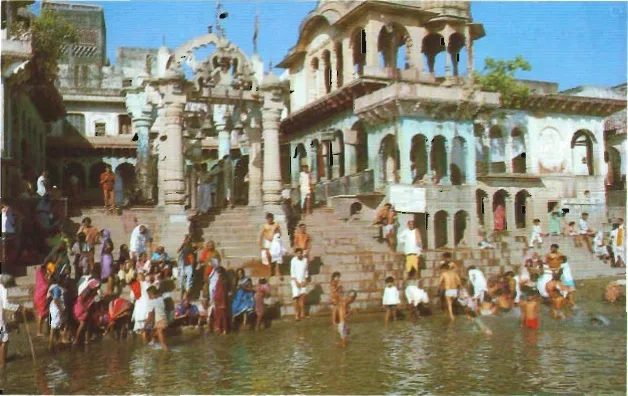
Two guidebooks say that a sunset ārati is offered to the Yamunā here every evening and that pilgrims bathe here before they set out.[95 +1] The 2007 guidebook shows a shrine at the ghāṭa with Deities of Śrī Śyāmasundara and Yamunā-devī.[21] The guidebooks place Durvāsā Muni's āśrama across the river, and the 2007 guidebook puts the temple of Gatāśrama-Nārāyaṇa south of the ghāṭa on the inner parikramā path.[109 +3]
Places at Viśrāma-ghāṭa
1 places
Also described on this page
- Yamunā-Yamarāja Mandira temple
Nearby places
Durvāsā Āśrama (across from Mathurā) · Pīpaleśvara Mahādeva · Dvārakādīśa Mandira
Pictures
4 pictures
History
The historian A. W. Entwistle (1987) gives the earliest datable mention of Viśrānti-tīrtha that he knows: Jinaprabha Sūri's description of Mathurā, written in the early fourteenth century, which names it first of five Hindu bathing places. He adds that a pilgrim from Bikaner who came in 1656 called the central ghāṭa "bisarāyat" and counted twenty-four others.[84]
According to Entwistle, who reports an earlier writer's source, the ghāṭa was built by Abdunnabī Khān, Aurangzeb's faujdār (military governor) of Mathurā. The ornamental arches on its terrace were put up by Bīr Singh Deo of Orchhā and a Rāṇā of Udaipur, in memory of the gold they gave there, and the buildings round the terrace were raised by princely families from the early eighteenth century on.[85] Entwistle and Prabhudayāl Mītal (1966), citing older records, both say that Bīr Singh Deo was weighed against gold at Viśrāma-ghāṭa on his pilgrimage of 1614 (Saṁvat 1671) and gave eighty-one maunds of gold more in charity; Mītal adds that from Akbar's time kings and officials made such gifts here and built gates in their memory, with large bells.[85 +3] F. S. Growse (1883) describes a small court with marble arches facing the water and buildings put up over a century and a half by princely families.[89 +1]
Where the sources differ
What Kṛṣṇa did with Kaṁsa's body and where He rested after the killing.
Accounts differ What Kṛṣṇa did with Kaṁsa's body and where He rested after the killing.
- Śrīmad-Bhāgavatam 10.44.38, 10.44.49Hari dragged the dead body along the ground in full view of everyone; later He had the funeral rites done for the slain. No place of rest is named.
- Viṣṇu Purāṇa 5.20.88; Harivaṁśa 76.35-37The body was dragged within the arena (raṅga-madhye; in the assembly enclosure, making a ditch) and let go not far away.
- Śrīla Prabhupāda, Kṛṣṇa book ch. 44Kṛṣṇa dragged the body like a lion drags an elephant, to assure His parents that Kaṁsa was dead; no destination; the queens then lamented over the bodies 'which lay on the wrestling dais', and the funeral ceremonies were conducted under Kṛṣṇa's personal supervision; no place is named for them.
- Śrīmad-Bhāgavatam 3.3.1 with Śrīla Prabhupāda's purportUddhava: Kṛṣṇa and Baladeva threw Kaṁsa down from his throne, killed him and pulled the body along the ground to please Their parents; Śrīla Prabhupāda: They pulled it 'along the ground' to convince Vasudeva and Devakī that Kaṁsa was dead. No destination.
The wording of these accounts is our summary of the sources, not a published translation.
Who rests here: the reasons given for the name.
Accounts differ Why the place is called Viśrānti/Viśrāma ('rest'): who rests there.
- Varāha Purāṇa 167.28-29Vāsudeva Janārdana, the lord of the world, takes rest there; therefore it is called Viśrānti.
- Varāha Purāṇa 179.33From 'resting' (viśramaṇa) comes the name, in a passage on pilgrims who come to Mathurā after wandering through all the tīrthas.
- 'Saura Purāṇa' as quoted in the Bhakti-ratnākara (p. 171) and Śrī Vraja-maṇḍala Parikramā (2007)The tīrtha gives people rest from the toil of wandering in the desert of worldly life.
- 'Skanda, Mathurā-khaṇḍa' as quoted in the Bhakti-ratnākara (p. 170) and by Śrīla Rūpa Gosvāmī (Mathurā-māhātmya v.225, 'Skanda')Those who have wandered through all the tīrthas find rest there: lasting rest, in the Bhakti-ratnākara's reading; in the printed edition of the Mathurā-māhātmya (Haridāsa Dāsa, c. 1944) it is the devotees (sātvatas) who come to rest there.
Where exactly Kaṁsa was killed, the sources answer differently; their accounts are set out on the page of Raṅga-bhūmi.[113]
Accounts differ Where Kṛṣṇa went after killing Dantavakra, and whether He bathed at Viśrānti on the way.
- Śrīmad-Bhāgavatam 10.78.9, 10.78.13-15; Śrīla Prabhupāda, Kṛṣṇa book ch. 78Kṛṣṇa killed Dantavakra (no place named) and then entered His capital, Dvārakā; no visit to Vraja, no bath.
- Padma Purāṇa, Uttara-khaṇḍa VI.252.21-27The fight took place at the gate of Mathurā on the bank of the Yamunā; afterwards Kṛṣṇa crossed the Yamunā, went to Nanda's Vraja and stayed two months (verse 29: then He entered Dvārakā); no ghāṭa is named.
- Śrīla Rūpa Gosvāmī, Laghu-bhāgavatāmṛta 1.5.482-484Quotes the Padma passage and explains 'having crossed' as a bath before going to Vraja; no ghāṭa is named.
- Śrīla Jīva Gosvāmī, Gopāla-campū Uttara 30.[12]After killing Dantavakra at the gate of Mathurā called 'Datihā', Kṛṣṇa came to Viśrānti, performed the bathing rites there and went on to Vraja.
Which bathing places make up Mathurā's twenty-four ghāṭas, and whether Viśrāma-ghāṭa divides them.
Accounts differ The twenty-four ghāṭas of Mathurā: their names and whether Viśrāma-ghāṭa is their dividing point.
- Śrī Vraja-maṇḍala Parikramā (2007)The Yamunā flows in a crescent with Viśrāma-ghāṭa in the centre; twelve ghāṭas (Avimukta … Bodhi) lie on the southern side and twelve (Nava-tīrtha … Koṭi) on the northern side.
- Śrī Vraja-maṇḍala Parikramā (2007)'The twelve following ghāṭas (numbered 13 to 24) lie south of Viśrāma-ghāṭa' (the same book's numbers 13-24 are its northern set).
- Bhakti-ratnākara (1912, pp. 175, 178)Avimukta … Bodhi are south of Viśrāma; Nava-tīrtha is north of Asi-kuṇḍa; not counting Viśrānti, twelve and twelve ghāṭas lie north and south of it (Mathurā-khaṇḍa: from Daśāśvamedha to Mokṣa).
- Śrīla Rūpa Gosvāmī, Mathurā-māhātmya v.274 (quoting the 'Mathurā-khaṇḍa')By the Mathurā-khaṇḍa, he says, there are twenty-four tīrthas without Viśrānti, south and north of it, from Daśāśvamedha to Mokṣa.
The wording of these accounts is our summary of the sources, not a published translation.
Accounts differ What Śrīnivāsa heard at Viśrāma-ghāṭa when he first came to Mathurā, from whom, and in what order the Gosvāmīs had departed.
- Bhakti-ratnākara, Fourth Wave (1912, pp. 132-133)Two or four brāhmaṇas came along that path talking of Vṛndāvana; they lamented that Śrī Kṛṣṇa-Caitanya had disappeared at Nīlācala and that Kāśīśvara had departed (p. 132), that Śrīla Raghunātha Bhaṭṭa had disappeared in separation from the Lord, within a few days Sanātana, and now Śrī Rūpa (p. 133).
- Prema-vilāsa, Fifth Vilāsa (c. 1913 ed., p. 31)On the road five Vrajavāsīs had told him that Sanātana passed away four months before; at 'Kṛṣṇa's Viśrāma-ghāṭa', sitting facing east, he heard three Vrajavāsīs going by say that first Sanātana, some days later Śrīla Raghunātha Bhaṭṭa, and now Śrī Rūpa had passed from sight (Kāśīśvara is not named).
How Śrīla Narottama dāsa Ṭhākura first came to the ghāṭa and went on to Vṛndāvana.
Accounts differ What happened when Narottama first came to Viśrāma-ghāṭa, and how he was brought on to Vṛndāvana.
- Narottama-vilāsa, Second Vilāsa (c. 1907 ed., p. 13)He went first to Viśrāma-ghāṭa, bathed in the Yamunā and stayed there; that night a Vaiṣṇava brāhmaṇa of Mathurā fed him and told him that Raghunātha, Kāśīśvara, Rūpa and Sanātana had passed from sight; toward dawn those four Gosvāmīs appeared to him in a dream; in the morning the brāhmaṇa sent a man to show him the road to Vṛndāvana, where Śrī Rūpa had told Śrīnivāsa in a dream that he would meet Narottama (pp. 13-14).
- Prema-vilāsa, Eleventh Vilāsa (c. 1913 ed., p. 62)After seeing Bhūteśvara, the Keśava temple and the birthplace he bathed at Viśrāma and stayed in the town; at a command of Śrī Rūpa, Jīva sent Vaiṣṇavas who bathed at Viśrānti, found him at that very ghāṭa and took him to Vṛndāvana.
The Yama-dvitīyā story: the two guidebooks tell it differently from the Purāṇas. In their version the Yamunā invites Yama on her birthday and asks for liberation for those who bathe in her, and they link that bath with this ghāṭa, which the Purāṇas do not name.[21 +2]
Accounts differ The story of Yamunā feeding Yama on Yama-dvitīyā and the terms of her boon.
- Śrī Vraja-maṇḍala Parikramā (2007), printed pp. 46-47, at Viśrāma-ghāṭa; repeated word for word by the undated parikramā notes Mathurā under 'Yamuna Yamaraja Temple' ('According to the Puranas')Yama (Dharmarāja) and Yamī (Yamunā) are twins; soft-hearted Yamunā, unable to bear the sufferings of living beings, invited her brother on her birthday and asked that those who bathe in her waters with faith on this day be freed from birth and death and the threefold miseries; Yama said 'So be it!'
- Skanda Purāṇa, Vaiṣṇava-khaṇḍa, Kārttikamāsa-māhātmya, adhyāya 11 (vv. 30-31, 42-53)Yamunā had invited Yama daily; he came on the second day of the bright half of Kārttika, after releasing the hell-dwellers. She asked that he come for food every year, that sinners be released from hell that day and that those who eat from their sisters' hands be happy; Yama promised that one who bathes in the Yamunā, offers libations, eats in his sister's house and honours her will never see his door. …
- Padma Purāṇa, Uttara-khaṇḍa 122.92-93The same passage as the Skanda's vv. 30-39 (122.92-103): bathing in the Yamunā on the second day of Kārttika and worshipping Yama keeps one from Yama's world; Yamunā fed and honoured Yama in her house that day; the hell-dwellers were set free, hence the name Yama-dvitīyā; one should eat from a sister's hand. No boon dialogue and no birthday.
- Bhaviṣya Purāṇa, Uttara-parva 14.18-27 (Śrī Kṛṣṇa to Yudhiṣṭhira)Yamunā fed Yama in her house on the second day of the bright half of Kārttika; the hell-dwellers were satisfied and set free, so the day is called Yama-dvitīyā; one should eat from a sister's hand and give her gifts. No boon dialogue, no birthday and no promise for bathers.
Accounts differ When Śrī Caitanya Mahāprabhu set out on the journey that brought Him to Mathurā — the reason Śrī Vraja-maṇḍala Parikramā (2007) gives for starting the Vraja-maṇḍala parikramā (vow at Viśrāma-ghāṭa) after Vijayā-daśamī.
- Śrī Vraja-maṇḍala Parikramā (2007)Some start the parikramā after Vijayā-daśamī in Āśvina because, according to the Caitanya-caritāmṛta, Mahāprabhu arrived from Nīlācala at this time to have darśana of Vraja-maṇḍala.
- Śrī Caitanya-caritāmṛta, Madhya 16.93-94 and 16.251Mahāprabhu set out for Vṛndāvana on Vijayā-daśamī, going through Bengal; that journey did not reach Vraja, and He returned to Nīlācala.
- Śrī Caitanya-caritāmṛta, Madhya 17.3The journey through Jhārikhaṇḍa that did reach Mathurā began 'when autumn arrived'; no day is named, and no date of arrival in Mathurā is given in the chapter.
More on this place
Śrīla Śrīnivāsa and Śrīla Narottama at Viśrāma-ghāṭa · How Kṛṣṇa killed Kaṁsa in the wrestling arena · The twenty-four ghāṭas of Mathurā
References
115 references
- Varāha Purāṇa, adhyāya 152, verses 34-38a, Sanskrit Wikisource
- Skanda Purāṇa, II.3.1.33-34, Sanskrit Wikisource
- Padma Purāṇa, VI.208.40-41, Sanskrit Wikisource
- Garga-saṁhitā, Aśvamedha-khaṇḍa (10) 62.23-24, Sanskrit Wikisource
- Śrīla Kṛṣṇadāsa Kavirāja Gosvāmī, Śrī Caitanya-caritāmṛta, Madhya-līlā 17.156, online edition · vedabase.io
- Śrīla Prabhupāda, Śrī Caitanya-caritāmṛta, Madhya-līlā 17.156, translation · vedabase.io
- Śrīla Narahari Cakravartī, Bhakti-ratnākara, Fifth Wave (pañcama taraṅga), 1912 ed. p. 171, 2nd ed., 1912
- Varāha Purāṇa, adhyāya 168, verses 13-15, Sanskrit Wikisource
- Varāha Purāṇa, adhyāya 167, verses 23-25, Sanskrit Wikisource
- Varāha Purāṇa, adhyāya 167, verses 26-30, Sanskrit Wikisource
- Śrīla Jīva Gosvāmī, Gopāla-campū, Uttara-campū, pūraṇa 5 ('Kaṁsa-vidhvaṁsana'), §55-56, GRETIL
- Śrīla Jīva Gosvāmī, Gopāla-campū, Uttara-campū 5.69 (the 'vīra' hymn 'jaya kṛta-mathurā-praveśa-bhāvuka'; GRETIL gc_2,5.69), GRETIL
- Śrīla Jīva Gosvāmī, Gopāla-campū, Pūrva-campū, pūraṇa 33 ('sarva-manoratha-pūraṇa'), ¶[36]
- Śrīla Narahari Cakravartī, Bhakti-ratnākara, Fourth Wave (caturtha taraṅga), 1912 ed. p. 132, 2nd ed., 1912
- Śrīla Narahari Cakravartī, Bhakti-ratnākara, Fifth Wave (pañcama taraṅga), 1912 ed. p. 170, 2nd ed., 1912
- Śrī Vraja-maṇḍala Parikramā (2007), PDF p. 30
- Śrī Vraja-maṇḍala Parikramā (2007), PDF p. 50
- Śrīla Narahari Cakravartī, Bhakti-ratnākara, Eleventh Wave (ekādaśa taraṅga), 1912 ed. p. 663, 2nd ed., 1912
- Śrīla Narahari Cakravartī, Narottama-vilāsa, Ninth Vilāsa, vv. 8-9 (1st ed., c. 1907), p. 78, 1st ed., Baṅgābda 1314
- Śrī Vraja-maṇḍala Parikramā (2007), PDF p. 22
Show all 115 references
- Śrī Vraja-maṇḍala Parikramā (2007), PDF p. 36
- Śrī Vraja-maṇḍala Parikramā (2007), PDF p. 42
- Śrī Vraja-maṇḍala Parikramā (2007), PDF p. 53
- Vṛndāvana-Dhāma Ki Jaya! (c. 1986), by Dhruva Mahārāja dāsa, PDF p. 18
- Vṛndāvana-Dhāma Ki Jaya! (c. 1986), by Dhruva Mahārāja dāsa, PDF p. 93
- Varāha Purāṇa, adhyāya 152, verses 34-38a, Sanskrit Wikisource
- Varāha Purāṇa, adhyāya 163, verses 16-20, Sanskrit Wikisource
- Śrīla Narahari Cakravartī, Bhakti-ratnākara, Fifth Wave (pañcama taraṅga), 1912 ed. p. 163, 2nd ed., 1912
- Varāha Purāṇa, adhyāya 163, verses 67-69, Sanskrit Wikisource
- Skanda Purāṇa, II.3.1.33-34, Sanskrit Wikisource
- Nārada Purāṇa, उत्तरार्धः/अध्यायः 79 v.79-22 to 79-23: Uttara-bhāga, chapter 79, verses 22-23
- Varāha Purāṇa, adhyāya 160, verses 1-2, Sanskrit Wikisource
- Varāha Purāṇa, adhyāya 160, verses 62-65, Sanskrit Wikisource
- Varāha Purāṇa, adhyāya 169, verses 15-18, Sanskrit Wikisource
- Śrī Vraja-maṇḍala Parikramā (2007), PDF p. 37
- Śrīla Rūpa Gosvāmī, Mathurā-māhātmya v.225
- Śrīla Rūpa Gosvāmī, Mathurā-māhātmya v.228-229
- Śrīla Rūpa Gosvāmī, Mathurā-māhātmya v.230-231
- Śrīla Rūpa Gosvāmī, Mathurā-māhātmya v.232-233
- Śrīla Rūpa Gosvāmī, Mathurā-māhātmya v.164-165
- Śrīla Rūpa Gosvāmī, Mathurā-māhātmya v.106
- Śrīla Rūpa Gosvāmī, Mathurā-māhātmya v.442-443
- Varāha Purāṇa, adhyāya 178, verses 4-7, Sanskrit Wikisource
- Varāha Purāṇa, adhyāya 167, verses 26-30, Sanskrit Wikisource
- Varāha Purāṇa, adhyāya 179, verses 32-34, Sanskrit Wikisource
- Śrī Vraja-maṇḍala Parikramā (2007), PDF p. 35
- Śrīla Rūpa Gosvāmī, Mathurā-māhātmya v.235-236
- Śrīmad-Bhāgavatam 10.44.38, Bhagavata Vidya Pith edition, ed. Bhagavata Rishi and Krishna Shankar Shastri, 1996
- Śrīmad-Bhāgavatam ŚB 3.3.1, GRETIL
- Śrīla Prabhupāda, Kṛṣṇa, the Supreme Personality of Godhead, Chapter 44 ('The Killing of Kaṁsa') · vedabase.io
- Śrīla Prabhupāda, Śrīmad-Bhāgavatam, 3.3.1, purport · vedabase.io
- Śrīla Jīva Gosvāmī, Gopāla-campū, Uttara-campū, pūraṇa 30, ¶[12]
- Śrīmad-Bhāgavatam: commentary ŚB 10.45.1, commentary: Jīva Gosvāmī (Laghu-vaiṣṇava-toṣaṇī), on the order of events from 10.44.38 to 10.45.2, Bhagavata Vidya Pith edition, ed. Bhagavata Rishi and Krishna Shankar Shastri, 1996
- Śrīmad-Bhāgavatam: commentary ŚB 10.44.38, commentary: Sanātana Gosvāmī (Bṛhad-vaiṣṇava-toṣaṇī), Bhagavata Vidya Pith edition, ed. Bhagavata Rishi and Krishna Shankar Shastri, 1996
- Viṣṇu Purāṇa 5.20.88-89, GRETIL
- Śrīla Locana dāsa Ṭhākura, Caitanya-maṅgala, Śeṣa-khaṇḍa, 1903 ed. p. 178, right column
- Śrīla Locana dāsa Ṭhākura, Caitanya-maṅgala, Śeṣa-khaṇḍa, 1903 ed. p. 171, left column
- Śrīmad-Bhāgavatam 10.44.49, Bhagavata Vidya Pith edition, ed. Bhagavata Rishi and Krishna Shankar Shastri, 1996
- Śrīla Prabhupāda, Kṛṣṇa, the Supreme Personality of Godhead, Chapter 44, 'The Killing of Kaṁsa' · vedabase.io
- Śrīmad-Bhāgavatam 10.78.9, Bhagavata Vidya Pith edition, ed. Bhagavata Rishi and Krishna Shankar Shastri, 1996
- Śrīmad-Bhāgavatam 10.78.13-15, Bhagavata Vidya Pith edition, ed. Bhagavata Rishi and Krishna Shankar Shastri, 1996
- Śrīla Prabhupāda, Kṛṣṇa, the Supreme Personality of Godhead, Chapter 78 ('The Killing of Dantavakra, Vidūratha and Romaharṣaṇa') · vedabase.io
- Padma Purāṇa, VI.252.21, Sanskrit Wikisource
- Padma Purāṇa, VI.252.25-27, Sanskrit Wikisource
- Śrīla Rūpa Gosvāmī, Laghu-bhāgavatāmṛta 1.5.484, GRETIL
- the undated parikramā notes Mathurā, ¶32
- Skanda Purāṇa, II.4.11.49-53, Sanskrit Wikisource
- Śrīmad-Bhāgavatam ŚB 6.6.40, GRETIL
- Śrīla Viśvanātha Cakravartī Ṭhākura: commentary on ŚB 10.29.1
- Śrīla Prabhupāda, Kṛṣṇa, the Supreme Personality of Godhead (the Kṛṣṇa book), chapter 29, 'The Rāsa Dance: Introduction', first paragraph · vedabase.io
- Śrīla Jīva Gosvāmī, Gopāla-campū, Pūrva-campū, pūraṇa 18, prose, GRETIL
- Śrīla Sanātana Gosvāmī: commentary on ŚB 10.30.9
- Śrīmad-Bhāgavatam 6.6.40, GRETIL
- Śrīla Prabhupāda, Śrīmad-Bhāgavatam, 10.3.50, synonyms · vedabase.io
- the undated parikramā notes Mathurā, ¶31
- Śrīla Rūpa Gosvāmī, Stava-mālā, part 35 (Yamunāṣṭaka or Viśākhā-stotra), v. 1 and the ṭīkā on it, after the edition of Bhakti Saranga Goswami and Purushottam Das, Vrindavan, 1959
- Skanda Purāṇa, Vaiṣṇava-khaṇḍa, Kārttikamāsa-māhātmya, adhyāya 11, vv. 30-31 (vulgate 2.4.11.30-31), Sanskrit Wikisource
- Skanda Purāṇa, Kārttikamāsa-māhātmya, adhyāya 11, vv. 49-51, Sanskrit Wikisource
- Padma Purāṇa, Uttara-khaṇḍa (6), adhyāya 122, vv. 92-93, Sanskrit Wikisource
- Bhaviṣya Purāṇa, Uttara-parva (4), adhyāya 14 (colophon 'yamadvitīyā-vrata-māhātmya'), vv. 18-21
- Skanda Purāṇa, Kārttikamāsa-māhātmya, adhyāya 11, vv. 52-53, Sanskrit Wikisource
- Bhaktamāla of Nābhā dāsa with Priyādāsa's kavittas and Rūpakalā's prose tilaka, entry on Śrī Keśava Bhaṭṭa (Kāśmīrī): Nābhā dāsa's chappaya 75 (the edition's mūla no. 407), printed p. 815, and Rūpakalā's prose (vārtika tilaka) on it, printed p. 816
- Bhaktamāla of Nābhā dāsa with Priyādāsa's kavittas and Rūpakalā's prose tilaka, entry on Śrī Keśava Bhaṭṭa (Kāśmīrī): Priyādāsa's ṭīkā kavitta 337 (the edition's no. 412), printed p. 820, and Rūpakalā's prose (vārtika tilaka) on it, printed p. 821
- A. W. Entwistle, ch. 8 ('The pilgrimage itinerary'), §1 'Mathura' (introduction), printed p. 309, Egbert Forsten, Groningen, 1987
- A. W. Entwistle, ch. 8 ('The pilgrimage itinerary'), §1.1 'Vishranti-/Vishrantatirtha/Vishram Ghat', printed p. 311, Egbert Forsten, Groningen, 1987
- A. W. Entwistle, ch. 5 §21 'Bir Singh Deo of Orchha', printed pp. 175-176, Egbert Forsten, Groningen, 1987
- Prabhudayāl Mītal, history part ('ब्रज का इतिहास'), Mughal period, section 'Rājā Vīrasiṁha aur Mathurā kā Keśava-mandir' (running heads 'Rājā Vīrasiṁha' and 'Mugal kāl'), printed p. 203
- Prabhudayāl Mītal, first part ('ब्रज-संस्कृति की भूमिका'), section 'Mathurā kī parikramā', entry 'Viśrāmaghāṭ', printed p. 150
- Mathurá (1883), F. S. Growse, B.C.S., M.A. Oxon., C.I.E. (as the title page gives him, p. 141
- Muttra (1911), D. L. Drake-Brockman, I.C.S. (edited and compiled), p. 300
- Śrīla Kṛṣṇadāsa Kavirāja Gosvāmī, Śrī Caitanya-caritāmṛta, CC Madhya-līlā 17.191, online edition · vedabase.io
- Śrīla Kṛṣṇadāsa Kavirāja Gosvāmī, Śrī Caitanya-caritāmṛta, Madhya-līlā 17.190, online edition · vedabase.io
- Śrīla Narahari Cakravartī, Bhakti-ratnākara, Fifth Wave (pañcama taraṅga), 1912 ed. p. 178, 2nd ed., 1912
- Śrīla Prabhupāda, Śrī Caitanya-caritāmṛta, Madhya-līlā 17.190, translation · vedabase.io
- Vṛndāvana-Dhāma Ki Jaya! (c. 1986), by Dhruva Mahārāja dāsa, PDF p. 19
- Kṛṣṇa-caitanya-caritāmṛta of Śrīla Murāri Gupta, prakrama 4, sarga 4, vv. 15-17
- Śrīla Vṛndāvana dāsa Ṭhākura, Śrī Caitanya-bhāgavata, Ādi-khaṇḍa, chapter 8 of this edition (Nityānanda's childhood and pilgrimage), ed. Rādhānātha Kābāsī 1931, printed p. 54
- the undated parikramā notes Mathurā, ¶25
- Prema-vilāsa, Fifth Vilāsa, publ. Yaśodālāl Tālukdār, Kolkata, Baṅgābda 1320 (c. 1913), p. 31, Kolkata, 1913
- Śrīla Narahari Cakravartī, Bhakti-ratnākara, Fifth Wave (pañcama taraṅga), 1912 ed. p. 288, 2nd ed., 1912
- Śrīla Narahari Cakravartī, Bhakti-ratnākara, Ninth Wave (navama taraṅga), 1912 ed. p. 568; verses 72-78 in the Grantha Mandira text numbering, 2nd ed., 1912
- Śrīla Narahari Cakravartī, Narottama-vilāsa, Second Vilāsa, v. 182 (1st ed., Kiśorī dāsa Bābājī, c. 1907), p. 13, 1st ed., Baṅgābda 1314
- Prema-vilāsa, Eleventh Vilāsa, publ. Yaśodālāl Tālukdār, Kolkata, Baṅgābda 1320 (c. 1913), p. 62, Kolkata, 1913
- Śrīla Narahari Cakravartī, Bhakti-ratnākara, Thirteenth Wave (trayodaśa taraṅga), 1912 ed. p. 1025; verses 381-384 in the Grantha Mandira text numbering, 2nd ed., 1912
- Prema-vilāsa, Twelfth Vilāsa, publ. Yaśodālāl Tālukdār, Kolkata, Baṅgābda 1320 (c. 1913), p. 83, Kolkata, 1913
- Śrīla Nārāyaṇa Bhaṭṭa Gosvāmī, Vraja-bhakti-vilāsa, Mathurā section, verse numbered 76, 1st ed., publ. Bābā Kṛṣṇadāsa, Kusuma-sarovara, Saṁvat 2008
- Śrīla Prabhupāda, Śrī Caitanya-caritāmṛta, Madhya-līlā 17.191, translation · vedabase.io
- the undated parikramā notes Mathurā, ¶29
- Vṛndāvana-Dhāma Ki Jaya! (c. 1986), by Dhruva Mahārāja dāsa, PDF p. 20
- Śrī Vraja-maṇḍala Parikramā (2007), PDF p. 264
- Śrī Vraja-maṇḍala Parikramā (2007), PDF p. 54
- Śrī Vraja-maṇḍala Parikramā (2007), PDF p. 57
- Padma Purāṇa, VI.213.2-6, Sanskrit Wikisource
- Vṛndāvana-Dhāma Ki Jaya! (c. 1986), by Dhruva Mahārāja dāsa, p. 1
- the undated parikramā notes Mathurā, ¶23