Ambarīṣa-ṭīlā
अम्बरीष-टीला Hindi name proposed
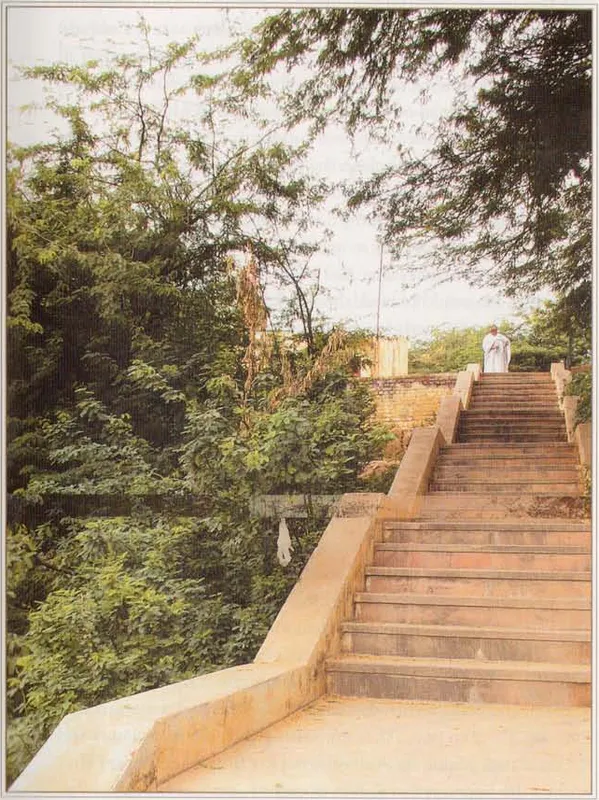
- What it is
- Ambarīṣa-ṭīlā is a hill (ṭīlā, a mound) by the Yamunā in Mathurā, with Cakra-tīrtha close by towards the river.
- Visiting
- Śrī Vraja-maṇḍala Parikramā (2007) prints a photograph of Ambarīṣa-ṭīlā: a long flight of stone steps rising through trees to a walled terrace.
In short
Ambarīṣa-ṭīlā is a hill (ṭīlā, a mound) by the Yamunā in Mathurā, with Cakra-tīrtha close by towards the river. According to the guidebook Śrī Vraja-maṇḍala Parikramā (2007), it is where the saintly King Ambarīṣa met the sage Durvāsā and the Lord's disc, the Sudarśana cakra, chased the sage, and the hill still stands as a witness to the king's devotion.[1 +2] Śrīmad-Bhāgavatam tells the story but places Ambarīṣa's worship in Madhuvana, after a bath in the Yamunā; no scripture or ācārya names the hill itself.[4 +2]
Key facts
| Kind | hill |
|---|---|
| Region · area | Mathurā |
Divine pastimes
Ambarīṣa and Durvāsā in the Bhāgavatam
Śrīmad-Bhāgavatam (9.4) tells that Ambarīṣa and his queen kept the vow of Ekādaśī and Dvādaśī for a year to worship Kṛṣṇa. At its end, in the month of Kārttika, after a three-night fast and a bath in the Yamunā, he worshipped Hari in Madhuvana.[4 +2]
vratānte kārtike māsi trirātraṃ samupoṣitaḥ / snātaḥ kadācit kālindyāṃ hariṃ madhuvane 'rcayat
In the month of Kārtika, after observing that vow for one year, after observing a fast for three nights and after bathing in the Yamunā, Mahārāja Ambarīṣa worshiped the Supreme Personality of Godhead, Hari, in Madhuvana.
Translation: Śrīla A.C. Bhaktivedanta Swami PrabhupādaIn his word-for-word gloss of this verse, Śrīla Prabhupāda explains madhuvane as the part of the Vṛndāvana area known as Madhuvana.[6] The Garga-saṁhitā, in Nārada's glorification of Mathurā, also names Ambarīṣa among those who reached perfection by austerities in Madhuvana, without naming a spot (summarised here, not translated).[7]
As the king was about to break his fast, Durvāsā arrived. He went to the Yamunā for his midday rites, and while he was away the king, with the brāhmaṇas' consent, broke the fast by drinking water. Durvāsā came back from the river bank and understood what had happened.[8 +4]
durvāsā yamunākūlāt kṛtāvaśyaka āgataḥ / rājñābhinanditastasya bubudhe ceṣṭitaṃ dhiyā
After executing the ritualistic ceremonies to be performed at noon, Durvāsā returned from the bank of the Yamunā. The King received him well, offering all respects, but Durvāsā Muni, by his mystic power, could understand that King Ambarīṣa had drunk water without his permission.
Translation: Śrīla A.C. Bhaktivedanta Swami PrabhupādaThe Lord's Sudarśana cakra then pursued Durvāsā, and a full year passed before he came back; all that time the king waited for him, living only on water.[8 +4] In a general note on Durvāsā, Śrīla Prabhupāda says that the sage travelled great distances within that one year, during his quarrel with King Ambarīṣa.[13]
Traditional accounts
According to Śrī Vraja-maṇḍala Parikramā (2007), the pastime took place at Ambarīṣa-ṭīlā, and at Cakra-tīrtha, nearby towards the …
According to Śrī Vraja-maṇḍala Parikramā (2007), the pastime took place at Ambarīṣa-ṭīlā, and at Cakra-tīrtha, nearby towards the Yamunā, Ambarīṣa calmed the cakra with his prayers.[1 +2] According to the same book, Durvāsā came from his āśrama across the Yamunā, one mile north of Viśrāma-ghāṭa (Durvāsā Āśrama), crossing the river on Dvādaśī to reach the king's palace in Mathurā; the Bhāgavatam does not say where he came from, so this detail is not certain.[14] It also tells the vow differently from the Bhāgavatam; see the accounts below.
Visiting today
Śrī Vraja-maṇḍala Parikramā (2007) prints a photograph of Ambarīṣa-ṭīlā: a long flight of stone steps rising through trees to a walled terrace. Its present state has not been checked.[16]
Location
| Where it is | 'on the right hand side, near the confluence of the Sarasvatī and Yamunā'; Cakra-tīrtha nearby[17] in Mathurā City[18] |
|---|
Nearby places
Sarasvatī River (Mathurā) · Cakra-tīrtha (Mathurā) · Nīlakaṇṭheśvara Mahādeva
History
In 1883 the historian F. S. Growse described the hill of Ambarīṣa, beside the Cakra-tīrtha ghāṭa, as between sixty and seventy feet high. Local rumour told of a treasure cave inside it. General Cunningham told him that a gold coin of Apollodotus had been found there, and Growse's own digging turned up a small piece of Buddhist sculpture, which he took as a sign that the mound was very old and had once been occupied by Buddhists.[15]
Where the sources differ
Where Ambarīṣa kept his vow and where the Durvāsā episode took place.
Accounts differ Where Ambarīṣa kept his vow and where the Durvāsā episode took place.
- Śrīmad-Bhāgavatam 9.4.30After bathing in the Yamunā he worshipped Hari 'in Madhuvana' (madhuvane); Śrīla Prabhupāda's gloss: 'in that part of the Vṛndāvana area known as Madhuvana'.
- Garga-saṁhitā, Mathurā-khaṇḍa 25.19Ambarīṣa attained perfection by austerities right here in Madhuvana (in Nārada's Mathurā-māhātmya).
- Śrī Vraja-maṇḍala Parikramā (2007), pp. 34, 78-79, 503At Ambarīṣa-ṭīlā in Mathurā city, near the Sarasvatī-Yamunā confluence; 'This pastime took place here'; Durvāsā came to 'the palace of Ambarīṣa Mahārāja in Mathurā'.
- Vṛndāvana-Dhāma Ki Jaya! (c. 1986), p. 2'The place of King Ambarīṣa's sacrificial performance is in Mathurā City and is known as Ambarīṣatilā or Cakra-tīrtha.'
The wording of these accounts is our summary of the sources, not a published translation.
Accounts differ Whether Ambarīṣa-ṭīlā and Cakra-tīrtha are one place or two.
- Vṛndāvana-Dhāma Ki Jaya! (c. 1986), p. 2One place: 'known as Ambarīṣatilā or Cakra-tīrtha'.
- Śrī Vraja-maṇḍala Parikramā (2007), pp. 58, 79Two places: Cakra-tīrtha (ghāṭa no. 21) is 'near Ambarīṣa-ṭīlā'; 'Nearby, towards the Yamunā, is Cakra-tīrtha'.
- F. S. Growse, Mathurá (1883), a historianGrowse places the Daśāśvamedha-ghāṭa below the hill of Ambarīṣa, and explains the fourth ghāṭa, Cakra-tīrtha, by that hill and Viṣṇu's discus.
How the vow was kept and the fast broken.
Accounts differ Details of Ambarīṣa's vow and fast-breaking.
- Śrīmad-Bhāgavatam 9.4.29-30, 9.4.39-40, 9.5.23A year's vow of Ekādaśī and Dvādaśī ending with a three-night fast; he broke the fast 'by drinking water'; during the year of Durvāsā's absence he lived on water. No yuga is named.
- Śrī Vraja-maṇḍala Parikramā (2007), pp. 34, 78-79'In Satya-yuga'; the Ekādaśī vow kept for one year 'by fasting without water (nirjala)'; he 'took a drop of the water that washed the Supreme Lord's feet'; he 'remained standing there' for a year.
References
18 references
- Śrī Vraja-maṇḍala Parikramā (2007), PDF p. 52
- Śrī Vraja-maṇḍala Parikramā (2007), PDF p. 42
- Śrī Vraja-maṇḍala Parikramā (2007), PDF p. 30
- Śrīmad-Bhāgavatam 9.4.29, GRETIL
- Śrīmad-Bhāgavatam 9.4.30, GRETIL
- Śrīla Prabhupāda, Śrīmad-Bhāgavatam, 9.4.30, synonyms · vedabase.io
- Garga-saṁhitā, Mathurā-khaṇḍa (5) 25.19 (chapter 'Mathurā-māhātmya'), Sanskrit Wikisource
- Śrīmad-Bhāgavatam 9.4.33-35, GRETIL
- Śrīmad-Bhāgavatam 9.4.37, GRETIL
- Śrīmad-Bhāgavatam 9.4.39-40, GRETIL
- Śrīmad-Bhāgavatam 9.4.42, GRETIL
- Śrīmad-Bhāgavatam 9.5.23, GRETIL
- Śrīla Prabhupāda, Śrīmad-Bhāgavatam, 1.15.11, purport · vedabase.io
- Śrī Vraja-maṇḍala Parikramā (2007), PDF p. 264
- Mathurá (1883), F. S. Growse, B.C.S., M.A. Oxon., C.I.E. (as the title page gives him, p. 145
- Śrī Vraja-maṇḍala Parikramā (2007), PDF p. 51
- Śrī Vraja-maṇḍala Parikramā (2007), p. 76-77
- Vṛndāvana-Dhāma Ki Jaya! (c. 1986), by Dhruva Mahārāja dāsa, p. 2