Cakra-tīrtha (Mathurā)
चक्र-तीर्थ (मथुरा)
- What it is
- Cakra-tīrtha is a bathing place on the Yamunā at Mathurā, close to Ambarīṣa-ṭīlā.
- Visiting
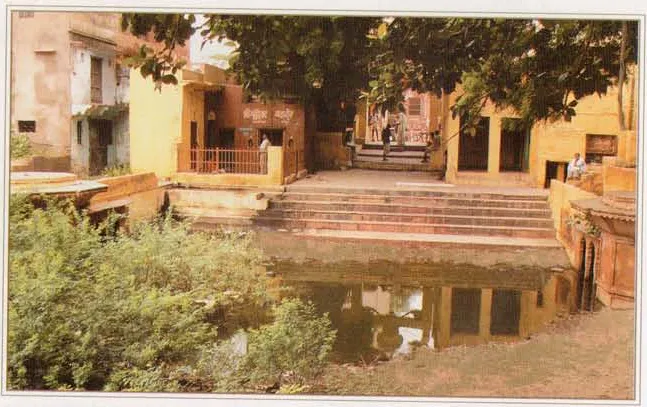
- Śrī Vraja-maṇḍala Parikramā (2007) prints a photograph captioned Cakra-tīrtha: a small stepped tank with yellow-washed buildings around it.
In short
Cakra-tīrtha is a bathing place on the Yamunā at Mathurā, close to Ambarīṣa-ṭīlā. The Varāha Purāṇa gives it a chapter of its own: a fast of one day and night at Cakra-tīrtha frees a person even from the sin of killing a brāhmaṇa.[1 +3] Śrīla Rūpa Gosvāmī counts it among the twenty-four Yamunā tīrthas of Mathurā and among the city's great tīrthas.[5 +3] According to the guidebook Śrī Vraja-maṇḍala Parikramā (2007), it is where King Ambarīṣa calmed the Lord's disc, the Sudarśana cakra, with his prayers.[9 +2]
Key facts
| Kind | ghāṭa |
|---|---|
| Region · area | Mathurā |
| Also part of | Yamunā |
| Ācāryas | Śrī Caitanya Mahāprabhu, Śrīla Narahari Cakravartī Ṭhākura, Śrīla Śrīnivāsa Ācārya, Śrīla Rūpa Gosvāmī, Śrīla Rāghava Paṇḍita Gosvāmī of Govardhana |
Why it is glorified
The Varāha Purāṇa's chapter on the power of Cakra-tīrtha places it to the north of Mathurā.
The Varāha Purāṇa's chapter on the power of Cakra-tīrtha places it to the north of Mathurā. It tells of a brāhmaṇa's son from Kalpagrāma who was held guilty of a brāhmaṇa's death because his words had driven his sick father to end his life. He came to Mathurā, lived outside the brāhmaṇas' quarter, ate the leftovers of a king's feeding-house and bathed at Cakra-tīrtha every day, until his wife saw with divine sight that the sin had left him (summarised here, not translated).[1 +2]
The chapter ends by saying that Cakra-tīrtha is a hundred times greater than Kalpagrāma, and that a fast of one day and night there frees one from the sin of killing a brāhmaṇa.[4]
कल्पग्रामाच्छतगुणं चक्रतीर्थं वसुन्धरे ।। अहोरात्रोपवासेन मुच्यते ब्रह्महत्यया ॥ 66 ॥
कल्पग्रामेण किं तस्य वाराणस्यां च वा शुभे ।। मथुरां तु समासाद्य यः कश्चिन्म्रियते भुवि ॥ 67 ॥
अपि कीटः पतङ्गो वा जायते स चतुर्भुजः
kalpagrāmācchataguṇaṁ cakratīrthaṁ vasundhare
ahorātropavāsena mucyate brahmahatyayā
kalpagrāmeṇa kiṁ tasya vārāṇasyāṁ ca vā śubhe
mathurāṁ tu samāsādya yaḥ kaścinmriyate bhuvi
api kīṭaḥ pataṅgo vā jāyate sa caturbhujaḥ
The Varāha Purāṇa also names Cakra-tīrtha, with Asi-kuṇḍa, Avimukta, Soma-tīrtha and others, among the holy places of Mathurā that destroy great sins and are a hundred times more meritorious than Kurukṣetra.[13] Śrīla Rūpa Gosvāmī's Mathurā-māhātmya quotes a verse of the Ādi-varāha that names Cakra-tīrtha and promises the same freedom to one who bathes there after a three-night fast; in the available text of the Varāha Purāṇa the same verse names no tīrtha (see the accounts below).[5 +1] He counts Cakra-tīrtha among the twenty-four Yamunā tīrthas, after Sarasvatī-patana, and among the great tīrthas of Mathurā with Viśrānti, Asi-kuṇḍa, Dhruva and the confluence of the Sarasvatī (summarised here, not translated).[5 +3]
Divine pastimes
Śrīmad-Bhāgavatam tells that King Ambarīṣa, after a three-night fast at the end of his year-long vow, bathed in the Yamunā and worshipped Hari in Madhuvana, and that the sage Durvāsā went to bathe in the Yamunā before the Sudarśana cakra pursued him; it names no ghāṭa.[14 +1] The Garga-saṁhitā names Ambarīṣa among those who reached perfection by austerities in Madhuvana.[16] Śrīla Prabhupāda writes that Durvāsā travelled even to the Vaikuṇṭha planets within one year during his quarrel with the king.[17]
According to Śrī Vraja-maṇḍala Parikramā (2007), the pastime took place at Ambarīṣa-ṭīlā, and at Cakra-tīrtha, nearby towards the Yamunā, Ambarīṣa calmed the cakra with his prayers; even today, the book says, both stand as witnesses to it. No scripture or Gosvāmī text found so far names either place as the site.[9 +2] According to the same guidebook, by the mercy of the Sudarśana cakra one who bathes here gains darśana of the Lord; the verse it cites does not say this, so it is not certain.[10]
The Gosvāmīs and ācāryas
According to the Bhakti-ratnākara of Śrīla Narahari Cakravartī Ṭhākura, Śrīla Rāghava Paṇḍita Gosvāmī of Govardhana, taking Śrīla …
According to the Bhakti-ratnākara of Śrīla Narahari Cakravartī Ṭhākura, Śrīla Rāghava Paṇḍita Gosvāmī of Govardhana, taking Śrīla Śrīnivāsa Ācārya and Śrīla Narottama dāsa Ṭhākura round Mathurā, showed them Cakra-tīrtha, which he called well known, where one bathes after a three-night fast and is freed from the sin of killing a brāhmaṇa by the bath alone; he quoted the Ādi-varāha verse (summarised here, not translated).[18 +1]
চক্রতীর্থ বিখ্যাত দেখহ শ্রীনিবাস। এথা স্নান করয়ে ত্রিরাত্র উপবাস ॥ … তথাহি আদিবারাহে ॥ চক্রতীর্থং তু বিখ্যাতং মাথুরে মম মণ্ডলে । যস্তত্র কুরুতে স্নানং ত্রিরাত্রোপোষিতো নরঃ ॥ স্নানমাত্রেণ মনুজো মুচ্যতে ব্রহ্মহত্যয়া ॥
cakratīrtha bikhyāta dekhaha śrīnibāsa| ethā snāna karaẏe trirātra upabāsa
… tathāhi ādibārāhe
cakratīrthaṁ tu bikhyātaṁ māthure mama maṇḍale
yastatra kurute snānaṁ trirātropoṣito naraḥ
snānamātreṇa manujo mucyate brahmahatyaẏā ||
The same book counts Cakra-tīrtha among the twenty-four ghāṭas in which, it says, Śrī Caitanya Mahāprabhu bathed with great joy; the Caitanya-caritāmṛta (Madhya 17.190) says that He bathed in the twenty-four ghāṭas without naming them, and Śrīla Prabhupāda's list of the twenty-four does not include Cakra-tīrtha.[18 +3] Read more: The twenty-four ghāṭas of Mathurā →
Visiting today
Śrī Vraja-maṇḍala Parikramā (2007) prints a photograph captioned Cakra-tīrtha: a small stepped tank with yellow-washed buildings around it. The book does not say whether the tank is joined to the river, and its present state has not been checked.[10]
Location
| Where it is | near Ambarīṣa-ṭīlā, 'towards the Yamunā' from it[24] |
|---|
Nearby places
Ambarīṣa-ṭīlā
Where the sources differ
Accounts differ Whether the Varāha verse on bathing after a three-night fast (removing brahma-hatyā) names Cakra-tīrtha.
- Śrīla Rūpa Gosvāmī, Mathurā-māhātmya v. 270 (in a run of Ādi-varāha verses)The verse, as he quotes it, names Cakra-tīrtha, famous in the Lord's Mathurā-maṇḍala.
- Bhakti-ratnākara, printed p. 177 ('tathāhi ādi-vārāhe')'cakratīrthaṁ tu vikhyātaṁ māthure mama maṇḍale …' (the verse names Cakra-tīrtha).
- Śrī Vraja-maṇḍala Parikramā (2007), endnote 41, '(Ādi-varāha Purāṇa)''cakra-tīrthaṁ tu vikhyātaṁ māthure mama maṇḍale …' (same reading as the Bhakti-ratnākara).
- Varāha Purāṇa 154.23-24'punar anyat pravakṣyāmi māthure mama maṇḍale …' (no name; the place in the series is the same).
Accounts differ Whether Cakra-tīrtha and Ambarīṣa-ṭīlā are one place or two neighbouring places.
- Vṛndāvana-Dhāma Ki Jaya! (c. 1986)The place 'is known as Ambarīṣatilā or Cakra-tīrtha' (one place, two names).
- Śrī Vraja-maṇḍala Parikramā (2007)Cakra-tīrtha 'is near Ambarīṣa-ṭīlā'; 'Nearby, towards the Yamunā, is Cakra-tīrtha' (two places).
The sources differ on which bathing places make up Mathurā's twenty-four ghāṭas and on which side of Viśrāma-ghāṭa the second twelve lie; their accounts are set out on the page of Viśrāma-ghāṭa.[1 +2]
More on this place
The twenty-four ghāṭas of Mathurā
References
24 references
- Varāha Purāṇa, adhyāya 162, 'cakra-tīrtha-prabhāva', v. 1, Sanskrit Wikisource
- Varāha Purāṇa, adhyāya 162, vv. 46-49, Sanskrit Wikisource
- Varāha Purāṇa, adhyāya 162, vv. 62-63, Sanskrit Wikisource
- Varāha Purāṇa, adhyāya 162, vv. 66-68, Sanskrit Wikisource
- Śrīla Rūpa Gosvāmī, Mathurā-māhātmya, v. 270, quoting the Ādi-varāha
- Śrīla Rūpa Gosvāmī, Mathurā-māhātmya, v. 239, section heading
- Śrīla Rūpa Gosvāmī, Mathurā-māhātmya, vv. 261-262, quoting the Ādi-varāha
- Śrīla Rūpa Gosvāmī, Mathurā-māhātmya v.442-443, 'mathurā-mahā-tīrthāni'
- Śrī Vraja-maṇḍala Parikramā (2007), PDF p. 52
- Śrī Vraja-maṇḍala Parikramā (2007), PDF p. 42
- Śrī Vraja-maṇḍala Parikramā (2007), PDF p. 30
- Varāha Purāṇa, adhyāya 162, vv. 66-68, Sanskrit Wikisource
- Varāha Purāṇa, adhyāya 168, vv. 14-18, Sanskrit Wikisource
- Śrīmad-Bhāgavatam 9.4.30, GRETIL
- Śrīmad-Bhāgavatam 9.4.37, GRETIL
- Garga-saṁhitā, Mathurā-khaṇḍa (5) 25.19 (chapter 'Mathurā-māhātmya'), Sanskrit Wikisource
- Śrīla Prabhupāda, Śrīmad-Bhāgavatam, 1.15.11, purport · vedabase.io
- Śrīla Narahari Cakravartī, Bhakti-ratnākara, Fifth Wave (pañcama taraṅga), printed p. 177 (1912 ed.), 2nd ed., 1912
- Śrīla Narahari Cakravartī, Bhakti-ratnākara, Fifth Wave (pañcama taraṅga), printed p. 165 (1912 ed.), 2nd ed., 1912
- Śrīla Narahari Cakravartī, Bhakti-ratnākara, Fifth Wave (pañcama taraṅga), 1912 ed. p. 178, 2nd ed., 1912
- Śrīla Narahari Cakravartī, Bhakti-ratnākara, Fifth Wave (pañcama taraṅga), 1912 ed. p. 175, 2nd ed., 1912
- Śrīla Kṛṣṇadāsa Kavirāja Gosvāmī, Śrī Caitanya-caritāmṛta, Madhya-līlā 17.190, online edition · vedabase.io
- Śrī Vraja-maṇḍala Parikramā (2007), PDF p. 37
- Śrī Vraja-maṇḍala Parikramā (2007), p. 58-59