Aniyora
आन्यौर
Also called Ānyora, Ānyora-gaon, Ānyora-grāma
- What it is
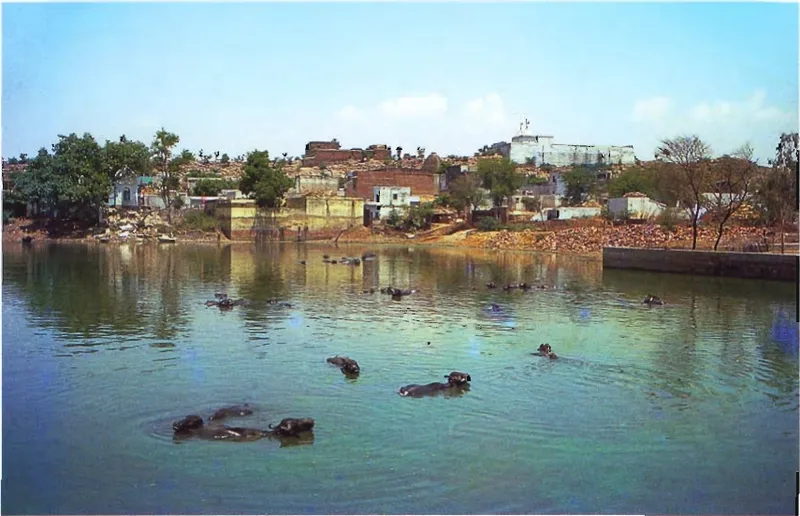
- Aniyora is a village near Govardhana Hill that present-day guides place on the parikramā path, the walk around the hill, about two miles south of the town of Govardhana.
- Visiting
- Śrī Vraja-maṇḍala Parikramā (2007) places the village on the parikramā path two miles south of the town of Govardhana, with Jatīpurā to the west, on the other side of the hill; Vṛndāvana-Dhāma Ki …
- Parikramā
- Govardhana parikramā, station 26
- Places here
- Bajanī-śilā (Aniyora), Balarāma Mandira (Aniyora), Gopāla Prakata Sthali, Saṅkarṣaṇa-kuṇḍa (Aniyora)
In short
Aniyora is a village near Govardhana Hill that present-day guides place on the parikramā path, the walk around the hill, about two miles south of the town of Govardhana.[1 +4] The Bhakti-ratnākara, which spells the name Āniyora, calls it the place of the Annakūṭa, where Kṛṣṇa ate the food offered to the hill at the first Govardhana-pūjā, and says that the village is named after His call, "āniyora, āniyora".[2 +2] Śrīla Prabhupāda identifies it with Annakūṭa-grāma, where, according to the Caitanya-caritāmṛta, the Deity Gopāla stayed in Śrī Caitanya Mahāprabhu's time.[5 +1] Śrīmad-Bhāgavatam tells the Annakūṭa without naming a village.[4 +5]
Key facts
| Kind | village |
|---|---|
| Region · area | Govardhana |
| On the parikramā | Govardhana parikramā, station 26 · the route |
| Ācāryas | Śrīla Raghunātha dāsa Gosvāmī, Śrīla Śrīnivāsa Ācārya, Śrīla Narahari Cakravartī Ṭhākura, Śrīla Bhaktisiddhānta Sarasvatī Ṭhākura, Śrīla Rāghava Paṇḍita Gosvāmī of Govardhana |
Why it is glorified
The Bhakti-ratnākara ends its account of the village by telling Śrīla Śrīnivāsa Ācārya that whoever sees this place has all his …
The Bhakti-ratnākara ends its account of the village by telling Śrīla Śrīnivāsa Ācārya that whoever sees this place has all his desires fulfilled. Śrīla Prabhupāda translates these lines in his purport on Annakūṭa-grāma:[2 +3]
এই আনিয়োর গ্রাম গিরিসন্নিধানে । এথা যে কৌতুক তা কহিতে কেবা জানে ॥ নন্দাদিক গোপ ইন্দ্রপূজা ত্যাগ করি । কৃষ্ণের কথায় পূজে গোবর্দ্ধন গিরি ॥ বিবিধ সামগ্রী গোবর্দ্ধনে ভোগ দিলা । কৃষ্ণ এক রূপে তথা সকল ভুঞ্জিলা । মেঘ হৈতে গভীর বচন উচ্চারয় । আনিয়োর আনিয়োর বার বার কয় ॥ গোপগোপী ভুঞ্জায়েন কৌতুক অপার । এই হেতু আনিয়োর নাম সে ইহার ॥ অন্নকূট স্থান এই দেখ শ্রীনিবাস । এস্থান দর্শনে পূর্ণ হয় অভিলাষ ॥
ei āniẏora grāma girisannidhāne
ethā ye kautuka tā kahite kebā jāne
nandādika gopa indrapūjā tyāga kari
kṛṣṇera kathāẏa pūje gobarddhana giri
bibidha sāmagrī gobarddhane bhoga dilā
kṛṣṇa eka rūpe tathā sakala bhuñjilā
megha haite gabhīra bacana uccāraẏa
āniẏora āniẏora bāra bāra kaẏa
gopagopī bhuñjāẏena kautuka apāra
ei hetu āniẏora nāma se ihāra
annakūṭa sthāna ei dekha śrīnibāsa
esthāna darśane pūrṇa haẏa abhilāṣa ||
“Here all the gopīs and the gopas enjoyed wonderful pastimes with Śrī Kṛṣṇa. Therefore this place is also called Āniyora. The Annakūṭa ceremony was celebrated here. O Śrīnivāsa, whoever sees this place has all his desires fulfilled.”
Translation: Śrīla A.C. Bhaktivedanta Swami PrabhupādaIn the same purport he quotes Śrīla Raghunātha dāsa Gosvāmī's prayer in the Vraja-vilāsa-stava to take shelter of the place known as Annakūṭa, where Kṛṣṇa in a gigantic form ate Nanda's offerings. The verse names the place Annakūṭa, not the village.[2 +3]
Divine pastimes
The Annakūṭa
Śrīmad-Bhāgavatam tells how, on Kṛṣṇa's advice, the cowherds used everything they had gathered for a sacrifice to Indra to worship the cows, the brāhmaṇas and the hill instead, and how Kṛṣṇa then took a huge form, declared that He was the hill and ate the offerings. It names no village:[4 +7]
kṛṣṇas tv anyatamaṃ rūpaṃ gopa-viśrambhaṇaṃ gataḥ / śailo 'smīti bruvan bhūri balim ādad bṛhad-vapuḥ
Kṛṣṇa then assumed an unprecedented, huge form to instill faith in the cowherd men. Declaring “I am Govardhana Mountain!” He ate the abundant offerings.
Translation: Śrīla Prabhupāda's disciples (BBT)Its commentators place that form on the summit of the hill and name no village either (summarised here, not translated). Śrīla Viśvanātha Cakravartī Ṭhākura says that it stood on top of Govardhana like a second mountain, called itself the lord of this region and offered boons, and with thousands of millions of outstretched hands took the offerings of the people of Vraja, near and far.[7 +1]
In his Vraja-rīti-cintāmaṇi, Śrīla Viśvanātha Cakravartī Ṭhākura places Nanda's great Annakūṭa festival where the two kuṇḍas (sacred ponds) Saṅkarṣaṇa and Dāna-nivartana are, on the southern part of the hill's eastern side; he names no village, and it is the guidebooks that put Aniyora on the bank of a Saṅkarṣaṇa-kuṇḍa.[18]
The Bhakti-ratnākara and the name
According to the Bhakti-ratnākara, Śrīla Rāghava Paṇḍita showed Śrīla Śrīnivāsa Ācārya "this Āniyora village near the hill", where Nanda and the cowherds gave up the worship of Indra and worshipped Govardhana at Kṛṣṇa's word. Kṛṣṇa, eating everything in one form, called out "āniyora, āniyora" again and again in a voice deep as a cloud, and for this reason, the book says, the village is called Aniyora.[2 +2]
The book does not say what the word means. Govardhana Hill (2001) and Śrī Vraja-maṇḍala Parikramā (2007) say that it means "bring more", the call of the hill-form for more food, while Śrīla Prabhupāda's translation of the last couplet links the name with the pastimes that the gopas and gopīs, the cowherd men and girls of Vraja, enjoyed here with Kṛṣṇa.[1 +5]
The guidebooks also place the Annakūṭa at this village, and one of them calls the hillside that ends here Annakūṭa-kṣetra, the field of the Annakūṭa.[4 +5] Read more: The first Govardhana-pūjā and the Annakūṭa →
Śrīla Prabhupāda
In his purport to Caitanya-caritāmṛta Madhya 18.37, Śrīla Prabhupāda passes on Śrīla Bhaktisiddhānta Sarasvatī Ṭhākura's …
In his purport to Caitanya-caritāmṛta Madhya 18.37, Śrīla Prabhupāda passes on Śrīla Bhaktisiddhānta Sarasvatī Ṭhākura's information about the village:[25]
Names this place“Śrīla Bhaktisiddhānta Sarasvatī Ṭhākura gives the following information about Govinda-kuṇḍa. There is a village named Āniyora on Govardhana Hill, a little distance from the village of Paiṭha. Govinda-kuṇḍa is situated near here, and there are two temples to Govinda and Baladeva there.”
Śrīla Prabhupāda, Śrī Caitanya-caritāmṛta, Madhya-līlā 18.37, purport · vedabase.io
He does not say whether this Baladeva temple is the village's Balarāma Mandira.[25]
Visiting today
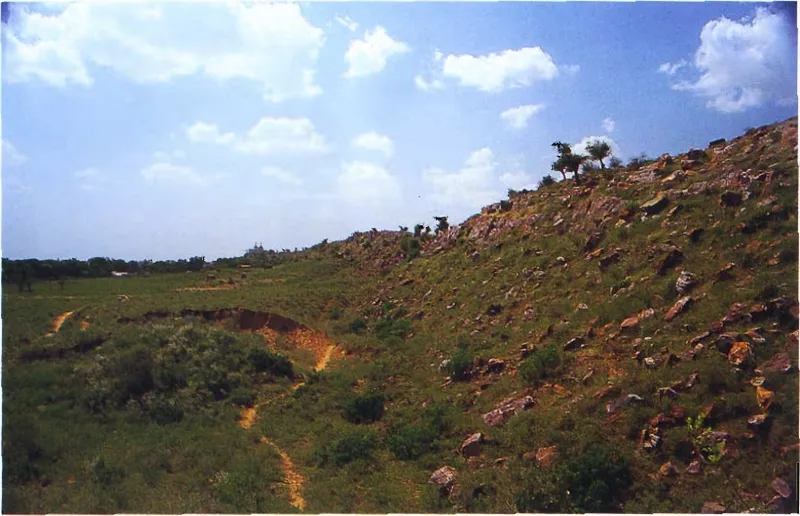
Śrī Vraja-maṇḍala Parikramā (2007) places the village on the parikramā path two miles south of the town of Govardhana, with Jatīpurā to the west, on the other side of the hill; Vṛndāvana-Dhāma Ki Jaya! (c. 1986) calls it the first village after Govardhana on the circuit, and Govardhana Hill (2001) says that the hill reaches its highest point just before Aniyora.[1 +2]
According to Śrī Vraja-maṇḍala Parikramā (2007), natural impressions of the Vrajavāsīs' bowls can be seen in the rocks of Girirāja, as Govardhana is also called, where the Annakūṭa was performed, with a musical stone, a bajanī-śilā, nearby. The Bhāgavatam names no vessels for the offering, and the Bhakti-ratnākara does not mention the marks.[1 +7]
Location
| Where it is | The hill's highest point is 'just before the village of Aniyor'; Jetipura is on the other side of the hill[30] “the first village after Govardhana on the parikrama trail”[31] |
|---|---|
| On the numbered Govardhana chart | 36 (printed as “Aniyor Village”)[32] |
Places at Aniyora
5 places
- 1Bajanī-śilā (Aniyora)śilā›
- 2Balarāma Mandira (Aniyora)temple›
- 3Gopāla Prakata Sthalipastime site›
- 4Saṅkarṣaṇa-kuṇḍa (Aniyora)kuṇḍa›
Also listed here
- Impressions of the Vrajavāsīs' bowls (Aniyora) śilā
Nearby places
Govardhana (town) · Jatīpurā · Gopāla Rāya Mandira
Pictures
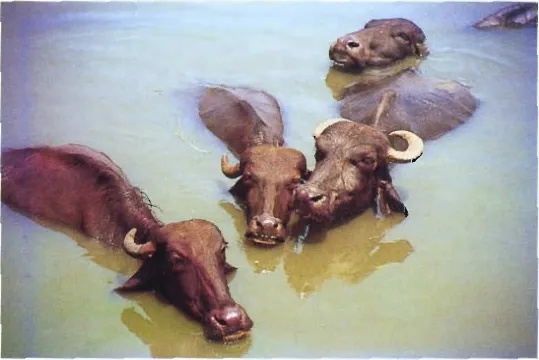
2 pictures
History
The Caitanya-caritāmṛta tells where the Deity Gopāla stayed in Śrī Caitanya Mahāprabhu's time, and Śrīla Prabhupāda's purport identifies that village with Aniyora:[5 +1]
‘annakūṭa’-nāme grāme gopālera sthiti
rājaputa-lokera sei grāme vasati
Gopāla stayed in a village called Annakūṭa-grāma on Govardhana Hill. The villagers who lived in that village were mainly from Rajasthan.
Translation: Śrīla A.C. Bhaktivedanta Swami PrabhupādaRight after the lines on the Annakūṭa place, the purport quotes another couplet of the Bhakti-ratnākara, which points to a dense forest near a kuṇḍa where Gopāla was concealed; the couplet does not name the kuṇḍa.[4 +4] Read more: The Gopāla Deity of Govardhana →
According to the Bengali Vṛndāvana-kathā (1920), Śrīla Mādhavendra Purī brought out the Gopāla Deity at Annakūṭa-grāma, whose present name it gives as Ānior, on the bank of Govinda-kuṇḍa. The guidebooks place Gopāla's temple and Śrīla Mādhavendra Purī's village at Jatīpurā, on the other side of the hill, and the sources differ on which village was Gopāla's:[24]
Accounts differ Which village belonged to Gopāla and Śrīla Mādhavendra Purī: Annakūṭa-grāma / Āniyora or Jatīpurā
- Caitanya-caritāmṛta Madhya 4.23-38Śrīla Mādhavendra Purī bathed in Govinda-kuṇḍa and sat under a tree (4.23); the boy lives 'in this village' (4.28, unnamed); the bush is not located further; the Deity is to be installed on top of the hill (4.37-38)
- Caitanya-caritāmṛta Madhya 18.26in Mahāprabhu's time Gopāla stayed in a village on Govardhana called Annakūṭa-grāma
- Śrīla Prabhupāda, CC Madhya 18.26 purport (quoting the Bhakti-ratnākara)Annakūṭa-grāma is Āniyora, the Annakūṭa place where Gopāla was concealed in a forest near the kuṇḍa
- Govardhana Hill: India's Most Sacred Mountain (2001)the prakaṭa-sthāli (appearance place) of the Gopāla Deity is in the village of Aniyora, and the boy says 'I am from the nearby village of Aniyora'; Jetipura is named after Śrīla Mādhavendra Purī, 'who stayed here during the time he was worshiping the Gopāla Deity', and the temple is on top of the hill 'and on the other side is the village of Aniyora'
Where the sources differ
Where the Annakūṭa took place
Accounts differ Where the Annakūṭa took place
- Garga-saṁhitā 3.8.4at Govardhana's mouth, below Śṛṅgāra-maṇḍala (no village named)
- Bhakti-ratnākara (Fifth Wave), 1912 ed. p. 201; quoted in CC Madhya 18.26 purport'this Āniyora village near the hill' is 'the Annakūṭa place' (Annakūṭa-grāma in CC Madhya 18.26)
- Śrīla Viśvanātha Cakravartī, Vraja-rīti-cintāmaṇi 3.18, 3.20Nanda's great Annakūṭa festival is held where the Saṅkarṣaṇa and Dāna-nivartana kuṇḍas are, on the southern part of the hill's eastern side (no village named)
- Varāha Purāṇa 164.23-26Annakūṭa is the name of the hill held up for the cows; a tīrtha made by Indra lies near it
The wording of these accounts is our summary of the sources, not a published translation.
Accounts differ Why the village is called Āniyora, and what 'āniyora' means
- Bhakti-ratnākara (Fifth Wave), 1912 ed. p. 201Kṛṣṇa, eating the offerings in one form, called out 'āniyora, āniyora' again and again in a voice deep as a cloud; then 'gopa-gopī bhuñjāyena kautuka apāra / ei hetu āniyora nāma se ihāra' (no meaning of the word is given)
- Śrīla Prabhupāda's translation of the last couplet (CC Madhya 18.26 purport)'Here all the gopīs and the gopas enjoyed wonderful pastimes with Śrī Kṛṣṇa. Therefore this place is also called Āniyora.' (the couplet on the call is not quoted)
- Govardhana Hill: India's Most Sacred Mountain (2001)Girirāja snapped his fingers saying 'Aniyora, aniyora', which 'means "bring more"'
- Śrī Vraja-maṇḍala Parikramā (2007)named Ānyora-grāma 'because it is here that Girirāja called out "Āno re, āno re!"', which it translates 'Bring more, bring more!'
More on this place
The first Govardhana-pūjā and the Annakūṭa · The Gopāla Deity of Govardhana
References
32 references
- Śrī Vraja-maṇḍala Parikramā (2007), PDF p. 126
- Vṛndāvana-Dhāma Ki Jaya! (c. 1986), by Dhruva Mahārāja dāsa, PDF p. 40
- Govardhana Hill: India's Most Sacred Mountain (2001), Rajasekhara dasa Brahmacari, PDF p. 59
- Śrīla Narahari Cakravartī, Bhakti-ratnākara, Fifth Wave, 1912 ed. p. 201, 2nd ed., 1912
- Śrīla Prabhupāda, Śrī Caitanya-caritāmṛta, Madhya-līlā 18.26, purport (quoting Bhakti-ratnākara, Fifth Wave) · vedabase.io
- Śrīla Kṛṣṇadāsa Kavirāja Gosvāmī, Śrī Caitanya-caritāmṛta, CC Madhya-līlā 18.26, online edition · vedabase.io
- Śrīmad-Bhāgavatam 10.24.35, GRETIL
- Garga-saṁhitā, Girirāja-khaṇḍa (3), adhyāya 2, verse 21, Sanskrit Wikisource
- Garga-saṁhitā, Girirāja-khaṇḍa (3), adhyāya 8, verse 4, Sanskrit Wikisource
- Govardhana Hill: India's Most Sacred Mountain (2001), Rajasekhara dasa Brahmacari, PDF p. 91
- Śrīla Narahari Cakravartī, Bhakti-ratnākara, Fifth Wave, 1912 ed. p. 202, 2nd ed., 1912
- Śrīla Narahari Cakravartī, Bhakti-ratnākara, Fifth Wave, 1912 ed. p. 201, 2nd ed., 1912
- Śrīla Prabhupāda, Śrī Caitanya-caritāmṛta, Madhya-līlā 18.26, purport (quoting Vraja-vilāsa-stava 75) · vedabase.io
- Śrīla Raghunātha dāsa Gosvāmī, Vraja-vilāsa-stava 75
- Śrīmad-Bhāgavatam 10.24.25, GRETIL
- Śrī Vraja-maṇḍala Parikramā (2007), PDF p. 142
- Śrīla Sanātana Gosvāmī, Śrīla Jīva Gosvāmī: commentary on ŚB 10.24.35, Bhagavata Vidya Pith edition, ed. Bhagavata Rishi and Krishna Shankar Shastri, 1996
- Śrīla Viśvanātha Cakravartī Ṭhākura, Vraja-rīti-cintāmaṇi 3.18 and 3.20
- Govardhana Hill: India's Most Sacred Mountain (2001), Rajasekhara dasa Brahmacari, PDF p. 93
- Govardhana Hill: India's Most Sacred Mountain (2001), Rajasekhara dasa Brahmacari, PDF p. 96
Show all 32 references
- the undated parikramā notes Govardhana, ¶97
- Śrīla Prabhupāda, Śrī Caitanya-caritāmṛta, Madhya-līlā 18.26, purport (quoting Bhakti-ratnākara) · vedabase.io
- Vṛndāvana-Dhāma Ki Jaya! (c. 1986), by Dhruva Mahārāja dāsa, PDF p. 43
- Vṛndāvana-kathā, printed p. 122, section on Govardhana
- Śrīla Prabhupāda, Śrī Caitanya-caritāmṛta, Madhya-līlā 18.37, purport · vedabase.io
- Śrīmad-Bhāgavatam 10.24.26, GRETIL
- Śrīmad-Bhāgavatam 10.24.32–33, GRETIL
- Śrīla Prabhupāda, Kṛṣṇa, the Supreme Personality of Godhead (Kṛṣṇa book), Chapter 24, Worshiping Govardhana Hill · vedabase.io
- Śrīla Prabhupāda, Śrī Caitanya-caritāmṛta, Madhya-līlā 18.26, purport (his translation of Bhakti-ratnākara, Fifth Wave) · vedabase.io
- Govardhana Hill: India's Most Sacred Mountain (2001), Rajasekhara dasa Brahmacari, p. 82
- Vṛndāvana-Dhāma Ki Jaya! (c. 1986), by Dhruva Mahārāja dāsa, p. 22
- Numbered list of the Govardhana sites (key of the Govardhana chart)