Candra-sarovara
चन्द्र-सरोवर Hindi name proposed
- What it is
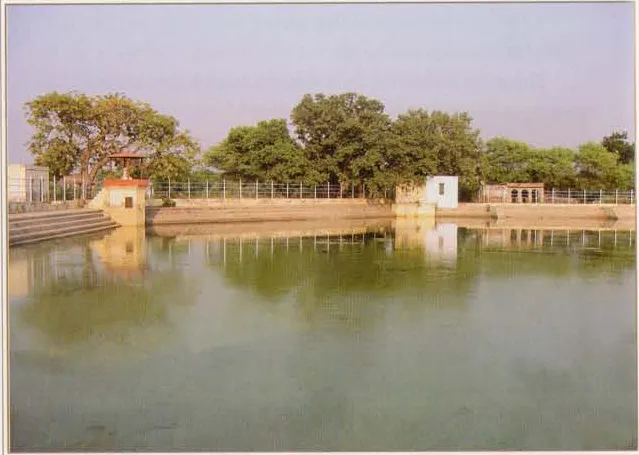
- Candra-sarovara, the lake of the moon, is a lake at Pārāsaulī.
- Visiting
- The key to the numbered chart of Govardhana gives Candra-sarovara one number with Catur-bhuja and a separate one to Pārāsaulī, while the map of Śrī Vraja-maṇḍala Parikramā (2007) gives Pārāsaulī and …
- Places here
- Śṛṅgāra Mandira (Pārāsaulī)
In short
Candra-sarovara, the lake of the moon, is a lake at Pārāsaulī. The Garga-saṁhitā counts it among the holy places of Govardhana and tells that after Rādhā was decorated on the hill, Kṛṣṇa came here with the gopīs and sported with them in its water, and the moon brought gifts to Rādhā and Kṛṣṇa.[1 +3] According to the Bhakti-ratnākara, Kṛṣṇa rested here, absorbed in the mood of the rāsa dance.[5] Two guidebooks add that the moon stood still here while he watched the rāsa.[6 +1] Śrīmad-Bhāgavatam tells of the moon's astonishment at a rāsa on the bank of the Yamunā and names no lake.[8 +1]
Key facts
| Kind | sarovara |
|---|---|
| Region · area | Govardhana · Pārāsaulī |
| Ācāryas | Śrīla Śrīnivāsa Ācārya, Śrīla Sanātana Gosvāmī, Śrīla Viśvanātha Cakravartī Ṭhākura |
Why it is glorified
The Garga-saṁhitā names Candra-sarovara with Mānasī-gaṅgā and Govinda-kuṇḍa among the holy places of Govardhana, and in its …
The Garga-saṁhitā names Candra-sarovara with Mānasī-gaṅgā and Govinda-kuṇḍa among the holy places of Govardhana, and in its picture of the hill as a body the lake is the hill's nose.[1 +1] Read more: The body of Govardhana: mouth, eyes, neck and the peacock →
नेत्रे वै मानसी गंगा नासा चन्द्रसरोवरः ॥ गोविन्दकुण्डो ह्यधरश्चिबुकं कृष्णकुण्डकः ॥ 5 ॥
netre vai mānasī gaṁgā nāsā candrasarovaraḥ
govindakuṇḍo hyadharaścibukaṁ kṛṣṇakuṇḍakaḥ || 5 ||
The Nārada Purāṇa, in its list of the holy places of Vṛndāvana, names a Candra-saras between Vatsa-tīrtha and the lake of the Apsarases. It is only a list and does not say which Candra-saras it means. Its neighbours in the list are places of Govardhana, but no source says that it is this lake, so it is told here only as a mention of the name.[10]
Divine pastimes
The rāsa in Śrīmad-Bhāgavatam
Śrīmad-Bhāgavatam (10.29–33) tells Kṛṣṇa's rāsa dance with the gopīs on moonlit autumn nights on the sandy bank of the Kālindī, the Yamunā, and names no village, lake or hill.[11 +5] Watching the dance, it says, the moon with his company, the stars, was astonished. The verse does not itself say that the moon stopped.[8 +1]
kṛṣṇa-vikrīḍitaṃ vīkṣya mumuhuḥ khe-cara-striyaḥ / kāmārditāḥ śaśāṅkaś ca sa-gaṇo vismito 'bhavat
The wives of the demigods, observing Kṛṣṇa’s playful activities from their airplanes, were entranced and became agitated with lust. Indeed, even the moon and his entourage, the stars, became astonished.
Translation: Śrīla Prabhupāda's disciples (BBT)Śrīla Śrīdhara Svāmī explains that the astonished moon forgot to move, so that the rāsa nights became very long, and the Bṛhat-krama-sandarbha says the same (summarised here, not translated). They tell this of the Bhāgavatam's rāsa and name no lake.[17] After the dance, the Bhāgavatam says, Kṛṣṇa entered the water with the gopīs to relieve their fatigue, like a king of elephants with his she-elephants. The Sanskrit says only water; the translation and the commentators say that it was the water of the Yamunā.[9 +2]
Some of the commentators let the rāsa nights include spring (summarised here, not translated). The Bṛhat-krama-sandarbha reads them as nights of autumn, spring and summer brought together. Śrīla Jīva Gosvāmī says that Kṛṣṇa enjoyed in the manner of the rāsa also the moonlit nights of spring and the other seasons, and Śrīla Viśvanātha Cakravartī Ṭhākura that He enjoyed the nights of all twelve months. None of them names Pārāsaulī, Govardhana or any other place.[20 +1] Read more: The spring rāsa at Govardhana: Pārāsaulī, Candra-sarovara and Paiṭhā →
At the lake in the Garga-saṁhitā
The Garga-saṁhitā tells a water-play at this lake, with the same simile. After Rādhā had been decorated at Śṛṅgāra-maṇḍala on Govardhana, Kṛṣṇa went with His beloved gopīs to Candra-sarovara and sported in its water like an elephant king with his she-elephants.[3 +1] Then Candra, the moon, came and gave two candrakānta jewels and two thousand-petalled lotuses to Rādhā and Kṛṣṇa. The text does not say that the moon stood still, nor that the lake is named after these gifts.[4]
चकार तज्जले क्रीडां गजीभिर्गजराडिव । तत्र चंद्रः समागत्य चंद्रकान्तौ मणी शुभौ ॥ 17 ॥ सहस्रदलपद्मे द्वे स्वामिन्यै हरये ददौ । अथ कृष्णो हरिः साक्षात् पश्यन् वृंदावनश्रियम् ॥ 18 ॥
cakāra tajjale krīḍāṁ gajībhirgajarāḍiva
tatra caṁdraḥ samāgatya caṁdrakāntau maṇī śubhau sahasradalapadme dve svāminyai haraye dadau
atha kṛṣṇo hariḥ sākṣāt paśyan vṛṁdāvanaśriyam
Kṛṣṇa's rest
According to the Bhakti-ratnākara, when Śrīla Śrīnivāsa Ācārya was shown the places of Govardhana, his guide showed him Parāsauli village, where Kṛṣṇa held the rāsa in the spring season, and then Candra-sarovara, beyond compare, where Kṛṣṇacandra rested, absorbed in the mood of the rāsa (summarised here, not translated).[5]
Traditional accounts
Śrī Vraja-maṇḍala Parikramā (2007) says that the place is called Candra-sarovara, the lake of the moon, because the spring rāsa …
Śrī Vraja-maṇḍala Parikramā (2007) says that the place is called Candra-sarovara, the lake of the moon, because the spring rāsa took place in the light of a brilliant full moon, and the moon, stunned, stayed in one place for the whole night.[6] The guidebook Vṛndāvana-Dhāma Ki Jaya! (c. 1986) records the local tradition that the moon-god ceased all his movements here while he watched the rāsa.[7] Śrīmad-Bhāgavatam and its commentators give these details of the rāsa on the bank of the Yamunā and do not name this lake; the guidebooks' placing of them here is a later local tradition and does not carry the Bhāgavatam's authority.[8 +2]
According to the local tradition recorded in the guidebook Govardhana Hill (2001) and the undated parikramā notes Govardhana, Balarāma, roaming on Govardhana Hill, crouched down and watched Kṛṣṇa's rāsa at Candra-sarovara from far away, and that this gave its name to the Doka Daujī temple; the undated notes add that His white complexion turned dark in His absorption. No scripture for this has been found, so it is not certain.[22 +1]
The Gosvāmīs and ācāryas
Śrīla Viśvanātha Cakravartī Ṭhākura's Vraja-rīti-cintāmaṇi (3.17) names, further east than Dāna-nivartana-kuṇḍa, the place of the …
Śrīla Viśvanātha Cakravartī Ṭhākura's Vraja-rīti-cintāmaṇi (3.17) names, further east than Dāna-nivartana-kuṇḍa, the place of the many supreme rāsa pastimes and Candra-sarovara, side by side. He names no village and no season (summarised here, not translated).[25]
According to the guidebook Govardhana Hill (2001), the longer Govardhana parikramā of twenty-four miles that Śrīla Sanātana Gosvāmī performed included Candra-sarovara.[26 +1]
Śrīla Prabhupāda
Śrīla Prabhupāda's Kṛṣṇa book does not name Candra-sarovara.
Śrīla Prabhupāda's Kṛṣṇa book does not name Candra-sarovara. Telling the rāsa of Śrīmad-Bhāgavatam, it describes the moon watching the dance, stunned with wonder, and it sets the water-play after the dance in the Yamunā. These are general descriptions of the rāsa, not of this lake.[9]
General teaching (does not name the place)“While Kṛṣṇa was enjoying the company of the gopīs in the rāsa dance, the astonished demigods and their wives gathered in the sky. The moon, being afflicted with a sort of lust, began to watch the dance and became stunned with wonder.”
Śrīla Prabhupāda, Kṛṣṇa, the Supreme Personality of Godhead (Kṛṣṇa book), Chapter 33, 'Description of the Rāsa Dance' · vedabase.io
Visiting today
The key to the numbered chart of Govardhana gives Candra-sarovara one number with Catur-bhuja and a separate one to Pārāsaulī, while the map of Śrī Vraja-maṇḍala Parikramā (2007) gives Pārāsaulī and Candra-sarovara a single number.[28 +2]
Location
| Where it is | Visible 'in the far distance' from Doka Daujī[31] Pārāsaulī[32] |
|---|---|
| On the numbered Govardhana chart | 33 (printed as “Candra Sarovara and Catur Bhuja”)[33] |
Places at Candra-sarovara
1 places
Nearby places
Paiṭhā-grāma · Doka Daujī Mandira · Rāsa-sthali (Candra-sarovara) · Catur-bhuja
History
According to the historian Prabhudayāl Mītal (1966), the masonry tank of Candra-sarovara was rebuilt in Saṁvat 1811 (1754–55) by Jawāhar Singh, the son of the Jāṭ king Sūraj Mal.[24] Mītal adds that in his time the tank was in a ruined state, and that temples of Śrī Candravihārī and Śrī Dāūjī stood above it. He gives no document or inscription.[24]
Accounts differ Who built the masonry tank and ghāṭs of Candra-sarovara
- F. S. Growse, Mathurá (1883), a historianGrowse describes an octagonal tank with stone ghāṭas, which he credits to Rājā Nāhar Siṁha of Bharatpur.
- Prabhudayāl Mītal (1966), a historianMītal records its rebuilding by Javāhara Siṁha, son of the Jāṭ king Sūraj Mal, in Saṁvat 1811.
- A. W. Entwistle (1987), a historianEntwistle, citing Growse and Mītal, gives the masonry steps to Rājā Nāhar Siṁha and their restoration to Rājā Javāhara Siṁha of Bharatpur in 1754.
Where the sources differ
Where Kṛṣṇa's water-play with the gopīs after the rāsa took place
Accounts differ Where Kṛṣṇa's water-play with the gopīs after the rāsa took place
- Śrīmad-Bhāgavatam 10.33.22-23in 'the water', like a king of elephants with his she-elephants; the translation says the Yamunā
- Śrīla Viśvanātha, Śrīla Sanātana, Śrīla Jīva, Śrīla Baladeva on ŚB 10.33.22in the water of the Yamunā (Kālindī)
- Kṛṣṇa book ch. 33 (Śrīla Prabhupāda)'The gopīs and Kṛṣṇa entered the water of the Yamunā just to relieve their fatigue from the rāsa dance'
- Garga-saṁhitā 2.20.16-17after Rādhā's decoration at Śṛṅgāra-maṇḍala on Govardhana, Kṛṣṇa went with His beloved gopīs to Candra-sarovara and sported in its water like an elephant king with she-elephants
Where the rāsa of Śrīmad-Bhāgavatam took place, with the astonished moon and the night of Brahmā, is told differently in the sources; they are set side by side on the page of Pārāsaulī.[11 +5]
Accounts differ Whether Pārāsaulī and Candra-sarovara are one place or two
- Śrī Vraja-maṇḍala Parikramā (2007)Pārāsaulī 'is also called Candra-sarovara'; one map number (21) for both, though the text speaks of 'the sarovara' within it
- the key of the numbered Govardhana chart (Govardhana chart key)33 Candra Sarovara and Catur Bhuja and '34 Parasauli' as separate entries
- Bhakti-ratnākara, Fifth Waveshows this Parāsauli village and then this Candra-sarovara as two successive sights
- Vṛndāvana-Dhāma Ki Jaya! (c. 1986)Candra-sarovara is 'nearby' Paitha; Pārāsaulī is not named
The wording of these accounts is our summary of the sources, not a published translation.
Where Rādhā was decorated at the rāsa on Govardhana, and by whom: Śrī Vraja-maṇḍala Parikramā (2007) names the Śṛṅgāra Mandira at the lake, and the other sources differ; they are set side by side on the page of the Śṛṅgāra Mandira.[3 +1]
More on this place
The spring rāsa at Govardhana: Pārāsaulī, Candra-sarovara and Paiṭhā · The body of Govardhana: mouth, eyes, neck and the peacock
References
33 references
- Garga-saṁhitā, Girirāja-khaṇḍa (3), adhyāya 7, verse 7, Sanskrit Wikisource
- Garga-saṁhitā, Girirāja-khaṇḍa (3), adhyāya 8, verse 5, Sanskrit Wikisource
- Garga-saṁhitā, Vṛndāvana-khaṇḍa (2), adhyāya 20, verses 15-16, Sanskrit Wikisource
- Garga-saṁhitā, Vṛndāvana-khaṇḍa (2), adhyāya 20, verses 17-18, Sanskrit Wikisource
- Śrīla Narahari Cakravartī, Bhakti-ratnākara, Fifth Wave, 1912 ed. p. 200, 2nd ed., 1912
- Śrī Vraja-maṇḍala Parikramā (2007), PDF p. 124
- Vṛndāvana-Dhāma Ki Jaya! (c. 1986), by Dhruva Mahārāja dāsa, PDF p. 43
- Śrīmad-Bhāgavatam 10.33.18, GRETIL
- Śrīla Prabhupāda, Kṛṣṇa, the Supreme Personality of Godhead (Kṛṣṇa book), Chapter 33, 'Description of the Rāsa Dance' · vedabase.io
- Nārada Purāṇa, उत्तरार्धः (Uttara-bhāga), adhyāya 80, verses 80-71 (second half) to 80-73
- Śrīmad-Bhāgavatam 10.29.1, GRETIL
- Śrīmad-Bhāgavatam 10.29.3, GRETIL
- Śrīmad-Bhāgavatam 10.29.45, GRETIL
- Śrīmad-Bhāgavatam 10.30.44, GRETIL
- Śrīmad-Bhāgavatam 10.33.2, GRETIL
- Śrīmad-Bhāgavatam 10.33.25, GRETIL
- Śrīdhara Svāmī: commentary on ŚB 10.33.18
- Śrīmad-Bhāgavatam 10.33.22
- Śrīla Viśvanātha Cakravartī Ṭhākura: commentary on ŚB 10.33.22
- Śrīla Jīva Gosvāmī: commentary on ŚB 10.29.1
Show all 33 references
- Śrīla Jīva Gosvāmī: commentary on ŚB 10.33.25
- Govardhana Hill: India's Most Sacred Mountain (2001), Rajasekhara dasa Brahmacari, PDF p. 119
- the undated parikramā notes Govardhana, ¶118
- Prabhudayāl Mītal, 'Braj-yātrā', Govardhana: 'Candrasarovara', printed p. 109
- Śrīla Viśvanātha Cakravartī Ṭhākura, Vraja-rīti-cintāmaṇi, third sarga, verse 17
- Govardhana Hill: India's Most Sacred Mountain (2001), Rajasekhara dasa Brahmacari, PDF p. 35
- Govardhana Hill: India's Most Sacred Mountain (2001), Rajasekhara dasa Brahmacari, PDF p. 38
- the key of the numbered Govardhana chart, ¶36
- Śrī Vraja-maṇḍala Parikramā (2007), PDF p. 110
- the key of the numbered Govardhana chart, ¶36-¶37
- Govardhana Hill: India's Most Sacred Mountain (2001), Rajasekhara dasa Brahmacari, p. 24
- Śrī Vraja-maṇḍala Parikramā (2007), p. 222-223
- Numbered list of the Govardhana sites (key of the Govardhana chart)