Girirāja Mahārāja Mandira (Rādhā-kuṇḍa)
गिरिराज महाराज मन्दिर (राधा-कुण्ड) Hindi name proposed
- What it is
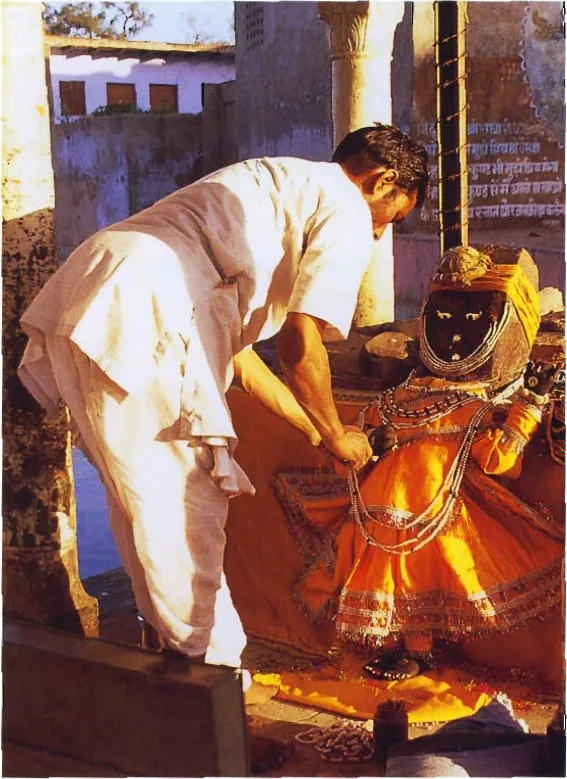
- The Girirāja Mahārāja Mandira is a small shrine at the Saṅgama, the meeting place of Rādhā-kuṇḍa and Śyāma-kuṇḍa, which The Colour Guide to Rādhā-kuṇḍa (1999) calls Ratna-vedi.
- Visiting
- The Colour Guide to Rādhā-kuṇḍa (1999) says that every evening around sunset one of the śilās is dressed with garments, jewellery and a crown like a regular Deity, and Govardhana Hill (2001) shows a …
In short
The Girirāja Mahārāja Mandira is a small shrine at the Saṅgama, the meeting place of Rādhā-kuṇḍa and Śyāma-kuṇḍa, which The Colour Guide to Rādhā-kuṇḍa (1999) calls Ratna-vedi. Here many Govardhana-śilās, stones of Govardhana Hill, have been piled one on top of another like a small Govardhana, and every evening one of them is dressed like a Deity.[1 +3] No scripture or statement of Śrīla Prabhupāda that names the shrine has been found in the works searched, and no source gives its date or founder. The texts speak of Govardhana and its stones in general, and of the meeting place of the two kuṇḍas.[5 +1]
Key facts
| Kind | shrine |
|---|---|
| Region · area | Rādhā-kuṇḍa · Saṅgama-ghāṭa |
| Ācāryas | Śrīla Raghunātha dāsa Gosvāmī, Śrīla Kṛṣṇadāsa Kavirāja Gosvāmī, Śrīla Viśvanātha Cakravartī Ṭhākura |
Why it is glorified
Śrīmad-Bhāgavatam (10.24) tells how Kṛṣṇa turned the cowherds from Indra's sacrifice to a sacrifice for the cows, the brāhmaṇas …
Govardhana and its stones
Śrīmad-Bhāgavatam (10.24) tells how Kṛṣṇa turned the cowherds from Indra's sacrifice to a sacrifice for the cows, the brāhmaṇas and Govardhana Hill. When it was done, He took a huge form, declared that He was the hill and ate the offerings, and with the people of Vraja He bowed down to that form. Govardhana Hill (2001) cites these verses for the worship of the śilās at this shrine; the verses themselves do not speak of stones or of Rādhā-kuṇḍa.[4 +4]
kṛṣṇas tv anyatamaṃ rūpaṃ gopa-viśrambhaṇaṃ gataḥ / śailo 'smīti bruvan bhūri balim ādad bṛhad-vapuḥ
Kṛṣṇa then assumed an unprecedented, huge form to instill faith in the cowherd men. Declaring “I am Govardhana Mountain!” He ate the abundant offerings.
Translation: Śrīla Prabhupāda's disciples (BBT)The Canto 10 commentators explain the verse (summarised here, not translated). Śrīla Sanātana Gosvāmī says that Kṛṣṇa Himself appeared on the summit of the hill and ate the offerings, and Śrīla Viśvanātha Cakravartī Ṭhākura that He appeared as a second mountain, as it were, on top of Govardhana. On the next verse Śrīla Baladeva Vidyābhūṣaṇa says that Kṛṣṇa bowed to Himself in the form of the hill.[9 +3] Read more: The first Govardhana-pūjā and the Annakūṭa →
The Garga-saṁhitā says that an exalted brāhmaṇa who serves a stone of Govardhana gains the merit of bathing in all the holy waters, and its chapter on the glory of the Govardhana-śilā tells how a demon, struck with such a stone, gave up his demon body and attained a form like Kṛṣṇa's. Neither passage mentions Rādhā-kuṇḍa.[13 +3]
गिरिराजशिलासेवां यः करोति द्विजोत्तमः । सप्तद्वीपमहीतीर्थावगाहफलमेति सः ॥ 31 ॥
girirājaśilāsevāṁ yaḥ karoti dvijottamaḥ
saptadvīpamahītīrthāvagāhaphalameti saḥ || 31 ||
The meeting of the two kuṇḍas
Śrīla Raghunātha dāsa Gosvāmī takes shelter of the place where the banks of the two kuṇḍas meet, a grove of kadamba, campaka, aśoka and mango trees with creepers, the dear place of the Divine Couple's play (summarised here, not translated).[5 +1] In the eternal pastimes, Śrīla Kṛṣṇadāsa Kavirāja Gosvāmī's Govinda-līlāmṛta sets a bridge on pillars above the junction, and Śrīla Viśvanātha Cakravartī Ṭhākura's Kṛṣṇa-bhāvanāmṛta a golden causeway, which its commentary says is known as "saṅgama".[18 +1] According to the Bengali Bhaktamāla of Kṛṣṇadāsa Bābājī (1905), a jewelled throne stands on the meeting place of the kuṇḍas.[20] None of these texts mentions a shrine or śilās.
The Gosvāmīs and ācāryas
Śrī Caitanya Mahāprabhu gave Śrīla Raghunātha dāsa Gosvāmī a Govardhana-śilā at Jagannātha Purī and told him that the stone is the form of Kṛṣṇa.[21]
General teaching (does not name the place)Śrī Caitanya Mahāprabhu instructed Raghunātha dāsa, “This stone is the transcendental form of Lord Kṛṣṇa. Worship the stone with great eagerness.”
Śrīla Prabhupāda, Śrī Caitanya-caritāmṛta, Antya-līlā 6.294, translation · vedabase.io
According to the Bhakti-ratnākara, Śrīla Rāghava Paṇḍita, showing Śrīla Śrīnivāsa Ācārya the places of Rādhā-kuṇḍa, named the kuṇḍa, the Govardhana-śilā and the guñjā garland as Śrīla Raghunātha dāsa Gosvāmī's well-known service, and then told him to see the meeting of the two kuṇḍas. It does not say that his śilā was kept there, and no source connects his śilā with this shrine.[5 +1] Govardhana Hill (2001) adds Śrīla Sanātana Gosvāmī to the great devotees who worshipped Govardhana-śilās.[4 +2]
Śrīla Prabhupāda
In his Kṛṣṇa book Śrīla Prabhupāda writes that Kṛṣṇa declared Himself to be Govardhana Hill to show that the hill and He are …
In his Kṛṣṇa book Śrīla Prabhupāda writes that Kṛṣṇa declared Himself to be Govardhana Hill to show that the hill and He are identical. He then gives a general teaching on the stones of the hill; he does not speak of this shrine. In two later letters he put such worship off and asked that a particular rock be returned to the hill; his statements are compared on the Govardhana page, and none is given here as a general rule.[6]
General teaching (does not name the place)“great devotees take rocks from Govardhana Hill and worship them exactly as they worship the Deity of Kṛṣṇa in the temples. The followers of the Kṛṣṇa consciousness movement may therefore collect small rocks or pebbles from Govardhana Hill and worship them at home, because this worship is as good as Deity worship.”
Śrīla Prabhupāda, Kṛṣṇa, the Supreme Personality of Godhead (Kṛṣṇa book), Chapter 24, Worshiping Govardhana Hill · vedabase.io
Visiting today
The Colour Guide to Rādhā-kuṇḍa (1999) says that every evening around sunset one of the śilās is dressed with garments, jewellery and a crown like a regular Deity, and Govardhana Hill (2001) shows a pūjārī, a temple priest, dressing a large śilā at the shrine.[1 +2] Govardhana Hill also says that Govardhana-śilās need not be installed, as they are already taken to be Deities. No older text that says so was found, so the rule is not certain.[4 +1] According to the undated parikramā notes Rādhā-kuṇḍa, the small Caraṇa-cinha shrine stands just past the heap of śilās, a placement that is not certain, on the stone path between the kuṇḍas.[3]
Location
| Where it is | At the saṅgam / Ratna-vedi.[22] on the stone path between Radha-Kunda and Syama-Kunda[3] |
|---|
Nearby places
Caraṇa-cinha (Rādhā-kuṇḍa)
References
22 references
- The Colour Guide to Rādhā-kuṇḍa (1999), Rājaśekhara dāsa Brahmacārī, PDF p. 160
- The Colour Guide to Rādhā-kuṇḍa (1999), Rājaśekhara dāsa Brahmacārī, PDF p. 161
- the undated parikramā notes Rādhā-kuṇḍa, ¶127
- Govardhana Hill: India's Most Sacred Mountain (2001), Rajasekhara dasa Brahmacari, PDF p. 26
- Śrīla Raghunātha dāsa Gosvāmī, Vraja-vilāsa-stava, verses 52–54
- Śrīla Prabhupāda, Kṛṣṇa, the Supreme Personality of Godhead (Kṛṣṇa book), Chapter 24, Worshiping Govardhana Hill · vedabase.io
- Śrīmad-Bhāgavatam 10.24.25, GRETIL
- Śrīmad-Bhāgavatam 10.24.37, GRETIL
- Śrīmad-Bhāgavatam 10.24.36, GRETIL
- Śrīmad-Bhāgavatam 10.24.35, GRETIL
- Śrīla Sanātana Gosvāmī (Bṛhad-vaiṣṇava-toṣaṇī): commentary on ŚB 10.24.35: Sanātana Śrīmad-Bhāgavatam canto 10, part 3, with ten commentaries, Jīva 302719 (Laghu) and 302720 (Krama), Viśvanātha 302722, Bhagavata Vidya Pith edition, ed. Bhagavata Rishi and Krishna Shankar Shastri, 1996
- Śrīla Jīva Gosvāmī (Laghu-vaiṣṇava-toṣaṇī): commentary on ŚB 10.24.36: Jīva Śrīmad-Bhāgavatam canto 10, part 3, with ten commentaries, Viśvanātha 302731, Baladeva 302732, Bhagavata Vidya Pith edition, ed. Bhagavata Rishi and Krishna Shankar Shastri, 1996
- Garga-saṁhitā, Girirāja-khaṇḍa (3), adhyāya 1, verse 31, Sanskrit Wikisource
- Garga-saṁhitā, Girirāja-khaṇḍa (3), adhyāya 10, verses 1-3 (chapter heading 'govardhana-śilā-māhātmyam'), Sanskrit Wikisource
- Garga-saṁhitā, Girirāja-khaṇḍa (3), adhyāya 10, verse 8, Sanskrit Wikisource
- Garga-saṁhitā, Girirāja-khaṇḍa (3), adhyāya 10, verse 41 (last verse of the chapter), Sanskrit Wikisource
- Śrīla Narahari Cakravartī, Bhakti-ratnākara, Fifth Wave, 1912 ed. p. 198; vv. 583-584 in the 1913 numbering of the typed text, 2nd ed., 1912
- Śrīla Kṛṣṇadāsa Kavirāja Gosvāmī, Govinda-līlāmṛta, sarga 7, verse 6 (in the 26-verse kulaka 7.1–26 on Rādhā-kuṇḍa), after the editions of Haridas Das and Haridas Shastri
- Śrīla Viśvanātha Cakravartī Ṭhākura, Kṛṣṇa-bhāvanāmṛta, 14.15 (caturdaśaḥ sargaḥ, 'jala-vihāra-līlāsvādana'), verse and ṭīkā (index locator '(14) trayodaśaḥ sargaḥ'), after the edition of Radhikanath Goswami, Vrindavan, 1906
- Śrī Śrī Bhakta-māla grantha, printed p. 333, right-hand column, first four lines
- Śrīla Prabhupāda, Śrī Caitanya-caritāmṛta, Antya-līlā 6.294, translation · vedabase.io
- The Colour Guide to Rādhā-kuṇḍa (1999), Rājaśekhara dāsa Brahmacārī, p. 156