Saṅgama-ghāṭa
संगम-घाट Hindi name proposed
Also called Saṅgam, Ratna-vedi, Rādhā-kuṇḍa Yogapītha, Yogapīṭha
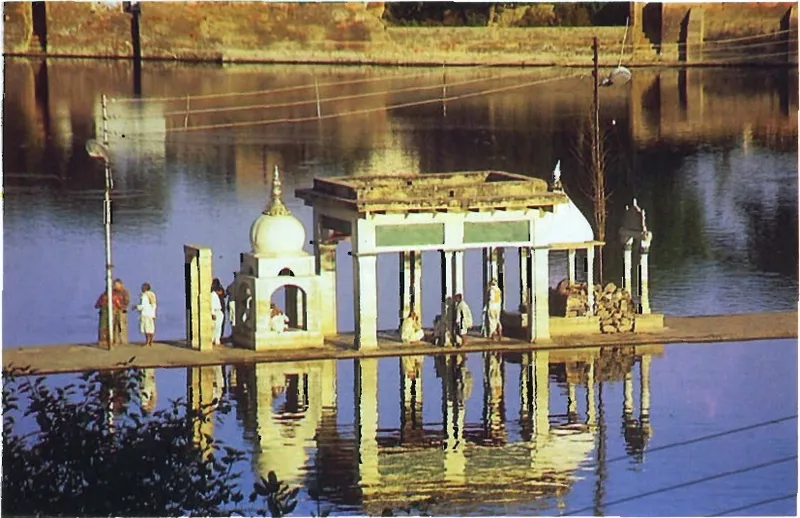
- What it is
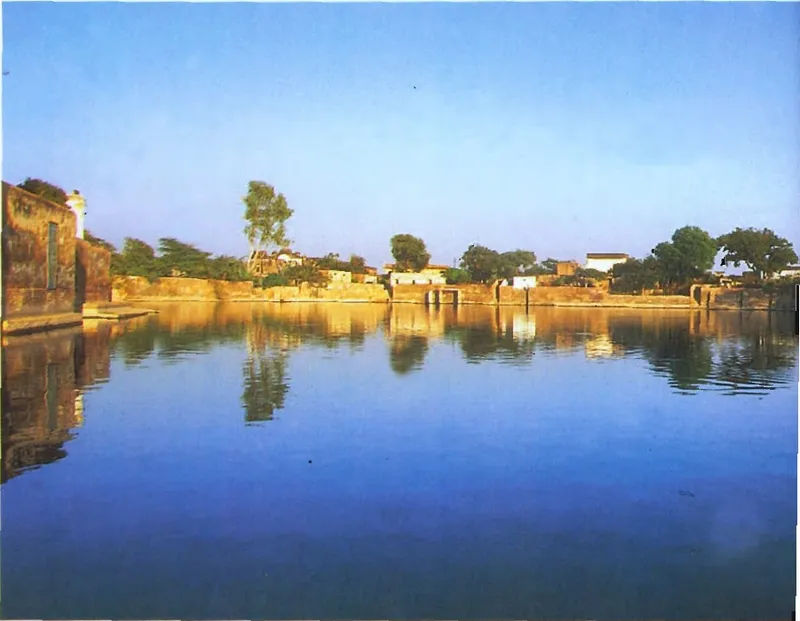
- Saṅgama-ghāṭa is the meeting place of Rādhā-kuṇḍa and Śyāma-kuṇḍa, where the banks of the two kuṇḍas (sacred ponds) touch.
- Visiting
- Two guidebooks report small slits in the stone steps or path below the Caraṇa-cinha shrine, through which the waters of the two kuṇḍas mix.
- Places here
- Caraṇa-cinha (Rādhā-kuṇḍa), Girirāja Mahārāja Mandira (Rādhā-kuṇḍa), Yugala-saṅgam-ghāṭa (Rādhā-kuṇḍa), Tamāla tree (Saṅgama-ghāṭa)
In short
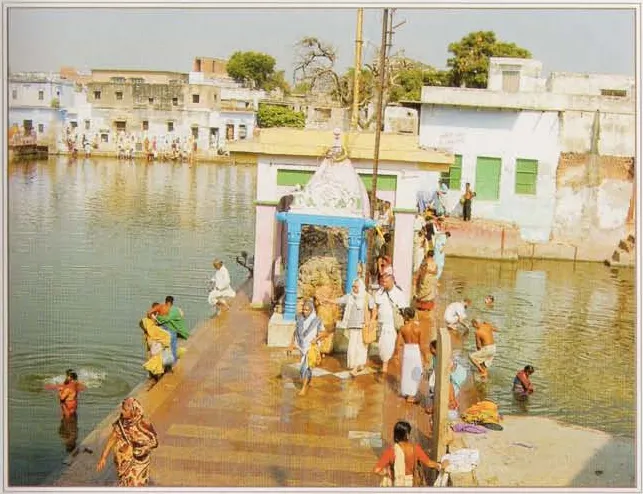
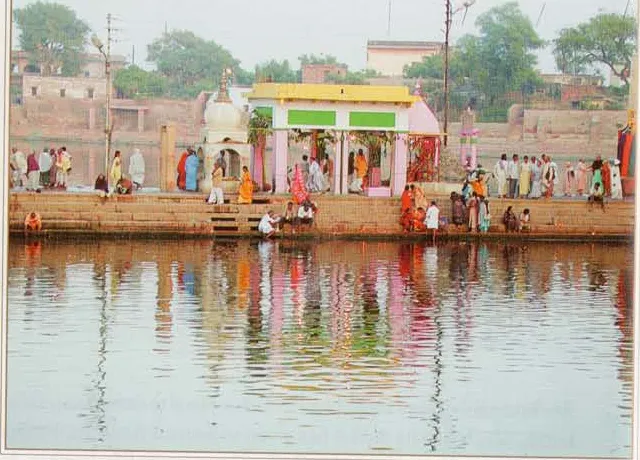
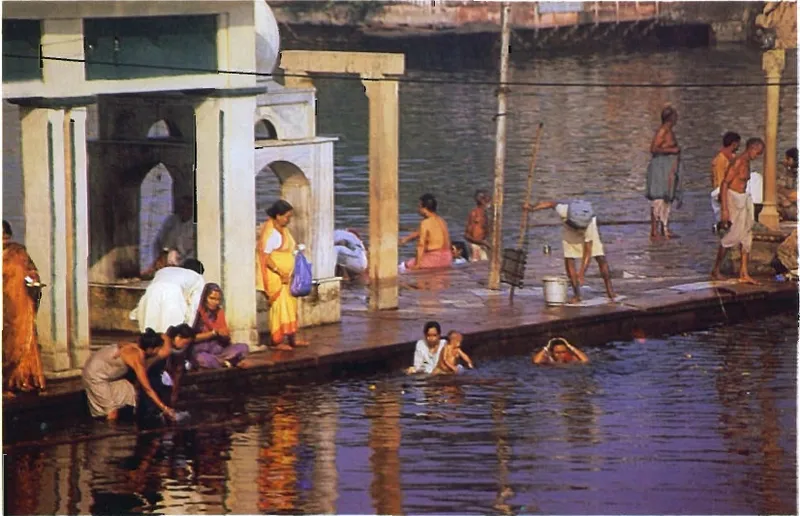
Saṅgama-ghāṭa is the meeting place of Rādhā-kuṇḍa and Śyāma-kuṇḍa, where the banks of the two kuṇḍas (sacred ponds) touch.[1 +3] Śrīla Raghunātha dāsa Gosvāmī takes shelter of this place as the dear place of Rādhā and Mādhava's pastimes.[1 +2] Śrīla Kṛṣṇadāsa Kavirāja Gosvāmī describes a bridge on pillars above the junction, and the commentary on Śrīla Viśvanātha Cakravartī Ṭhākura's Kṛṣṇa-bhāvanāmṛta says that the golden causeway there is known as the Saṅgama, "the meeting".[4 +1] Today pilgrims bathe on both sides of it, and the guidebooks call the spot Ratna-vedi and Yogapīṭha.[6 +3]
Key facts
| Kind | ghāṭa |
|---|---|
| Region · area | Rādhā-kuṇḍa |
| Also part of | Śyāma-kuṇḍa (Rādhā-kuṇḍa) |
| Ācāryas | Śrīla Raghunātha dāsa Gosvāmī, Śrīla Jīva Gosvāmī, Śrīla Śrīnivāsa Ācārya, Śrīla Sanātana Gosvāmī, Śrīla Kṛṣṇadāsa Kavirāja Gosvāmī |
Why it is glorified
In his Vraja-vilāsa-stava (52) Śrīla Raghunātha dāsa Gosvāmī takes shelter of the middle region where the banks of the two …
In his Vraja-vilāsa-stava (52) Śrīla Raghunātha dāsa Gosvāmī takes shelter of the middle region where the banks of the two beloved kuṇḍas meet. Kadamba, campaka, aśoka, mango, punnāga and bakula trees surround it, and it is the place where Rādhā and Mādhava play (summarised here, not translated).[1 +2]
नीपैश्चम्पकपालिभिर्नववराशोकै रसालोत्करैः
पुन्नागैर्बकुलैर्लवङ्गलतिका वासन्तिकाभिर्वृतैः ।
हृद्यं तत्प्रियकुण्डयोस्तटमिलन्मध्यप्रदेशं परं
राधामाधवयोः प्रियस्थलमिदं केल्यास्तदेवाश्रये ॥ ५२॥
nīpaiścampakapālibhirnavavarāśokai rasālotkaraiḥ punnāgairbakulairlavaṅgalatikā vāsantikābhirvṛtaiḥ
hṛdyaṁ tatpriyakuṇḍayostaṭamilanmadhyapradeśaṁ paraṁ rādhāmādhavayoḥ priyasthalamidaṁ kelyāstadevāśraye || 52 ||
Śrīla Jīva Gosvāmī, in the opening of his Gopāla-campū (1.9), describes the two kuṇḍas of Hari and Rādhā shining as a joined pair. He thinks, he says, that they are Their love made visible in liquid form (summarised here, not translated).[10 +1] Śrīla Viśvanātha Cakravartī Ṭhākura writes in his Vraja-rīti-cintāmaṇi that, as he understands it, Rādhā and Kṛṣṇa melted with joy at the sight of each other and became the two kuṇḍas; The Colour Guide to Rādhā-kuṇḍa (1999) gives the same teaching in his name.[11 +1]
Divine pastimes
How the waters met
Śrīmad-Bhāgavatam (10.36) tells how Kṛṣṇa killed the bull-demon Ariṣṭa and then entered the cowherd village. It names no kuṇḍa and no meeting of two kuṇḍas.[13 +3] Śrīla Viśvanātha Cakravartī Ṭhākura's commentary on that chapter sets down the story of the two kuṇḍas in twenty verses. In them the holy places that were in Kṛṣṇa's kuṇḍa ask Rādhā to let them come into Her lake, and She smiles at Her beloved and says, "Please come."[17 +3] Then they break through the wall of Kṛṣṇa's pond and fill Rādhā's:[20 +4]
prāpya prasādam atha te vṛṣabhānujāyāḥ
śrī-kṛṣṇa-kuṇḍa-gata-tīrtha-varāḥ prasahya
bhittveva bhittim ati-vegata eva rādhā-
kuṇḍaṁ vyadhuḥ sva-salilaiḥ paripūrṇam eva
Thus gaining the grace of Śrīmatī Rādhārāṇī, the holy rivers and lakes in Śrī Kṛṣṇa-kuṇḍa forcibly broke through its boundary walls and swiftly filled Rādhā-kuṇḍa with their waters.
Translation: Śrīla Prabhupāda's disciples (BBT)The Bhakti-ratnākara tells the same: at Kṛṣṇa's direction the holy places entered Rādhikā-kuṇḍa from Śyāma-kuṇḍa.[20 +4] The verses tell how the waters passed from one kuṇḍa into the other, but they do not describe the spot where this happened.[17 +3] Read more: How Rādhā-kuṇḍa appeared: the accounts side by side →
In the eternal pastimes
Śrīla Kṛṣṇadāsa Kavirāja Gosvāmī's Govinda-līlāmṛta (7.6) says that Rādhā-kuṇḍa is joined with Kṛṣṇa's dear kuṇḍa between the east and the south-east, and that above the junction stands a wonderful bridge resting on pillars (summarised here, not translated).[5 +1] In his Kṛṣṇa-bhāvanāmṛta (14.15) Śrīla Viśvanātha Cakravartī Ṭhākura describes a golden causeway by which the two lakes meet, with the great Ariṣṭa-kuṇḍa beyond it. The commentary printed with it, by Śrī Kṛṣṇadeva Sārvabhauma, says that this causeway is known as the Saṅgama.[4]
According to Śrīla Nārāyaṇa Bhaṭṭa Gosvāmī's Vraja-bhakti-vilāsa, beside the confluence of the two kuṇḍas is the place of the sakhīs' circle, where the sakhīs, Rādhā's companions, are worshipped on the seventh night.[26 +1] The Bengali Bhaktamāla of Kṛṣṇadāsa Bābājī (1905) says that the two kuṇḍas are the forms of the divine pair, and that a jewelled throne stands on their meeting place.[28]
Traditional accounts
The guidebooks of today call the meeting place Ratna-vedi, "the jewelled altar", and Yogapīṭha; Śrī Vraja-maṇḍala Parikramā …
Ratna-vedi and Yogapīṭha
The guidebooks of today call the meeting place Ratna-vedi, "the jewelled altar", and Yogapīṭha; Śrī Vraja-maṇḍala Parikramā (2007) says that the juncture of the kuṇḍas is a jewelled platform called the Yogapīṭha of Kṛṣṇa's pastimes.[6 +3] According to the tradition recorded in The Colour Guide (1999), in the unmanifest pastimes Ratna-vedi is a bridge studded with gems across the saṅgam. The poems describe a bridge or a golden causeway here, but none of them uses the names Ratna-vedi or Yogapīṭha, so these names are not certain.[4 +2]
The tamāla tree
According to the local tradition recorded in Śrī Vraja-maṇḍala Parikramā (2007), there was an old tamāla tree at Saṅgama-ghāṭa which told one devotee that it was the sage Agastya Ṛṣi. The book names neither the devotee nor the time, so the story is not certain, and it says "there was", not that the tree still stands.[8] The Bengali Bhaktamāla (1905), in its couplets on the meeting of the two kuṇḍas, says that the divine pair always sport at the foot of the tamāla tree. It does not say where the tree stands and does not mention Agastya.[28] Śrīla Prabhupāda writes in general why the tamāla is dear in Vraja:[29]
General teaching (does not name the place)“Perhaps you know Tamala is a nice tree in Vrndavana, and because the color of the tree exactly resembles that of Krsna, therefore Srimati Radharani always used to take rest underneath the Tamala tree when she was feeling separation from Krsna.”
Śrīla Prabhupāda, Letter to Tamala Krsna, letter 70-05-01, 1 May 1970 · vedabase.io
The footprints at Caraṇa-cinha
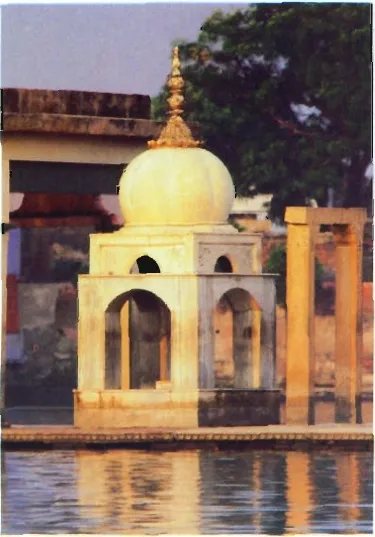
On the meeting place stands a small shrine called Caraṇa-cinha, "the footprints". The Colour Guide (1999) says that it holds impressions of the lotus footprints of Rādhā and Kṛṣṇa, to which devotees offer flowers, incense, tulasī leaves and water from the kuṇḍas; the undated parikramā notes Rādhā-kuṇḍa call it a small open-air shrine with some Govardhana-śilās.[9 +1] No text found tells how or when the footprints came to be here; Śrīla Raghunātha dāsa Gosvāmī's verse on this spot does not mention them.[1]
The Gosvāmīs and ācāryas
According to the Bhakti-ratnākara, Śrīla Rāghava Paṇḍita, showing Śrīla Śrīnivāsa Ācārya the places of Rādhā-kuṇḍa, told him to …
According to the Bhakti-ratnākara, Śrīla Rāghava Paṇḍita, showing Śrīla Śrīnivāsa Ācārya the places of Rādhā-kuṇḍa, told him to see the meeting of the two kuṇḍas, Rādhā's and Śyāma's. The same work quotes Śrīla Raghunātha dāsa Gosvāmī's verse on this place where it describes the two kuṇḍas.[21 +1]
The undated parikramā notes Rādhā-kuṇḍa say that Śrīla Sanātana Gosvāmī's favourite spot for chanting japa was near the Saṅgama on the bank of Śyāma-kuṇḍa, with a view of both kuṇḍas. No older source is known for this, so it is not certain.[35]
Visiting today
Two guidebooks report small slits in the stone steps or path below the Caraṇa-cinha shrine, through which the waters of the two kuṇḍas mix.[6 +1] The parikramā notes place the shrine on the stone path between the kuṇḍas, just past a "mini-mountain" of Govardhana-śilās at the Girirāja Mahārāja Mandira, about five metres before the neem tree of Govinda-ghāṭa.[6 +2] The Colour Guide calls the bathing ghāṭas on both sides of Ratna-vedi the Yugala-saṅgam-ghāṭa.[6]
Location
| Where it is | Between Rādhā-kuṇḍa and Śyāma-kuṇḍa; slits "below Caraṇa-cinha".[38] "the saṅgam, or meeting place of the two sacred kuṇḍas", where "the waters of Rādhā-kuṇḍa flow into the waters of Śyāma-kuṇḍa"[39] |
|---|
Places at Saṅgama-ghāṭa
4 places
Nearby places
Bāṅke-bihārī Mandira (Rādhā-kuṇḍa) · Sanātana Gosvāmī's baiṭhaka (Rādhā-kuṇḍa) · Rādhā-kuṇḍa
Pictures
6 pictures
History
Two historians, A. W. Entwistle (1987) and Prabhudayāl Mītal (1966), credit the masonry ghāṭas of Rādhā-kuṇḍa to Lālā Bābū (Kṛṣṇacandra Siṁha) in the nineteenth century. Entwistle says that he rebuilt the steps around the two tanks and the causeway between them. Neither gives a year.[31 +2] Read more: How Rādhā-kuṇḍa was found and dug out again →
Where the sources differ
The guidebooks call the Saṅgama the most popular bathing place at Rādhā-kuṇḍa, but they give the order of the bath differently.
The guidebooks call the Saṅgama the most popular bathing place at Rādhā-kuṇḍa, but they give the order of the bath differently.[6 +3]
Accounts differ The order of bathing in the two kuṇḍas.
- Vraja-bhakti-vilāsa (Śrīla Nārāyaṇa Bhaṭṭa), p. 85First bathe in Rādhā's kuṇḍa, which grants every aim, then in Kṛṣṇa-kuṇḍa, which destroys all sins.
- Śrī Vraja-maṇḍala Parikramā (2007)At Saṅgama-ghāṭa Vaiṣṇavas first bathe in Rādhā-kuṇḍa and then in Śyāma-kuṇḍa.
- The Colour Guide to Rādhā-kuṇḍa (1999)Rādhā-kuṇḍa, then Śyāma-kuṇḍa, then Rādhā-kuṇḍa again (on Bahulāṣṭamī, and at the saṅgam).
In which direction the waters of the two kuṇḍas pass into each other.[6 +4]
Accounts differ In which direction the waters of the two kuṇḍas pass into each other.
- Verse quoted in the ŚB 10.36.16 purport (verse 17); Bhakti-ratnākara p. 191; Śrī Vraja-maṇḍala Parikramā (2007)At the origin the holy places in Kṛṣṇa's kuṇḍa broke through and filled Rādhā-kuṇḍa ('a current of water flowed from Kṛṣṇa-kuṇḍa into Rādhā-kuṇḍa', Śrī Vraja-maṇḍala Parikramā (2007)).
- The Colour Guide to Rādhā-kuṇḍa (1999)At the saṅgam 'the waters of Rādhā-kuṇḍa flow into the waters of Śyāma-kuṇḍa, where they embrace one another eternally'.
- The Colour Guide to Rādhā-kuṇḍa (1999); the undated parikramā notes Rādhā-kuṇḍaSlits in the stone steps or path let the waters of the two kuṇḍas flow into one another (mix).
Who composed the twenty verses on the origin of the two kuṇḍas is told differently; those accounts are on the Śyāma-kuṇḍa page.[17 +3]
More on this place
How Rādhā-kuṇḍa appeared: the accounts side by side · How Rādhā-kuṇḍa was found and dug out again
References
39 references
- Śrīla Raghunātha dāsa Gosvāmī, Vraja-vilāsa-stava, verses 52–54
- Govardhana Hill: India's Most Sacred Mountain (2001), Rajasekhara dasa Brahmacari, PDF p. 151
- Vṛndāvana-Dhāma Ki Jaya! (c. 1986), by Dhruva Mahārāja dāsa, PDF p. 35
- Śrīla Viśvanātha Cakravartī Ṭhākura, Kṛṣṇa-bhāvanāmṛta, sarga 14 (jala-vihāra-līlāsvādana), verse 15, with the ṭīkā, after the edition of Radhikanath Goswami, Vrindavan, 1906
- Śrīla Kṛṣṇadāsa Kavirāja Gosvāmī, Govinda-līlāmṛta, sarga 7, verse 6 (in the 26-verse kulaka 7.1–26 on Rādhā-kuṇḍa), after the editions of Haridas Das and Haridas Shastri
- The Colour Guide to Rādhā-kuṇḍa (1999), Rājaśekhara dāsa Brahmacārī, PDF p. 158
- Śrī Vraja-maṇḍala Parikramā (2007), PDF p. 89
- Śrī Vraja-maṇḍala Parikramā (2007), PDF p. 100
- the undated parikramā notes Rādhā-kuṇḍa, ¶127
- Śrīla Jīva Gosvāmī, Gopāla-campū, Pūrva-campū 1.9, GRETIL
- The Colour Guide to Rādhā-kuṇḍa (1999), Rājaśekhara dāsa Brahmacārī, PDF p. 19
- Śrīla Viśvanātha Cakravartī Ṭhākura, Vraja-rīti-cintāmaṇi, sarga 3, verses 34–35
- Śrīmad-Bhāgavatam 10.36.1, GRETIL
- Śrīmad-Bhāgavatam 10.36.9, GRETIL
- Śrīmad-Bhāgavatam 10.36.13-15, GRETIL
- Śrīla Prabhupāda, Kṛṣṇa, the Supreme Personality of Godhead (Kṛṣṇa book), Chapter 36, 'Kaṁsa Sends Akrūra for Kṛṣṇa' · vedabase.io
- Śrīla Viśvanātha Cakravartī Ṭhākura: commentary on ŚB 10.36.15, Bhagavata Vidya Pith edition, ed. Bhagavata Rishi and Krishna Shankar Shastri, 1996
- Śrīla Viśvanātha Cakravartī Ṭhākura: commentary on ŚB 10.36.15, verses iv–v, Bhagavata Vidya Pith edition, ed. Bhagavata Rishi and Krishna Shankar Shastri, 1996
- Śrīla Viśvanātha Cakravartī Ṭhākura: commentary on ŚB 10.36.15, verses xv–xvi, Bhagavata Vidya Pith edition, ed. Bhagavata Rishi and Krishna Shankar Shastri, 1996
- Śrīmad-Bhāgavatam 10.36.16, purport, verse 17 of the twenty quoted verses, online edition · vedabase.io
Show all 39 references
- Śrīla Narahari Cakravartī, Bhakti-ratnākara, Fifth Wave, 1912 ed. p. 191, 2nd ed., 1912
- Śrī Vraja-maṇḍala Parikramā (2007), PDF p. 85
- The Colour Guide to Rādhā-kuṇḍa (1999), Rājaśekhara dāsa Brahmacārī, PDF p. 31
- the undated parikramā notes Rādhā-kuṇḍa, ¶79
- Śrīla Kṛṣṇadāsa Kavirāja Gosvāmī, Govinda-līlāmṛta, sarga 7, verses 105–106 (Kṛṣṇa's fancies about Rādhā-kuṇḍa, 7.103–108), after the editions of Haridas Das and Haridas Shastri
- Śrīla Nārāyaṇa Bhaṭṭa, Vraja-bhakti-vilāsa, printed p. 45, 'atha śrī-kuṇḍa-vanam', list ascribed to the Ādi-vārāha (section 43), 1st ed., publ. Bābā Kṛṣṇadāsa, Kusuma-sarovara, Saṁvat 2008
- Śrīla Nārāyaṇa Bhaṭṭa, Vraja-bhakti-vilāsa, printed p. 85, after the bathing rules of the two kuṇḍas, 1st ed., publ. Bābā Kṛṣṇadāsa, Kusuma-sarovara, Saṁvat 2008
- Śrī Śrī Bhakta-māla grantha, printed p. 333, right-hand column, first four lines
- Śrīla Prabhupāda, Letter to Tamala Krsna, letter 70-05-01, 1 May 1970 · vedabase.io
- The Colour Guide to Rādhā-kuṇḍa (1999), Rājaśekhara dāsa Brahmacārī, PDF p. 162
- A. W. Entwistle, ch. 8 §12 'Radhakund', printed p. 339, Egbert Forsten, Groningen, 1987
- A. W. Entwistle, ch. 5 §35 'Patronage in the nineteenth century' (Krishna Chandra Sinha, 'Lala Babu'), printed p. 216, Egbert Forsten, Groningen, 1987
- Prabhudayāl Mītal, part 2 ('Braj kā itihās'), 'Ādhunik kāl': 'Braj ke samṛddhiśālī bhakt jan', Kṛṣṇacandra Siṁha (Lālā Bābū), printed p. 275
- Śrīla Narahari Cakravartī, Bhakti-ratnākara, Fifth Wave, 1912 ed. p. 198, 2nd ed., 1912
- the undated parikramā notes Rādhā-kuṇḍa, ¶117
- The Colour Guide to Rādhā-kuṇḍa (1999), Rājaśekhara dāsa Brahmacārī, PDF p. 159
- Śrīla Nārāyaṇa Bhaṭṭa, Vraja-bhakti-vilāsa, printed p. 85, section on the Rādhā and Kṛṣṇa kuṇḍas (ending '॥ ५ ॥'), 1st ed., publ. Bābā Kṛṣṇadāsa, Kusuma-sarovara, Saṁvat 2008
- The Colour Guide to Rādhā-kuṇḍa (1999), Rājaśekhara dāsa Brahmacārī, p. 154
- The Colour Guide to Rādhā-kuṇḍa (1999), Rājaśekhara dāsa Brahmacārī, p. 15