The first Govardhana-pūjā and the Annakūṭa
पहली गोवर्धन-पूजा और अन्नकूट
In short
Kṛṣṇa started Govardhana-pūjā when, as a boy in Vraja, He stopped the cowherds' yearly sacrifice to Indra. He had them worship the cows, the brāhmaṇas and Govardhana Hill instead. He then took a huge form, declared that He was the hill and ate the offerings, the Annakūṭa or hill of food (ŚB 10.24).[1–9]
On this page
At a glance
- The text: Śrīmad-Bhāgavatam, Tenth Canto, chapter 24, with Śrīla Prabhupāda's Kṛṣṇa book chapter 24.[1–5]
- The reason: the cows receive their grass from the hill, so Kṛṣṇa told Nanda to worship it, the representative of God, rather than Indra.[10]
- The Annakūṭa: Kṛṣṇa, in another huge form, said that He was the hill and ate the abundant offerings.[4–9]
- The day: Śrīla Jīva Gosvāmī and Śrīla Viśvanātha Cakravartī Ṭhākura give it as the first day of the bright half of Kārttika (October–November), the day after the new moon.[11–13]
- The place: the Bhāgavatam names none; the Bhakti-ratnākara and the guidebooks name the village of Āniyora.[6 +5]
- The festival: in Śrīla Prabhupāda's description (1970), the temples of Vṛndāvana and beyond prepare and distribute huge quantities of food.[4]
Why did Kṛṣṇa stop the sacrifice to Indra?
Every year, on the day after Dīpāvalī, temples in Vṛndāvana and far beyond prepare huge amounts of food for Govardhan Puja, also called Annakūṭa, the hill of food. The festival repeats a day in Kṛṣṇa's childhood that the Bhāgavatam tells in its Tenth Canto, chapter 24.[1 +7] Śrīla Prabhupāda summed it up for his disciples in Vṛndāvana in 1972.[18]
Names this place“This is the Govardhana-pūjā. This Govardhana-pūjā, Nanda Mahārāja was arranging for worshiping Indra, and Kṛṣṇa stopped it. And He engaged him for worshiping Govardhana, which is representation of Kṛṣṇa.”
Śrīla Prabhupāda, Śrīmad-Bhāgavatam 1.2.26 lecture, Vṛndāvana, 6 November 1972 · vedabase.io
The chapter opens with Kṛṣṇa and Baladeva watching the cowherd men busily arranging a sacrifice to Indra (10.24.1).[19] The commentators, the ācāryas who explain the Bhāgavatam verse by verse, set the scene a little differently (summarised here, not translated). Śrīla Viśvanātha Cakravartī Ṭhākura and Śrīla Baladeva Vidyābhūṣaṇa picture Nanda sitting with his brothers in the meeting hall of the cowherd village. He orders the cowherds to gather what the sacrifice needs.[11] Śrīla Sanātana Gosvāmī places the raising of Indra's flag and the gathering of offerings at a kuṇḍa (sacred pond) called Indra-dhvaja. It lay on the east side of Govardhana, and the time was autumn, at the end of the rains. Śrīla Jīva Gosvāmī says only that the cowherds had gathered at a suitable place near the village.[11]
When his son asked what the sacrifice was for, Nanda explained that Indra controls the rain. The clouds are his helpers, he said, and give the water that keeps every creature alive.[20] Kṛṣṇa answered him and ended by proposing a different sacrifice.[1]
tasmād gavāṃ brāhmaṇānām adreś cārabhyatāṃ makhaḥ / ya indra-yāga-sambhārās tair ayaṃ sādhyatāṃ makhaḥ
Therefore may a sacrifice for the pleasure of the cows, the brāhmaṇas and Govardhana Hill begin! With all the paraphernalia collected for worshiping Indra, let this sacrifice be performed instead.
Translation: Śrīla Prabhupāda's disciples (BBT)Śrīla Prabhupāda gives the plain reason in another of his books, Teachings of Lord Kapila.[10]
Names this placeHe told His father, “There is no need to offer sacrifices to Indra. It is better to worship Govardhana Hill, which is the representative of God. The cows receive their grass and grains from Govardhana Hill; therefore it is better to worship it.”
Śrīla Prabhupāda, Teachings of Lord Kapila, the Son of Devahūti, Chapter 17, under Text 42 (ŚB 3.25.42) · vedabase.io
Why does the hill mean Govardhana?
Kṛṣṇa's words in 10.24.25 say only the hill (adri). Śrīla Sanātana Gosvāmī explains that it can only be Govardhana. It is the chief hill, the one known in tradition and scripture for its worship, and the one Kṛṣṇa would lift soon afterwards.[1, 21] Śrīla Jīva Gosvāmī adds that Vṛndāvana has many hills, such as Nandīśvara, Aṣṭakūṭa and Varasānu. But this one stood so near, right in front of Vraja, that no name was needed (summarised here, not translated).[1, 21]
In the verse before (10.24.24), Kṛṣṇa says that the cowherds have no cities or villages but always live in the forests and on the hills. Both ācāryas read this as a sign that the people of Vraja were then living close to Govardhana.[22, 23]
What was offered at the first Annakūṭa?
Kṛṣṇa then gave the order of the new sacrifice. Many kinds of food were to be cooked, from sweet rice to vegetable soups, with cakes baked and fried and all the milk products.[24] Learned brāhmaṇas were to light the sacred fires, and then be fed and given cows.[25] After the feast everyone was to dress well, put on sandalwood paste and walk around the cows, the brāhmaṇas, the fires and the hill (10.24.29).[26]
Nanda and the elders did everything as He said. They had the brāhmaṇas recite the Vedic mantras and presented the offerings to the hill and the brāhmaṇas. They gave grass to the cows and walked round Govardhana with the cows in front (10.24.31–33).[1–5] The walk round the hill is told in “Govardhana parikramā”.[26]
In the Kṛṣṇa book Śrīla Prabhupāda names the dishes.[4]
General teaching (does not name the place)“Prepare very nice foods of all descriptions from the grain and ghee collected for the yajña. Prepare rice, dāl, then halavā, pakorā, purī and all kinds of milk preparations, such as sweet rice, rabrī, sweetballs, sandeśa, rasagullā and laḍḍu … Then Kṛṣṇa began to eat all the food offered there.”
Śrīla Prabhupāda, Kṛṣṇa, the Supreme Personality of Godhead (Kṛṣṇa book), Chapter 24, Worshiping Govardhana Hill · vedabase.io
What happened when Kṛṣṇa declared that He was the hill?
Then came the moment the festival remembers.[6]
kṛṣṇas tv anyatamaṃ rūpaṃ gopa-viśrambhaṇaṃ gataḥ / śailo 'smīti bruvan bhūri balim ādad bṛhad-vapuḥ
Kṛṣṇa then assumed an unprecedented, huge form to instill faith in the cowherd men. Declaring “I am Govardhana Mountain!” He ate the abundant offerings.
Translation: Śrīla Prabhupāda's disciples (BBT)With the people of Vraja, Kṛṣṇa bowed down to that form, and so, in effect, to Himself. He told them to see how the hill had appeared in person to show them mercy. It was wise, He said, to bow to it for their own safety and their cows'.[7, 27] Śrīla Viśvanātha Cakravartī Ṭhākura and Śrīla Baladeva Vidyābhūṣaṇa read the verse in just that way: He bowed to Himself in the form of the hill.[28] Śrīla Prabhupāda explains the same in his purport to Caitanya-caritāmṛta Madhya 4.86.[5]
Names this placeAt that time Kṛṣṇa expanded Himself and declared, “I am Govardhana Hill.” In this way He accepted all the paraphernalia and food offered to Govardhana Hill.
Śrīla Prabhupāda, Śrī Caitanya-caritāmṛta, Madhya-līlā 4.86, purport · vedabase.io
The commentators agree that the form that ate was Kṛṣṇa Himself. They place it on the top of the hill or above it. Śrīla Sanātana Gosvāmī says that Kṛṣṇa did it to show that the sacrifice He had begun surpassed Indra's and to give the cowherds firm faith in it.[6, 29] Śrīla Jīva Gosvāmī adds that many unseen forms appeared at the same moment, to complete every rite and satisfy every group of cowherds.[29]
Śrīla Viśvanātha Cakravartī Ṭhākura and Śrīla Baladeva Vidyābhūṣaṇa have the form say that it is the lord of the region and invite the cowherds to choose boons. Śrīla Viśvanātha Cakravartī Ṭhākura says it took the offerings with countless outstretched hands. It took them from the people of Vraja near and far, even from those in Nandagrāma (all summarised here, not translated).[29]
The Garga-saṁhitā tells the scene in its own way. Kṛṣṇa takes a second, giant form that rises from the middle of the hill. He says that He is the hill and eats the whole hill of food (3.2.21, summarised here, not translated).[4–9] How the descriptions of that form differ, and what the mouth of the hill means, is set out in “The body of Govardhana: mouth, eyes, neck and the peacock”.[6, 29]
The Gosvāmīs remember the day
Śrīla Raghunātha dāsa Gosvāmī prays to the place of that feast in his Vraja-vilāsa-stava. Śrīla Prabhupāda translates his words in his purport (explanation) to Caitanya-caritāmṛta Madhya 18.26.[17 +2]
Names this place“When Nanda Mahārāja offered a large quantity of food to Govardhana Hill, Kṛṣṇa assumed a gigantic form and eagerly invited everyone to ask boons from Him. Then, deceiving even Śrīmatī Rādhārāṇī, He ate all the offered food. Let me take shelter of the place known as Annakūṭa, where Lord Kṛṣṇa enjoyed these pastimes.”
Śrīla Prabhupāda, Śrī Caitanya-caritāmṛta, Madhya-līlā 18.26, purport (quoting Vraja-vilāsa-stava 75) · vedabase.io
Śrīla Rūpa Gosvāmī sings the same moment in his second Govardhanāṣṭaka: Kṛṣṇa shows a huge form, says that He is the hill and eats the food the cowherds offered.[32] In Śrīla Jīva Gosvāmī's Gopāla-campū, the gopīs sing a song of question and answer as they walk round the hill after the festival. One asks who ordered the worship of Govardhana, and the others answer with Kṛṣṇa's deeds in Vraja.[33]
When is Govardhana-pūjā kept?
The Bhāgavatam gives no date. Śrīla Jīva Gosvāmī (on 10.24.1 and 10.45.3) and Śrīla Viśvanātha Cakravartī Ṭhākura (on 10.29.1) give the same day. Indra's sacrifice was stopped on the new moon of Kārttika. Govardhana was worshipped on the next day, the first day of the bright half of the month (summarised here, not translated).[11–13] Śrīla Jīva Gosvāmī adds that the holding of the hill began on the third day.[13] Śrīla Viśvanātha Cakravartī Ṭhākura says Kṛṣṇa was then seven years old.[11–13]
The Purāṇas, old scriptures, fix the same day for the yearly worship. The Skanda and Padma Purāṇas say that the morning of the first day of Kārttika's bright half is the time to worship Govardhana. The cows are decorated and given rest from work, and a prayer is said to Govardhana as the protector of the herds, raised up by Viṣṇu's arm.[34–36] The Nārada Purāṇa asks for an Annakūṭa of every kind of food in the worship of Govardhana. In the evening one should worship the hill with the cows and walk round it (all summarised here, not translated).[34–36]
In his second Govardhanāṣṭaka Śrīla Rūpa Gosvāmī says that the great worship Kṛṣṇa began for the hill still shines, even in his day, on that first day of Kārttika.[32]
The Annakūṭa repeated by Śrīla Mādhavendra Purī
The Caitanya-caritāmṛta tells how, centuries later, Śrīla Mādhavendra Purī found the Deity Gopāla at Govardhana. He installed Him on top of the hill and held an Annakūṭa for Him, and the nearby villages went on repeating it day after day (Madhya 4.21–97).[37–42]
dekhiyā purīra prabhāva loke camatkāra
pūrva annakūṭa yena haila sākṣātkāra
Seeing the influence of Mādhavendra Purī, all the people gathered there were struck with wonder. They saw that the Annakūṭa ceremony, which had been performed before during the time of Kṛṣṇa, was now taking place again by the mercy of Śrī Mādhavendra Purī.
Translation: Śrīla A.C. Bhaktivedanta Swami PrabhupādaThe story of that Deity is told in “The Gopāla Deity of Govardhana”.[37–42]
How is Govardhana-pūjā kept?
Śrīla Prabhupāda describes the festival as the devotees of his time kept it, in the Kṛṣṇa book (preface dated 1970).[4]
Names this place“From that day, Govardhana-pūjā has been going on and is known as Annakūṭa. In all the temples of Vṛndāvana or outside of Vṛndāvana, huge quantities of food are prepared in this ceremony and are very sumptuously distributed to the general population.”
Śrīla Prabhupāda, Kṛṣṇa, the Supreme Personality of Godhead (Kṛṣṇa book), Chapter 24, Worshiping Govardhana Hill · vedabase.io
He adds that his own movement observes it, because Śrī Caitanya Mahāprabhu taught that Kṛṣṇa's land, Vṛndāvana and Govardhana Hill, is worshipable as Kṛṣṇa is.[4]
Names this place“The sacrifice known as Govardhana-pūjā is observed in the Kṛṣṇa consciousness movement. Lord Caitanya has recommended that since Kṛṣṇa is worshipable, so His land – Vṛndāvana and Govardhana Hill – is also worshipable. To confirm this statement, Lord Kṛṣṇa said that Govardhana-pūjā is as good as worship of Him.”
Śrīla Prabhupāda, Kṛṣṇa, the Supreme Personality of Godhead (Kṛṣṇa book), Chapter 24, Worshiping Govardhana Hill · vedabase.io
Indra did not take the loss of his sacrifice quietly. What followed, the storm, the lifting of the hill and Indra's homage, is told in “The lifting of Govardhana Hill, Indra's homage and the name Govinda”.[11–13]
Where the sources differ
The Bhāgavatam names no village or spot for the feast. Later sources do, and they do not agree.[6 +5]
- The Garga-saṁhitā puts it at the hill's mouth, below a place called Śṛṅgāra-maṇḍala, without naming a village (3.8.4).[16]
- The Varāha Purāṇa uses Annakūṭa as a name of the hill itself, the hill held up for the cows. It speaks of a tīrtha made by Indra near Annakūṭa, where Kṛṣṇa stopped Indra's sacrifice (164.23–26).[43]
- Śrīla Jīva Gosvāmī (on ŚB 10.25.19) says that the part of the hill Kṛṣṇa lifted, north of Mānasa-gaṅgā, is the part the Varāha calls Annakūṭa. It is known separately even today, he says, but he does not relate it to any village.[43, 44]
- The Bhakti-ratnākara: Śrīla Rāghava Paṇḍita Gosvāmī shows Śrīla Śrīnivāsa Ācārya the village of Āniyora near the hill. There Nanda and the cowherds gave up Indra-pūjā, and Kṛṣṇa, eating everything offered, called out for more again and again; hence the name.[6 +5]
- Śrīla Viśvanātha Cakravartī Ṭhākura, in the Vraja-rīti-cintāmaṇi (3.18–20), sets Nanda's great Annakūṭa festival where the Saṅkarṣaṇa and Dāna-nivartana kuṇḍas lie. That is the southern part of the hill's eastern side; he names no village.[45]
Śrīla Prabhupāda quotes the closing lines of the Bhakti-ratnākara passage in his purport to Madhya 18.26, where the Caitanya-caritāmṛta speaks of Annakūṭa-grāma.[15] The guidebooks follow the Bhakti-ratnākara: the 2001 guidebook calls the whole hillside from Dāna-nivartana-kuṇḍa to Āniyora the Annakūṭa-kṣetra, and the others name Āniyora too. No known text says that the Garga-saṁhitā's mouth of the hill or the Varāha's Annakūṭa is Āniyora, and none brings all these places together.[6 +5]
Accounts differ Where the Annakūṭa took place
- Garga-saṁhitā 3.8.4at Govardhana's mouth, below Śṛṅgāra-maṇḍala (no village named)
- Bhakti-ratnākara (Fifth Wave), 1912 ed. p. 201; quoted in CC Madhya 18.26 purport'this Āniyora village near the hill' is 'the Annakūṭa place' (Annakūṭa-grāma in CC Madhya 18.26)
- Śrīla Viśvanātha Cakravartī, Vraja-rīti-cintāmaṇi 3.18, 3.20Nanda's great Annakūṭa festival is held where the Saṅkarṣaṇa and Dāna-nivartana kuṇḍas are, on the southern part of the hill's eastern side (no village named)
- Varāha Purāṇa 164.23-26Annakūṭa is the name of the hill held up for the cows; a tīrtha made by Indra lies near it
The wording of these accounts is our summary of the sources, not a published translation.
The form that ate, and where it stood, is told in the same way by some and differently by others.[6, 29]
Accounts differ Where and in what form Kṛṣṇa appeared at the first Annakūṭa
- Śrīmad-Bhāgavatam 10.24.35another, huge form, saying 'I am the hill'; no place named
- Śrīla Sanātana Gosvāmī and Śrīla Jīva Gosvāmī (on ŚB 10.24.35, quoting the Harivaṁśa)on the summit of the hill, in the shape of a mountain; Jīva: many unseen forms also appeared
- Śrīla Viśvanātha Cakravartī (on ŚB 10.24.35)on top of Govardhana like a second mountain; lord of this region; boons; thousands of millions of outstretched hands, taking offerings from near and far, even from Nandagrāma
- Śrīla Baladeva Vidyābhūṣaṇa (on ŚB 10.24.35)a form risen above Govardhana, with a thousand arms; lord of this region; boons
The wording of these accounts is our summary of the sources, not a published translation.
Places in this article
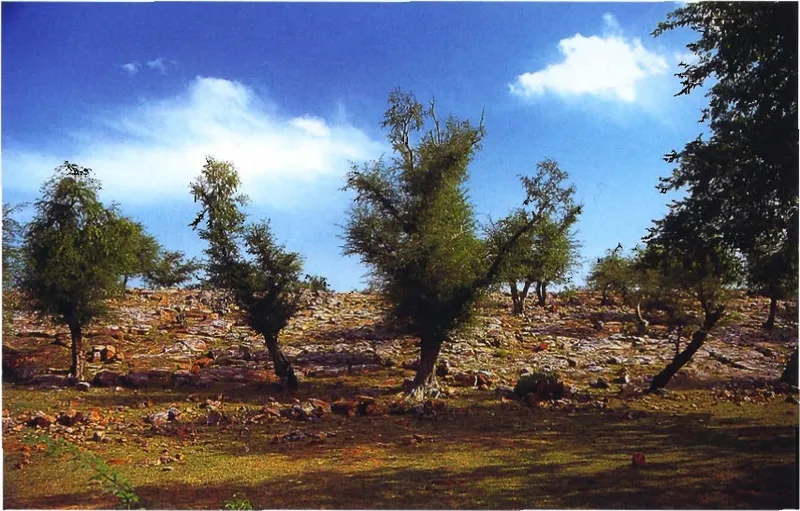
Govardhana
गोवर्धनGovardhana is the hill that Kṛṣṇa lifted with one hand and held up for seven days, so that the people and cows of Vraja could shelter under it from Indra's rain.
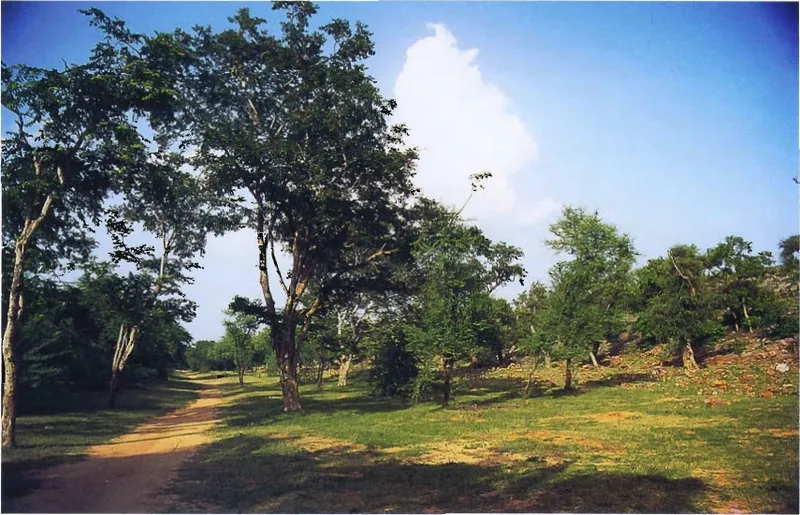
Govardhana parikramā path
गोवर्धन परिक्रमा मार्गThe Govardhana parikramā path is the circuit round Govardhana Hill that pilgrims walk; a parikramā is a walk round a holy place in worship.
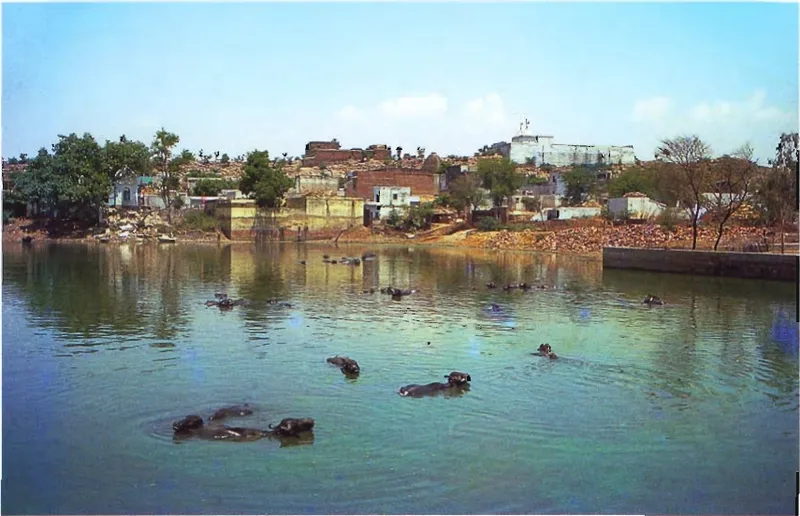
Aniyora
आन्यौरAniyora is a village near Govardhana Hill that present-day guides place on the parikramā path, the walk around the hill, about two miles south of the town of Govardhana.
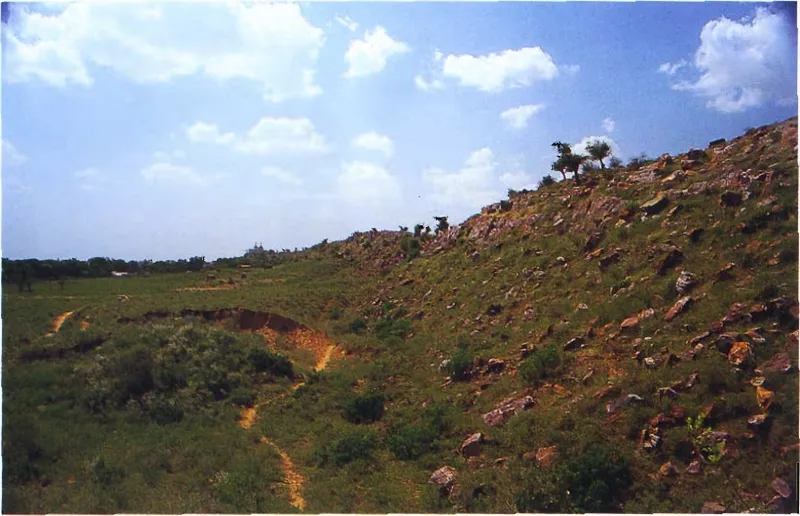
Annakūṭa-kṣetra
अन्नकूट-क्षेत्रAnnakūṭa-kṣetra, the field of the Annakūṭa, is the name that the guidebook Govardhana Hill (2001) gives to the stretch of Govardhana Hill from Dāna-nivartana-kuṇḍa up to …
Annakūṭa-sthalī
अन्नकूट-स्थलीAnnakūṭa-sthalī, the place of the Annakūṭa, the hill of food offered to Govardhana, is the name that the guidebook Śrī Vraja-maṇḍala Parikramā (2007) gives to a place bes …
Impressions of the Vrajavāsīs' bowls (Aniyora)
व्रजवासियों के कटोरों के चिह्न (आन्यौर)Indradhvaja-vedī
इन्द्रध्वज-वेदीIndradhvaja-vedī, the altar of Indra's banner, is the place on the circuit of Govardhana where, according to the Bhakti-ratnākara, Nanda Mahārāja used to perform the wors …
Saṅkarṣaṇa-kuṇḍa (Aniyora)
संकर्षण-कुण्ड (आन्यौर)Saṅkarṣaṇa-kuṇḍa is a pond that bears a name of Lord Balarāma, Saṅkarṣaṇa.
Dāna-nivartana-kuṇḍa
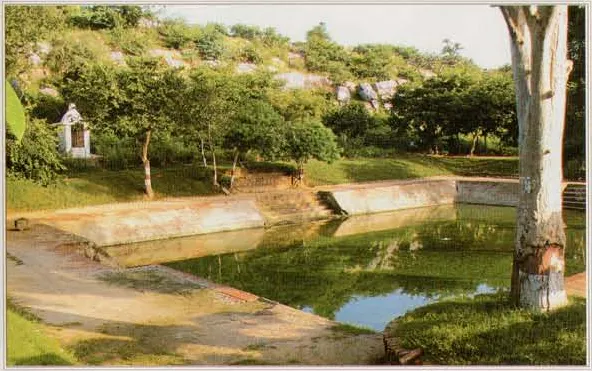
दान-निवर्तन-कुण्डDāna-nivartana-kuṇḍa is a lake (kuṇḍa) of Govardhana, some distance from Dāna-ghāṭī, where, according to the guidebook Govardhana Hill (2001), the stretch of the hill cal …
Śakra-kuṇḍa
शक्र-कुण्डQuestions and answers
He stopped the cowherds' sacrifice to Indra and had them worship the cows, the brāhmaṇas and Govardhana Hill instead. Śrīla Prabhupāda explains that the cows receive their grass from the hill, which is the representative of God.[1, 10]
The hill of food offered at Govardhana-pūjā. In the Bhāgavatam Kṛṣṇa, in a huge form, declared that He was the hill and ate the abundant offerings. Śrīla Prabhupāda describes the temples preparing and distributing huge quantities of food on the day.[4–9]
According to the ācāryas and the Purāṇas, on the first day of the bright half of Kārttika, the day after the Dīpāvalī new moon. Śrīla Jīva Gosvāmī and Śrīla Viśvanātha Cakravartī Ṭhākura date Kṛṣṇa's first worship to that day, and the Skanda, Padma and Nārada Purāṇas fix the yearly rite on it.[11 +5]
Śrīla Viśvanātha Cakravartī Ṭhākura says He was seven years old.[12]
The Bhāgavatam names no place. The Bhakti-ratnākara and the guidebooks name the village of Āniyora near the hill; other works place it differently without naming a village.[6 +6]
Kṛṣṇa Himself declared that He was the hill and bowed to it with the people of Vraja. Śrīla Prabhupāda says that Kṛṣṇa called Govardhana-pūjā as good as worship of Him.[4, 7]
Sources
- Śrīmad-Bhāgavatam 10.24.25, GRETIL
- Śrīmad-Bhāgavatam 10.24.32-33, GRETIL
- Garga-saṁhitā, Girirāja-khaṇḍa (3), adhyāya 2, verse 19, Sanskrit Wikisource
- Śrīla Prabhupāda, Kṛṣṇa, the Supreme Personality of Godhead (Kṛṣṇa book), Chapter 24, Worshiping Govardhana Hill · vedabase.io
- Śrīla Prabhupāda, Śrī Caitanya-caritāmṛta, Madhya-līlā 4.86, purport · vedabase.io
- Śrīmad-Bhāgavatam 10.24.35, GRETIL
- Śrīmad-Bhāgavatam 10.24.36, GRETIL
- Garga-saṁhitā, Girirāja-khaṇḍa (3), adhyāya 2, verse 21, Sanskrit Wikisource
- Govardhana Hill: India's Most Sacred Mountain (2001), Rajasekhara dasa Brahmacari, PDF p. 26
- Śrīla Prabhupāda, Teachings of Lord Kapila, the Son of Devahūti, Chapter 17, under Text 42 (ŚB 3.25.42) · vedabase.io
- Śrīla Sanātana Gosvāmī, Śrīla Jīva Gosvāmī: commentary on ŚB 10.24.1, Bhagavata Vidya Pith edition, ed. Bhagavata Rishi and Krishna Shankar Shastri, 1996
- Śrīla Viśvanātha Cakravartī Ṭhākura: commentary on ŚB 10.29.1
- Śrīla Jīva Gosvāmī: commentary on ŚB 10.45.3, Bhagavata Vidya Pith edition, ed. Bhagavata Rishi and Krishna Shankar Shastri, 1996
- Śrīla Narahari Cakravartī, Bhakti-ratnākara, Fifth Wave, 1912 ed. p. 201, 2nd ed., 1912
- Śrīla Prabhupāda, Śrī Caitanya-caritāmṛta, Madhya-līlā 18.26, purport (quoting Bhakti-ratnākara, Fifth Wave) · vedabase.io
- Garga-saṁhitā, Girirāja-khaṇḍa (3), adhyāya 8, verse 4, Sanskrit Wikisource
- Govardhana Hill: India's Most Sacred Mountain (2001), Rajasekhara dasa Brahmacari, PDF p. 91
- Śrīla Prabhupāda, Śrīmad-Bhāgavatam 1.2.26 lecture, Vṛndāvana, 6 November 1972 · vedabase.io
- Śrīmad-Bhāgavatam 10.24.1, GRETIL
- Śrīmad-Bhāgavatam 10.24.8, GRETIL
Show all 45 references
- Śrīla Sanātana Gosvāmī, Śrīla Jīva Gosvāmī: commentary on ŚB 10.24.25, Bhagavata Vidya Pith edition, ed. Bhagavata Rishi and Krishna Shankar Shastri, 1996
- Śrīmad-Bhāgavatam 10.24.24, GRETIL
- Śrīla Sanātana Gosvāmī, Śrīla Jīva Gosvāmī: commentary on ŚB 10.24.24, Bhagavata Vidya Pith edition, ed. Bhagavata Rishi and Krishna Shankar Shastri, 1996
- Śrīmad-Bhāgavatam 10.24.26, GRETIL
- Śrīmad-Bhāgavatam 10.24.27, GRETIL
- Śrīmad-Bhāgavatam 10.24.29, GRETIL
- Śrīmad-Bhāgavatam 10.24.37, GRETIL
- Baladeva Vidyābhūṣaṇa: commentary on ŚB 10.24.36, Bhagavata Vidya Pith edition, ed. Bhagavata Rishi and Krishna Shankar Shastri, 1996
- Śrīla Sanātana Gosvāmī, Śrīla Jīva Gosvāmī: commentary on ŚB 10.24.35, Bhagavata Vidya Pith edition, ed. Bhagavata Rishi and Krishna Shankar Shastri, 1996
- Śrīla Prabhupāda, Śrī Caitanya-caritāmṛta, Madhya-līlā 18.26, purport (quoting Vraja-vilāsa-stava 75) · vedabase.io
- Vṛndāvana-Dhāma Ki Jaya! (c. 1986), by Dhruva Mahārāja dāsa, PDF p. 40
- Nīla Skandhojjvala Ruci Bharair (Dvitīya Govardhanāṣṭakam) (Rūpa Gosvāmī (as the song book credits it)) · song book
- Giri Pujeyaṁ Vihita Kena Araci Śakra Padam Abhayaṁ Yena (Gopāla-campū) (Jīva Gosvāmī (as the song book credits it, attributed from its book Gopāla-campū)) · song book
- Skanda Purāṇa, 2.4.10.22-24, Sanskrit Wikisource
- Padma Purāṇa, खण्डः 6 (उत्तरखण्डः)/अध्यायः 122 vv. 29-31: Uttara-khaṇḍa 122.29-31, Sanskrit Wikisource
- Nārada Purāṇa, पूर्वार्धः/अध्यायः 110 v.110-35 to 110-37: Pūrva-bhāga, chapter 110, verses 35-37
- Śrīla Kṛṣṇadāsa Kavirāja Gosvāmī, Śrī Caitanya-caritāmṛta, CC Madhya-līlā 4.23, online edition · vedabase.io
- Śrīla Kṛṣṇadāsa Kavirāja Gosvāmī, Śrī Caitanya-caritāmṛta, CC Madhya-līlā 4.37, online edition · vedabase.io
- Śrīla Kṛṣṇadāsa Kavirāja Gosvāmī, Śrī Caitanya-caritāmṛta, CC Madhya-līlā 4.41, online edition · vedabase.io
- Śrīla Kṛṣṇadāsa Kavirāja Gosvāmī, Śrī Caitanya-caritāmṛta, CC Madhya-līlā 4.42, online edition · vedabase.io
- Śrīla Kṛṣṇadāsa Kavirāja Gosvāmī, Śrī Caitanya-caritāmṛta, CC Madhya-līlā 4.53, online edition · vedabase.io
- Śrīla Kṛṣṇadāsa Kavirāja Gosvāmī, Śrī Caitanya-caritāmṛta, CC Madhya-līlā 4.86, online edition · vedabase.io
- Varāha Purāṇa, adhyāya 164, verses 23-26, Sanskrit Wikisource
- Śrīla Sanātana Gosvāmī, Śrīla Jīva Gosvāmī, Śrīla Viśvanātha Cakravartī Ṭhākura: commentary on ŚB 10.25.19, Bhagavata Vidya Pith edition, ed. Bhagavata Rishi and Krishna Shankar Shastri, 1996
- Śrīla Viśvanātha Cakravartī Ṭhākura, Vraja-rīti-cintāmaṇi 3.18 and 3.20
Further sources
- Śrīmad-Bhāgavatam 10.24, with the Canto 10 commentaries of Śrīla Sanātana Gosvāmī, Śrīla Jīva Gosvāmī, Śrīla Viśvanātha Cakravartī Ṭhākura and Śrīla Baladeva Vidyābhūṣaṇa (Sanskrit; summarised here, not translated).
- Śrīla Prabhupāda, Kṛṣṇa, the Supreme Personality of Godhead, chapter 24; Teachings of Lord Kapila, chapter 17; lecture of 6 November 1972; Śrī Caitanya-caritāmṛta, Madhya 4 and 18.26 with purports (BBT).
- Garga-saṁhitā, Girirāja-khaṇḍa; Skanda, Padma, Nārada and Varāha Purāṇas; Vraja-rīti-cintāmaṇi; Bhakti-ratnākara, Fifth Wave (summarised here, not translated).
- Śrīla Rūpa Gosvāmī, second Govardhanāṣṭaka; Śrīla Jīva Gosvāmī, Gopāla-campū.