Gvāla-pokharā
ग्वाल-पोखरा
Also called Gopāla-kuṇḍa
- What it is
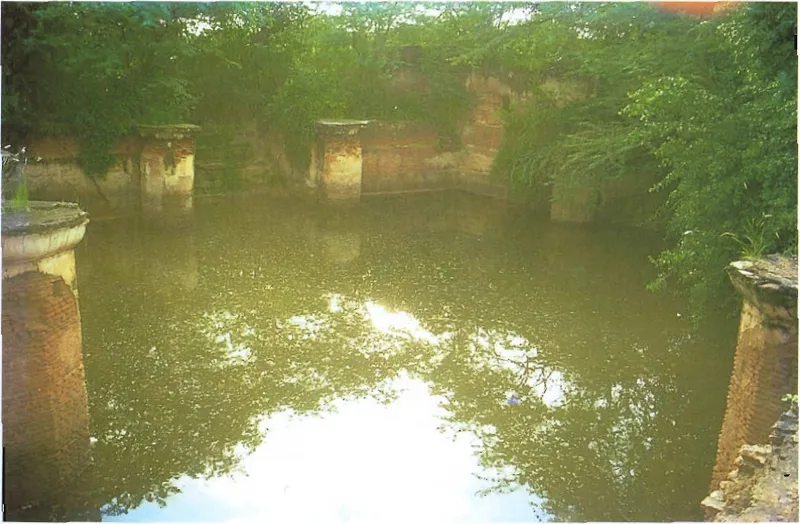
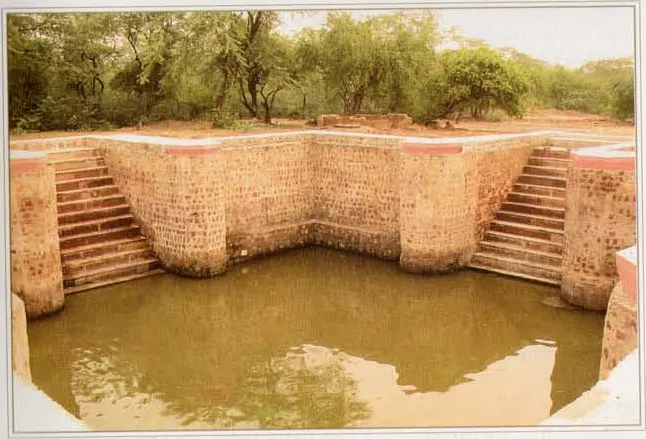
- Gvāla-pokharā is a small pond on Govardhana Hill.
- Parikramā
- Govardhana parikramā, station 8
In short
Gvāla-pokharā is a small pond on Govardhana Hill. The guidebook Govardhana Hill (2001) explains the name as the pond (pokharā) of the cowherd boys (gvāl) and says that Kṛṣṇa and His cowherd friends would sit down here to take their lunch.[1] Śrī Vraja-maṇḍala Parikramā (2007) says that He rested here at noon while herding the cows.[2 +2] The Bhāgavatam tells of such lunches and rests in the forest without naming a place.[5 +5] Govardhana Hill also calls the pond Gopāla-kuṇḍa and makes it the hill's ear; the Garga-saṁhitā names a Gopāla-kuṇḍa (kuṇḍa: sacred pond) as the hill's ear without saying where it lies, and no other source identifies it with this pond.[1 +2]
Key facts
| Kind | pokharā |
|---|---|
| Region · area | Govardhana |
| On the parikramā | Govardhana parikramā, station 8 · the route |
| Ācāryas | Śrī Caitanya Mahāprabhu |
Divine pastimes
The pastimes that the guidebooks set at this pond are told in the Bhāgavatam without a place. After the killing of the demon Aghāsura, Kṛṣṇa brought the cowherd boys to the sandy bank of a river and proposed that they eat there, since it was late and they were hungry. They sat around Him in circles, all facing Him. Śrīla Prabhupāda's Kṛṣṇa book calls the place the bank of the Yamunā; neither book names a pond on Govardhana.[5 +2]
atra bhoktavyam asmābhir divārūḍhaṃ kṣudhārditāḥ / vatsāḥ samīpe 'paḥ pītvā carantu śanakais tṛṇam
I think we should take our lunch here, since we are already hungry because the time is very late. Here the calves may drink water and go slowly here and there and eat the grass.
Translation: Śrīla A.C. Bhaktivedanta Swami PrabhupādaIn another chapter the Bhāgavatam tells how Kṛṣṇa, tired from wrestling, would lie down at the foot of a tree with a cowherd boy's lap as His pillow, while some boys massaged His feet, others fanned Him and others sang. It names no place and no time of day.[8 +2] In the rainy season, it says, He ate rice and yogurt sent from home with Balarāma and the boys, sitting on a large stone near the water, without saying which water; the Kṛṣṇa book puts that stone on the bank of the Yamunā.[13 +1]
The commentators add details but no name (summarised here, not translated). Śrīla Sanātana Gosvāmī places such rests at a cool place such as the bank of the Yamunā, under a kadamba tree, and names the boy whose lap was Kṛṣṇa's pillow: Śrīdāmā, the brother of Śrī Rādhā.[15] Śrīla Viśvanātha Cakravartī Ṭhākura writes that eating places on the bank of a kuṇḍa can be seen by everyone, most likely even today, but he does not say which kuṇḍa.[16] Śrīla Sanātana Gosvāmī and Śrīla Jīva Gosvāmī read one of the gopīs' songs as Kṛṣṇa's midday: He bathed in some great lake, ate a forest meal with His friends and sat on a rock under a great tree. They do not name the lake.[17]
Traditional accounts
According to Govardhana Hill (2001), Kṛṣṇa and His cowherd friends would sit down here and eat their lunch together, and …
Lunch and rest at the pond
According to Govardhana Hill (2001), Kṛṣṇa and His cowherd friends would sit down here and eat their lunch together, and afterwards Kṛṣṇa slipped away to meet Śrīmatī Rādhārāṇī and the gopīs, the cowherd girls, at Rādhā-kuṇḍa.[1] The guidebook Śrī Vraja-maṇḍala Parikramā (2007), which also calls the pond Bāla-pokharā, says that Kṛṣṇa rested here at noon while herding the cows, and that the cowherd boys served Him in the mood of friendship (sakhya-rasa).[2 +2]
The same book tells, without naming a source, that Kṛṣṇa, dressed as a young priest, and His brāhmaṇa friend Madhumaṅgala performed Rādhikā's worship of the Sun-god at Sūrya-kuṇḍa. Afterwards, here, the cowherd boys snatched Madhumaṅgala's laḍḍus (sweet balls), and Kṛṣṇa calmed him.[2 +2] Read more: Śrī Rādhā's worship of the Sun (Sūrya-pūjā) → The Bhāgavatam's verse on the forest lunch does not name Madhumaṅgala. Śrīla Prabhupāda names him in his purport to it, though he mentions no laḍḍus and no place:[18]
General teaching (does not name the place)When Kṛṣṇa was eating with His cowherd boyfriends, a certain bumblebee came there to take part in the eating. Thus Kṛṣṇa joked, “Why have you come to disturb My brāhmaṇa friend Madhumaṅgala? You want to kill a brāhmaṇa. This is not good.” All the boys would laugh and enjoy, speaking such joking words while eating.
Śrīla Prabhupāda, Śrīmad-Bhāgavatam, ŚB 10.13.11, purport · vedabase.io
Gopāla-kuṇḍa, the hill's ear
Govardhana Hill (2001) says that the pond is also called Gopāla-kuṇḍa and reports a saying that it forms the ears of Giri-Govardhana; no other source makes this link.[1 +1] The Garga-saṁhitā names a Gopāla-kuṇḍa among the holy places of Govardhana and, describing the hill as a body, calls that kuṇḍa its ears, but it does not say where on the hill the kuṇḍa lies.[11 +1]
Śrī Caitanya Mahāprabhu
Śrī Vraja-maṇḍala Parikramā (2007) says that Śrī Caitanya Mahāprabhu rested here for a short time on His walk around Govardhana and remembered these pastimes. The Caitanya-caritāmṛta, which tells of His circuit of the hill, does not mention the pond, so this may be the guidebook's account only.[3 +3]
Location
| Where it is | near Śyāma-kuṭī[22] Govardhana map: '4-6' (shared key number with Ratna-siṁhāsana and Śyāma-kuṭī) on the narrow upper tip of the hill[23] |
|---|---|
| On the numbered Govardhana chart | 13 (printed as “Gval Pokhara”)[24] |
Nearby places
Śyāma-kuṭī
Pictures
1 pictures
Where the sources differ
Accounts differ Where Govardhana Hill first comes out of the ground (one guidebook gives two places)
- Govardhana Hill: India's Most Sacred Mountain (2001), p. 45 (Gvāl Pokharā)'In the dense jungle behind Gvāl Pokharā, one can see where Govardhana Hill actually begins to emerge from the ground'; from there it rises to its highest point just before Aniyor
- Govardhana Hill: India's Most Sacred Mountain (2001), p. 42 (Śyāma Kuṭira)'Śyāma Kuṭira also marks the spot where Govardhana Hill first starts to appear above the ground'
More on this place
Śrī Rādhā's worship of the Sun (Sūrya-pūjā)
References
24 references
- Govardhana Hill: India's Most Sacred Mountain (2001), Rajasekhara dasa Brahmacari, PDF p. 59
- Śrī Vraja-maṇḍala Parikramā (2007), PDF p. 115
- Śrī Vraja-maṇḍala Parikramā (2007), PDF p. 116
- the undated parikramā notes Govardhana, ¶40
- Śrīmad-Bhāgavatam 10.13.6, GRETIL
- Śrīmad-Bhāgavatam 10.13.8, Bhagavata Vidya Pith edition, ed. Bhagavata Rishi and Krishna Shankar Shastri, 1996
- Śrīla Prabhupāda, Kṛṣṇa, the Supreme Personality of Godhead (Kṛṣṇa book), Chapter 13, 'The Stealing of the Boys and Calves by Brahmā' · vedabase.io
- Śrīmad-Bhāgavatam 10.15.16, GRETIL
- Śrīmad-Bhāgavatam 10.15.17, GRETIL
- Śrīla Prabhupāda, Kṛṣṇa, the Supreme Personality of Godhead (Kṛṣṇa book), Chapter 15, 'The Killing of Dhenukāsura' · vedabase.io
- Garga-saṁhitā, Girirāja-khaṇḍa (3), adhyāya 8, verse 6, Sanskrit Wikisource
- Garga-saṁhitā, Girirāja-khaṇḍa (3), adhyāya 7, verse 8, Sanskrit Wikisource
- Śrīmad-Bhāgavatam 10.20.29, GRETIL
- Śrīla Prabhupāda, Kṛṣṇa, the Supreme Personality of Godhead (Kṛṣṇa book), Chapter 20, 'Description of Autumn' · vedabase.io
- Śrīla Sanātana Gosvāmī: commentary on ŚB 10.15.16'), Bhagavata Vidya Pith edition, ed. Bhagavata Rishi and Krishna Shankar Shastri, 1996
- Śrīla Viśvanātha Cakravartī Ṭhākura: commentary on ŚB 10.20.29–31, Bhagavata Vidya Pith edition, ed. Bhagavata Rishi and Krishna Shankar Shastri, 1996
- Śrīla Sanātana Gosvāmī: commentary on ŚB 10.35.10–11, Bhagavata Vidya Pith edition, ed. Bhagavata Rishi and Krishna Shankar Shastri, 1996
- Śrīla Prabhupāda, Śrīmad-Bhāgavatam, ŚB 10.13.11, purport · vedabase.io
- the undated parikramā notes Govardhana, ¶41
- Śrīla Kṛṣṇadāsa Kavirāja Gosvāmī, Śrī Caitanya-caritāmṛta, CC Madhya-līlā 18.32, online edition · vedabase.io
- Govardhana Hill: India's Most Sacred Mountain (2001), Rajasekhara dasa Brahmacari, PDF p. 131
- Śrī Vraja-maṇḍala Parikramā (2007), p. 204-205
- Śrī Vraja-maṇḍala Parikramā (2007), p. 194-195
- Numbered list of the Govardhana sites (key of the Govardhana chart)