Śrī Rādhā's worship of the Sun (Sūrya-pūjā)
श्री राधा की सूर्य-पूजा
In short
The ācāryas' poems of Kṛṣṇa's daily pastimes tell that at midday Śrīmatī Rādhārāṇī goes to worship the Sun. Kṛṣṇa comes dressed as a young brāhmaṇa priest to lead the worship. The poems do not name the place. The Bhakti-ratnākara sets it at the Sun temple of Sūrya-kuṇḍa village.[1–3] Śrī Vraja-maṇḍala Parikramā (2007) puts Sūrya-kuṇḍa about four miles north of Rādhā-kuṇḍa.[4, 5]
On this page
At a glance
- The place: Sūrya-kuṇḍa, "the pond of the Sun", today also called Choṭā Bharanā (Chhota Bharna). A temple of Sūryadeva, the sun-god, stands there, according to Śrī Vraja-maṇḍala Parikramā (2007).[4, 5]
- Three works of the Gosvāmīs and ācāryas tell the worship, with Kṛṣṇa as the priest: the Lalita-mādhava, the Govinda-līlāmṛta and the Kṛṣṇa-bhāvanāmṛta.[6–9]
- None of these works names Sūrya-kuṇḍa. The Bhakti-ratnākara shows the Sun temple of Sūryakuṇḍa village as the place.[3, 6–9]
- The flower garden of the worship, the Madana-raṇa-vāṭikā, is already named in the Govinda-līlāmṛta.[10–12]
- In the nineteenth century, according to the guidebooks, two Vaiṣṇavas lived and chanted at the kuṇḍa: Śrī Madhusūdana dāsa Bābājī and Śrīla Jagannātha dāsa Bābājī.[5, 13]
- The books do not agree on how often the worship takes place: every day, especially on Sundays, or once.[1 +4]
Is Śrī Rādhā's Sun worship in the Bhāgavatam?
The Śrīmad-Bhāgavatam does not tell this pastime. Neither its Tenth Canto nor its commentaries speak of the gopīs worshipping the Sun, and no chapter of Śrīla Prabhupāda's Kṛṣṇa book tells it. It belongs to the midday pastimes as the Gosvāmīs and later ācāryas, the teachers of the Gauḍīya tradition, describe them.[6–10]
A Purāṇa, one of the old scriptures, does speak of it. The Padma Purāṇa (Pātāla-khaṇḍa 83) has Vṛndā describe the daily pastimes to Nārada. In it Rādhā goes with Her sakhīs, Her close girlfriends, to the Sun's house. Kṛṣṇa comes there dressed as a brāhmaṇa and, when Her friends ask, performs the Sun worship. It names no path, village or kuṇḍa (summarised here, not translated).[15, 16]
This article keeps to simple things. It tells which books speak of the pastime, where the place is, who has lived there, and how often the books say the worship takes place.[4–9]
Which works tell the pastime?
Śrīla Rūpa Gosvāmī tells it in a play. In the second act of his Lalita-mādhava, Vṛndā tells Paurṇamāsī that today, the day of the Sun, Rādhikā will surely go to his pavilion. Jaṭilā, Rādhā's mother-in-law, goes ahead to make the pavilion ready (summarised here, not translated).[6–9] Śrīla Prabhupāda names the Lalita-mādhava among the books written by Śrī Rūpa Gosvāmī.[17]
Śrīla Kṛṣṇadāsa Kavirāja Gosvāmī, the author of the Caitanya-caritāmṛta, tells it in his Govinda-līlāmṛta, a long poem on Rādhā and Kṛṣṇa's pastimes through the day. In its eighth canto, Rādhā walks through the forest with Her sakhīs at midday. She comes to an image of the Sun in a kuñja, a bower, in the middle of a flower garden called the Madana-raṇa-vāṭikā.[1 +2]
With devotion and folded hands She bows to the Sun and prays to him. Two maidservants stay behind with the things needed for the Sūrya-pūjā, the worship of the Sun (8.67–70). The poem does not say where the garden is.[10]
Its eighteenth canto tells the worship itself, at a Sun temple. Kṛṣṇa is the young priest who leads it, and His friend Madhumaṅgala comes with Him (18.54–92).[1]
Śrīla Viśvanātha Cakravartī Ṭhākura tells the same worship at the Sun temple in his Kṛṣṇa-bhāvanāmṛta (15.53–66), where it follows the dice game of Rādhā and Kṛṣṇa. In an earlier canto of the same poem, Rādhā and Her friends come to the garden called Mada-raṇa, enter the Sun's home there and worship the Sun (8.55–57).[2 +3] Read more: The dice game of Rādhā and Kṛṣṇa: the books and the places →
In both poems Jaṭilā comes to the temple. She asks the young priest from Mathurā, who is said to be a student of the sage Garga, to perform the worship. Both poems are summarised here, not translated.[1, 2]
In the prayers of Śrīla Raghunātha dāsa Gosvāmī
Śrīla Raghunātha dāsa Gosvāmī longs to serve at this worship. In his prayers, the Vilāpa-kusumāñjali, he pictures Rādhā among Her friends, about to offer arghya, a respectful offering of water, to the Sun on an altar of sun-stones. He prays that he, as Her maidservant, may hand Her the things made ready (verse 45).[19, 20]
In another verse he longs to hear the old Mukharā call out that the time of Her Sun worship has come (verse 83). He names no place (summarised here, not translated).[19, 20]
In his Dāna-keli-cintāmaṇi the same Gosvāmī has Rādhā worship the Sun at Her own kuṇḍa. Then She sets out with fresh butter for Bhāguri's sacrifice at Govinda-kuṇḍa, the sacrifice at which the toll pastime takes place (verses 8–10; summarised here, not translated).[14 +2] Read more: Kṛṣṇa's toll pastime (dāna-līlā) at Govardhana and Varṣāṇā →
Why does Śrī Rādhā worship the Sun?
The Bhakti-ratnākara gives the devotional reason in one line. This kind Sun gives love for Kṛṣṇa, it says, and it asks who would not worship him.[3]
It then quotes a Sanskrit verse that greets the Sun as the father of the Yamunā, the remover of all diseases, and the giver of rati, attachment, for Kṛṣṇa. The book does not say where the verse comes from (summarised here, not translated).[3]
The Yamunā as the Sun's daughter also appears in Śrīla Prabhupāda's Kṛṣṇa book. There the river in person tells Kṛṣṇa and Arjuna who she is.[23]
Names this placeThe beautiful girl was the river Yamunā personified. She replied, “Sir, I am the daughter of the sun god, and I am now performing penance and austerity to have Lord Viṣṇu as my husband.”
Śrīla Prabhupāda, Kṛṣṇa, the Supreme Personality of Godhead, ch. 58 "Five Queens Married by Kṛṣṇa" · vedabase.io
Śrīla Prabhupāda explains, as a general teaching and not about this place, how a devotee of Kṛṣṇa thinks of the sun-god. A Vaiṣṇava respects the demigods in the way the Brahma-saṁhitā teaches, where the sun moves by Govinda's order. But he never takes any of them to be equal to Kṛṣṇa.[24]
General teaching (does not name the place)“Vaiṣṇavas can also worship all these demigods, but only on the principles of the Brahma-saṁhitā, which is recommended by Śrī Caitanya Mahāprabhu. … All the demigods are servants of Kṛṣṇa; they are not equal with Kṛṣṇa.”
Śrīla Prabhupāda, Śrī Caitanya-caritāmṛta, Ādi-līlā 7.157, purport · vedabase.io
Where is Sūrya-kuṇḍa?
Neither of the two poems names Sūrya-kuṇḍa. The link with the kuṇḍa comes from three other sources: a commentary, the Bhakti-ratnākara and the guidebooks.[6–9, 18]
- The commentary. In the Kṛṣṇa-bhāvanāmṛta, Madhumaṅgala tells Kṛṣṇa that the sage Garga will come to the Sūrya-tīrtha to bathe (8.63). The verse says only Sūrya-tīrtha, "the holy bathing place of the Sun". Śrī Kṛṣṇadeva Sārvabhauma's commentary explains it as the Sūrya-kuṇḍa in the Madana-raṇa-vāṭikā. That is his reading, and he does not say where the garden is (summarised here, not translated).[12, 18]
- *The Bhakti-ratnākara.* Śrīla Narahari Cakravartī Ṭhākura describes a pilgrimage through Vraja. On it, Śrīla Rāghava Paṇḍita shows Śrīla Śrīnivāsa Ācārya the Sūryakuṇḍa village and the image of the Sun in a temple in the forest. Here, he says, Rāī (Śrī Rādhā) worships the Sun with Her sakhīs, and Kṛṣṇa, having become the priest, leads the worship (summarised here, not translated).[3, 25]
- The guidebooks. Śrī Vraja-maṇḍala Parikramā (2007) tells the pastime at Sūrya-kuṇḍa and describes a temple of Sūryadeva there. It says that the bower of the worship beside the kuṇḍa is also called the Madana-raṇa-vāṭikā. It places the pastime at midday; afterwards Rādhikā returns to Jāvaṭa and Kṛṣṇa to His friends.[1 +5]
The garden's name is much older than the guidebook. The Govinda-līlāmṛta names the flower garden called Madana-raṇa-vāṭikā, and the Kṛṣṇa-bhāvanāmṛta the garden called Mada-raṇa. In both poems the Sun's image or home stands in it. But neither poem says where the garden is.[10–12]
The path from Rādhā-kuṇḍa
The Bhakti-ratnākara remembers the pastime once more at Rādhā-kuṇḍa. One midday Śrīla Śrīnivāsa Ācārya and Śrīla Narottama dāsa Ṭhākura were walking among the bowers there. Śrīnivāsa told Narottama that Śrī Rādhikā goes by this path to the Sun temple to worship the Sun. At that very moment they heard the sound of ankle-bells.[26]
The passage does not say where that Sun temple is. The book speaks of paths to it from Yāvaṭa and from Rādhā-kuṇḍa. The only Sun temple it shows is the one at Sūryakuṇḍa village.[3, 26]
Gvāla-pokharā
One more story begins at the kuṇḍa. According to the local tradition recorded in the undated parikramā notes Govardhana, Kṛṣṇa and Madhumaṅgala went back from the worship to Gvāla-pokharā, "the cowherds' pond". There the cowherd boys grabbed Madhumaṅgala's laḍḍūs (sweets). Śrī Vraja-maṇḍala Parikramā says that Kṛṣṇa rested at that pond at noon while herding the cows, and His friends served Him.[27–29]
Who performed bhajana at Sūrya-kuṇḍa?
Pilgrims also come to the kuṇḍa for the Vaiṣṇavas who lived beside it. According to Śrī Vraja-maṇḍala Parikramā (2007), Śrī Madhusūdana dāsa Bābājī performed his bhajana, his worship and chanting, on the west bank. His disciple Śrīla Jagannātha dāsa Bābājī also did bhajana there for a long time. Later he moved to Navadvīpa in Bengal, where his bhajana-kuṭī (hut for worship) and samādhi (tomb) are, at Koladvīpa.[5, 13]
The historian A. W. Entwistle (1987) also places both Vaiṣṇavas at this kuṇḍa in the nineteenth century. He does not point to a dated record.[5, 13]
Śrīla Jagannātha dāsa Bābājī belongs to Śrīla Prabhupāda's own line of teachers. In the introduction to the Caitanya-caritāmṛta, Śrīla Prabhupāda writes:[30]
General teaching (does not name the place)“Śrīla Viśvanātha Cakravartī Ṭhākura accepted Śrīla Jagannātha dāsa Bābājī, the spiritual master of Śrīla Bhaktivinoda Ṭhākura, who in turn accepted Śrīla Gaurakiśora dāsa Bābājī, the spiritual master of Oṁ Viṣṇupāda Śrīla Bhaktisiddhānta Sarasvatī Gosvāmī Mahārāja, the divine master of our humble self.”
Śrīla Prabhupāda, Śrī Caitanya-caritāmṛta, Ādi-līlā, Chapter 1 ('The Spiritual Masters'), introduction · vedabase.io
Vṛndāvana, the Playground of God (2010) tells more. At Sūrya-kuṇḍa, it says, Śrīla Jagannātha dāsa Bābājī worshipped for about ten years the Ṣaḍbhuja, the six-armed Deity of Mahāprabhu, which his disciple Bihārī dāsa had brought from Rādhā-kuṇḍa. When he moved to Bengal, the Deity was given to Śrī Narottama dāsa Bābājī, and He was worshipped in that Vaiṣṇava's temple in Vṛndāvana.[31] Read more: The six-armed form of Śrī Caitanya Mahāprabhu →
How should these pastimes be heard?
Some film-makers once wished to show Kṛṣṇa's pastimes with the songs of the poet Jayadeva. Śrīla Prabhupāda told them that Jayadeva's poetry of Kṛṣṇa and Śrī Rādhā is very confidential, not meant for ordinary people. To present it as something ordinary, he said, is to distort it.[32]
General teaching (does not name the place)“Jayadeva's, that poetry, that Kṛṣṇa is begging pardon from Rādhārāṇī, that is also very confidential. … We must understand it is very confidential thing. It is not for ordinary men. If we present as ordinary thing, that is distortion.”
Śrīla Prabhupāda, Room Conversation with Film Producer about Kṛṣṇa Lila, Bhubaneswar, 22 January 1977 · vedabase.io
For this reason the worship at Sūrya-kuṇḍa is only outlined here: its books, its place and its devotees.[6–9, 32]
Where the sources differ
On how often Śrī Rādhā comes, the books give three answers.[1 +5]
- Every day. In the Kṛṣṇa-bhāvanāmṛta, Jaṭilā says the young priest will have Rādhā worship every day. The Govinda-līlāmṛta counts the worship among the pastimes of each midday. Vṛndāvana, the Playground of God (2010) also says every day.[2, 31]
- Especially on Sundays. So says Śrī Vraja-maṇḍala Parikramā (2007). The Lalita-mādhava also sets its scene on the day of the Sun.[1 +4]
- Once, on a Sunday. A note printed after verse 10 of the Dāna-keli-cintāmaṇi, which the printed Sanskrit text gives as the editor Haridās Dās's, says this. In the note Jaṭilā sends Rādhā to Sūrya-kuṇḍa to bathe and worship the Sun before Bhāguri's sacrifice. The verse itself says only that She worshipped the Sun and set out from Her own kuṇḍa.[14]
- No answer. The Bhakti-ratnākara gives no number of days.[3]
Accounts differ How often Rādhā worships the Sun at Sūrya-kuṇḍa.
- Śrī Vraja-maṇḍala Parikramā (2007)Especially on Sundays.
- Vṛndāvana, the Playground of God (2010)Every day.
- Bhakti-ratnākara, Fifth Wave (1912 ed. p. 212)No frequency given.
- Kṛṣṇa-bhāvanāmṛta 15.66 (Śrīla Viśvanātha Cakravartī Ṭhākura)Jaṭilā says the brāhmaṇa boy (Kṛṣṇa in disguise) will make her daughter-in-law worship 'every day' (pratidinaṁ); the Sun temple is not located.
Accounts differ How often Rādhā came to Sūrya-kuṇḍa for the Sūrya worship.
- Śrī Vraja-maṇḍala Parikramā (2007)Rādhikā used to come here with Her sakhīs, 'especially on Sundays', on the pretext of worshipping Mitradeva (Sūryadeva).
- Vṛndāvana, the Playground of God (2010)Sūrya-kuṇḍa is where Śrīmatī Rādhārāṇī 'goes every day to worship the sun god'.
- Bhakti-ratnākara (Fifth Wave)Rādhā worships Sūrya there with Her sakhīs; no day or frequency is given.
There are also open questions about the kuṇḍa's devotees. Śrī Vraja-maṇḍala Parikramā says that Śrīla Bhaktivinoda Ṭhākura met Śrīla Jagannātha dāsa Bābājī at Sūrya-kuṇḍa. Another guidebook, and this website's biography of Śrīla Jagannātha dāsa Bābājī, place their first meeting in Vṛndāvana, about 1880. It is not certain.[5, 31]
Accounts differ Where Śrīla Bhaktivinoda Ṭhākura met (first met) Śrīla Jagannātha dāsa Bābājī.
- Śrī Vraja-maṇḍala Parikramā (2007)At Sūrya-kuṇḍa.
- Vṛndāvana, the Playground of God (2010)First met in Vṛndāvana, around 1880; shortly after that Śrīla Jagannātha dāsa Bābājī returned to Navadvīpa.
The guidebooks also say that brass Deities of Gaura and Nitāi, later called Soṇā Gaurāṅga, "golden Gaurāṅga", were installed for Śrīla Jagannātha dāsa Bābājī at Sūrya-kuṇḍa. Thieves tried to steal Them because They shone like gold, and later They were taken to Vṛndāvana. The books tell differently how the theft failed and who cared for Them.[13 +3]
Accounts differ The Soṇā Gaurāṅga Deities: how the theft failed and what happened to the Deities.
- Vṛndāvana, the Playground of God (2010)Made when Śrīla Jagannātha dāsa Bābājī, living at Sūrya-kuṇḍa, asked his disciple Bihārī dāsa to install Deities; the dacoits broke in but could not lift Them; disturbed by the risk, he had Bihārī donate Them to a Gosvāmī family in Vṛndāvana town, where They still are.
- The Color Guide to Vṛndāvana (2000)Moved to Vṛndāvana when thieves tried to steal Them; when Śrīla Jagannātha dāsa Bābājī returned to Bengal They were looked after by a local brāhmaṇa.
- the undated parikramā notes VṛndāvanaSent to Vṛndāvana when thieves who thought They were gold tried to steal Them.
- Entwistle (1987), printed p. 358 (historian)The local people built a hut and a small temple for Siddha Jagannātha dāsa Bābā, in which images of Caitanya and Nityānanda were installed; no theft or move is mentioned.
Places in this article
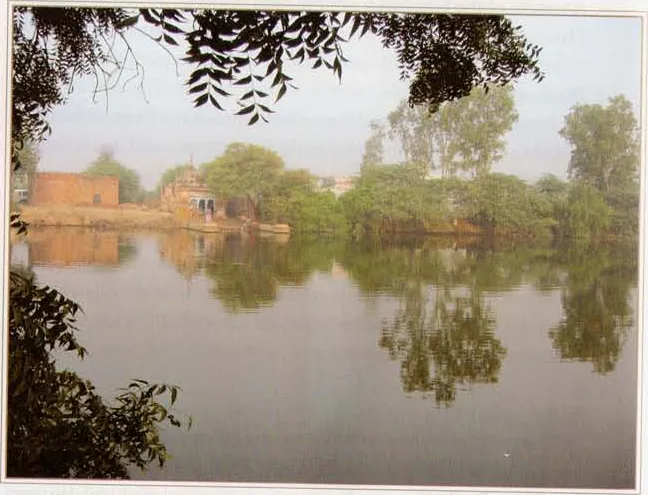
Sūrya-kuṇḍa (Choṭā Bharanā)
सूर्य-कुण्ड (छोटा भरना)Sūrya-kuṇḍa, the kuṇḍa of the Sun, lies about four miles north of Rādhā-kuṇḍa and is today also called Choṭā Bharanā; a temple of Sūryadeva, the sun-god, stands there.
Sūryadeva Mandira (Sūrya-kuṇḍa, Choṭā Bharanā)
सूर्यदेव मन्दिर (सूर्य-कुण्ड, छोटा भरना)The Sūryadeva Mandira is a temple of Sūryadeva, the sun-god, at Sūrya-kuṇḍa (Choṭā Bharanā), about four miles north of Rādhā-kuṇḍa, according to the guidebook Śrī Vraja-m …
Madana-raṇa-vāṭikā
मदन-रण-वाटिकाMadana-raṇa-vāṭikā is a kuñja, a grove, that the guidebook Śrī Vraja-maṇḍala Parikramā (2007) places next to Sūrya-kuṇḍa at Choṭā Bharanā.
Gvāla-pokharā
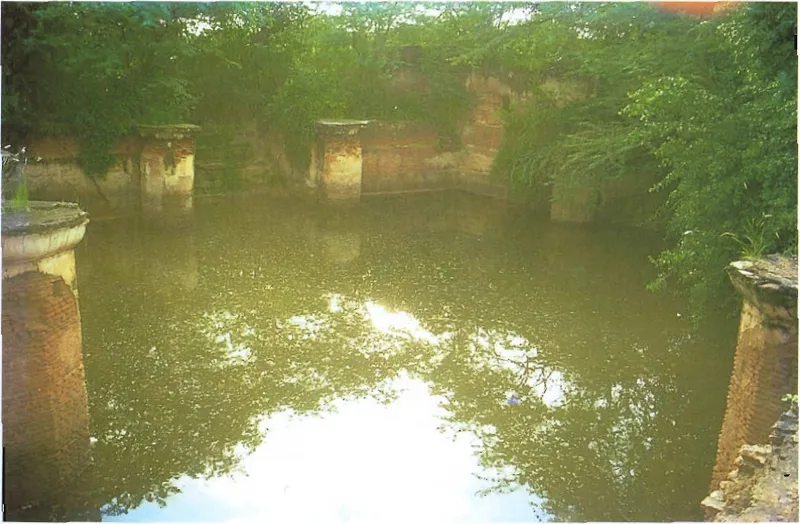
ग्वाल-पोखराGvāla-pokharā is a small pond on Govardhana Hill.
Rādhā-kuṇḍa
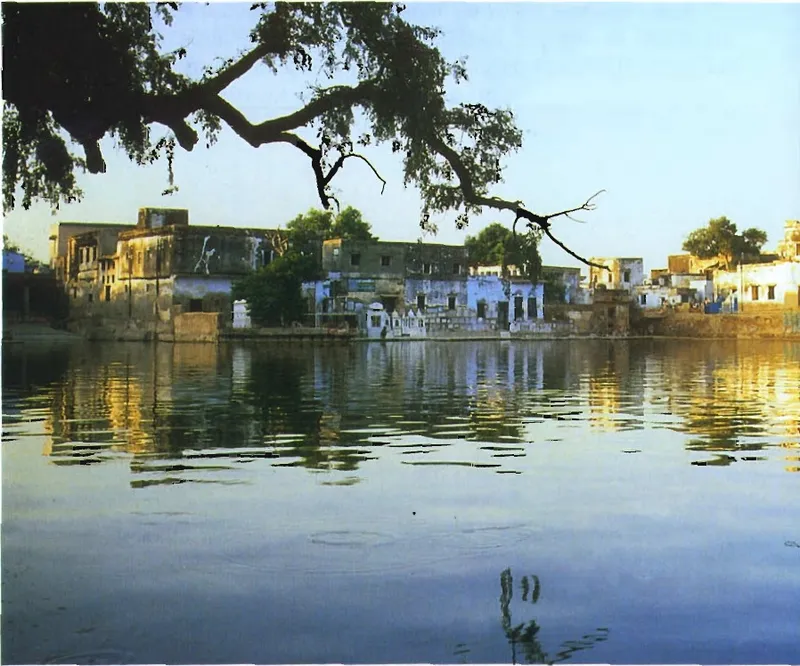
राधा-कुण्डRādhā-kuṇḍa is the lake of Śrī Rādhā at the foot of Govardhana Hill, in the village of Āriṭa.
Questions and answers
The ācāryas tell the worship as part of Her midday pastimes, with Kṛṣṇa as the priest. The Bhakti-ratnākara adds that this kind Sun gives love for Kṛṣṇa, and quotes a verse that greets him as the giver of attachment to Kṛṣṇa (summarised here, not translated).[3, 6–9]
About four miles north of Rādhā-kuṇḍa, at the place today also called Choṭā Bharanā, with a temple of Sūryadeva, according to Śrī Vraja-maṇḍala Parikramā (2007). The Bhakti-ratnākara calls it Sūryakuṇḍa village.[3–5]
Śrīla Rūpa Gosvāmī's Lalita-mādhava (Act 2), Śrīla Kṛṣṇadāsa Kavirāja Gosvāmī's Govinda-līlāmṛta (cantos 8 and 18) and Śrīla Viśvanātha Cakravartī Ṭhākura's Kṛṣṇa-bhāvanāmṛta (cantos 8 and 15). The Padma Purāṇa also speaks of the Sun's house.[6 +5]
No. It is not told in the Tenth Canto or its commentaries, nor in Śrīla Prabhupāda's Kṛṣṇa book. It comes from the ācāryas' works on the daily pastimes.[6–9]
It is the flower garden in which the Sun's image or home stands in the Govinda-līlāmṛta and the Kṛṣṇa-bhāvanāmṛta. Śrī Vraja-maṇḍala Parikramā (2007) gives the name to the bower beside Sūrya-kuṇḍa.[5 +4]
According to the guidebooks, Śrī Madhusūdana dāsa Bābājī and his disciple Śrīla Jagannātha dāsa Bābājī. They performed bhajana on the west bank, and Śrīla Jagannātha dāsa Bābājī later moved to Navadvīpa.[5, 13]
Sources
- Śrīla Kṛṣṇadāsa Kavirāja Gosvāmī, Govinda-līlāmṛta, 18.56-58, after the editions of Haridas Das and Haridas Shastri
- Śrīla Viśvanātha Cakravartī Ṭhākura, Kṛṣṇa-bhāvanāmṛta, 15.58 with the ṭīkā, pañcadaśaḥ sargaḥ, mādhyāhnika-līlāsvādana; the index labels it '(15) caturdaśaḥ sargaḥ'), after the edition of Radhikanath Goswami, Vrindavan, 1906
- Śrīla Narahari Cakravartī, Bhakti-ratnākara, Fifth Wave, 1912 ed. p. 212, 2nd ed., 1912
- Śrī Vraja-maṇḍala Parikramā (2007), PDF p. 136
- Śrī Vraja-maṇḍala Parikramā (2007), PDF p. 137
- Śrīla Rūpa Gosvāmī, Lalita-mādhava, Act 2, speeches 24, 32, 38 and 42', prose after verse 9)
- Śrīla Kṛṣṇadāsa Kavirāja Gosvāmī, Govinda-līlāmṛta, 18.55–18.59, after the editions of Haridas Das and Haridas Shastri
- Śrīla Kṛṣṇadāsa Kavirāja Gosvāmī, Govinda-līlāmṛta, 18.69–18.70 with the ṭīkā, after Haridas Shastri's edition, 1981
- Śrīla Viśvanātha Cakravartī, Kṛṣṇa-bhāvanāmṛta, 15.57–15.58 with the ṭīkā caturdaśaḥ sargaḥ'), after the edition of Radhikanath Goswami, Vrindavan, 1906
- Śrīla Kṛṣṇadāsa Kavirāja Gosvāmī, Govinda-līlāmṛta, 8.67-68 and 8.70, after the editions of Haridas Das and Haridas Shastri
- Śrīla Viśvanātha Cakravartī, Kṛṣṇa-bhāvanāmṛta, 8.55–8.57 saptamaḥ sargaḥ'), after the edition of Radhikanath Goswami, Vrindavan, 1906
- Śrīla Viśvanātha Cakravartī, Kṛṣṇa-bhāvanāmṛta, 8.63 with the ṭīkā saptamaḥ sargaḥ'), after the edition of Radhikanath Goswami, Vrindavan, 1906
- A. W. Entwistle, §25 'Nimgaon and other places in the vicinity of Govardhan', printed p. 358, Egbert Forsten, Groningen, 1987
- Śrīla Raghunātha dāsa Gosvāmī, Dāna-keli-cintāmaṇi, v.10 and the note after it
- Padma Purāṇa, Pātāla-khaṇḍa 83.46-47, Sanskrit Wikisource
- Padma Purāṇa, Pātāla-khaṇḍa 83.77-79, Sanskrit Wikisource
- Śrīla Prabhupāda, Śrī Caitanya-caritāmṛta, Madhya-līlā 1.38, translation · vedabase.io
- Śrīla Viśvanātha Cakravartī Ṭhākura, Kṛṣṇa-bhāvanāmṛta, 8.63 with the ṭīkā, aṣṭamaḥ sargaḥ, saṅgava-līlāsvādana; the index labels it '(8) saptamaḥ sargaḥ'), after the edition of Radhikanath Goswami, Vrindavan, 1906
- Śrīla Raghunātha dāsa Gosvāmī, Vilāpa-kusumāñjali 45
- Śrīla Raghunātha dāsa Gosvāmī, Vilāpa-kusumāñjali 83
Show all 35 references
- Śrīla Raghunātha dāsa Gosvāmī, Dāna-keli-cintāmaṇi, vv. 8–10
- Śrīla Raghunātha dāsa Gosvāmī, Dāna-keli-cintāmaṇi, verses 6-7
- Śrīla Prabhupāda, Kṛṣṇa, the Supreme Personality of Godhead, ch. 58 "Five Queens Married by Kṛṣṇa" · vedabase.io
- Śrīla Prabhupāda, Śrī Caitanya-caritāmṛta, Ādi-līlā 7.157, purport · vedabase.io
- Śrīla Narahari Cakravartī, Bhakti-ratnākara, Fifth Wave, 1912 ed. p. 211, 2nd ed., 1912
- Śrīla Narahari Cakravartī, Bhakti-ratnākara, Sixth Wave, 1912 ed. p. 467, 2nd ed., 1912
- the undated parikramā notes Govardhana, ¶40
- Śrī Vraja-maṇḍala Parikramā (2007), PDF p. 115
- Śrī Vraja-maṇḍala Parikramā (2007), PDF p. 116
- Śrīla Prabhupāda, Śrī Caitanya-caritāmṛta, Ādi-līlā, Chapter 1 ('The Spiritual Masters'), introduction · vedabase.io
- Vṛndāvana, the Playground of God (2010), Bhakti Caitanya Svāmī, PDF p. 175
- Śrīla Prabhupāda, Room Conversation with Film Producer about Kṛṣṇa Lila, Bhubaneswar, 22 January 1977 · vedabase.io
- Vṛndāvana, the Playground of God (2010), Bhakti Caitanya Svāmī, PDF p. 187
- The Color Guide to Vṛndāvana (2000), Written and Photographed by Rājaśekhara dāsa Brahmacārī, PDF p. 124
- the undated parikramā notes Vṛndāvana, ¶241
Further sources
- Śrīla Rūpa Gosvāmī, Lalita-mādhava, Act 2; Śrīla Kṛṣṇadāsa Kavirāja Gosvāmī, Govinda-līlāmṛta 8 and 18; Śrīla Viśvanātha Cakravartī Ṭhākura, Kṛṣṇa-bhāvanāmṛta 8 and 15, with the commentary of Śrī Kṛṣṇadeva Sārvabhauma; Śrīla Raghunātha dāsa Gosvāmī, Vilāpa-kusumāñjali 45 and 83 and Dāna-keli-cintāmaṇi 8–10 with the editor's note: summarised here, not translated.
- Padma Purāṇa, Pātāla-khaṇḍa 83: summarised here, not translated.
- Śrīla Narahari Cakravartī Ṭhākura, Bhakti-ratnākara, Fifth and Sixth Waves.
- Śrīla Prabhupāda, Caitanya-caritāmṛta (Ādi-līlā, introduction; Ādi 7.157 purport; Madhya 1.38); Kṛṣṇa, chapter 58; room conversation, Bhubaneswar, 22 January 1977.
- Śrī Vraja-maṇḍala Parikramā (2007); Vṛndāvana, the Playground of God (2010); Govardhana, undated parikramā notes; A. W. Entwistle, Braj, Centre of Krishna Pilgrimage (1987).