Jīva Gosvāmī's samādhi (Rādhā-Dāmodara)
जीव गोस्वामी की समाधि (राधा-दामोदर) Hindi name proposed
Also called Jīva Gosvāmī Samādhi
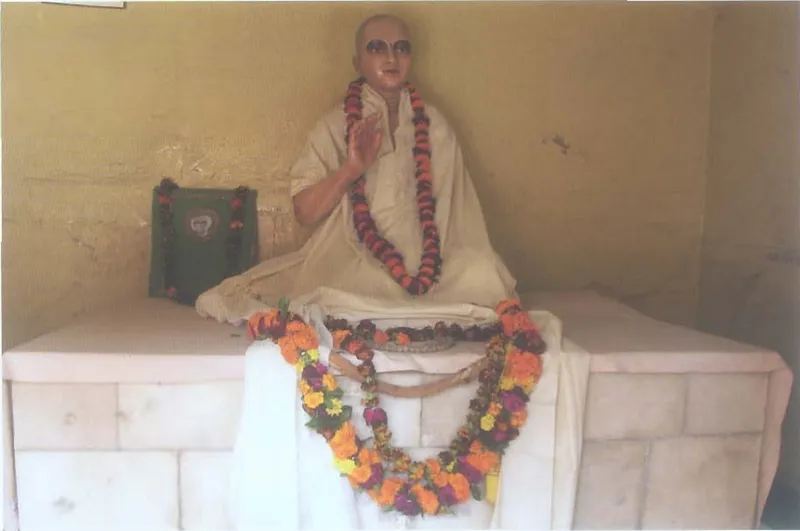
- What it is
- The samādhi (tomb) of Śrīla Jīva Gosvāmī stands in the compound of the Rādhā-Dāmodara Mandira in Vṛndāvana, the temple he founded for his Deities.
- Visiting
- The guidebooks describe the samādhi in the temple compound, near the Deities; Śrī Vraja-maṇḍala Parikramā (2007) places it behind the temple together with Śrīla Kṛṣṇadāsa Kavirāja Gosvāmī's.
In short
The samādhi (tomb) of Śrīla Jīva Gosvāmī stands in the compound of the Rādhā-Dāmodara Mandira in Vṛndāvana, the temple he founded for his Deities. Śrīla Prabhupāda writes that the actual tombs of Śrīla Rūpa Gosvāmī and Śrīla Jīva Gosvāmī are laid at this spot, and the guidebooks place Śrīla Jīva Gosvāmī's near his beloved Deities, Śrī Rādhā-Dāmodara.[1 +9] The Bhakti-ratnākara and the Narottama-vilāsa show him living here, beside Śrīla Rūpa Gosvāmī's samādhi.[11 +5] The sources give two different years for his passing.
Key facts
| Kind | samādhi |
|---|---|
| Region · area | Vṛndāvana · Rādhā-Dāmodara Mandira (Vṛndāvana) |
| Ācāryas | Śrīla Jīva Gosvāmī |
The Gosvāmīs and ācāryas
Śrīla Jīva Gosvāmī at this place
According to the Bhakti-ratnākara, Śrīla Rūpa Gosvāmī's samādhi was at the place of Śrīla Jīva Gosvāmī's Deities, Rādhā-Dāmodara, in his own residence. He took Śrīla Śrīnivāsa Ācārya there, and when Śrīla Śrīnivāsa Ācārya left for Bengal with the books he prayed before that samādhi and then went to see Rādhā-Dāmodara, "the treasure of Śrī Jīva's life".[11 +8]
শ্রীনিবাস শ্রীরূপের সমাধিসম্মুখে । কৈল যে প্রার্থনা তা কে কবে এক মুখে ॥ শ্রীনিবাস শ্রীরূপের অনুগ্রহমতে । বিদায় হইয়া চলে সমাধি হইতে ॥ শ্রীজীবের প্রাণধন রাধাদামোদরে । করয়ে দর্শন গিয়া অধৈর্য্য অন্তরে ॥
śrīnibāsa śrīrūpera samādhisammukhe
kaila ye prārthanā tā ke kabe eka mukhe
śrīnibāsa śrīrūpera anugrahamate
bidāẏa haiẏā cale samādhi haite
śrījībera prāṇadhana rādhādāmodare
karaẏe darśana giẏā adhairyya antare ||
The Narottama-vilāsa, by the same author, tells that Śrīla Jīva Gosvāmī brought Śrīla Narottama dāsa Ṭhākura to his residence and showed him Rādhā-Dāmodara; at the sight of Śrīla Rūpa Gosvāmī's samādhi Śrīla Narottama dāsa Ṭhākura rolled on the ground in tears, and Śrīla Jīva Gosvāmī then took him to his own hut.[15] Śrīla Prabhupāda said at the temple in 1972 that the Gosvāmīs first lived under trees, and that when Śrīla Jīva Gosvāmī built the temple, Śrīla Rūpa Gosvāmī lived here with him.[13 +3] Read more: Śrī Rādhā-Dāmodara, the Deity of Śrīla Jīva Gosvāmī →
In his purport on Śrīla Jīva Gosvāmī, Śrīla Prabhupāda writes, citing the Gaura-gaṇoddeśa-dīpikā (195), that he was formerly the gopī Vilāsa-mañjarī.[5 +5]
General teaching (does not name the place)“In the Gaura-gaṇoddeśa-dīpikā (195) it is said that Śrīla Jīva Gosvāmī was formerly Vilāsa-mañjarī gopī. … After the disappearance of Śrīla Rūpa Gosvāmī and Sanātana Gosvāmī in Vṛndāvana, Śrīla Jīva Gosvāmī became the ācārya of all the Vaiṣṇavas in Bengal, Orissa and the rest of the world”
Śrīla Prabhupāda, Śrī Caitanya-caritāmṛta, Ādi-līlā 10.85, purport · vedabase.io
His passing and his tomb
According to the guidebooks, when Śrīla Jīva Gosvāmī entered samādhi his body was placed here, near his Deities; no Vaiṣṇava account of his burial older than the twentieth century was found.[1 +3] The earliest description found is that of the Bengali Vṛndāvana-kathā (1920): his tomb was inside a house in the courtyard on the south side of the temple, with a small house beside it for the tomb of Śrīla Kṛṣṇadāsa Kavirāja Gosvāmī.[4 +5] The same book reports that his disappearance festival was held every year on the third day of the bright fortnight of Pauṣa.[27]
Śrīla Prabhupāda
Śrīla Prabhupāda places the tomb at this spot in his purport to Śrīmad-Bhāgavatam 2.2.5, in a letter of 1967 and in a letter of …
Śrīla Prabhupāda places the tomb at this spot in his purport to Śrīmad-Bhāgavatam 2.2.5, in a letter of 1967 and in a letter of 1975, where he praises the pictures of the tombs of Śrīla Rūpa Gosvāmī, Śrīla Jīva Gosvāmī and Śrīla Kṛṣṇadāsa Kavirāja Gosvāmī printed in his Caitanya-caritāmṛta.[1 +2]
Names this place“the foremost duty discharged by them was to hold learned discourses amongst themselves at Sevākuñja, Vṛndāvana (the spot where Śrī Rādhā-Dāmodara Temple was established by Śrīla Jīva Gosvāmī and where the actual samādhi tombs of Śrīla Rūpa Gosvāmī and Śrīla Jīva Gosvāmī are laid).”
Śrīla Prabhupāda, Śrīmad-Bhāgavatam, 2.2.5, purport · vedabase.io
In 1964, while he was living at the temple, he printed a flyer for a Janmāṣṭamī festival held at the samādhi ground of Śrīla Rūpa Gosvāmī and Śrīla Jīva Gosvāmī, as the flyer names the temple.[28 +1] His biography says that he felt inspired in the presence of these tombs and, living there, regularly visited the samādhis of Śrīla Jīva Gosvāmī, Śrīla Bhaktisiddhānta Sarasvatī Ṭhākura and Śrīla Kṛṣṇadāsa Kavirāja Gosvāmī.[30] Read more: Śrīla Prabhupāda at the Rādhā-Dāmodara temple →
In 1967, when the temple was in disorder, he wrote to one of its sevāits:[1 +2]
Names this place“Any way please try to save temple of Jiva Goswami because in very near future many people all parts of the world will come to see the Temple and Samadhi of Jiva Goswami and Rupa Goswami.”
Śrīla Prabhupāda, Letter to Nripen Babu, 67-03-18, 18 March 1967 · vedabase.io
Visiting today
The guidebooks describe the samādhi in the temple compound, near the Deities; Śrī Vraja-maṇḍala Parikramā (2007) places it behind the temple together with Śrīla Kṛṣṇadāsa Kavirāja Gosvāmī's. Next to it is the puṣpa-samādhi of King Bīr Hambīr, and just in front of it that of Śrīla Bhaktisiddhānta Sarasvatī Ṭhākura.[4 +5] The photograph in Vṛndāvana, the Playground of God (2010) shows a seated, life-size figure on the samādhi platform.[4 +5]
Location
| Where it is | Rādhā-Dāmodara temple[34] |
|---|
Nearby places
Kṛṣṇadāsa Kavirāja Gosvāmī Samādhi (Rādhā-Dāmodara) · Puṣpa-samādhi of King Birhambir · Bhaktisiddhānta Sarasvatī Gosvāmī Puṣpa-samādhi (Rādhā-Dāmodara) · Rādhā-Dāmodara Mandira (Vṛndāvana)
Where the sources differ
The year in which Śrīla Jīva Gosvāmī entered samādhi: the guidebooks give 1598 or 1608, and a Bengali book of 1920 gives 1608 from a temple register; a testament of 1606, as the historian A. W. Entwistle (1987) reports it, shows him alive that year (the original has not been independently examined). Which year is right is not certain.[4 +6]
Accounts differ The year in which Śrīla Jīva Gosvāmī entered samādhi (was placed in this tomb)
- The Color Guide to Vṛndāvana (2000), entry 33B and chronology1598 ('In the year 1598, Śrīla Jīva Gosvāmī entered samādhi')
- Vṛndāvana, the Playground of God (2010), entry 4a'till his disappearance in about 1598'
- The Color Guide to Vṛndāvana (2000), entry 33A-B continuation and later chronology'It is believed … 1598, but according to a document kept at Rādhā Damodhara and considered to be his last will and testament, his disappearance was in the year 1608'; chronology: 1608
- an undated parikramā guide (Vrindavana chapter), text and chronology1608
More on this place
Śrī Rādhā-Dāmodara, the Deity of Śrīla Jīva Gosvāmī · Śrīla Prabhupāda at the Rādhā-Dāmodara temple
References
34 references
- Śrīla Prabhupāda, Śrīmad-Bhāgavatam, 2.2.5, purport · vedabase.io
- Śrīla Prabhupāda, Letter to Nripen Babu, 67-03-18, 18 March 1967 · vedabase.io
- Śrīla Prabhupāda, Letter to Radhavallabha, 75-05-26, 26 May 1975 · vedabase.io
- The Color Guide to Vṛndāvana (2000), Written and Photographed by Rājaśekhara dāsa Brahmacārī, PDF p. 80
- The Color Guide to Vṛndāvana (2000), Written and Photographed by Rājaśekhara dāsa Brahmacārī, PDF p. 72
- The Color Guide to Vṛndāvana (2000), Written and Photographed by Rājaśekhara dāsa Brahmacārī, PDF p. 84
- Śrī Vraja-maṇḍala Parikramā (2007), PDF p. 331
- Vṛndāvana-Dhāma Ki Jaya! (c. 1986), by Dhruva Mahārāja dāsa, PDF p. 67
- the undated parikramā notes Vṛndāvana, ¶158
- Vṛndāvana, the Playground of God (2010), Bhakti Caitanya Svāmī, PDF p. 53
- Śrīla Narahari Cakravartī, Bhakti-ratnākara, Sixth Wave, 1912 ed. p. 471; vv.281–283 in the 1913 numbering (Bhakti-ratnākara, taraṅgas 1–8), 2nd ed., 1912
- Śrīla Narahari Cakravartī, Bhakti-ratnākara, Sixth Wave, 1912 ed. pp. 473-474; vv.307–309 in the 1913 numbering (Bhakti-ratnākara, taraṅgas 1–8), 2nd ed., 1912
- Śrīla Prabhupāda, Morning Walk, Vṛndāvana, 15 October 1972 · vedabase.io
- Vṛndāvana, the Playground of God (2010), Bhakti Caitanya Svāmī, PDF p. 57
- Śrīla Narahari Cakravartī, Narottama-vilāsa, Second Vilāsa (dvitīya vilāsa), vv.284–286 and 288, 1st ed. (c. 1907) printed p. 17, 1st ed., Baṅgābda 1314
- Vṛndāvana-kathā, end of chapter 4 (caturtha pariccheda; chapter 5, on Rādhā-Dāmodara, begins on p. 77), printed p. 76
- Śrīla Narahari Cakravartī, Bhakti-ratnākara, Fourth Wave, 1912 ed. p. 139; vv.298–300 in the 1913 numbering, 2nd ed., 1912
- Śrīla Narahari Cakravartī, Bhakti-ratnākara, Ninth Wave, 1912 ed. p. 576; vv.197–199 in the 1913 numbering, 2nd ed., 1912
- Śrīla Narahari Cakravartī, Bhakti-ratnākara, Eleventh Wave, 1912 ed. p. 673; vv.251–258 in the 1913 numbering, 2nd ed., 1912
- Śrīla Narahari Cakravartī, Bhakti-ratnākara, Sixth Wave, 1912 ed. pp. 473-474; vv.307–309 in the 1913 numbering (Bhakti-ratnākara, taraṅgas 1–8), 2nd ed., 1912
Show all 34 references
- Śrī Vraja-maṇḍala Parikramā (2007), PDF p. 330
- Śrīla Prabhupāda, Śrī Caitanya-caritāmṛta, Ādi-līlā 10.85, purport · vedabase.io
- Vṛndāvana, the Playground of God (2010), Bhakti Caitanya Svāmī, PDF p. 58
- Gaura-gaṇoddeśa-dīpikā, v.195, v.197 (second line), v.198 and v.199 (first line)
- Gaura-gaṇoddeśa-dīpikā, v.204
- Śrīla Prabhupāda, Morning Walk, Vṛndāvana, 15 October 1972 · vedabase.io
- Vṛndāvana-kathā, end of chapter 5 (pañcama pariccheda), printed p. 84 and footnote
- Satsvarūpa dāsa Gosvāmī, Śrīla Prabhupāda-līlāmṛta, vol. 1, ch. 11 (quoting a flyer printed by Bhaktivedanta Swami), 31 August 1964 (date printed on the flyer) · vedabase.io
- Vṛndāvana, the Playground of God (2010), Bhakti Caitanya Svāmī, PDF p. 63
- Satsvarūpa dāsa Gosvāmī, Śrīla Prabhupāda-līlāmṛta, vol. 1, ch. 10 · vedabase.io
- The Color Guide to Vṛndāvana (2000), Written and Photographed by Rājaśekhara dāsa Brahmacārī, PDF p. 25
- The Color Guide to Vṛndāvana (2000), Written and Photographed by Rājaśekhara dāsa Brahmacārī, PDF p. 159
- A. W. Entwistle, ch. 5 §15 'Some Gaudiya devotees of the late sixteenth century', printed p. 166, Egbert Forsten, Groningen, 1987
- Vṛndāvana, the Playground of God (2010), Bhakti Caitanya Svāmī, p. 53