Lakṣmī-Nārāyaṇa Mandira (Govardhana)
लक्ष्मी-नारायण मन्दिर (गोवर्धन) Hindi name proposed
Also called Lakṣmī Nārāyaṇa Mandīra
On this page
In short
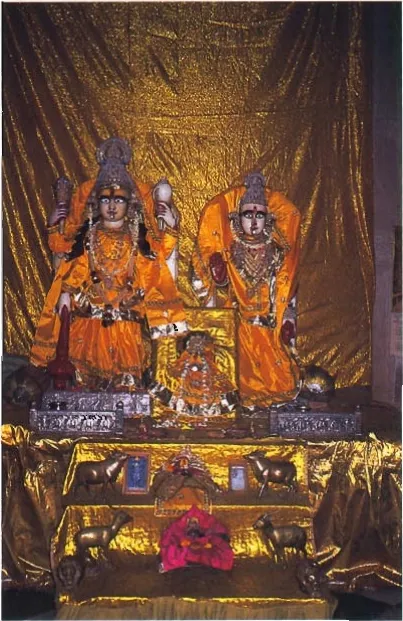
The Lakṣmī-Nārāyaṇa Mandira is an old temple of Lakṣmī-Nārāyaṇa at Govardhana. The guidebook Govardhana Hill (2001) lists it between Śrīla Sanātana Gosvāmī's bhajana-kuṭī at Cakra-tīrtha and Dāna-ghāṭī.[1 +2] According to the local tradition recorded in the same book, its Deities of Lakṣmī-Nārāyaṇa are the utsava-mūrtis, the festival Deities, of Govardhana Hill; the book does not say who holds this view, so it is not certain.[1] Śrīla Nārāyaṇa Bhaṭṭa Gosvāmī's Vraja-bhakti-vilāsa names a place of Lakṣmī-Nārāyaṇa just after Cakra-tīrtha, with a prayer to be said there, but no source says that it is this temple.[4 +1]
Key facts
| Kind | temple |
|---|---|
| Region · area | Govardhana |
Traditional accounts
In its list of the sites of Govardhana, the Vraja-bhakti-vilāsa names a Lakṣmī-Nārāyaṇa-sthala, a place of Lakṣmī-Nārāyaṇa, right after Cakra-tīrtha and the image of Cakreśvara Mahādeva. It does not describe a temple there.[4] In its order of worship for the same stretch, after the bath at Cakra-tīrtha and the prayer to Cakreśvara, it gives a prayer to Lakṣmī-Nārāyaṇa as the joy of Govardhana, to be recited four times while walking round and bowing down, for sons and all one's desires (summarised here, not translated).[4 +1]
Near that place of Lakṣmī-Nārāyaṇa the same book puts a forest called Kadamba-khaṇḍa, with Harideva-kuṇḍa in its middle, in a different part of the hill from the Kadamba Vana that the guidebooks place on its western side.[4]
History
In 1987 the historian A. W. Entwistle described a temple of Lakṣmī-Nārāyaṇa on the bank of Mānasī-gaṅgā at Govardhana, probably this one, as the oldest establishment in Braj of the Śrī-vaiṣṇava sampradāya, the line of Śrī Rāmānujācārya. He thought that the building he saw dated from the eighteenth century, but cited no document for the date.[1 +1]
Location
| On the numbered Govardhana chart | 28 (printed as “Laksmi Narayana Temple”)[7] |
|---|
References
- Govardhana Hill: India's Most Sacred Mountain (2001), Rajasekhara dasa Brahmacari, PDF p. 84
- Govardhana Hill: India's Most Sacred Mountain (2001), Rajasekhara dasa Brahmacari, PDF p. 11
- the key of the numbered Govardhana chart, ¶31
- Śrīla Nārāyaṇa Bhaṭṭa, Vraja-bhakti-vilāsa, Govardhana-liṅga (list of Govardhana's sites), § 50, printed p. 47, 1st ed., publ. Bābā Kṛṣṇadāsa, Kusuma-sarovara, Saṁvat 2008
- Śrīla Nārāyaṇa Bhaṭṭa, Vraja-bhakti-vilāsa, Govardhana section, § 9 (prayer at the Lakṣmī-Nārāyaṇa place, after Cakra-tīrtha and Cakreśvara), printed p. 114, 1st ed., publ. Bābā Kṛṣṇadāsa, Kusuma-sarovara, Saṁvat 2008
- A. W. Entwistle, ch. 5 §19 'The Sampradays of Ramanuja and Ramanand', printed p. 172, Egbert Forsten, Groningen, 1987
- Numbered list of the Govardhana sites (key of the Govardhana chart)