Mānasī-gaṅgā
मानसी-गंगा
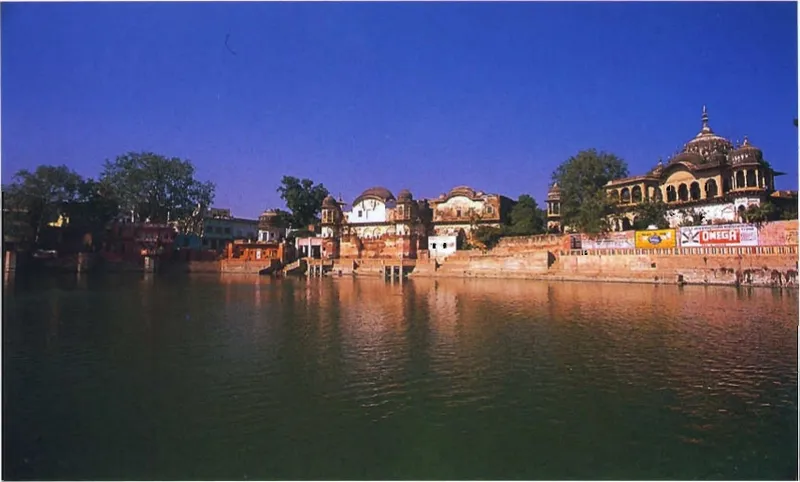
- What it is
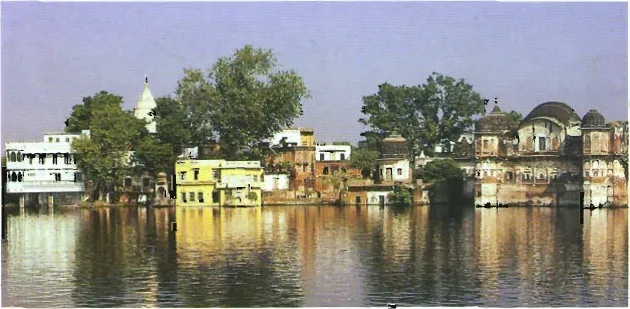
- Mānasī-gaṅgā is the large lake in the middle of Govardhana town, on Govardhana Hill.
- Visiting
- Govardhana Hill (2001) calls Mānasī-gaṅgā the largest kuṇḍa of Vraja and says that it was once much larger and is shrinking like the hill; the undated parikramā notes Govardhana also say that it has …
- Parikramā
- Govardhana parikramā, station 11
- Places here
- Cakra-tīrtha (Govardhana), Harideva Mandira, Mānasī-gaṅgā Mandira, Manasā-devī Mandira, Mukhāravinda Mandira +1 more
In short
Mānasī-gaṅgā is the large lake in the middle of Govardhana town, on Govardhana Hill.[1 +3] The Garga-saṁhitā says that it arose from the heavenly Gaṅgā water with which Kṛṣṇa was bathed after He had lifted the hill, and that even great Vedic sacrifices do not equal it.[5 +1] A verse of the Varāha Purāṇa, which Śrīla Rūpa Gosvāmī quotes, joins a bath here to the walk around the hill, and Śrī Caitanya Mahāprabhu bathed here before He walked around Govardhana.[7 +7] The prayers of the Gosvāmīs make the lake the scene of Kṛṣṇa's boat pastime with Śrī Rādhā.[8 +2]
Key facts
| Kind | kuṇḍa |
|---|---|
| Region · area | Govardhana · Govardhana (town) |
| On the parikramā | Govardhana parikramā, station 11 · the route |
| Ācāryas | Śrī Caitanya Mahāprabhu, Śrīla Raghunātha dāsa Gosvāmī, Śrīla Rūpa Gosvāmī, Śrīla Jīva Gosvāmī, Śrīla Viśvanātha Cakravartī Ṭhākura |
Why it is glorified
The Garga-saṁhitā names Mānasī-gaṅgā first among the holy places on Girirāja, the king of hills, as Govardhana is called, and …
The Garga-saṁhitā names Mānasī-gaṅgā first among the holy places on Girirāja, the king of hills, as Govardhana is called, and calls it the destroyer of a flood of great sins.[17] In another chapter a siddha, a perfected sage, tells a brāhmaṇa that a thousand horse sacrifices and a hundred rājasūya sacrifices do not equal Mānasī-gaṅgā:[6]
अश्वमेधसहस्राणि राजसूयशतानि च । मानसीगङ्गया तुल्यं न भवंत्यत्र नो गिरौ ॥ 39 ॥
aśvamedhasahasrāṇi rājasūyaśatāni ca
mānasīgaṅgayā tulyaṁ na bhavaṁtyatra no girau
The Varāha Purāṇa says that one who walks around Annakūṭa, as it calls Govardhana, does not return to birth, and that one who has bathed in the Mānasa-gaṅgā, seen Hari at Govardhana and walked around the hill has no more cause to grieve (summarised here, not translated).[7] Śrīla Rūpa Gosvāmī gives these verses of the Ādi-varāha under the glory of Govardhana in his Mathurā-māhātmya.[8 +4] The Bhakti-ratnākara repeats the promise, reads the Purāṇa's Hari as the Deity Harideva, and says that the water of the lake is supremely pure and that no one can tell the fruit of bathing in it.[7 +1]
Śrīla Jīva Gosvāmī explains the name in his Gopāla-campū (summarised here, not translated): the lake is the mind (mānasa) melted in love for Kṛṣṇa, and it is greater than the Gaṅgā, which the touch of Vāmana's foot made purifying, because Kṛṣṇa Himself always plays here. He also pictures it as a stream of love for Kṛṣṇa that enters the hill.[19 +1]
In the Garga-saṁhitā's picture of Govardhana as a body, Mānasī-gaṅgā is the hill's eyes, while Śrīla Viśvanātha Cakravartī Ṭhākura's Vraja-rīti-cintāmaṇi draws the hill as a peacock and makes the lake its neck.[21 +1] The guidebooks describe the hill's form in still other ways. Read more: The body of Govardhana: mouth, eyes, neck and the peacock →
Accounts differ Which part of Govardhana's 'body' the Mānasī-gaṅgā is
- Garga-saṁhitā 3.8.5the hill's eyes
- Govardhana Hill: India's Most Sacred Mountain (2001)the hill's neck
- Śrī Vraja-maṇḍala Parikramā (2007)the hill is a sitting cow whose lotus face (Mukhāravinda) is on the northern bank of Mānasī-gaṅgā and whose two eyes are Rādhā-kuṇḍa and Śyāma-kuṇḍa
- Śrīla Viśvanātha Cakravartī, Vraja-rīti-cintāmaṇi 3.23 and 3.29the hill is peacock-shaped; its neck (gala-sthalī) is the Mānasa-jāhnavī, where Rādhā and Kṛṣṇa play in the boat, and its eyes are Rādhā-kuṇḍa and Kṛṣṇa-kuṇḍa
Divine pastimes
How the lake came to be
Śrīmad-Bhāgavatam tells that after Kṛṣṇa had lifted Govardhana, Surabhi, the mother of the cows, bathed Him with her milk, and Indra, the king of heaven, with the demigods and sages, bathed Him with water of the heavenly Gaṅgā carried by the trunk of his elephant Airāvata and named Him Govinda. It names no lake that arose from this bath.[23 +2]
Śukadeva Gosvāmī said: Having thus appealed to Lord Kṛṣṇa, mother Surabhi performed His bathing ceremony with her own milk, and Indra, ordered by Aditi and other mothers of the demigods, anointed the Lord with heavenly Gaṅgā water from the trunk of Indra’s elephant carrier, Airāvata. Thus, in the company of the demigods and great sages, Indra coronated Lord Kṛṣṇa, the descendant of Daśārha, and gave Him the name Govinda.
Translation: Śrīla Prabhupāda's disciples (BBT)The Garga-saṁhitā says that the heavenly Gaṅgā water that fell at this bath became Mānasī-gaṅgā, and that Surabhi's milk became Govinda-kuṇḍa:[5 +1]
द्युगङ्गाजलपातेन कृष्णस्नानेन मैथिल । तत्र वै मानसी गङ्गा गिरौ जाताऽघनाशिनी ॥ 15 ॥
dyugaṅgājalapātena kṛṣṇasnānena maithila
tatra vai mānasī gaṅgā girau jātā'ghanāśinī
Explaining the next verse of the Bhāgavatam, Śrīla Jīva Gosvāmī places that bath at the spot of Govardhana known as Śakra-kuṇḍa and as Govinda-kuṇḍa, and does not name Mānasī-gaṅgā (summarised here, not translated).[27]
Other books tell the origin differently. Śrīla Nārāyaṇa Bhaṭṭa Gosvāmī's Vraja-bhakti-vilāsa says that at the gopīs' word Kṛṣṇa made Mānasī Gaṅgā with His mind, to be freed from the offence of killing a bull, and it gives a prayer for bathing in the lake.[28 +1] Kṛṣṇa is the Supreme Lord and no sin touches Him: Śrīmad-Bhāgavatam tells of no atonement after Ariṣṭa's killing, and Śrīla Jīva Gosvāmī, explaining Kṛṣṇa's joking words to Śrī Rādhā after it, says that no sin had arisen in Him at all; the talk of an offence belongs to that loving exchange.[30 +3] The guidebooks tie the lake to the killing of the bull demon Ariṣṭa or of the calf demon Vatsāsura, or to other events, and tell it in several ways. The Bhāgavatam tells both killings, Vatsāsura's on the bank of the Yamunā, but it tells of no bath after either.[30 +11] Read more: How Mānasī-gaṅgā came to be: the Gaṅgā of the mind at Govardhana →
Accounts differ How the Mānasī-gaṅgā came to be (origin stories)
- Garga-saṁhitā, Girirāja-khaṇḍa 3.4.15after the lifting of the hill, the celestial Gaṅgā water that fell when Kṛṣṇa was bathed on Govardhana became the Mānasī-gaṅgā on the hill
- Vraja-bhakti-vilāsa (Śrīla Nārāyaṇa Bhaṭṭa), printed p. 112at the gopīs' word Kṛṣṇa made the Mānasī Gaṅgā with His mind, to be freed from the offence of killing a bull (the bull is not named)
- Śrī Vraja-maṇḍala Parikramā (2007) and the undated parikramā notes Govardhanaat the gopīs' insistence Kṛṣṇa created it from His mind and bathed in it to atone for killing the bull Vṛṣabhāsura
- Govardhana Hill: India's Most Sacred Mountain (2001) and Vṛndāvana-Dhāma Ki Jaya! (c. 1986)after Kṛṣṇa killed the calf-demon Vatsāsura near Govardhana, the cowherd boys asked Him to bathe in the Ganges and He called the Ganges from His mind
Kṛṣṇa with the cows and the gopīs
Śrīmad-Bhāgavatam (10.15.9) says that Kṛṣṇa enjoyed grazing the animals with His friends on the banks of the river by the hill; it names neither the river nor the hill.[43 +1] Śrīla Baladeva Vidyābhūṣaṇa takes the river as Mānasa-gaṅgā, the river of the king of hills. In a confidential reading, Śrīla Viśvanātha Cakravartī Ṭhākura says that Kṛṣṇa sent the cows ahead with Balarāma to the Yamunā and met the young gopīs on the banks of Mānasa-gaṅgā (both summarised here, not translated).[43 +1] The translation of the verse by Śrīla Prabhupāda's disciples, and his own Kṛṣṇa book, speak of the Yamunā.[43 +1]
When the gopīs sing that the rivers are stunned by Kṛṣṇa's flute and embrace His feet with their waves (ŚB 10.21.15, 10.35.6–7), Śrīla Sanātana Gosvāmī, Śrīla Jīva Gosvāmī and Śrīla Viśvanātha Cakravartī Ṭhākura name Mānasa-gaṅgā among those rivers, with the Yamunā.[46 +4]
On the gopīs' praise of Govardhana as the best of Hari's servants (ŚB 10.21.18), Śrīla Viśvanātha Cakravartī Ṭhākura says that they planned to go and bathe in Mānasa-gaṅgā and see its presiding Deity, the Nārāyaṇa named Śrī Harideva: their elders could not object to such a visit, and Kṛṣṇa plays right there (summarised here, not translated).[51]
The Gosvāmīs describe the same daily life. Śrīla Jīva Gosvāmī's Gopāla-campū says that Kṛṣṇa brought the animals to the banks of Mānasa-gaṅgā almost every day, and Śrīla Kṛṣṇadāsa Kavirāja Gosvāmī's Govinda-līlāmṛta that He gathered the cows with His flute and drove them with His friends to the lake to drink.[52 +1]
The boat pastime
Commenting on the gopīs' songs (ŚB 10.35.14–15), Śrīla Śrīnātha Cakravartī and the Bṛhat-krama-sandarbha, printed under Śrīla Jīva Gosvāmī's name, speak of the gopīs having Kṛṣṇa ferry them across the Yamunā; they do not mention Mānasa-gaṅgā.[54 +1]
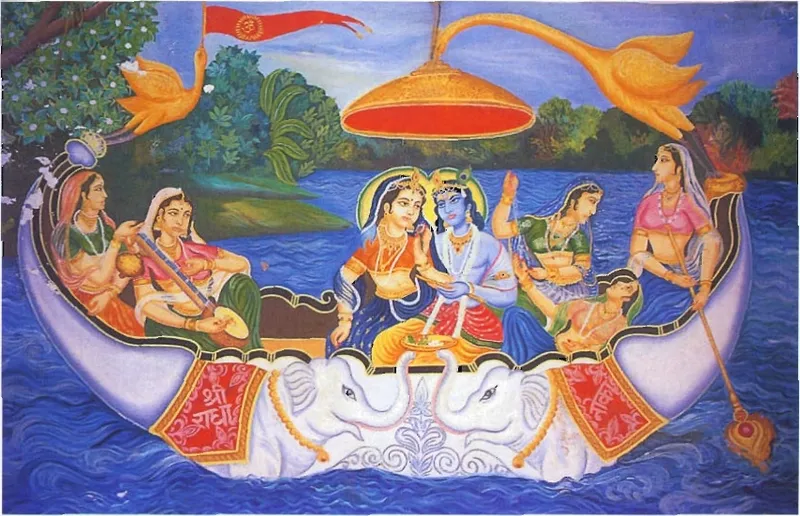
The prayers of the Gosvāmīs set the boat pastime on Mānasī-gaṅgā. Śrīla Raghunātha dāsa Gosvāmī prays to Mānasa-jāhnavī, as he calls the lake, which is full of the joy of Rādhā and Kṛṣṇa's boat pastimes and lifts the stones of Govardhana with its waves. In another prayer Mādhava is the boatman who takes Rādhā across. Śrīla Rūpa Gosvāmī's second Govardhanāṣṭaka speaks of the same boat pastimes and of the play over the ferry fare.[8 +4]
Śrīla Viśvanātha Cakravartī Ṭhākura writes in his Vraja-rīti-cintāmaṇi that Rādhā and Kṛṣṇa always play in the boat here, and in his Govardhanāṣṭaka that Kṛṣṇa took Rādhā into a boat on the Gaṅgā; that verse names only the Gaṅgā.[16 +3] Śrīla Rūpa Gosvāmī's Rādhā-Kṛṣṇa-gaṇoddeśa-dīpikā calls the lake's ghāṭa (bathing place with steps) Pāraṅga, the crossing, and says that the boat called Suvilāsatarā is there. The guidebook Śrī Vraja-maṇḍala Parikramā (2007) places Pāraṅga-ghāṭa at Cakreśvara.[11 +1]
According to the Bhakti-ratnākara, Śrīla Śrīnivāsa Ācārya's guide showed him Mānasa-gaṅgā as the place of the boat pastime, and later a ghāṭa of the lake near Śrīla Sanātana Gosvāmī's place at Cakra-tīrtha, where Kṛṣṇa as boatman took Rādhikā and Her friends across.[60 +1] In their accounts of Śrī Caitanya Mahāprabhu's visit to Govardhana, Śrīla Murāri Gupta's Kṛṣṇa-caitanya-caritāmṛta and Śrīla Locana dāsa Ṭhākura's Caitanya-maṅgala also tell of Kṛṣṇa's boat on Mānasa-gaṅgā; in the Caitanya-maṅgala the gopīs could not cross the water on land, so Kṛṣṇa ferried them across in a boat.[62 +2] The boat scene of Śrīla Jīva Gosvāmī's Gopāla-campū is set on a river that Kṛṣṇa makes from the mountain streams, which it does not name.[65] Read more: The boat pastime on Mānasī-gaṅgā: Kṛṣṇa as the boatman →
The toll pastime
In Śrīla Rūpa Gosvāmī's play Dāna-keli-kaumudī, on Kṛṣṇa's toll pastime, Vṛndā and Subala go down to the bank of Mānasa-gaṅgā to watch, and Rādhā and Her friends walk along the bank carrying pots of fresh butter for a sacrifice.[10] Read more: Kṛṣṇa's toll pastime (dāna-līlā) at Govardhana and Varṣāṇā →
Rādhā-kuṇḍa and the fight with Ariṣṭa
In the twenty verses on the origin of Rādhā-kuṇḍa that Śrīla Viśvanātha Cakravartī Ṭhākura gives in his commentary on the Bhāgavatam's account of Ariṣṭa, Rādhā refuses the water of Kṛṣṇa's pond, stained, She says, by the killing of a bull, and decides to fill Her own lake with water that Her friends will bring from Mānasa-gaṅgā:[58 +3]
āhṛtya puṇya-salilaṁ śata-koṭi-kumbhaiḥ
sakhy-arbudena saha mānasa-jāhnavītaḥ
etat saraḥ sva-madhunā paripūrayāmi
tenaiva kīrtim atulāṁ tanavāni loke
‘I will have My countless gopī companions bring the pure water of the Mānasa-gaṅgā here in billions of pots. In this way I will fill this lake with My own water and thus make its renown unequaled in the entire world.
Translation: Śrīla Prabhupāda's disciples (BBT)About this place: In the verses on the origin of Rādhā-kuṇḍa that Śrīla Viśvanātha Cakravartī Ṭhākura quotes 'from the Purāṇas', in the loving exchange after the killing of the bull-demon, Śrī Rādhā declines the water of Kṛṣṇa's pond and says that Her countless friends will bring the pure water of the Mānasa-gaṅgā in billions of pots to fill Her own lake. The pilgrimage guidebooks tell the same plan.
According to the Bhakti-ratnākara, Rādhā wished to fill Her new kuṇḍa (sacred pond) with the water of Mānasī-gaṅgā, which holds all the holy places, and Kṛṣṇa, knowing Her wish, had the holy places enter it from Śyāma-kuṇḍa.[69] Explaining the same chapter, Śrīla Jīva Gosvāmī quotes the Ādi-varāha: Kṛṣṇa fought Ariṣṭa north of the Gaṅgā, which he explains as Mānasa-gaṅgā, and then bathed in a tīrtha, a holy pond, that He had made with His heel; he calls the bath a pretext to show the tīrtha's glory (summarised here, not translated).[33]
The lifting of the hill
Explaining how Kṛṣṇa lifted Govardhana (ŚB 10.25.19), Śrīla Jīva Gosvāmī says that He cut off the part of the hill that He held, since the hill is separated north of Mānasa-gaṅgā, and that this part, which the Varāha Purāṇa calls Annakūṭa, is still known by itself today (summarised here, not translated).[70] The commentator Vaṁśīdhara says that Kṛṣṇa's Sudarśana cakra dried up the wind and rain, and the undated parikramā notes Govardhana say that the cakra afterwards stayed on the northern bank of the lake, at Cakra-tīrtha.[71 +1] Read more: The lifting of Govardhana Hill, Indra's homage and the name Govinda →
Śrī Caitanya Mahāprabhu
The Caitanya-caritāmṛta tells that Śrī Caitanya Mahāprabhu spent a night in the temple of Harideva and in the morning bathed in Mānasa-gaṅgā before He walked around Govardhana:[13 +1]
prātaḥ-kāle prabhu ‘mānasa-gaṅgā’ya kari’ snāna
govardhana-parikramāya karilā prayāṇa
In the morning, Śrī Caitanya Mahāprabhu took His bath in a lake called Mānasa-gaṅgā. He then circumambulated Govardhana Hill.
Translation: Śrīla A.C. Bhaktivedanta Swami PrabhupādaIn Śrīla Murāri Gupta's account of the visit, the guide tells Mahāprabhu of a river called Mānasa Gaṅgā on the side of Govardhana Hill, on whose banks Kṛṣṇa and Balarāma always play with Their friends. In Śrīla Locana dāsa Ṭhākura's account, the guide says that the people of Vraja lived on both banks of the lake and that its stream lies north-east of the hill.[62 +2]
Traditional accounts
According to the local tradition recorded in the guidebooks, when Nanda Mahārāja and the people of Vraja planned a pilgrimage to …
According to the local tradition recorded in the guidebooks, when Nanda Mahārāja and the people of Vraja planned a pilgrimage to bathe in the Ganges, Kṛṣṇa showed them the Ganges here at Govardhana, and Gaṅgā-devī, the goddess of the river, appeared. Śrī Vraja-maṇḍala Parikramā (2007) and the undated parikramā notes Govardhana say that she came on an alligator on the dark-moon night of Kārttika, the day of Dīpāvalī.[37 +5] The same two books tell another story, from no older source found, so it is not certain: at the Yamunā's request Kṛṣṇa called her elder sister Gaṅgā to Vraja and played in her waters with the gopīs.[39 +1]
The guidebooks say that Mānasī-gaṅgā is one with the Ganges and greater than it: a bath in the Ganges removes sins, while a bath here also gives prema-bhakti, loving devotion to Kṛṣṇa.[1 +2] Govardhana Hill (2001) and the same undated notes also record the local tradition that when Rādhā and the gopīs, waiting for Kṛṣṇa near the lake, called out the name Harideva in the pain of separation, a Deity of Kṛṣṇa holding Govardhana and the flute appeared; no scripture tells it, so it is not certain.[75 +2]
The Gosvāmīs and ācāryas
According to the Bhakti-ratnākara, Śrīla Jāhnavā-devī went slowly from Rādhā-kuṇḍa to Govardhana with her attendants, with the …
Visits
According to the Bhakti-ratnākara, Śrīla Jāhnavā-devī went slowly from Rādhā-kuṇḍa to Govardhana with her attendants, with the permission of Śrīla Raghunātha dāsa Gosvāmī. On seeing Govardhana, Mānasa-gaṅgā and the other places she was overwhelmed with love, and those with her were so moved that Śrīla Jīva Gosvāmī and others had to calm them.[80]
Vṛndāvana, the Playground of God (2010) says that Śrīla Sanātana Gosvāmī left this world at Mānasī-gaṅgā on Guru-pūrṇimā in 1558, and Govardhana Hill (2001) that the Gosvāmīs found that he had left his body in his bhajana-kuṭī at Cakra-tīrtha when they came to ask him to lead the yearly parikramā, the walk around the lake. No older source for the place or the date has been found, so they are not certain.[81 +2]
Who wrote of the lake
- Śrīla Raghunātha dāsa Gosvāmī glorifies it in four of his prayers, and in his Vraja-vilāsa-stava tells how Paurṇamāsī crowned Rādhā in Vṛndāvana by sprinkling Her with the water of Mānasa-jāhnavī and the lesser rivers, at Unmatta-Rādhā-sthalī.[8 +5]
- Śrīla Jīva Gosvāmī describes the lake in his Gopāla-campū, and in his Saṅkalpa-kalpadruma he names it, with the Yamunā, in a description of the Vṛndāvana where Kṛṣṇa always plays with the people of Vraja.[19 +4]
- Śrīla Nārāyaṇa Bhaṭṭa Gosvāmī's Vraja-bhakti-vilāsa gives the prayer to recite while bathing in the lake and sipping its water.[28 +1]
Śrīla Prabhupāda
Śrīla Prabhupāda speaks of this lake as a place only in his translation of the Caitanya-caritāmṛta, shown above, where Śrī …
Śrīla Prabhupāda speaks of this lake as a place only in his translation of the Caitanya-caritāmṛta, shown above, where Śrī Caitanya Mahāprabhu bathes in "a lake called Mānasa-gaṅgā".[14] His Kṛṣṇa book tells, without naming the lake, the pastimes that the commentators and the guidebooks connect with it: the bath of Kṛṣṇa after the lifting of Govardhana, the killing of Ariṣṭāsura, and the herding of the cows, which he places on the bank of the Yamunā.[25 +2] Telling the gopīs' praise of Govardhana, in a general passage, he speaks of the water of the hill's lakes:[87]
General teaching (does not name the place)“Another gopī began to praise the unique position of Govardhana Hill … because Govardhana Hill is so obliged to Lord Kṛṣṇa and Balarāma, it is supplying different kinds of fruits, roots and herbs, as well as very pleasing crystal water from its lakes, in presentation to the Lord.”
Śrīla Prabhupāda, Kṛṣṇa, the Supreme Personality of Godhead (Kṛṣṇa book), Chapter 21, 'The Gopīs Attracted by the Flute' · vedabase.io
Songs
Śrīla Rūpa Gosvāmī's second Govardhanāṣṭaka: the waves of the lake wash the stones of Govardhana, and Kṛṣṇa's boat pastimes and …
Śrīla Rūpa Gosvāmī's second Govardhanāṣṭaka: the waves of the lake wash the stones of Govardhana, and Kṛṣṇa's boat pastimes and the play over the ferry fare show the gopīs' love.[88]
kaṁsārātes tari-vilasitair ātarānaṅga-raṅgair
ābhīrīṇāṁ praṇayam abhitaḥ pātram unmīlayantyāḥ
dhauta-grāvāvalir amalinair mānasāmartya-sindhor
vīci-vrātaiḥ prathayatu sadā śarma govardhano naḥ
Śrīla Bhaktivinoda Ṭhākura names Mānasa-gaṅgā, with Kusuma-sarovara and the Yamunā, among the holy waters of Vraja by which he longs to live.[89]
kusuma-sarovara, mānasa-gaṅgā
kalinda-nandinī vipula-taraṅga
Visiting today
Govardhana Hill (2001) calls Mānasī-gaṅgā the largest kuṇḍa of Vraja and says that it was once much larger and is shrinking like the hill; the undated parikramā notes Govardhana also say that it has become much smaller.[1 +2]
According to Govardhana Hill, it is a custom of Vaiṣṇavas and of the people of Vraja to bathe first in Mānasī-gaṅgā and then take darśana of Harideva, the sight of the Deity, before they begin the parikramā of Govardhana; the book adds that Śrīla Rūpa Gosvāmī's Mathurā-māhātmya recommends this.[9 +3] The Varāha Purāṇa names a day for it: on the ekādaśī, the eleventh day, of the bright half of Bhādrapada one fasts at Govardhana and walks around it after bathing in the lake at sunrise.[90] Read more: Govardhana parikramā →
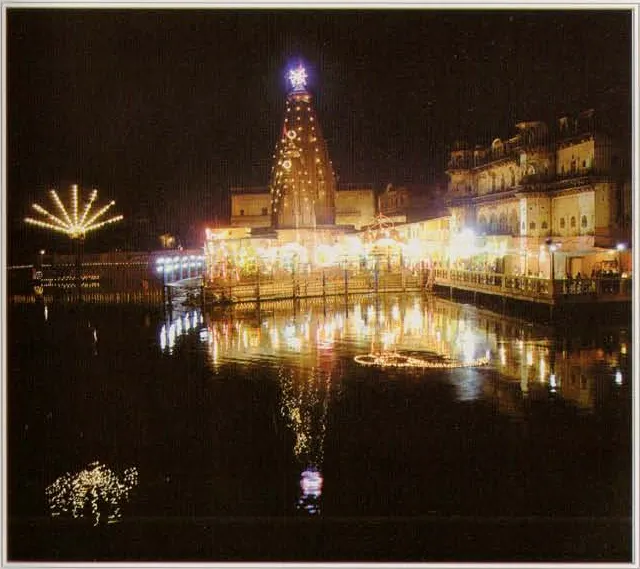
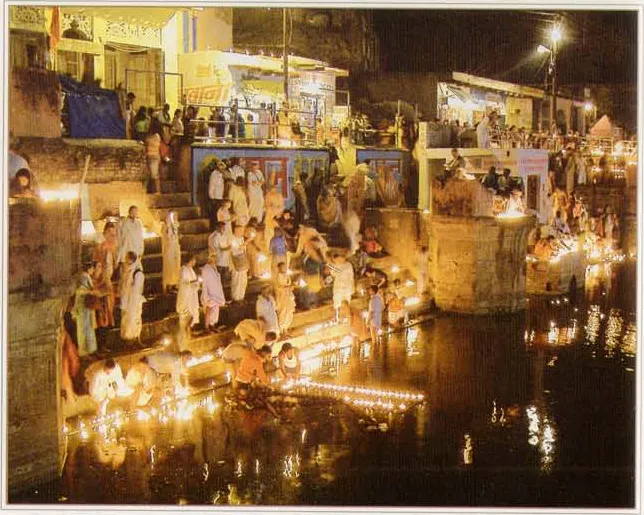
Śrī Vraja-maṇḍala Parikramā (2007) says that on Dīpāvalī large numbers of people bathe in the lake, take darśana of Śrī Harideva and offer ghee lamps on all its banks.[39] The same book places the temple of Harideva, whom it calls the presiding Deity of Govardhana, on the southern bank, and the temple of Manasā-devī on the same bank above Brahma-kuṇḍa.[51 +5] Read more: Harideva of Govardhana: the Deity, Śrī Caitanya's visit and the temple → Its street plan of the town shows the other places around the lake, among them Cakra-tīrtha, Śrīla Sanātana Gosvāmī's bhajana-kuṭī and the Mukhāravinda temple.[1 +2]
The guidebook Vṛndāvana-Dhāma Ki Jaya! (c. 1986) says that a Mānasī Gaṅgā Mandira then stood on the northern bank, right after it tells how Gaṅgā-devī appeared here on her crocodile carrier; it names no Deity, date or founder.[40] The books differ on where the temple of the lake's goddess stands, and on whether this is that temple (see below).
Go-ghāṭa
Go-ghāṭa, the ghāṭa (bathing place) of the cows, is named only by Śrī Vraja-maṇḍala Parikramā (2007), which lists it among the places of Govardhana town, after Manasā-devī and before Cakra-tīrtha, in its account of Mānasī-gaṅgā. According to the local tradition recorded in this book, Kṛṣṇa brought the cows and calves here to drink; the book does not say on which water the ghāṭa lies, and no other source names it, so this is not certain.[94] The Govinda-līlāmṛta of Śrīla Kṛṣṇadāsa Kavirāja Gosvāmī tells, in its account of Kṛṣṇa's day, that He gathered with His flute the cows that were wandering here and there, and drove them with His friends to the Mānasa-jāhnavī, Mānasī-gaṅgā, to give them water. When the cows had drunk its cool, sweet and very clear water, the cowherd boys drank, bathed and played in it for a long time (summarised here, not translated). The book names no ghāṭa.[94 +1]
Śrīmad-Bhāgavatam tells of Kṛṣṇa and His friends watering the calves at a reservoir, just before the demon Bakāsura attacked, and the cows at the Yamunā; it names no Go-ghāṭa and does not set either at Govardhana, and no source connects that pastime with this ghāṭa.[36 +3] Śrīla Sanātana Gosvāmī and Śrīla Jīva Gosvāmī place that reservoir at the great lake called Baka-sthala, east of Nandīśvara Hill at Nandagrāma, while Śrīla Prabhupāda's Kṛṣṇa book sets the watering of the calves on the bank of the Yamunā; the accounts are set side by side below.[36 +1]
Location
| Where it is | 'Situated right in the heart of Govardhana town'; 'right in the middle' of the hill[100] Govardhana map: '9' on a long narrow tank crossing the hill inside the town rectangle; Town map: long shaded tank across the centre, north-west to south-east[101] |
|---|---|
| On the numbered Govardhana chart | 20 (printed as “Manasi Ganga”)[102] |
Places at Mānasī-gaṅgā
7 places
- ↳Cakra-tīrtha (Govardhana)tīrtha›
- ↳Harideva Mandiratemple›
- ↳Mānasī-gaṅgā Mandiratemple›
- ↳Manasā-devī Mandiratemple›
- ↳Mukhāravinda Mandiratemple›
- ↳Pāraṅga-ghāṭaghāṭa›
Also described on this page
- Go-ghāṭa (Govardhana) ghāṭa
Nearby places
Cakaleśvara Mahādeva Mandira
Pictures
6 pictures
History
Two historians credit the first masonry of the lake to Rājā Mān Singh, the son of Rājā Bhagavān dāsa of Āmer: A. W. Entwistle (1987), reporting F. S. Growse, and Prabhudayāl Mītal (1966). Mītal adds that the lake was therefore also called Mānasiṁha Gaṅgā, and that devout kings and merchants built the ghāṭas on its four sides from time to time; Entwistle that the Mahārājas of Bharatpur later repaired the tank and put up some of the buildings around it. Neither gives a date or a document for the ghāṭas.[78 +1]
Where the sources differ
Who built the stone ghāṭas is not certain: Śrī Vraja-maṇḍala Parikramā (2007) names Bhagavān dāsa, the father of Mān Singh, and …
Who built the stone ghāṭas is not certain: Śrī Vraja-maṇḍala Parikramā (2007) names Bhagavān dāsa, the father of Mān Singh, and the historians his son (see History); the names that all the sources give for the builders of the ghāṭas and of the Harideva temple are set side by side on the page of the Harideva Mandira.[39 +2]
Accounts differ Where the temple of Mānasī-gaṅgā's goddess stands, and whether Vṛndāvana-Dhāma Ki Jaya! (c. 1986)'s 'Mānasī Gaṅgā Mandira' is that temple
- Vṛndāvana-Dhāma Ki Jaya! (c. 1986)'A Mānasī Gaṅgā Mandira now adorns the northern bank' (after the story of Gaṅgā-devī appearing on her crocodile carrier)
- Govardhana Hill: India's Most Sacred Mountain (2001)the Mānasī Devī temple overlooks Brahma-kuṇḍa; Mānasī Devī is the presiding Deity of Mānasī-gaṅgā
- Śrī Vraja-maṇḍala Parikramā (2007)the Manasā-devī temple is on the southern bank of Mānasī-gaṅgā above Brahma-kuṇḍa; Manasā-devī is Yogamāyā; some Vaiṣṇavas call Mānasī-gaṅgā-devī simply Manasā-devī
- Vraja-bhakti-vilāsa (Śrīla Nārāyaṇa Bhaṭṭa), Govardhana-liṅga § 50, printed p. 47lists Mānasī-gaṅgā, Brahma-kuṇḍa, then the temple of the goddess called Manasā and darśana of Manasā-devī, then Cakra-tīrtha; no bank is given
The wording of these accounts is our summary of the sources, not a published translation.
Accounts differ Where the calves were watered before Bakāsura's attack (ŚB 10.11.46)
- Śrīmad-Bhāgavatam 10.11.46at a reservoir of water (jalāśaya), not named
- Śrīla Sanātana Gosvāmī, Śrīla Jīva Gosvāmī and Vaṁśīdhara on ŚB 10.11.46at the great lake known as Baka-sthala, east of Nandīśvara hill
- Śrīla Prabhupāda, Kṛṣṇa book ch. 11on the bank of the river Yamunā
- Śrīla Baladeva Vidyābhūṣaṇa on ŚB 10.11.46at the great lake (mahāsaraḥ) known as Baka-sthala, east of Nandīśvara hill ('nandīśvara-gireḥ pūrvato bakasthalam iti khyātaṁ'); the boys went near it
Accounts differ Whether Kṛṣṇa bathed to atone for killing the bull Ariṣṭa (Vṛṣabhāsura), and where
- Śrīmad-Bhāgavatam 10.36.1–15Ariṣṭa, a demon in the form of a bull (vṛṣabhāsura), is killed; Kṛṣṇa then enters the cowherd village with Balarāma; no atonement or bath is told and no lake is named
- Śrīla Prabhupāda, Kṛṣṇa book ch. 36after killing the bull demon Kṛṣṇa triumphantly entered Vṛndāvana village with Balarāma; no bath
- Śrīla Jīva Gosvāmī on ŚB 10.36.15, quoting the Ādi-varāha (Vaṁśīdhara the same)the fight took place to the north of the 'Gaṅgā', which Jīva explains as the Mānasa-gaṅgā; Kṛṣṇa made a tīrtha with His heel and bathed there with the cowherds; Jīva explains the bath as a pretext to show the tīrtha's glory and, glossing Kṛṣṇa's joking words to Rādhā, says that no sin had arisen in Him
- Varāha Purāṇa text 164.31–35the fight as far as the north of the Gaṅgā (which Gaṅgā is not said); Kṛṣṇa, charged with killing a bull and anxious, bathed in the tīrtha He had made with His heel
The wording of these accounts is our summary of the sources, not a published translation.
Accounts differ Which river is 'the river by the hill' on whose banks Kṛṣṇa grazed the animals in ŚB 10.15.9
- Śrīmad-Bhāgavatam 10.15.9on the banks of the river by the hill (adreḥ sarid-rodhaḥsu); neither the river nor the hill is named
- vedabase translation of ŚB 10.15.9 (Śrīla Prabhupāda's disciples)'on the banks of the river Yamunā below Govardhana Hill'
- Śrīla Prabhupāda, Kṛṣṇa book ch. 15Kṛṣṇa and Balarāma herded the calves and cows 'on the bank of the Yamunā'
- Śrīla Śrīdhara Svāmī on ŚB 10.15.9on the banks of the rivers near the hill
Accounts differ Where Kṛṣṇa's boat pastime with the gopīs took place
- Śrīla Jīva Gosvāmī's Bṛhat-krama-sandarbha and Śrīla Śrīnātha Cakravartī on ŚB 10.35.14–15the gopīs had Kṛṣṇa ferry them across the Yamunā; Śrīla Śrīnātha speaks of His pastimes as 'the Yamunā's boatman'
- Śrīla Raghunātha dāsa Gosvāmī (Vraja-vilāsa-stava 64, Govardhanāśraya-daśaka 6, Utkaṇṭhā-daśaka 7) and Śrīla Rūpa Gosvāmī (Govardhanāṣṭaka 2.6)the boat pastime with Rādhā on the Mānasa-gaṅgā (Mano-jāhnavī)
- Gopāla-campū, Pūrva 31a river formed by Kṛṣṇa from the mountain streams among the gopīs; not named
- Śrīmad-Bhāgavatam, canto 10the verses tell no boat pastime
Accounts differ Order of Mahāprabhu's bath in Mānasa-gaṅgā, His darśana of Harideva and His stop at Brahma-kuṇḍa
- Caitanya-caritāmṛta, Madhya 18.17-22 and 18.32He came to Govardhana village and saw Harideva, danced, took His bath and meal at Brahma-kuṇḍa, spent the night in Harideva's temple, and bathed in Mānasa-gaṅgā the next morning before the parikramā
- Govardhana Hill: India's Most Sacred Mountain (2001)Mahāprabhu first bathed in Mānasī-gaṅgā and then saw Harideva (as Śrīla Rūpa Gosvāmī's Mathurā-māhātmya recommends), and 'it is said' He then rested at Brahma-kuṇḍa
- Varāha Purāṇa 164.11 and Bhakti-ratnākara (1912 p. 205)for the pilgrim: bathe in Mānasa-gaṅgā, see Hari (Bhakti-ratnākara: Harideva) at Govardhana, then go round Annakūṭa-Govardhana (a prescribed order, not an account of Mahāprabhu)
Accounts differ Who composed the twenty verses on the origin of Rādhā-kuṇḍa and Śyāma-kuṇḍa that Śrīla Viśvanātha Cakravartī gives on ŚB 10.36.15 (among them Rādhā's plan to bring water from the Mānasa-gaṅgā)
- Śrīla Viśvanātha Cakravartī, Sārārtha-darśinī on ŚB 10.36.15introduces them as 'the Purāṇic story … set down in twenty verses' (paurāṇikī … viṁśatyā ślokair nibadhyate); names no Purāṇa and no other author
- vedabase purport on ŚB 10.36.16 (Śrīla Prabhupāda's disciples)'From the Purāṇas, Śrīla Viśvanātha Cakravartī Ṭhākura has quoted twenty verses'
- Grantha Mandira text of the Rādhā-kuṇḍotpatti-varṇana, headingheads them śrī-viśvanātha-cakravarti-ṭhakkureṇa viracitam (bhāgavata-purāṇasya daśama-skandhe ṣaṭtriṁśe’dhyāye pañcadaśa-ślokasya ṭīkāyām saṁniviṣṭam.): composed by Śrīla Viśvanātha Cakravartī Ṭhākura and included in his commentary on Bhāgavatam 10.36.15
The wording of these accounts is our summary of the sources, not a published translation.
More on this place
How Mānasī-gaṅgā came to be: the Gaṅgā of the mind at Govardhana · The boat pastime on Mānasī-gaṅgā: Kṛṣṇa as the boatman · The body of Govardhana: mouth, eyes, neck and the peacock · The lifting of Govardhana Hill, Indra's homage and the name Govinda
- →How Mānasī-gaṅgā came to be: the Gaṅgā of the mind at Govardhanaarticle›
- →The boat pastime on Mānasī-gaṅgā: Kṛṣṇa as the boatmanarticle›
- →The body of Govardhana: mouth, eyes, neck and the peacockarticle›
- →The lifting of Govardhana Hill, Indra's homage and the name Govindaarticle›
- →Kṛṣṇa's toll pastime (dāna-līlā) at Govardhana and Varṣāṇāarticle›
- →Harideva of Govardhana: the Deity, Śrī Caitanya's visit and the templearticle›
- →Govardhana parikramāarticle›
References
102 references
- Govardhana Hill: India's Most Sacred Mountain (2001), Rajasekhara dasa Brahmacari, PDF p. 70
- Govardhana Hill: India's Most Sacred Mountain (2001), Rajasekhara dasa Brahmacari, PDF p. 71
- the undated parikramā notes Govardhana, ¶50
- Śrī Vraja-maṇḍala Parikramā (2007), PDF p. 111
- Garga-saṁhitā, Girirāja-khaṇḍa (3), adhyāya 4, verse 15, Sanskrit Wikisource
- Garga-saṁhitā, Girirāja-khaṇḍa (3), adhyāya 10, verse 39, Sanskrit Wikisource
- Varāha Purāṇa, adhyāya 164 (Annakūṭa-parikrama-prabhāva), verses 11-12a, Sanskrit Wikisource
- Śrīla Rūpa Gosvāmī, Govardhanāṣṭaka 2, verse 6
- Śrīla Rūpa Gosvāmī, Mathurā-māhātmya vv.400-401, in the section 'atha śrī-govardhanasya' (v.399), quoting the Ādi-varāha
- Śrīla Rūpa Gosvāmī, Dāna-keli-kaumudī, prose before v.10 and v.10, after the undated edition published by Krishna Das of Kusum Sarovar
- Śrīla Rūpa Gosvāmī, Rādhā-Kṛṣṇa-gaṇoddeśa-dīpikā, description of places (sthāna-vivaraṇa), vv.115-116
- Govardhana Hill: India's Most Sacred Mountain (2001), Rajasekhara dasa Brahmacari, PDF p. 38
- Śrīla Kṛṣṇadāsa Kavirāja Gosvāmī, Śrī Caitanya-caritāmṛta, CC Madhya-līlā 18.32, online edition · vedabase.io
- Śrīla Prabhupāda, Śrī Caitanya-caritāmṛta, Madhya-līlā 18.32, translation · vedabase.io
- Śrīla Raghunātha dāsa Gosvāmī, Vraja-vilāsa-stava, verse 64
- Śrīla Raghunātha dāsa Gosvāmī, Utkaṇṭhā-daśaka, verse 7
- Garga-saṁhitā, Girirāja-khaṇḍa (3), adhyāya 7, verse 7, Sanskrit Wikisource
- Śrīla Narahari Cakravartī, Bhakti-ratnākara, Fifth Wave, 1912 ed. p. 205, 2nd ed., 1912
- Śrīla Jīva Gosvāmī, Gopāla-campū, Pūrva-campū 1, prose [52] and verse 1.23 (jgc_1,1.23), GRETIL
- Śrīla Jīva Gosvāmī, Gopāla-campū, Pūrva-campū 1.8 (jgc_1,1.8), GRETIL
Show all 102 references
- Garga-saṁhitā, Girirāja-khaṇḍa (3), adhyāya 8, verse 5, Sanskrit Wikisource
- Śrīla Viśvanātha Cakravartī Ṭhākura, Vraja-rīti-cintāmaṇi 3.23-24
- Śrīmad-Bhāgavatam 10.27.21, GRETIL
- Śrīmad-Bhāgavatam 10.27.22–23, GRETIL
- Śrīla Prabhupāda, Kṛṣṇa, the Supreme Personality of Godhead (Kṛṣṇa book), Chapter 27, 'Prayers by Indra, the King of Heaven' · vedabase.io
- Garga-saṁhitā, Girirāja-khaṇḍa (3), adhyāya 4, verse 16, Sanskrit Wikisource
- Śrīla Jīva Gosvāmī: commentary on ŚB 10.27.24, Bhagavata Vidya Pith edition, ed. Bhagavata Rishi and Krishna Shankar Shastri, 1996
- Śrīla Nārāyaṇa Bhaṭṭa, Vraja-bhakti-vilāsa, Govardhana section, printed p. 112, 1st ed., publ. Bābā Kṛṣṇadāsa, Kusuma-sarovara, Saṁvat 2008
- Śrīla Nārāyaṇa Bhaṭṭa, Vraja-bhakti-vilāsa, Govardhana section, printed p. 113, mantra 4, 1st ed., publ. Bābā Kṛṣṇadāsa, Kusuma-sarovara, Saṁvat 2008
- Śrīmad-Bhāgavatam 10.36.1, GRETIL
- Śrīmad-Bhāgavatam 10.36.15, GRETIL
- Śrīla Prabhupāda, Kṛṣṇa, the Supreme Personality of Godhead (Kṛṣṇa book), Chapter 36, 'Kaṁsa Sends Akrūra for Kṛṣṇa' · vedabase.io
- Śrīla Jīva Gosvāmī: commentary on ŚB 10.36.15, Bhagavata Vidya Pith edition, ed. Bhagavata Rishi and Krishna Shankar Shastri, 1996
- Śrīmad-Bhāgavatam 10.11.41, GRETIL
- Śrīmad-Bhāgavatam 10.11.43, GRETIL
- Śrīla Prabhupāda, Kṛṣṇa, the Supreme Personality of Godhead (Kṛṣṇa book), Chapter 11, 'Killing the Demons Vatsāsura and Bakāsura' · vedabase.io
- Govardhana Hill: India's Most Sacred Mountain (2001), Rajasekhara dasa Brahmacari, PDF p. 74
- Śrī Vraja-maṇḍala Parikramā (2007), PDF p. 116
- Śrī Vraja-maṇḍala Parikramā (2007), PDF p. 117
- Vṛndāvana-Dhāma Ki Jaya! (c. 1986), by Dhruva Mahārāja dāsa, PDF p. 39
- the undated parikramā notes Govardhana, ¶45
- the undated parikramā notes Ādi-Badrinātha, ¶39
- Śrīmad-Bhāgavatam 10.15.9, GRETIL
- Śrīla Prabhupāda, Kṛṣṇa, the Supreme Personality of Godhead (Kṛṣṇa book), Chapter 15, 'The Killing of Dhenukāsura' · vedabase.io
- Baladeva Vidyābhūṣaṇa: commentary on ŚB 10.15.9, Bhagavata Vidya Pith edition, ed. Bhagavata Rishi and Krishna Shankar Shastri, 1996
- Śrīmad-Bhāgavatam 10.21.15, GRETIL
- Śrīla Sanātana Gosvāmī: commentary on ŚB 10.21.15, Bhagavata Vidya Pith edition, ed. Bhagavata Rishi and Krishna Shankar Shastri, 1996
- Śrīmad-Bhāgavatam 10.35.6–7, GRETIL
- Śrīla Viśvanātha Cakravartī Ṭhākura: commentary on ŚB 10.35.6–7, Bhagavata Vidya Pith edition, ed. Bhagavata Rishi and Krishna Shankar Shastri, 1996
- Śrīla Prabhupāda, Kṛṣṇa, the Supreme Personality of Godhead (Kṛṣṇa book), Chapter 35, 'The Gopīs’ Feelings of Separation' · vedabase.io
- Śrīla Viśvanātha Cakravartī Ṭhākura: commentary on ŚB 10.21.18, Bhagavata Vidya Pith edition, ed. Bhagavata Rishi and Krishna Shankar Shastri, 1996
- Śrīla Jīva Gosvāmī, Gopāla-campū, Pūrva-campū 12, prose [46] (after jgc_1,12.18), GRETIL
- Śrīla Kṛṣṇadāsa Kavirāja Gosvāmī, Govinda-līlāmṛta 6.36, after the editions of Haridas Das and Haridas Shastri
- Śrīla Jīva Gosvāmī: commentary on ŚB 10.35.14-15, Bhagavata Vidya Pith edition, ed. Bhagavata Rishi and Krishna Shankar Shastri, 1996
- Śrīmad-Bhāgavatam 10.35.14–15, GRETIL
- Śrīla Raghunātha dāsa Gosvāmī, Vraja-vilāsa-stava, verse 61
- Śrīla Raghunātha dāsa Gosvāmī, Muktā-carita, para 302, GRETIL
- Śrīmad-Bhāgavatam 10.36.16, purport (Rādhā-kuṇḍa origin verses quoted from Viśvanātha Cakravartī), online edition · vedabase.io
- Śrī Vraja-maṇḍala Parikramā (2007), PDF p. 120
- Śrīla Narahari Cakravartī, Bhakti-ratnākara, Fifth Wave, 1912 ed. p. 204, 2nd ed., 1912
- Śrīla Narahari Cakravartī, Bhakti-ratnākara, Fifth Wave, 1912 ed. p. 209, 2nd ed., 1912
- Kṛṣṇa-caitanya-caritāmṛta of Murāri Gupta, prakrama 4, sarga 3, vv.11-12
- Kṛṣṇa-caitanya-caritāmṛta of Murāri Gupta, prakrama 4, sarga 8, vv.2 and 4
- Śrīla Locana dāsa Ṭhākura, Caitanya-maṅgala, Śeṣa-khaṇḍa, 1903 ed. printed p. 174, left column
- Śrīla Jīva Gosvāmī, Gopāla-campū, Pūrva-campū 31, prose [50] with verses 31.39-40 (jgc_1,31.39-40), GRETIL
- Śrīla Viśvanātha Cakravartī Ṭhākura: commentary on ŚB 10.36.15, introduction and verse ix of the twenty Rādhā-kuṇḍa verses, Bhagavata Vidya Pith edition, ed. Bhagavata Rishi and Krishna Shankar Shastri, 1996
- Govardhana Hill: India's Most Sacred Mountain (2001), Rajasekhara dasa Brahmacari, PDF p. 155
- The Colour Guide to Rādhā-kuṇḍa (1999), Rājaśekhara dāsa Brahmacārī, PDF p. 30
- Śrīla Narahari Cakravartī, Bhakti-ratnākara, Fifth Wave, 1912 ed. p. 191, 2nd ed., 1912
- Śrīla Jīva Gosvāmī: commentary on ŚB 10.25.19, Bhagavata Vidya Pith edition, ed. Bhagavata Rishi and Krishna Shankar Shastri, 1996
- Vaṁśīdhara: commentary on ŚB 10.25.26, Bhagavata Vidya Pith edition, ed. Bhagavata Rishi and Krishna Shankar Shastri, 1996
- the undated parikramā notes Govardhana, ¶62
- the undated parikramā notes Govardhana, ¶47
- the undated parikramā notes Govardhana, ¶44
- Govardhana Hill: India's Most Sacred Mountain (2001), Rajasekhara dasa Brahmacari, PDF p. 76
- Govardhana Hill: India's Most Sacred Mountain (2001), Rajasekhara dasa Brahmacari, PDF p. 78
- the undated parikramā notes Govardhana, ¶53
- A. W. Entwistle, ch. 8 §14.2 'Manasi Ganga', printed p. 343, Egbert Forsten, Groningen, 1987
- Prabhudayāl Mītal, 'Braj-yātrā', Govardhana: 'Mānasī Gaṅgā', printed p. 107
- Śrīla Narahari Cakravartī, Bhakti-ratnākara, Eleventh Wave, 1912 ed. p. 669, 2nd ed., 1912
- Vṛndāvana, the Playground of God (2010), Bhakti Caitanya Svāmī, PDF p. 25
- Govardhana Hill: India's Most Sacred Mountain (2001), Rajasekhara dasa Brahmacari, PDF p. 84
- the undated parikramā notes Govardhana, ¶65
- the undated parikramā notes Khadiravana, ¶61
- Śrīla Jīva Gosvāmī, Saṅkalpa-kalpadruma, verse 3 of the description of Vṛndāvana, GRETIL
- Śrīla Jīva Gosvāmī, Bhakti-sandarbha, anuccheda 286, GRETIL
- Śrīla Prabhupāda, Kṛṣṇa, the Supreme Personality of Godhead (Kṛṣṇa book), Chapter 21, 'The Gopīs Attracted by the Flute' · vedabase.io
- Nīla Skandhojjvala Ruci Bharair (Dvitīya Govardhanāṣṭakam), verse 6 (Rūpa Gosvāmī (as the song book credits it)) · song book
- Rādhā-kuṇḍa-taṭa-kuñja-kuṭīr (Śaraṇāgati), verse 2 (Bhaktivinoda Ṭhākura (as the song book credits it)) · song book
- Varāha Purāṇa, adhyāya 164, verses 17-18, Sanskrit Wikisource
- Śrī Vraja-maṇḍala Parikramā (2007), PDF p. 118
- Śrīla Jīva Gosvāmī: commentary on ŚB 10.11.35, Bhagavata Vidya Pith edition, ed. Bhagavata Rishi and Krishna Shankar Shastri, 1996
- Govardhana Hill: India's Most Sacred Mountain (2001), Rajasekhara dasa Brahmacari, PDF p. 79
- Śrī Vraja-maṇḍala Parikramā (2007), PDF p. 119
- Śrīla Kṛṣṇadāsa Kavirāja Gosvāmī, Govinda-līlāmṛta 6.36-37, after the editions of Haridas Das and Haridas Shastri
- Śrīmad-Bhāgavatam 10.22.36–37, GRETIL
- Śrīmad-Bhāgavatam 10.11.46, GRETIL
- Śrīla Prabhupāda, Kṛṣṇa, the Supreme Personality of Godhead (Kṛṣṇa book), Chapter 22, 'Stealing the Garments of the Unmarried Gopī Girls' · vedabase.io
- Vaṁśīdhara, Śrīla Sanātana Gosvāmī, Śrīla Jīva Gosvāmī: commentary on ŚB 10.11.46, Bhagavata Vidya Pith edition, ed. Bhagavata Rishi and Krishna Shankar Shastri, 1996
- Govardhana Hill: India's Most Sacred Mountain (2001), Rajasekhara dasa Brahmacari, p. 56
- Śrī Vraja-maṇḍala Parikramā (2007), p. 194-195
- Numbered list of the Govardhana sites (key of the Govardhana chart)