Sanātana Gosvāmī's bhajana-kuṭī (Govardhana)
सनातन गोस्वामी की भजन-कुटी (गोवर्धन) Hindi name proposed
Also called Sanātana Gosvāmī Bhajana Kuṭira
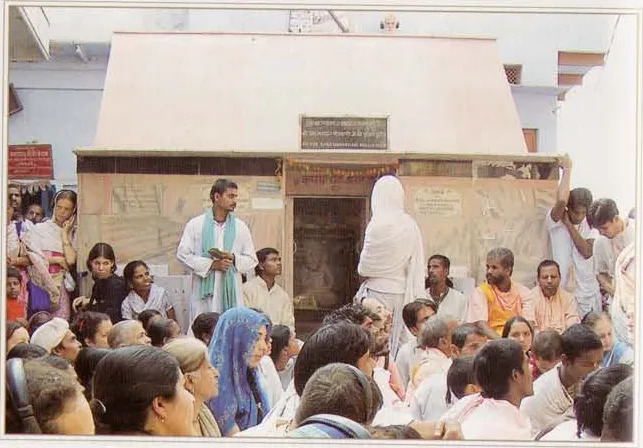
- What it is
- Śrīla Sanātana Gosvāmī's bhajana-kuṭī, his hut for chanting and prayer, is a small shrine at Cakra-tīrtha on Mānasī-gaṅgā, next to the Cakaleśvara Mahādeva temple.
- Visiting
- The guidebooks say that a small bhajana-kuṭī has been built to mark the spot: next to the Cakaleśvara temple according to Govardhana Hill (2001) and Vṛndāvana-Dhāma Ki Jaya!
- Parikramā
- Govardhana parikramā, station 17
In short
Śrīla Sanātana Gosvāmī's bhajana-kuṭī, his hut for chanting and prayer, is a small shrine at Cakra-tīrtha on Mānasī-gaṅgā, next to the Cakaleśvara Mahādeva temple.[1 +5] According to the Bhakti-ratnākara, he was told to stay at Cakra-tīrtha and lived here in a hut in the forest, walking around Govardhana every day. When he grew old, Kṛṣṇa came as a cowherd boy and gave him at the hut a Govardhana-śilā, a stone of the hill, bearing His footprint, so that going around the stone would complete his parikramā, his circuit of the hill.[7 +1]
Key facts
| Kind | bhajana-kuṭīra |
|---|---|
| Region · area | Govardhana · Cakra-tīrtha (Govardhana) |
| On the parikramā | Govardhana parikramā, station 17 · the route |
| Ācāryas | Śrīla Sanātana Gosvāmī, Śrīla Śrīnivāsa Ācārya, Śrīla Rūpa Gosvāmī, Śrīla Raghunātha dāsa Gosvāmī, Śrīla Raghunātha Bhaṭṭa Gosvāmī |
The Gosvāmīs and ācāryas
At Cakra-tīrtha
The Bhakti-ratnākara tells how Śrīla Śrīnivāsa Ācārya's guide showed him this place: Śrīla Sanātana Gosvāmī was told to stay at Cakra-tīrtha and lived here with great joy, and his hut stood inside the forest. Every day he walked around Govardhana, a circuit of twelve krośas (an old measure of distance).[7] The same book has him come from Govardhana to Rādhā-kuṇḍa to see Śrīla Rūpa Gosvāmī and Śrīla Raghunātha dāsa Gosvāmī, and go back again.[9]
According to the local tradition recorded in four guidebooks, mosquitoes once made him think of leaving, and Cakaleśvara Mahādeva, the Śiva of the temple next door, came in the guise of a brāhmaṇa, asked him to stay and promised that the mosquitoes would no longer disturb him; Govardhana Hill (2001) adds that they troubled him while he was writing his books.[1 +4] The Bhakti-ratnākara, the older Vaiṣṇava source, tells only that he was told to stay at Cakra-tīrtha, and no Śiva or mosquito appears there (see the accounts below).[7]
The stone with Kṛṣṇa's footprint
Seeing how hard the daily walk had become for him in his old age, the Bhakti-ratnākara continues, Kṛṣṇa, as Gopīnātha, met him in the guise of a cowherd boy. The boy wiped his sweat, climbed the hill and brought down a Govardhana-śilā bearing His own footprint. He told him to go around this stone from that day, since it would complete the whole parikramā, gave it to him at the hut and disappeared, and Śrīla Sanātana Gosvāmī wept (summarised here, not translated).[2 +5]
The Bengali Vṛndāvana-kathā (1920) tells the gift more briefly: when in old age he could no longer walk the seven-krośa parikramā, a child of great beauty gave him a stone marked with Śrī Kṛṣṇa's footprint, told him to go around it and disappeared, and he went around that stone for the rest of his life. It does not say where this happened.[12] The guidebooks add details of their own: what the stone bears, how many rounds equal a parikramā, and where it is kept today (see the accounts below).
His last years
Govardhana Hill (2001) says that the devotees of Vṛndāvana, led by the Gosvāmīs, used to come to this kuṭī on Guru-pūrṇimā to worship him and to be led by him around Mānasī-gaṅgā, and that on one such day they found that he had left his body. It is the only source for this account, so it is not certain.[13] The Vṛndāvana-kathā (1920) says instead that he lived at times at Govardhana, at times in Vṛndāvana, at Mahāvana and at Rādhā-kuṇḍa, with a hut at each place.[12]
Govardhana Hill (2001) and The Color Guide to Vṛndāvana (2000) date his disappearance to 1558 and say that his body was laid to rest beside the Madana-mohana temple in Vṛndāvana, where his samādhi is; no older record of the year has been checked.[13 +3]
Śrīla Prabhupāda
Śrīla Prabhupāda does not speak of this kuṭī in the pages found, but two general passages bear on its story.
Śrīla Prabhupāda does not speak of this kuṭī in the pages found, but two general passages bear on its story. He writes that the Gosvāmīs used to walk around Govardhana Hill:[17]
General teaching (does not name the place)“Some devotees go around more than three times – ten times, fifteen times – according to their vows. The Gosvāmīs used to circumambulate Govardhana Hill.”
Śrīla Prabhupāda, The Nectar of Devotion, Chapter 6, How to Discharge Devotional Service (the item on circumambulating the temple) · vedabase.io
And in the Caitanya-caritāmṛta he translates Śrī Caitanya Mahāprabhu's words to Śrīla Raghunātha dāsa Gosvāmī when He gave him a stone from Govardhana: that stone, He said, was Kṛṣṇa's own form. The words were spoken of that gift; they are not told of Śrīla Sanātana Gosvāmī's stone.[18]
General teaching (does not name the place)Śrī Caitanya Mahāprabhu instructed Raghunātha dāsa, “This stone is the transcendental form of Lord Kṛṣṇa. Worship the stone with great eagerness.”
Śrīla Prabhupāda, Śrī Caitanya-caritāmṛta, Antya-līlā 6.294, translation · vedabase.io
Visiting today
The guidebooks say that a small bhajana-kuṭī has been built to mark the spot: next to the Cakaleśvara temple according to Govardhana Hill (2001) and Vṛndāvana-Dhāma Ki Jaya! (c. 1986), in front of it according to Śrī Vraja-maṇḍala Parikramā (2007). Govardhana Hill shows a small shrine with a painted portrait inside. No builder or date is recorded.[1 +5]
Location
| Where it is | 'Right next to the Cakaleśvara Mahādeva temple'[19] at Cakra-tīrtha, in front of the Cakaleśvara Mahādeva temple[20] |
|---|
Nearby places
Cakaleśvara Mahādeva Mandira
Pictures
2 pictures
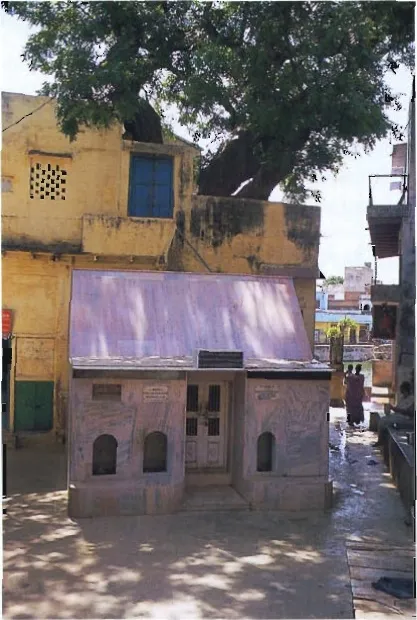
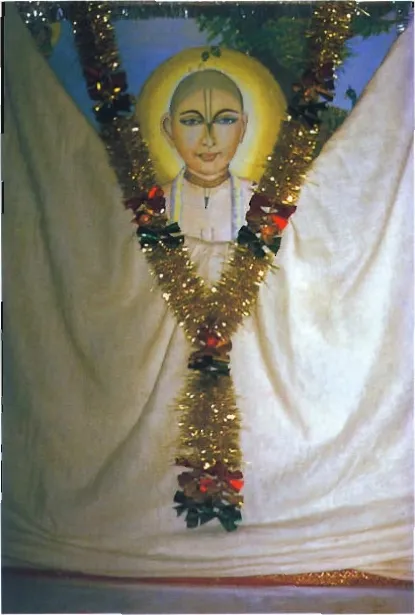
Where the sources differ
Accounts differ Śrīla Sanātana Gosvāmī's Govardhana-śilā: its marks, the rule of circumambulation, and where it is now
- Bhakti-ratnākara, Fifth WaveA Govardhana-śilā with Kṛṣṇa's own footprint; from today circumambulate it; the whole parikramā is fulfilled by it; given at the hut. No number of rounds, no present place.
- Govardhana Hill: India's Most Sacred Mountain (2001)Footprint of Kṛṣṇa, a calf's hoof print, flute and stick; seven rounds equal a parikramā; kept at the Rādhā-Dāmodara temple in Vṛndāvana and 'can still be seen'; a similar śilā at Jaipur; the Vṛndāvana one 'believed to be the original'.
- Śrī Vraja-maṇḍala Parikramā (2007)Marked with Kṛṣṇa's staff and lotus feet; circumambulate it every day; formerly at Rādhā-Dāmodara, Vṛndāvana, 'nowadays' at Rādhā-Dāmodara, Jaipur, with a pratibhū-vigraha in Vṛndāvana; four rounds of the Rādhā-Dāmodara temple give the result of Govardhana parikramā.
- the undated parikramā notes GovardhanaKṛṣṇa gave him a Govardhana-śilā here; no details.
The wording of these accounts is our summary of the sources, not a published translation.
Accounts differ Who asked Śrīla Sanātana Gosvāmī to stay at Cakra-tīrtha, and why
- Bhakti-ratnākara, Fifth Wave'cakratīrtha ājñā kaila rahite ekhāne': Cakra-tīrtha gave him the order to stay here (or: at Cakra-tīrtha he was told to stay); no Śiva, brāhmaṇa or mosquitoes.
- Govardhana Hill: India's Most Sacred Mountain (2001)Mosquitoes troubled him while he was writing his books; Cakaleśvara Mahādeva (Śiva) appeared in the guise of a brāhmaṇa and promised they would not disturb him.
- Śrī Vraja-maṇḍala Parikramā (2007)Cakaleśvara Mahādeva came in the guise of a brāhmaṇa: 'Bābājī, please do not move away … mosquitoes will no longer trouble you.'
- Vṛndāvana-Dhāma Ki Jaya! (c. 1986)Lord Śiva (Cakaleśvara) came disguised as a brāhmaṇa and said the mosquitoes would no longer disturb him.
Accounts differ Where Śrīla Sanātana Gosvāmī lived in his old age and where he passed away
- Bhakti-ratnākara, Fifth WaveHe lived at Cakra-tīrtha, went round Govardhana daily, received the śilā there in old age, and went from Govardhana to Rādhā-kuṇḍa and back; the place of his passing is not given in the pages read.
- Govardhana Hill: India's Most Sacred Mountain (2001)He came here in the last years of his life; the Gosvāmīs found him in samādhi in his kuṭī on Guru-pūrṇimā (1558) and carried his body to Vṛndāvana.
- the undated parikramā notes GovardhanaHe stayed here in the last year of his life and left his body here; samādhi in the Madana-mohana temple area.
- Śrī Vraja-maṇḍala Parikramā (2007)He 'occasionally resided here' and 'remained here for some time'.
The wording of these accounts is our summary of the sources, not a published translation.
Whether the place is free of mosquitoes today: the guidebooks put it in different ways.
Accounts differ Whether mosquitoes are found at Cakra-tīrtha today
- Govardhana Hill: India's Most Sacred Mountain (2001)'Local people still say that even today no mosquitoes can be found at Cakra-tīrtha.'
- Vṛndāvana-Dhāma Ki Jaya! (c. 1986)'Local inhabitants claim that even to this day the place is mostly free from mosquitoes.'
- Śrī Vraja-maṇḍala Parikramā (2007)'Mosquitoes have not caused a disturbance here since.'
References
20 references
- Vṛndāvana-Dhāma Ki Jaya! (c. 1986), by Dhruva Mahārāja dāsa, PDF p. 39
- Govardhana Hill: India's Most Sacred Mountain (2001), Rajasekhara dasa Brahmacari, PDF p. 82
- Govardhana Hill: India's Most Sacred Mountain (2001), Rajasekhara dasa Brahmacari, PDF p. 83
- Śrī Vraja-maṇḍala Parikramā (2007), PDF p. 120
- Śrī Vraja-maṇḍala Parikramā (2007), PDF p. 121
- Śrī Vraja-maṇḍala Parikramā (2007), PDF p. 111
- Śrīla Narahari Cakravartī, Bhakti-ratnākara, Fifth Wave, 1912 ed. p. 208, 2nd ed., 1912
- Śrīla Narahari Cakravartī, Bhakti-ratnākara, Fifth Wave, 1912 ed. p. 209, 2nd ed., 1912
- Śrīla Narahari Cakravartī, Bhakti-ratnākara, Fifth Wave, 1912 ed. p. 210, 2nd ed., 1912
- Vṛndāvana-Dhāma Ki Jaya! (c. 1986), by Dhruva Mahārāja dāsa, PDF p. 40
- the undated parikramā notes Govardhana, ¶65
- Vṛndāvana-kathā, chapter 3 (tṛtīya pariccheda), printed pp. 65-66
- Govardhana Hill: India's Most Sacred Mountain (2001), Rajasekhara dasa Brahmacari, PDF p. 84
- Govardhana Hill: India's Most Sacred Mountain (2001), Rajasekhara dasa Brahmacari, PDF p. 161
- The Color Guide to Vṛndāvana (2000), Written and Photographed by Rājaśekhara dāsa Brahmacārī, PDF p. 61
- The Color Guide to Vṛndāvana (2000), Written and Photographed by Rājaśekhara dāsa Brahmacārī, PDF p. 25
- Śrīla Prabhupāda, The Nectar of Devotion, Chapter 6, How to Discharge Devotional Service (the item on circumambulating the temple) · vedabase.io
- Śrīla Prabhupāda, Śrī Caitanya-caritāmṛta, Antya-līlā 6.294, translation · vedabase.io
- Govardhana Hill: India's Most Sacred Mountain (2001), Rajasekhara dasa Brahmacari, p. 68
- Śrī Vraja-maṇḍala Parikramā (2007), p. 214-215