Dāna-ghāṭī
दान-घाटी
- What it is
- Dāna-ghāṭī, the pass (ghāṭī) of the toll (dāna), is the place where the road from Mathurā crosses Govardhana Hill, as the guidebooks describe it.
- Visiting
- Govardhana Hill (2001) places Dāna-ghāṭī where the Mathurā road goes over Govardhana Hill, and says that a narrow pass used by the gopīs was there before; Śrī Vraja-maṇḍala Parikramā (2007) places it …
- Parikramā
- Govardhana parikramā, station 21
- Places here
- Dāna-ghāṭī Girirāja Mandira, Rādhārāṇī's footprint (Dāna-ghāṭī)
In short
Dāna-ghāṭī, the pass (ghāṭī) of the toll (dāna), is the place where the road from Mathurā crosses Govardhana Hill, as the guidebooks describe it.[1 +1] According to the Bhakti-ratnākara, here Kṛṣṇa, the king of rasikas (those who relish loving exchange), takes a toll of milk products from the gopīs, the cowherd girls of Vraja, and some call the place Kṛṣṇa-vedī.[1 +7] The Bhāgavatam does not tell this toll pastime; Śrīla Rūpa Gosvāmī and Śrīla Raghunātha dāsa Gosvāmī set it on the top of Govardhana, and Śrīla Viśvanātha Cakravartī Ṭhākura names a Śrī Dāna-ghaṭṭa on the hill.[9 +13] The Bhakti-ratnākara also tells that Śrī Caitanya Mahāprabhu asked about the toll pastimes here.[3 +3]
Key facts
| Kind | pass (ghāṭī) |
|---|---|
| Region · area | Govardhana · Govardhana (town) |
| On the parikramā | Govardhana parikramā, station 21 · the route |
| Ācāryas | Śrī Caitanya Mahāprabhu, Śrīla Rūpa Gosvāmī, Śrīla Raghunātha dāsa Gosvāmī, Śrīla Śrīnivāsa Ācārya, Śrīla Narahari Cakravartī Ṭhākura |
Why it is glorified
The Garga-saṁhitā tells that when the sage Pulastya was carrying Govardhana through Vraja, the hill decided to stay there …
The Garga-saṁhitā tells that when the sage Pulastya was carrying Govardhana through Vraja, the hill decided to stay there, because the Lord would perform His toll pastime and His pastime of jealous anger in that land.[26]
दानलीलां मानलीलां हरिरत्र करिष्यति । तस्मान्मया न गन्तव्यं भूमिश्चेयं कलिन्दजा ॥ 38 ॥
dānalīlāṁ mānalīlāṁ hariratra kariṣyati
tasmānmayā na gantavyaṁ bhūmiśceyaṁ kalindajā
The verse names the pastime, not a spot on the hill.[26]
Śrīla Raghunātha dāsa Gosvāmī praises Govardhana for this pastime in two of his prayers (summarised here, not translated). In the Govardhanāśraya-daśaka (verse 8) it is the hill where the young divine couple enjoy the playful quarrel born of a new toll, and whose stones point to those pastimes. In the Govardhana-vāsa-prārthanā-daśaka (verse 4) it is the hill that brings forth the śyāma-vedī, a dark platform that witnessed the couple's toll pastime. Neither verse names Dāna-ghāṭī or a spot on the hill.[1 +5]
Divine pastimes
The toll pastime
Śrīmad-Bhāgavatam does not tell a toll pastime. Among the games of Kṛṣṇa, Balarāma and the cowherd boys it lists "imitating monarchs" (10.18.15), and the gopīs tell Yaśodā that her son is expert in the ways of the cowherds (10.35.14); Śrīla Prabhupāda's Kṛṣṇa book tells these verses without a toll. Some commentators read the toll pastime into them, without naming a place.[9 +7] Read more: Kṛṣṇa's toll pastime (dāna-līlā) at Govardhana and Varṣāṇā →
Śrīla Rūpa Gosvāmī's play Dāna-keli-kaumudī, which the Caitanya-caritāmṛta names among his works, sets the pastime on the top of Govardhana (summarised here, not translated).[2 +9] On the day of a sacrifice that the sage Bhāguri performed on the bank of Govinda-kuṇḍa for the welfare of Kṛṣṇa and Balarāma, Rādhā and Her friends set out with fresh butter for it. Kṛṣṇa is brought to the top of the hill, behind a dark pavilion, and there demands a toll; Viśākhā calls it a toll on Govardhana never seen before, and a gopī answers that a toll station belongs at a ghāṭa of the Yamunā.[13 +5] Verses of the play that Śrīla Rūpa Gosvāmī quotes in his Ujjvala-nīlamaṇi also set the toll quarrel on the rugged slopes of Govardhana Hill. The play does not use the name Dāna-ghāṭī.[17 +2]
Śrīla Raghunātha dāsa Gosvāmī's poem Dāna-keli-cintāmaṇi gives the same occasion, and has Kṛṣṇa set up His toll seat on a high, dark platform (śyāma-vedī) on top of the king of hills (summarised here, not translated).[19 +2] In his Vraja-vilāsa-stava (77) he praises the Kṛṣṇa-vedī, where one morning Kṛṣṇa posed as a toll collector, asking a toll of milk products, and with His friends stopped Śrī Rādhā and Her companions.[1 +6] No source says whether the śyāma-vedī of these verses is the Kṛṣṇa-vedī, or where on the hill it stood; the Bhakti-ratnākara says that some call Dāna-ghāṭī itself Kṛṣṇa-vedī.[1 +7]
According to the Bhakti-ratnākara, Śrīla Śrīnivāsa Ācārya's guide, Śrīla Rāghava Paṇḍita, told him on their walk around Govardhana that this is the place Dānaghāṭi, where Kṛṣṇa takes the toll of milk products.[1 +4] He called it a very secluded place, which some call Kṛṣṇa-vedī, and quoted Śrīla Raghunātha dāsa Gosvāmī's verse; the toll pastime here, he said, is beyond compare, and Śrī Rūpa described it in the Dāna-keli-kaumudī.[1 +8] Śrīla Viśvanātha Cakravartī Ṭhākura's Vraja-rīti-cintāmaṇi also names Śrī Dāna-ghaṭṭa on Govardhana, where Rādhā and Kṛṣṇa had their play of words in the quarrel over the toll.[22]
The Caitanya-caritāmṛta quotes the opening verse of the Dāna-keli-kaumudī. Its Sanskrit says only that Kṛṣṇa blocked Rādhā on the path; Śrīla Prabhupāda's translation calls it Her way to the dāna-ghāṭi.[35 +2]
yathā vā dāna-keli-kaumudyāṃ (1)- antaḥ-smeratayojjvalā jala-kaṇa-vyākīrṇa-pakṣmāṅkurā kiñcit pāṭalitāñcalā rasikatotsiktā puraḥ kuñcatī
ruddhāyāḥ pathi mādhavena madhura-vyābhugna-tārottarā rādhāyāḥ kilakiñcita-stavakinī dṛṣṭiḥ śriyaṃ vaḥ kriyāt //
May the sight of Śrīmatī Rādhārāṇī’s kila-kiñcita ecstasy, which is like a bouquet, bring good fortune to all. When Śrī Kṛṣṇa blocked Rādhārāṇī’s way to the dāna-ghāṭi, there was laughter within Her heart.
Translation: Śrīla A.C. Bhaktivedanta Swami PrabhupādaIn his purports Śrīla Prabhupāda explains the dāna-ghāṭi as the spot where the boatman of the Yamunā collects his fares, and calls the pastime dāna-keli-līlā; he does not mention Govardhana.[35 +2]
The guidebooks tell the same toll pastime of this pass, but they give different reasons why the gopīs were passing.[1 +3]
Accounts differ Why the gopīs were crossing at the pass when Kṛṣṇa demanded the toll
- the undated parikramā notes GovardhanaThey were taking their milk products to the market.
- Śrī Vraja-maṇḍala Parikramā (2007)Rādhikā and Her sakhīs were bringing yoghurt, milk, butter and milk sweets for Śrī Bhāgurī Ṛṣi's sacrifice on the bank of Govinda-kuṇḍa.
- Govardhana Hill: India's Most Sacred Mountain (2001)They used the narrow pass to take their stock of milk products from one side of Govardhana Hill to the other.
Śrī Caitanya Mahāprabhu at the place of the toll
According to the Bhakti-ratnākara, at Dāna-ghāṭī Śrī Caitanya Mahāprabhu asked the brāhmaṇa travelling with Him about the toll pastimes, and smiled with joy as he described them. Then, absorbed in love, He had darśana (sight) of Harideva and danced, and the people wept and said that He was an avatāra.[3 +3] The Caitanya-caritāmṛta tells of the darśana of Harideva and the dance, but not of this talk at Dāna-ghāṭī.[3 +3]
Two other lives of Śrī Caitanya tell what He felt at the place of the toll, without using the name Dāna-ghāṭī (both summarised here, not translated). In Śrīla Murāri Gupta's Kṛṣṇa-caitanya-caritāmṛta His guide tells Him that here, for the sake of the toll, Hari entered a part of the rock and had His pastimes with the gopīs; losing outward awareness, He asks Rādhā for the toll and weeps. In Śrīla Locana dāsa Ṭhākura's Caitanya-maṅgala the guide shows Him a royal road through the middle of the hill and, on top of the hill, the stone and the toll platform where Kṛṣṇa took the great toll from the gopīs; He rubs the stone with His hand, presses His chest to it, asks Rādhā for the toll and falls to the ground.[24 +1]
Traditional accounts
According to Govardhana Hill (2001) and the undated parikramā notes Govardhana, a rock at Dāna-ghāṭī bears the lotus footprint of …
Rādhārāṇī's footprint
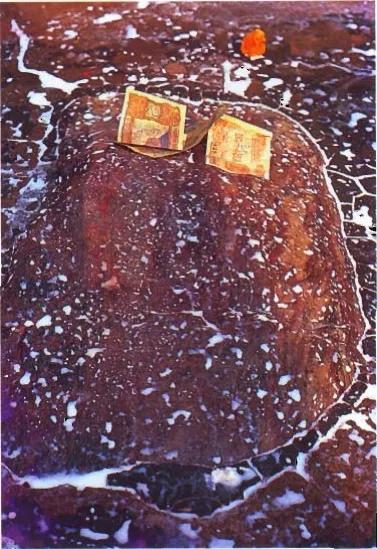
According to Govardhana Hill (2001) and the undated parikramā notes Govardhana, a rock at Dāna-ghāṭī bears the lotus footprint of Śrīmatī Rādhārāṇī.[4 +2] Govardhana Hill adds that, according to the priests, the print on the right of the same rock is Kṛṣṇa's. Neither book says how or when the prints were made.[4 +2]
Śrīla Prabhupāda
No statement of Śrīla Prabhupāda about this place has been found in the works searched.
No statement of Śrīla Prabhupāda about this place has been found in the works searched. Explaining the word dāna-ghāṭi in the Caitanya-caritāmṛta, he writes, in a general explanation about a crossing of the Yamunā:[35 +2]
General teaching (does not name the place)To cross the river, She has to pay the boatman, and the spot where the boatman collects his fares is called the dāna-ghāṭi. Lord Śrī Kṛṣṇa stops Her from going, telling Her, “First You have to pay the fee; then You will be allowed to go.” This pastime is called dāna-keli-līlā.
Śrīla Prabhupāda, Śrī Caitanya-caritāmṛta, Madhya-līlā 14.173, purport · vedabase.io
Songs
Śrīla Raghunātha dāsa Gosvāmī's Govardhanāśraya-daśaka (verse 8): the hill of the toll quarrel, whose stones point to those …
Śrīla Raghunātha dāsa Gosvāmī's Govardhanāśraya-daśaka (verse 8): the hill of the toll quarrel, whose stones point to those pastimes.[27]
yatra svīya-gaṇasya vikrama-bhṛtā vācā muhuḥ phullatoḥ
smera-krūra-dṛg-anta-vibhrama-śaraiḥ śaśvan mitho viddhayoḥ
tad yūnor nava-dāna-sṛṣṭija-kalir bhaṅgyā hasan jṛmbhate
kas taṁ tat-pṛthu-keli-sūcana-śilaṁ govardhanaṁ nāśrayet
His Govardhana-vāsa-prārthanā-daśaka (verse 4): a prayer for a home near the hill whose dark platform witnessed the toll pastime.[21]
rasa-nidhi-nava-yūnoḥ sākṣiṇīṁ dāna-keler
dyuti-parimala-viddhaṁ śyāma-vediṁ prakaṣya
rasika-vara-kulānāṁ modam āsphālayan me
nija-nikaṭa-nivāsaṁ dehi govardhana tvam
Visiting today
Govardhana Hill (2001) places Dāna-ghāṭī where the Mathurā road goes over Govardhana Hill, and says that a narrow pass used by the gopīs was there before; Śrī Vraja-maṇḍala Parikramā (2007) places it in the middle of Govardhana, on the road between Mathurā and Kāmyavana.[1 +1] The 2007 book says that even today a toll must be paid to pass through here, without saying what kind of toll.[2]
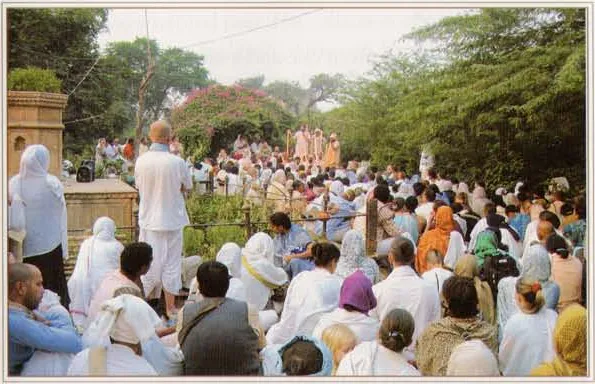
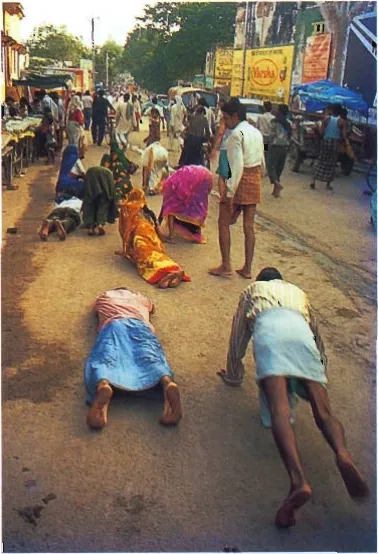
Govardhana Hill reports that pilgrims stop at Rādhārāṇī's footprint, offer flowers, pour milk over the stone and walk around it three times before they go on with the parikramā, the walk around the hill.[33]
Location
| Where it is | 'where the Mathurā road goes over Govardhana Hill'[44] in the middle of Govardhana on the present road between Mathurā and Kāmyavana[45] |
|---|
Places at Dāna-ghāṭī
2 places
Nearby places
Dāna-nivartana-kuṇḍa · Kṛṣṇa Vedi
Pictures
4 pictures
History
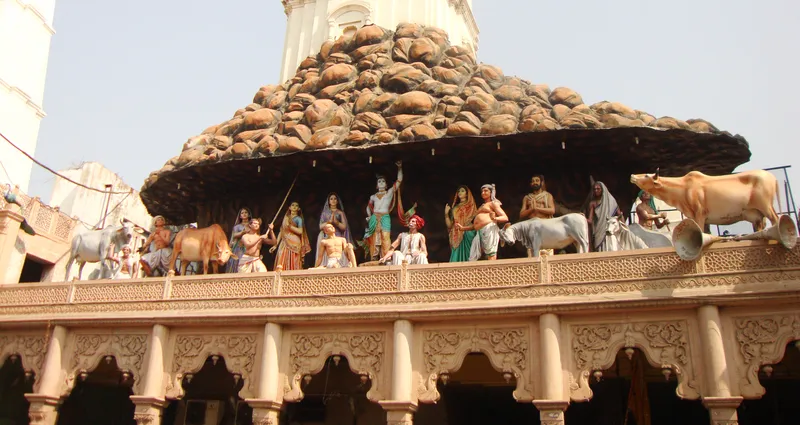
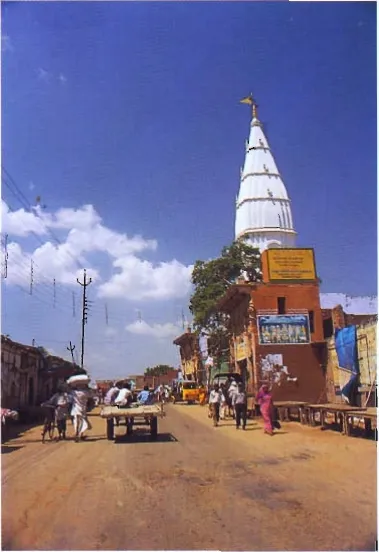
The Girirāja temple
Govardhana Hill (2001) says that the priests of the abandoned Dāni Raya temple on top of the hill moved the Govardhana-śilā (a sacred stone of the hill) that they worshipped there to a new temple, the Dāna-ghāṭī Girirāja Mandira, where the Mathurā road crosses the hill. It gives no date for the move or for the temple.[40 +1] In 1987 the historian A. W. Entwistle described a temple beside the road at Dāna-ghāṭī, dedicated to Kṛṣṇa as Dānirāy, which had then lately been decorated and given a tall spire; he too gives no year of building. Neither book says that the temple it describes is the one the other names.[42]
Where the sources differ
Where Kṛṣṇa took the toll from the gopīs: the Bhāgavatam tells no toll, and the other sources set it in different places.
Where Kṛṣṇa took the toll from the gopīs: the Bhāgavatam tells no toll, and the other sources set it in different places.
Accounts differ Where Kṛṣṇa took the toll from the gopīs
- Śrīmad-Bhāgavatam 10.18.14-16, 10.35.14no toll pastime is narrated; Kṛṣṇa's games are set among the rivers, hills, valleys, groves and lakes of Vṛndāvana
- Śrīla Viśvanātha Cakravartī and Vaṁśīdhara on ŚB 10.18.15at the toll place (dāna-ghaṭṭa); not located
- Śrīla Śrīdhara Svāmī, Śrīla Jīva Gosvāmī (Laghu-toṣaṇī) and Śrīla Baladeva Vidyābhūṣaṇa on ŚB 10.18.15'imitating kings' is a game of playing king (Śrīdhara: like the play of kings; Jīva and Baladeva: a throne of hill-stone, an umbrella of flowers); no toll
- Śrīla Prabhupāda's disciples, purport of ŚB 10.18.15Śrīla Viśvanātha's toll place was on the riverbank, where people crossing the Yamunā paid a small tax
The wording of these accounts is our summary of the sources, not a published translation.
Which place is the neck of Govardhana, when the hill is pictured as a body: Śrīla Viśvanātha Cakravartī Ṭhākura's Vraja-rīti-cintāmaṇi makes Mānasī-gaṅgā the neck of the peacock-shaped hill, and the other sources name other places.[43] Read more: The body of Govardhana: mouth, eyes, neck and the peacock →
Accounts differ Which place is Govardhana's neck: an ācārya's position
- Śrīla Viśvanātha Cakravartī, Vraja-rīti-cintāmaṇi 3.23the neck-place (gala-sthalī) is Mānasa-jāhnavī (Mānasī-gaṅgā)
- the undated parikramā notes Govardhana'Dan Ghati is its long neck'
- Govardhana Hill: India's Most Sacred Mountain (2001)its neck is Mānasī-gaṅgā
- Garga-saṁhitā 3.8.7the neck is the Vādanī-śilā
More on this place
Kṛṣṇa's toll pastime (dāna-līlā) at Govardhana and Varṣāṇā · The body of Govardhana: mouth, eyes, neck and the peacock
References
45 references
- Govardhana Hill: India's Most Sacred Mountain (2001), Rajasekhara dasa Brahmacari, PDF p. 84
- Śrī Vraja-maṇḍala Parikramā (2007), PDF p. 122
- Śrīla Narahari Cakravartī, Bhakti-ratnākara, Fifth Wave, 1912 ed. pp. 203-204, 2nd ed., 1912
- the undated parikramā notes Govardhana, ¶71
- Śrīla Narahari Cakravartī, Bhakti-ratnākara, Fifth Wave, 1912 ed. p. 204, 2nd ed., 1912
- Śrīla Raghunātha dāsa Gosvāmī, Vraja-vilāsa-stava 77 (as numbered in the quotation); Bhakti-ratnākara 1912 ed. p. 204, 2nd ed., 1912
- Śrīla Raghunātha dāsa Gosvāmī, Vraja-vilāsa-stava, verse 77
- the undated parikramā notes Govardhana, ¶70
- Śrīmad-Bhāgavatam 10.18.15, GRETIL
- Śrīmad-Bhāgavatam 10.35.14, GRETIL
- Śrīla Prabhupāda, Kṛṣṇa, the Supreme Personality of Godhead (Kṛṣṇa book), Chapter 18, 'Killing the Demon Pralambāsura' · vedabase.io
- Śrīla Prabhupāda, Kṛṣṇa, the Supreme Personality of Godhead (Kṛṣṇa book), Chapter 35, 'The Gopīs’ Feelings of Separation' · vedabase.io
- Śrīla Rūpa Gosvāmī, Dāna-keli-kaumudī, opening scene after the prologue, part 1 after v.8 - after v.9, after the undated edition published by Krishna Das of Kusum Sarovar
- Śrīla Rūpa Gosvāmī, Dāna-keli-kaumudī, opening scene, part 1 after v.12, after the undated edition published by Krishna Das of Kusum Sarovar
- Śrīla Rūpa Gosvāmī, Dāna-keli-kaumudī, the toll scene, part 1 after v.37, after the undated edition published by Krishna Das of Kusum Sarovar
- Śrīla Rūpa Gosvāmī, Dāna-keli-kaumudī, the toll scene, part 1 after v.40, after the undated edition published by Krishna Das of Kusum Sarovar
- Śrīla Rūpa Gosvāmī, Ujjvala-nīlamaṇi 15.241, quoting Dāna-keli-kaumudī 64, GRETIL
- Śrīla Rūpa Gosvāmī, Ujjvala-nīlamaṇi 14.3, quoting Dāna-keli-kaumudī 30, GRETIL
- Śrīla Raghunātha dāsa Gosvāmī, Dāna-keli-cintāmaṇi, verses 6-7
- Śrīla Raghunātha dāsa Gosvāmī, Dāna-keli-cintāmaṇi, verse 15
Show all 45 references
- Śrīla Raghunātha dāsa Gosvāmī, Govardhana-vāsa-prārthanā-daśaka, verse 4
- Śrīla Viśvanātha Cakravartī Ṭhākura, Vraja-rīti-cintāmaṇi, third sarga, verses 21-22
- Śrīla Kṛṣṇadāsa Kavirāja Gosvāmī, Śrī Caitanya-caritāmṛta, Madhya-līlā 18.19, online edition · vedabase.io
- Kṛṣṇa-caitanya-caritāmṛta of Murāri Gupta, prakrama 4, sarga 8, vv.5-7
- Śrīla Locana dāsa Ṭhākura, Caitanya-maṅgala, Śeṣa-khaṇḍa, 1903 ed. p. 174, left column
- Garga-saṁhitā, Vṛndāvana-khaṇḍa (2), adhyāya 2, verse 38, Sanskrit Wikisource
- Śrīla Raghunātha dāsa Gosvāmī, Govardhanāśraya-daśaka, verse 8
- Śrīla Viśvanātha Cakravartī Ṭhākura, Śrīla Jīva Gosvāmī, Baladeva Vidyābhūṣaṇa: commentary on ŚB 10.18.15, Bhagavata Vidya Pith edition, ed. Bhagavata Rishi and Krishna Shankar Shastri, 1996
- Śrīla Sanātana Gosvāmī: commentary on ŚB 10.18.14, Bhagavata Vidya Pith edition, ed. Bhagavata Rishi and Krishna Shankar Shastri, 1996
- Śrīla Jīva Gosvāmī: commentary on ŚB 10.35.14-15, Bhagavata Vidya Pith edition, ed. Bhagavata Rishi and Krishna Shankar Shastri, 1996
- Śrīla Sanātana Gosvāmī: commentary on ŚB 10.33.25
- Śrīla Prabhupāda, Śrī Caitanya-caritāmṛta, Madhya-līlā 1.39-40, translation · vedabase.io
- Govardhana Hill: India's Most Sacred Mountain (2001), Rajasekhara dasa Brahmacari, PDF p. 85
- Śrī Vraja-maṇḍala Parikramā (2007), PDF p. 123
- Śrīla Prabhupāda, Śrī Caitanya-caritāmṛta, Madhya-līlā 14.171, translation · vedabase.io
- Śrīla Prabhupāda, Śrī Caitanya-caritāmṛta, Madhya-līlā 14.173, purport · vedabase.io
- Śrīla Rūpa Gosvāmī, Ujjvala-nīlamaṇi 11.46, quoting Dāna-keli-kaumudī 1; CC Madhya 14.180, GRETIL
- Śrīla Rūpa Gosvāmī, Ujjvala-nīlamaṇi 11.46, quoting Dāna-keli-kaumudī 1; CC Madhya 14.180, GRETIL
- the key of the numbered Govardhana chart, ¶30
- Govardhana Hill: India's Most Sacred Mountain (2001), Rajasekhara dasa Brahmacari, PDF p. 86
- the key of the numbered Govardhana chart, ¶29
- A. W. Entwistle, the entry '9 Dan Ghati and Daniray temple' of his Govardhan section, printed p. 346, Egbert Forsten, Groningen, 1987
- Śrīla Viśvanātha Cakravartī Ṭhākura, Vraja-rīti-cintāmaṇi, third sarga, verse 23
- Govardhana Hill: India's Most Sacred Mountain (2001), Rajasekhara dasa Brahmacari, p. 70
- Śrī Vraja-maṇḍala Parikramā (2007), p. 218-219