Cakra-tīrtha (Govardhana)
चक्र-तीर्थ (गोवर्धन) Hindi name proposed
Also called Cakra Tīrtha
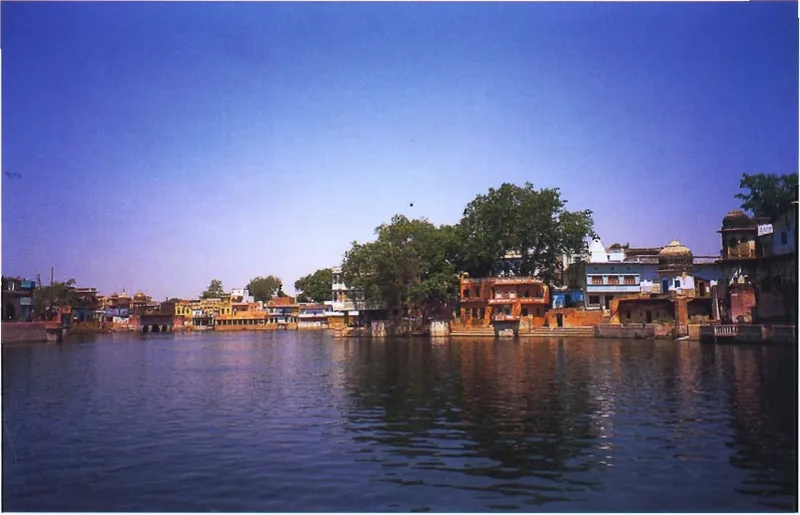
- What it is
- Cakra-tīrtha is a holy bathing place (tīrtha) on the northern bank of Mānasī-gaṅgā in Govardhana town, as the guidebooks place it.
- Visiting
- Govardhana Hill (2001), Śrī Vraja-maṇḍala Parikramā (2007) and the undated parikramā notes Govardhana put Cakra-tīrtha on the northern bank of Mānasī-gaṅgā; the 2007 book marks it on its map of the …
- Parikramā
- Govardhana parikramā, station 16
- Places here
- Cakaleśvara Mahādeva Mandira, Daivata Hill, Sanātana Gosvāmī's bhajana-kuṭī (Govardhana)
In short
Cakra-tīrtha is a holy bathing place (tīrtha) on the northern bank of Mānasī-gaṅgā in Govardhana town, as the guidebooks place it.[1 +4] Śrīla Raghunātha dāsa Gosvāmī praises it among the holy places around Govardhana Hill, and the Bhakti-ratnākara calls it very well known, sets Śrī Rādhā and Kṛṣṇa's swing pastime here and tells that Śrīla Sanātana Gosvāmī lived here.[1 +5] The Varāha Purāṇa names a bath at a Cakra-tīrtha at the close of the walk around Govardhana, though it does not say where that tīrtha lies.[11] The guidebooks explain the name from the lifting of the hill, but Śrīmad-Bhāgavatam tells the lifting without any cakra, the disc weapon of Kṛṣṇa.[12 +2]
Key facts
| Kind | tīrtha |
|---|---|
| Region · area | Govardhana · Govardhana (town) |
| Also part of | Mānasī-gaṅgā |
| On the parikramā | Govardhana parikramā, station 16 · the route |
| Ācāryas | Śrīla Sanātana Gosvāmī, Śrīla Raghunātha dāsa Gosvāmī, Śrīla Śrīnivāsa Ācārya, Śrīla Narahari Cakravartī Ṭhākura, Śrīla Nārāyaṇa Bhaṭṭa Gosvāmī |
Why it is glorified
The Vraja-bhakti-vilāsa of Śrīla Nārāyaṇa Bhaṭṭa Gosvāmī lists Cakra-tīrtha among the sites of Govardhana, after Mānasī-gaṅgā …
The Vraja-bhakti-vilāsa of Śrīla Nārāyaṇa Bhaṭṭa Gosvāmī lists Cakra-tīrtha among the sites of Govardhana, after Mānasī-gaṅgā, Brahma-kuṇḍa and the temple of Manasā-devī, and before the image of Cakreśvara Mahādeva.[15 +1] It gives a prayer for bathing in its water and sipping it, which addresses the tīrtha as marked by Kṛṣṇa's cakra and as the destroyer of all sins; said ten times while bathing, the book says, it frees one from sin (summarised here, not translated).[15 +1]
The Varāha Purāṇa closes its directions for the walk around Govardhana with a bath at Cakra-tīrtha, in a kuṇḍa (pond) called Pañca-tīrtha, followed by a night of vigil at Govardhana. The verse does not say where this Cakra-tīrtha is.[11]
Śrīla Raghunātha dāsa Gosvāmī's Vraja-vilāsa-stava (verse 79) praises the best lakes on every side of Govardhana and, with them, Cakra-tīrtha and jewelled seats (summarised here, not translated).[1 +6] The words of the verse, cakraka-tīrtha-daivata-giri-śrī-ratna-pīṭhāni, can be divided in more than one way: as Cakra-tīrtha, a hill of the Deity (daivata-giri) and the jewelled seats, or as the jewelled seats of that hill at Cakra-tīrtha. The guidebook Govardhana Hill (2001) reads them as the jewelled thrones on Daivata Hill at Cakra-tīrtha, and this verse is the only source of that name.[6 +1] The Bhakti-ratnākara quotes the verse here, right after calling Cakra-tīrtha very well known.[8]
Divine pastimes
The lifting of the hill, and the cakra
Śrīmad-Bhāgavatam (10.25) tells that when Indra's rain fell on Vraja, Kṛṣṇa resolved to protect the cowherds by His own potency, lifted Govardhana with one hand and held it up for seven days. He told the people under the hill not to fear the wind and the rain, since their deliverance had been arranged, and Indra, seeing Kṛṣṇa's mystic power, called back his clouds. The chapter names no Sudarśana cakra, no Śeṣa and no Śiva, and no Cakra-tīrtha.[12 +6]
tasmān mac-charaṇaṃ goṣṭhaṃ man-nāthaṃ mat-parigraham / gopāye svātma-yogena so 'yaṃ me vrata āhitaḥ
I must therefore protect the cowherd community by My transcendental potency, for I am their shelter, I am their master, and indeed they are My own family. After all, I have taken a vow to protect My devotees.
Translation: Śrīla Prabhupāda's disciples (BBT)Śrīla Prabhupāda's Kṛṣṇa book tells it the same way: Kṛṣṇa protects them by His mystic power, and they stay under the hill for one week.[12 +2]
The Garga-saṁhitā adds the cakra. When the flood came, Kṛṣṇa gave an order in His mind to the Sudarśana cakra and to Śeṣa, the divine serpent; the cakra stayed above the hill and drank up the falling rain while Kṛṣṇa held the hill for seven days.[23 +2] The chapter does not say what the cakra did afterwards, and it does not name Cakra-tīrtha.[23 +2]
कोटिसूर्यप्रभं चाद्रेरूर्ध्वं चक्रं सुदर्शनम् । धारासंपातमपिबदगस्त्य इव मैथिल ॥ 21 ॥
koṭisūryaprabhaṁ cādrerūrdhvaṁ cakraṁ sudarśanam
dhārāsaṁpātamapibadagastya iva maithila
Among the commentators on the Bhāgavatam (summarised here, not translated), only Vaṁśīdhara brings in the Garga-saṁhitā's account. He reads one word of the Bhāgavatam as the body of Śeṣa, which kept the water out of the hollow under the hill, and says that the wind and the rain were dried up by the Sudarśana. He does not say where the cakra went afterwards.[26 +1] Śrīla Sanātana Gosvāmī, Śrīla Jīva Gosvāmī and Śrīla Viśvanātha Cakravartī Ṭhākura ascribe the keeping off and the drying of the rain to Kṛṣṇa's own potencies, and none of them names a cakra.[27 +4]
Śrīla Jīva Gosvāmī also says that Kṛṣṇa took up the hill by cutting it from its base upward, since the hill is broken off to the north of the Mānasa-gaṅgā, and that this part, which the Varāha Purāṇa calls Annakūṭa, is still known separately. His is the only commentary on the Tenth Canto found that connects the lifting with the Mānasa-gaṅgā, on whose northern bank the guidebooks put Cakra-tīrtha; he does not name Cakra-tīrtha.[28] Read more: The lifting of Govardhana Hill, Indra's homage and the name Govinda →
The guidebooks explain the name of Cakra-tīrtha from this pastime, but each tells it differently:
Accounts differ How the rain was held off during the lifting of Govardhana, and how Cakra-tīrtha got its name
- Garga-saṁhitā, Girirāja-khaṇḍa 3.3.20-23Kṛṣṇa mentally ordered Sudarśana and Śeṣa; the cakra, brilliant as ten million suns, stayed above the hill and drank the falling rain; Śeṣa held the water back below; Kṛṣṇa held the hill seven days. Nothing about the cakra staying at Mānasī-gaṅgā or a Cakra-tīrtha.
- Govardhana Hill: India's Most Sacred Mountain (2001)Kṛṣṇa released the Sudarśana cakra; it stayed over the hill seven days, produced heat equal to seven suns and evaporated the rain; at its request Kṛṣṇa told it to stay here, which became Cakra-tīrtha; the cakra 'is embedded' here.
- the undated parikramā notes GovardhanaThe cakra stayed above the hill the whole seven days; heat 'equal to many suns' consumed the rain; afterwards it remained on the northern bank of Mānasī-gaṅgā.
- Śrī Vraja-maṇḍala Parikramā (2007)Mahādeva (Sadāśiva, viṣṇu-tattva) protected Girirāja and the Vrajavāsīs by raising his trident like a cakra; 'some devotees' say the Sudarśana cakra protected Vraja at Mahādeva's request, and so he became Cakreśvara.
The swing pastime
According to the Bhakti-ratnākara, Śrīla Śrīnivāsa Ācārya's guide told him that Cakra-tīrtha is very well known at Govardhana, that by its mercy one's desire is fulfilled, and that Śrī Rādhā and Kṛṣṇa's swing pastime is here.[6 +5] For the swing it quotes the next verse of the Vraja-vilāsa-stava (80), in which the sakhīs, Rādhā's girl companions, swing Śrī Gāndharvā (Rādhā) and the holder of the hill every spring. That verse names the place Govinda-sthala, not Cakra-tīrtha.[6 +4]
The boat pastime
According to the Bhakti-ratnākara, Kṛṣṇa, controlled by love, has many pastimes in the flower garden by Śrīla Sanātana Gosvāmī's hut. When Śrī Rādhikā comes with Her sakhīs, He goes ahead and brings them here, and at this ghāṭa (bathing place) of Mānasī-gaṅgā He takes a boat and, as the boatman, ferries them all across. For this pastime the book quotes a verse of Śrīla Raghunātha dāsa Gosvāmī, given below with the songs.[17 +3] Śrī Vraja-maṇḍala Parikramā (2007) sets the boat pastime at Pāraṅga-ghāṭa, where, it says, Cakreśvara presides and from where the gopīs, the cowherd girls, used to cross the lake. The verses quoted for the pastime name Mānasī-gaṅgā but not the ghāṭa.[17 +3] Read more: The boat pastime on Mānasī-gaṅgā: Kṛṣṇa as the boatman →
The Gosvāmīs and ācāryas
According to the Bhakti-ratnākara, Śrīla Sanātana Gosvāmī was told to stay at Cakra-tīrtha and lived here with great joy, and the …
Śrīla Sanātana Gosvāmī
According to the Bhakti-ratnākara, Śrīla Sanātana Gosvāmī was told to stay at Cakra-tīrtha and lived here with great joy, and the guide showed Śrīla Śrīnivāsa Ācārya his hut inside the forest, his bhajana-kuṭī (a hut for chanting and prayer). Every day he walked around Govardhana, twelve krośas (an old measure of distance), and when Kṛṣṇa saw his great labour in his old age, He met him in the guise of a cowherd boy.[8 +1] The book's line can be read to say that Cakra-tīrtha itself gave him the order to stay, or that at Cakra-tīrtha he was told to stay. The guidebooks say instead that Cakaleśvara Mahādeva asked him to stay.[8 +2]
Śrī Nityānanda Prabhu
According to the Bhakti-ratnākara, Śrī Nityānanda Prabhu, touring the holy places, came to Govardhana for the sake of a dear devotee, a wealthy brāhmaṇa who lived near the hill, and stayed for some days at a solitary spot that the guide shows just before Cakra-tīrtha. The book does not name the spot.[35]
Śrīla Prabhupāda
Śrīla Prabhupāda does not speak of Cakra-tīrtha by name.
Śrīla Prabhupāda does not speak of Cakra-tīrtha by name. In his Kṛṣṇa book, in a general telling of the lifting, the protection that Kṛṣṇa arranged for the people of Vraja is the lifted hill itself:[36]
General teaching (does not name the place)“You have been too much afflicted from the heavy rain and strong wind; therefore I have lifted this hill, which will protect you exactly like a huge umbrella. I think this is a proper arrangement to relieve you of your immediate distress.”
Śrīla Prabhupāda, Kṛṣṇa, the Supreme Personality of Godhead (Kṛṣṇa book), Chapter 25, 'Devastating Rainfall in Vṛndāvana' · vedabase.io
Songs
Śrīla Raghunātha dāsa Gosvāmī's Govardhanāśraya-daśaka (verse 6), which the Bhakti-ratnākara quotes at the ghāṭa by Śrīla …
Śrīla Raghunātha dāsa Gosvāmī's Govardhanāśraya-daśaka (verse 6), which the Bhakti-ratnākara quotes at the ghāṭa by Śrīla Sanātana Gosvāmī's hut: Mādhava (Kṛṣṇa), as the boatman, takes Rādhā across the Mānasī-gaṅgā in His boat.[17 +1]
Śrīla Viśvanātha Cakravartī Ṭhākura's Govardhanāṣṭaka (verse 7), which Śrī Vraja-maṇḍala Parikramā quotes for the boat pastime at Pāraṅga-ghāṭa; the verse itself names only the Gaṅgā.[32 +2]
Visiting today
Govardhana Hill (2001), Śrī Vraja-maṇḍala Parikramā (2007) and the undated parikramā notes Govardhana put Cakra-tīrtha on the northern bank of Mānasī-gaṅgā; the 2007 book marks it on its map of the town near the west end of the lake.[1 +4]
Location
| Where it is | 'on the northern bank of Mānasī-gaṅgā'[39] north side of Mānasī-gaṅgā[40] |
|---|---|
| On the numbered Govardhana chart | 19 (printed as “Cakra Tirtha (Cakaleswara Temple, Bhajan Kutir of Sanatana Goswami)”)[41] |
Places at Cakra-tīrtha (Govardhana)
3 places
Where the sources differ
Who asked Śrīla Sanātana Gosvāmī to stay at Cakra-tīrtha: the Bhakti-ratnākara and four guidebooks tell it differently, and their accounts are set side by side on the page of his bhajana-kuṭī.[8 +2]
Whether mosquitoes are found at Cakra-tīrtha today: three guidebooks report it in different words.
Accounts differ Whether mosquitoes are found at Cakra-tīrtha today
- Govardhana Hill: India's Most Sacred Mountain (2001)'Local people still say that even today no mosquitoes can be found at Cakra-tīrtha.'
- Vṛndāvana-Dhāma Ki Jaya! (c. 1986)'Local inhabitants claim that even to this day the place is mostly free from mosquitoes.'
- Śrī Vraja-maṇḍala Parikramā (2007)'Mosquitoes have not caused a disturbance here since.'
More on this place
The lifting of Govardhana Hill, Indra's homage and the name Govinda · The boat pastime on Mānasī-gaṅgā: Kṛṣṇa as the boatman
References
41 references
- Govardhana Hill: India's Most Sacred Mountain (2001), Rajasekhara dasa Brahmacari, PDF p. 81
- Śrī Vraja-maṇḍala Parikramā (2007), PDF p. 119
- Śrī Vraja-maṇḍala Parikramā (2007), PDF p. 111
- the undated parikramā notes Govardhana, ¶62
- the key of the numbered Govardhana chart, ¶21
- Śrīla Raghunātha dāsa Gosvāmī, Vraja-vilāsa-stava, verse 79
- Śrīla Raghunātha dāsa Gosvāmī, Vraja-vilāsa-stava, as quoted in the Bhakti-ratnākara, Fifth Wave, 1912 ed. p. 208; verse printed as Vraja-vilāsa '৮৯' (89), 2nd ed., 1912
- Śrīla Narahari Cakravartī, Bhakti-ratnākara, Fifth Wave, 1912 ed. p. 208, 2nd ed., 1912
- Śrīla Raghunātha dāsa Gosvāmī, Vraja-vilāsa-stava, as quoted in the Bhakti-ratnākara, Fifth Wave, 1912 ed. p. 208; verse printed as Vraja-vilāsa '৮০' (80), 2nd ed., 1912
- Śrīla Raghunātha dāsa Gosvāmī, Vraja-vilāsa-stava, verse 80
- Varāha Purāṇa, adhyāya 164, verses 41-42, Sanskrit Wikisource
- Śrīmad-Bhāgavatam 10.25.18, GRETIL
- Śrīmad-Bhāgavatam 10.25.23, GRETIL
- Śrīla Prabhupāda, Kṛṣṇa, the Supreme Personality of Godhead, Chapter 25, Devastating Rainfall in Vṛndāvana · vedabase.io
- Śrī Nārāyaṇa Bhaṭṭa Gosvāmī, Vraja-bhakti-vilāsa, Govardhana-liṅga (list of Govardhana's sites), printed p. 47, 1st ed., publ. Bābā Kṛṣṇadāsa, Kusuma-sarovara, Saṁvat 2008
- Śrī Nārāyaṇa Bhaṭṭa Gosvāmī, Vraja-bhakti-vilāsa, Govardhana section, Cakra-tīrtha (§ 7), printed p. 114, 1st ed., publ. Bābā Kṛṣṇadāsa, Kusuma-sarovara, Saṁvat 2008
- Śrīla Raghunātha dāsa Gosvāmī, Govardhanāśraya-daśaka, verse 6
- Śrīla Narahari Cakravartī, Bhakti-ratnākara, Fifth Wave, 1912 ed. p. 209, 2nd ed., 1912
- Śrīmad-Bhāgavatam 10.25.19, GRETIL
- Śrīmad-Bhāgavatam 10.25.21, GRETIL
Show all 41 references
- Śrīmad-Bhāgavatam 10.25.24, GRETIL
- Śrīmad-Bhāgavatam 10.25.26, GRETIL
- Garga-saṁhitā, Girirāja-khaṇḍa (3), adhyāya 3, verse 20, Sanskrit Wikisource
- Garga-saṁhitā, Girirāja-khaṇḍa (3), adhyāya 3, verse 21, Sanskrit Wikisource
- Garga-saṁhitā, Girirāja-khaṇḍa (3), adhyāya 3, verse 23, Sanskrit Wikisource
- Vaṁśīdhara: commentary on ŚB 10.25.21, Bhagavata Vidya Pith edition, ed. Bhagavata Rishi and Krishna Shankar Shastri, 1996
- Vaṁśīdhara: commentary on ŚB 10.25.26, Bhagavata Vidya Pith edition, ed. Bhagavata Rishi and Krishna Shankar Shastri, 1996
- Śrīla Jīva Gosvāmī, Śrīla Viśvanātha Cakravartī Ṭhākura: commentary on ŚB 10.25.19, Bhagavata Vidya Pith edition, ed. Bhagavata Rishi and Krishna Shankar Shastri, 1996
- Śrīla Sanātana Gosvāmī: commentary on ŚB 10.25.22, Bhagavata Vidya Pith edition, ed. Bhagavata Rishi and Krishna Shankar Shastri, 1996
- Śrīla Viśvanātha Cakravartī Ṭhākura: commentary on ŚB 10.25.23, Bhagavata Vidya Pith edition, ed. Bhagavata Rishi and Krishna Shankar Shastri, 1996
- Vaṁśīdhara, Śrīla Sanātana Gosvāmī, Śrīla Jīva Gosvāmī: commentary on ŚB 10.25.24, Bhagavata Vidya Pith edition, ed. Bhagavata Rishi and Krishna Shankar Shastri, 1996
- Śrīla Viśvanātha Cakravartī Ṭhākura, Śrī Govardhanāṣṭaka, verse 7
- Śrī Vraja-maṇḍala Parikramā (2007), PDF p. 120
- Govardhana Hill: India's Most Sacred Mountain (2001), Rajasekhara dasa Brahmacari, PDF p. 82
- Śrīla Narahari Cakravartī, Bhakti-ratnākara, Fifth Wave, 1912 ed. p. 206 and p. 208, 2nd ed., 1912
- Śrīla Prabhupāda, Kṛṣṇa, the Supreme Personality of Godhead (Kṛṣṇa book), Chapter 25, 'Devastating Rainfall in Vṛndāvana' · vedabase.io
- Saptāhaṁ Murajit Karāmbuja (Govardhanāśraya-daśakam), verse 6 (Raghunātha dāsa Gosvāmī (as the song book credits it)) · song book
- Kṛṣṇa Prasādena Samasta (Śrī Govardhanāṣṭakam), verse 7 (Viśvanātha Cakravartī Ṭhākura (as the song book credits it)) · song book
- Govardhana Hill: India's Most Sacred Mountain (2001), Rajasekhara dasa Brahmacari, p. 67
- Śrī Vraja-maṇḍala Parikramā (2007), p. 212-213
- Numbered list of the Govardhana sites (key of the Govardhana chart)