Kadamba Vana (Govardhana)
कदम्ब वन (गोवर्धन) Hindi name proposed
Also called Kadambavana, Kadamba Van Forest
- What it is
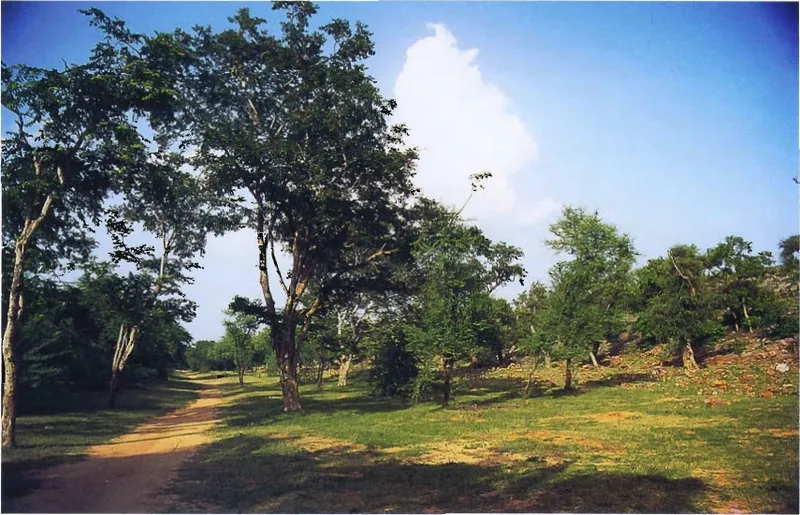
- Kadamba Vana is a forest on the Govardhana parikramā (the walk around the hill), on the stretch between Pūñcharī and Jatīpurā.
- Visiting
- In 2001 Govardhana Hill reported that most of the kadamba trees of the forest had disappeared, and it photographed the parikramā path running through it.
- Places here
- Airāvata-kuṇḍa, Indra-kuṇḍa (Kadamba Vana), Surabhi-kuṇḍa (Govardhana)
In short
Kadamba Vana is a forest on the Govardhana parikramā (the walk around the hill), on the stretch between Pūñcharī and Jatīpurā. According to the guidebook Govardhana Hill (2001) and the undated parikramā notes Govardhana, Surabhi-kuṇḍa, Indra-kuṇḍa and Airāvata-kuṇḍa lie in it.[1 +2] Both books say that Rādhā and Kṛṣṇa met here.[1 +1] The Bhakti-ratnākara shows on the same stretch of the circuit a Kadamba-khaṇḍī, where Kṛṣṇa waits for Rādhikā; no source says that the two are one place.[4] Scripture also glorifies a Kadamba-khaṇḍa at Govardhana, but no source says that it is this forest.[5 +3]
Key facts
| Kind | forest |
|---|---|
| Region · area | Govardhana |
| Ācāryas | Śrīla Śrīnivāsa Ācārya |
Divine pastimes
According to the Bhakti-ratnākara, when Śrīla Śrīnivāsa Ācārya was shown the Govardhana circuit, his guide came after Rudra-kuṇḍa to Kadamba-khaṇḍī and said that here Kṛṣṇa stays looking along the path by which Rādhikā will come. Dāna-ghāṭī was shown next.[4 +1] The book's order of places agrees with the guidebooks' position for Kadamba Vana, but it does not say that the two are one place.[4]
Govardhana Hill (2001) says that Kadamba Vana saw many loving pastimes of Rādhā and Kṛṣṇa, and that the kadamba tree is dear to Kṛṣṇa because its yellow flowers remind Him of Rādhārāṇī's complexion. The undated parikramā notes Govardhana report a saying that Rādhā and Kṛṣṇa would meet in this forest. Neither book names a source.[1 +1]
Traditional accounts
The Garga-saṁhitā names a Kadamba-khaṇḍa among the holy places of Govardhana, a tīrtha ever connected with Kṛṣṇa's pastimes, and …
Texts that name a Kadamba-khaṇḍa
The Garga-saṁhitā names a Kadamba-khaṇḍa among the holy places of Govardhana, a tīrtha ever connected with Kṛṣṇa's pastimes, and promises that one who simply sees it attains a form like Nārāyaṇa's; in its picture of the hill as a body, Kadamba-khaṇḍa is the hill's chest (summarised here, not translated).[5 +1] The Varāha Purāṇa, on its circuit of Govardhana, names a kuṇḍa called Kadamba-khaṇḍa, with clear water, after the tīrtha that Indra made near Annakūṭa. One who bathes there and worships the forefathers reaches Brahmaloka, it says.[7 +1] Śrīla Raghunātha dāsa Gosvāmī's Vraja-vilāsa-stava (verse 79) names a lake of this name, Kadamba-khaṇḍa, among the best lakes that shine all round the hill.[10]
The Garga-saṁhitā and the stava give no position for it, and in the Varāha Purāṇa and the stava it is a lake, not a forest. No source says that any of these is Kadamba Vana.[5 +4]
Other places of the name
Śrīla Nārāyaṇa Bhaṭṭa Gosvāmī's Vraja-bhakti-vilāsa knows a forest called Kadamba-khaṇḍa in another part of Govardhana, near the place of Lakṣmī-Nārāyaṇa that follows Cakra-tīrtha, with Harideva-kuṇḍa in its middle.[11] Citing a work it calls the Bhaviṣya, it says that the forest got its name when Kṛṣṇa sat in a kadamba tree and played His flute for the gopīs, the cowherd girls of Vraja, who sat below, eager for the rāsa dance with Him. It promises a share in liberation to one who comes there and bows down.[11 +1]
The name is also given to a garden. Śrī Rūpakalā's prose commentary in the Hindi Bhaktamāla (1904) said that the garden called Kadamba-khaṇḍī of the poet Śrī Govinda Svāmī still existed near Govardhana; it did not say where.[13]
Visiting today
In 2001 Govardhana Hill reported that most of the kadamba trees of the forest had disappeared, and it photographed the parikramā path running through it.[1 +2]
Location
| Where it is | Contains Surabhi-kuṇḍa, Indra-kuṇḍa and Airāvata-kuṇḍa[14] |
|---|
Places at Kadamba Vana (Govardhana)
3 places
Pictures
1 pictures
Where the sources differ
Accounts differ Where the Kadamba-khaṇḍa (Kadamba Vana, Kadamba-khaṇḍī) of Govardhana is, and whether it is a forest or a kuṇḍa/lake
- Garga-saṁhitā 3.7.26, 3.8.9Kadamba-khaṇḍa-tīrtha, always connected with Hari's pastimes; the hill's chest; no position
- Varāha Purāṇa 164.28-29a kuṇḍa called Kadamba-khaṇḍa with clear water, after the tīrtha made by Śakra near Annakūṭa and before Devagiri
- Śrīla Raghunātha dāsa Gosvāmī, Vraja-vilāsa-stava 79a lake named Kadamba-khaṇḍa among the best lakes all round Govardhana; no position
- Vraja-bhakti-vilāsa, § 50 (printed p. 47) and printed p. 114 (citing 'Bhaviṣya')a forest called Kadamba-khaṇḍa near the Lakṣmī-Nārāyaṇa-sthala after Cakra-tīrtha, with Harideva-kuṇḍa in its middle and Indradhvaja-vana beside it; named after the gopīs sitting below the kadambas while Kṛṣṇa played His flute from a tree
References
14 references
- Govardhana Hill: India's Most Sacred Mountain (2001), Rajasekhara dasa Brahmacari, PDF p. 131
- Govardhana Hill: India's Most Sacred Mountain (2001), Rajasekhara dasa Brahmacari, PDF p. 132
- the undated parikramā notes Govardhana, ¶142
- Śrīla Narahari Cakravartī, Bhakti-ratnākara, Fifth Wave, 1912 ed. p. 203, 2nd ed., 1912
- Garga-saṁhitā, Girirāja-khaṇḍa (3), adhyāya 7, verse 26, Sanskrit Wikisource
- Garga-saṁhitā, Girirāja-khaṇḍa (3), adhyāya 8, verse 9, Sanskrit Wikisource
- Varāha Purāṇa, adhyāya 164, verses 26b-29, Sanskrit Wikisource
- Varāha Purāṇa, adhyāya 164, verses 23b-25a, Sanskrit Wikisource
- the undated parikramā notes Govardhana, ¶141
- Śrīla Raghunātha dāsa Gosvāmī, Vraja-vilāsa-stava, verse 79
- Śrīla Nārāyaṇa Bhaṭṭa, Vraja-bhakti-vilāsa, Govardhana-liṅga (list of Govardhana's sites), § 50, printed p. 47, 1st ed., publ. Bābā Kṛṣṇadāsa, Kusuma-sarovara, Saṁvat 2008
- Śrīla Nārāyaṇa Bhaṭṭa, Vraja-bhakti-vilāsa, Govardhana section, § 10 (after Cakra-tīrtha, Cakreśvara and Lakṣmī-Nārāyaṇa), printed p. 114; the text cites 'Bhaviṣya', 1st ed., publ. Bābā Kṛṣṇadāsa, Kusuma-sarovara, Saṁvat 2008
- Bhaktamāla of Nābhā dāsa with Priyādāsa's kavittas and Rūpakalā's prose tilaka, section 'Śrī Govinda Svāmī jī', Rūpakalā's 'vārttika tilaka', printed p. 948
- Govardhana Hill: India's Most Sacred Mountain (2001), Rajasekhara dasa Brahmacari, p. 117