Lalitā-kuṇḍa (Sevā-kuñja)
ललिता-कुण्ड (सेवा-कुंज) Hindi name proposed
Also called Lalita Kuṇḍa
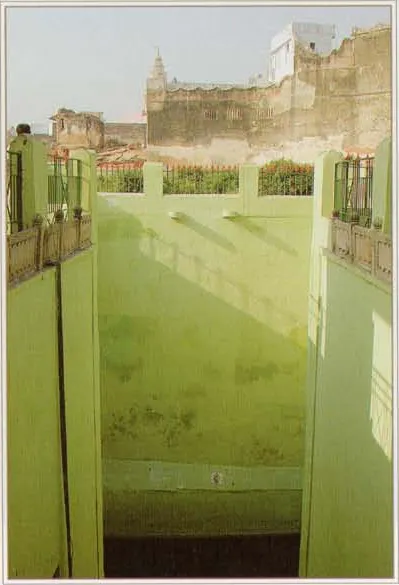
- What it is
- Lalitā-kuṇḍa is a small walled tank in the Sevā-kuñja garden of Vṛndāvana.
- Visiting
- Śrī Vraja-maṇḍala Parikramā (2007) shows the kuṇḍa as a deep, narrow tank with steep plastered walls, railings and potted plants around its rim, and a large crowd of pilgrims seated at it; The Color …
In short
Lalitā-kuṇḍa is a small walled tank in the Sevā-kuñja garden of Vṛndāvana.[1 +1] The guidebooks say that Kṛṣṇa made it for Lalitā, Śrī Rādhā's foremost friend, when she was thirsty during the rāsa dance; they differ on whether He dug it with His flute or pressed His foot into the ground.[3 +2] Two of them also set here part of the story of Śrīla Śyāmānanda Paṇḍita and Śrī Rādhā's anklet.[6 +2] Śrīmad-Bhāgavatam's account of the rāsa tells of no thirst and no kuṇḍa, and the oldest record found of a kuṇḍa named after Lalitā in this garden is a Bengali history of 1920.[1 +5]
Key facts
| Kind | kuṇḍa |
|---|---|
| Region · area | Vṛndāvana · Sevā-kuñja |
| Ācāryas | Śyāmānanda Paṇḍita (Duḥkhī Kṛṣṇadāsa) |
Divine pastimes
The rāsa and the tired gopīs
In Śrīmad-Bhāgavatam the rāsa dance begins on the bank of the Yamunā. When the gopīs grow tired, Kṛṣṇa wipes their faces with His hand and then, to dispel their fatigue, enters the water of the Yamunā with them. The Bhāgavatam tells of no thirst, no drinking water and no kuṇḍa, and it does not name Lalitā.[9 +3]
Śrīla Prabhupāda's Kṛṣṇa book tells the same:[9 +3]
General teaching (does not name the place)“The gopīs and Kṛṣṇa entered the water of the Yamunā just to relieve their fatigue from the rāsa dance. … Both the gopīs and Kṛṣṇa forgot their real identities, playing in the water, enjoying each other’s company and relieving the fatigue of rāsa dancing.”
Śrīla Prabhupāda, Kṛṣṇa, the Supreme Personality of Godhead, Chapter 33, 'Description of the Rāsa Dance' · vedabase.io
Lalitā in the rāsa
The commentators name Lalitā in the rāsa as a singer. Of the two gopīs who sang with Kṛṣṇa and whom He praised, Śrīla Viśvanātha Cakravartī Ṭhākura identifies the second as Lalitā, to whom He gave many jewelled necklaces and rings, and Śrīla Jīva Gosvāmī takes the two singers as Rādhā's friends Lalitā and Viśākhā (summarised here, not translated). None of them speaks of thirst or of a kuṇḍa.[13 +2]
kācit samaṃ mukundena svara-jātīr amiśritāḥ / unninye pūjitā tena prīyatā sādhu sādhv iti / tad eva dhruvam unninye tasyai mānaṃ ca bahv adāt
One gopī, joining Lord Mukunda in His singing, sang pure melodious tones that rose harmoniously above His. Kṛṣṇa was pleased and showed great appreciation for her performance, saying “Excellent! Excellent!” Then another gopī repeated the same melody, but in a special metrical pattern, and Kṛṣṇa praised her also.
Translation: Śrīla Prabhupāda's disciples (BBT)Traditional accounts
The guidebook Śrī Vraja-maṇḍala Parikramā (2007) says that when Lalitā was thirsty during the rāsa, Kṛṣṇa made this kuṇḍa by …
Kṛṣṇa makes water for Lalitā
The guidebook Śrī Vraja-maṇḍala Parikramā (2007) says that when Lalitā was thirsty during the rāsa, Kṛṣṇa made this kuṇḍa by digging with His flute, and Lalitā and the sakhīs drank its sweet, cool water; a keli-kadamba tree stands nearby.[3] Vṛndāvana, the Playground of God (2010) records only a local tradition that the kuṇḍa was dug by the Lord with His flute.[7] The Color Guide to Vṛndāvana (2000) and the undated parikramā notes Vṛndāvana say instead that Kṛṣṇa pushed His foot into the ground to make water for the thirsty Lalitā.[4 +1] The 2007 guidebook counts the kuṇḍa among the six chief kuṇḍas of Vṛndāvana and tells a matching story of Viśākhā-kuṇḍa in Nidhuvana, made with the flute for the thirsty Viśākhā.[16 +2] No text older than these guidebooks was found for the story.[9 +3]
Śrīla Śyāmānanda Paṇḍita and the anklet
The Bhakti-ratnākara, in a song of Śrīla Narahari Cakravartī Ṭhākura, says that Duḥkhī Kṛṣṇadāsa found Rāī's (Rādhā's) anklet in Vṛndāvana, "in a new nikuñja" (a new grove), and that there he became known as Śyāmānanda; it names no kuṇḍa and no bath (summarised here, not translated).[19] Two modern guidebooks set part of the story at this kuṇḍa: Lalitā had him bathe in it, and he came out in the form of a mañjarī, a maidservant of Rādhā. The other tellings have no kuṇḍa; the sources differ (see below).[6 +2]
Visiting today
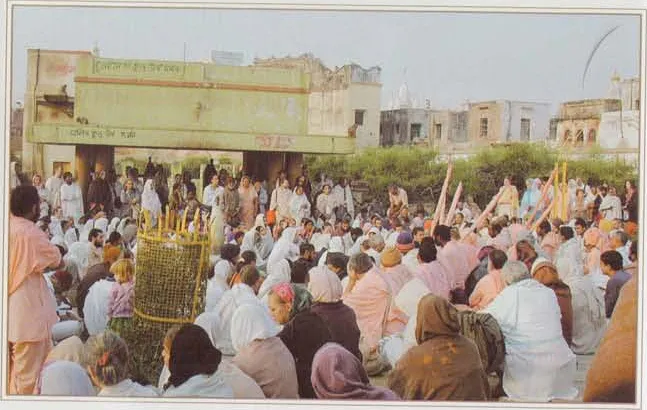
Śrī Vraja-maṇḍala Parikramā (2007) shows the kuṇḍa as a deep, narrow tank with steep plastered walls, railings and potted plants around its rim, and a large crowd of pilgrims seated at it; The Color Guide to Vṛndāvana (2000) marks it as no. 3 on its plan of the garden.[3 +2] The guidebooks do not agree whether it lies near the entrance of the garden or in its middle (see below).[4 +2]
Location
| Where it is | in Sevā-kuñja[24] in Nikuñjavana (Seva-kuñja) (Famous kuṇḍas list; 'Seva' printed without macron)[25] |
|---|
Nearby places
Keli-kadamba (Sevā-kuñja)
Pictures
1 pictures
History
The Vṛndāvana-kathā (1920), a Bengali history of Vṛndāvana, records in the garden that people call Sevā-kuñja an embanked kuṇḍa named Lalitā, with a tree named keli-kadamba. The historian A. W. Entwistle (1987) also records a small tank of this name in the walled garden. Neither tells a pastime of it, and no older record names the kuṇḍa.[1 +1] A district gazetteer of 1911 describes Sevā-kuñja as a walled garden with a masonry tank; it does not name the tank, which may be this one.[20]
Where the sources differ
How Kṛṣṇa made water for the thirsty Lalitā: the guidebooks tell it with His flute or with His foot, and as a kuṇḍa or a well.
How Kṛṣṇa made water for the thirsty Lalitā: the guidebooks tell it with His flute or with His foot, and as a kuṇḍa or a well.[3 +4]
Accounts differ How Kṛṣṇa made water for the thirsty Lalitā in Sevā-kuñja (a kuṇḍa or a well).
- Śrī Vraja-maṇḍala Parikramā (2007)He manifested Lalitā-kuṇḍa by digging it with His flute, during the rāsa.
- Vṛndāvana, the Playground of God (2010)The kuṇḍa 'is said to have been dug by the Lord with His flute'.
- The Color Guide to Vṛndāvana (2000); the undated parikramā notes Vṛndāvana (same wording)He pushed His foot into the ground and made a kuṇḍa near the entrance.
- Vṛndāvana-Dhāma Ki Jaya! (c. 1986)He created a well (not a kuṇḍa) by pushing His flute into the ground; it is in the central part of the gardens.
Accounts differ Where in Sevā-kuñja the kuṇḍa lies.
- Vṛndāvana, the Playground of God (2010), in its account of Śrīla Śyāmānanda Paṇḍita'Lalitā-kuṇḍa, in the middle of Sevā-kuñja'.
- Vṛndāvana, the Playground of God (2010), in its entry on Sevā-kuñja'a kuṇḍa nearer to the entrance named Lalitā-kuṇḍa'.
- The Color Guide to Vṛndāvana (2000); the undated parikramā notes Vṛndāvana'Near the entrance to this garden is a kuṇḍa'.
- Vṛndāvana-Dhāma Ki Jaya! (c. 1986)Lalitā's well is 'within the central part of the gardens'.
Whether Śrīla Śyāmānanda Paṇḍita may have bathed in Lalitā-kuṇḍa during the anklet pastime, as two guidebooks say. Other tellings set the meeting with Śrī Rādhā at Jhāḍū-maṇḍala or elsewhere in Sevā-kuñja.[6 +3]
Accounts differ Whether Śyāmānanda's anklet pastime included a bath in Lalitā-kuṇḍa.
- Vṛndāvana, the Playground of God (2010)Yes: Lalitā dipped him in Lalitā-kuṇḍa and he became Kanaka Mañjarī before meeting Rādhārāṇī.
- The Color Guide to Vṛndāvana (2000)Yes: he bathed in the Lalita Kuṇḍa at Lalitā's request, became a mañjarī and was taken to 'gupta Vṛndāvana'.
- Śrī Vraja-maṇḍala Parikramā (2007)No kuṇḍa: at Jhāḍū-maṇḍala Rādhikā Herself came with Lalitā and Viśākhā, he tied the anklet on Her foot, and Lalitā stamped the anklet on his forehead.
- the undated parikramā notes VṛndāvanaNo kuṇḍa: Rādhārāṇī came to Sevā-kuñja Herself and touched the anklet to his forehead.
References
25 references
- Vṛndāvana-kathā, chapter 17 (saptadaśa pariccheda), section 2 'udyāna' (gardens), twelfth garden, printed p. 196
- A. W. Entwistle, ch. 8, §66.10 'Seva Kunj', printed p. 405, Egbert Forsten, Groningen, 1987
- Śrī Vraja-maṇḍala Parikramā (2007), PDF p. 305
- The Color Guide to Vṛndāvana (2000), Written and Photographed by Rājaśekhara dāsa Brahmacārī, PDF p. 70
- the undated parikramā notes Vṛndāvana, ¶111
- Vṛndāvana, the Playground of God (2010), Bhakti Caitanya Svāmī, PDF p. 98
- Vṛndāvana, the Playground of God (2010), Bhakti Caitanya Svāmī, PDF p. 154
- The Color Guide to Vṛndāvana (2000), Written and Photographed by Rājaśekhara dāsa Brahmacārī, PDF p. 97
- Śrīmad-Bhāgavatam 10.33.2, GRETIL
- Śrīmad-Bhāgavatam 10.33.20, GRETIL
- Śrīmad-Bhāgavatam 10.33.22, GRETIL
- Śrīla Prabhupāda, Kṛṣṇa, the Supreme Personality of Godhead, Chapter 33, 'Description of the Rāsa Dance' · vedabase.io
- Śrīmad-Bhāgavatam 10.33.9, GRETIL
- Śrīla Viśvanātha Cakravartī Ṭhākura (Sārārtha-darśinī) and Baladeva Vidyābhūṣaṇa (Vaiṣṇavānandinī): commentary on ŚB 10.33.9: Viśvanātha Śrīmad-Bhāgavatam canto 10, part 4, with commentaries, Baladeva 305267
- Śrīla Jīva Gosvāmī: commentary on ŚB 10.33.10
- Śrī Vraja-maṇḍala Parikramā (2007), PDF p. 345
- Śrī Vraja-maṇḍala Parikramā (2007), PDF p. 315
- Śrī Vraja-maṇḍala Parikramā (2007), PDF p. 341
- Śrīla Narahari Cakravartī, Bhakti-ratnākara, Fifteenth Wave (pañcadaśa taraṅga), 1912 ed. p. 1060, song in rāga Suhai ('punaḥ suhai'), 2nd ed., 1912
- Muttra: A Gazetteer, District Gazetteers of the United Provinces of Agra and Oudh vol. VII
Show all 25 references
- Śrī Vraja-maṇḍala Parikramā (2007), PDF p. 303
- The Color Guide to Vṛndāvana (2000), Written and Photographed by Rājaśekhara dāsa Brahmacārī, PDF p. 165
- Vṛndāvana, the Playground of God (2010), Bhakti Caitanya Svāmī, PDF p. 96
- Śrī Vraja-maṇḍala Parikramā (2007), p. 584-585
- Śrī Vraja-maṇḍala Parikramā (2007), p. 664-665