Jhāḍū-maṇḍala
झाड़ू-मण्डल Hindi name proposed
- What it is
- Jhāḍū-maṇḍala (also written Jāru Maṇḍala) is a small shrine near Cīra-ghāṭa in Vṛndāvana.
- Visiting
- Śrī Vraja-maṇḍala Parikramā places the well-known Jhāḍū-maṇḍala near Cīra-ghāṭa, which lies on the Yamunā close to Keśī-ghāṭa, and marks it on its map of Vṛndāvana.
- Places here
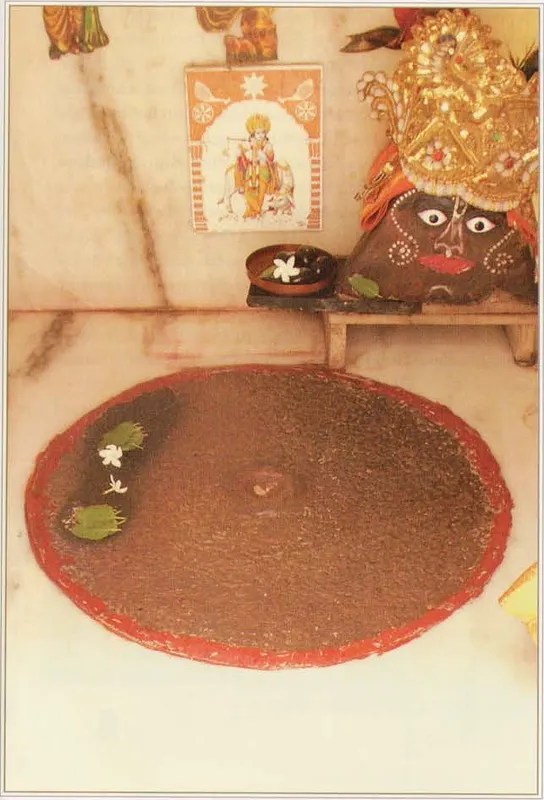
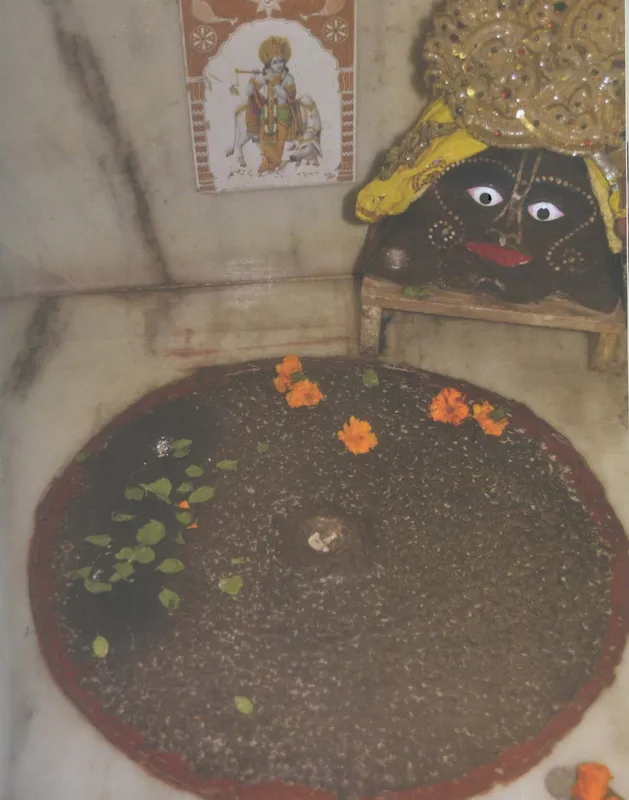
- Kṛṣṇa's footprint on the grinding mortar (Jhāḍū-maṇḍala)
In short
Jhāḍū-maṇḍala (also written Jāru Maṇḍala) is a small shrine near Cīra-ghāṭa in Vṛndāvana. Its name means "the area swept with a broom".[1 +3] The guidebooks connect three stories with it: Kṛṣṇa leaving Śrī Rādhā in the night of the rāsa dance, a footprint that, according to a local tradition, Kṛṣṇa pressed into an old woman's grindstone, and Śrīla Śyāmānanda Paṇḍita finding Rādhā's anklet while sweeping; their placing here is not certain.[1 +3] Śrīmad-Bhāgavatam tells the first of these without naming any place, and the sources differ on where each story belongs.[7]
Key facts
| Kind | pastime site |
|---|---|
| Region · area | Vṛndāvana |
| Ācāryas | Śyāmānanda Paṇḍita (Duḥkhī Kṛṣṇadāsa), Śrīla Jīva Gosvāmī |
Divine pastimes
Kṛṣṇa leaves His beloved
In the night of the rāsa dance Kṛṣṇa disappeared from the gopīs and led one gopī away into the forest. She thought herself the best of women, because He had left all the others for her.[7] Where the grass hurt her feet He lifted her up and carried her; later, in one part of the forest, she said that she could walk no further and asked Him to carry her. He told her to climb on His shoulder and at once disappeared.[8 +4]
evam uktaḥ priyām āha skandha āruhyatām iti / tataś cāntardadhe kṛṣṇaḥ sā vadhūr anvatapyata
Thus addressed, Lord Kṛṣṇa replied, “Just climb on My shoulder.” But as soon as He said this, He disappeared. His beloved consort then immediately felt great remorse.
Translation: Śrīla Prabhupāda's disciples (BBT)Searching on His path, the other gopīs found their unhappy friend close by, and she told them how Mādhava had honoured her and how she had then been dishonoured.[13 +2] Śrīla Prabhupāda's Kṛṣṇa book names the gopī Rādhārāṇī and tells the same moment in the gopīs' words.[8 +4]
General teaching (does not name the place)“But immediately Kṛṣṇa must have disappeared, and now Rādhārāṇī must be lamenting for Him … Kṛṣṇa, however, is not coming to Her. He must be watching Her from a distant place and enjoying Her sorrow.”
Śrīla Prabhupāda, Kṛṣṇa, the Supreme Personality of Godhead (Kṛṣṇa book), Chapter 30, 'Kṛṣṇa’s Hiding from the Gopīs' · vedabase.io
The commentators describe the spot only as a part of the forest (summarised here, not translated). Śrīla Viśvanātha Cakravartī Ṭhākura and Śrīla Jīva Gosvāmī say that when Kṛṣṇa vanished He stayed right there, unseen, still watching Her.[11 +4] Later Kṛṣṇa Himself told the gopīs that even when He removed Himself from their sight He never stopped loving them.[20 +1]
Two guidebooks set the place where Kṛṣṇa left Rādhā here, at a tree they say marks the spot; another sets it at Śṛṅgāravaṭa. The sources differ, and the Bhāgavatam names no place.[7 +2]
Accounts differ Where Kṛṣṇa left Śrīmatī Rādhārāṇī during the rāsa night.
- Vṛndāvana, the Playground of God (2010)At Jhāḍū-maṇḍala (Jāru Maṇḍala): an old tree marks the place, and the gopīs found Her lamenting there.
- The Color Guide to Vṛndāvana (2000)At Jhāḍū-maṇḍala: 'a very ancient Jamun tree' marks where He disappeared from Her.
- Śrī Vraja-maṇḍala Parikramā (2007)At or near Śṛṅgāravaṭa, where He had decorated Her (told under Imlītalā and Śṛṅgāravaṭa); the sakhīs then took Her to the bank of the Yamunā.
- Śrīmad-Bhāgavatam 10.30.37-40; Kṛṣṇa book ch. 30In 'one part of the forest' (vanoddeśa); no place name.
Traditional accounts
The guidebooks tell, in two versions, how Kṛṣṇa's footprint came to be on a grindstone here.
Kṛṣṇa's footprint on the grindstone
The guidebooks tell, in two versions, how Kṛṣṇa's footprint came to be on a grindstone here. According to Śrī Vraja-maṇḍala Parikramā (2007), an old woman of this place, who ground wheat for a living while singing Kṛṣṇa's names, was visited before dawn by a dark boy. He put His foot on her grindstone, because its noise kept Him from sleeping, and promised that people would come to see His footprint and support her; next morning the footprint had appeared.[5] Vṛndāvana, the Playground of God (2010) and The Color Guide to Vṛndāvana (2000) record instead a local tradition of a blind old lady whose grinding disturbed the devotees who sat here hearing Kṛṣṇa's pastimes; in their telling Kṛṣṇa stopped the stone with His foot and promised that visitors would give her offerings.[1 +2] No scripture or Vaiṣṇava work that tells this story was found, so it is not certain.
Accounts differ Why Kṛṣṇa put His foot on the old woman's grindstone.
- Śrī Vraja-maṇḍala Parikramā (2007)Its rumbling 'gharr-gharr' kept the dark boy from sleeping.
- Vṛndāvana, the Playground of God (2010); The Color Guide to Vṛndāvana (2000)Its noise disturbed the devotees who sat there hearing Kṛṣṇa's pastimes.
The broom
Vṛndāvana, the Playground of God says that the same old lady also swept the area so that the devotees could sit, and gives this as the meaning of the name; Śrī Vraja-maṇḍala Parikramā says instead that Śrīla Jīva Gosvāmī gave the sweeping of this place to Śrīla Śyāmānanda Paṇḍita, as told below. The accounts differ, and neither may be more than a local explanation of the name.[1 +7]
Accounts differ Who swept Jhāḍū-maṇḍala.
- Śrī Vraja-maṇḍala Parikramā (2007)Śyāmānanda, on Śrīla Jīva Gosvāmī's order.
- Vṛndāvana, the Playground of God (2010)'It is said' a blind old lady swept the area day and night so devotees could sit and hear, and also ground grain there.
- The Color Guide to Vṛndāvana (2000)The area was swept with a broom so that devotees could sit and hear (sweeper not named); a blind old lady ground grain nearby.
The Gosvāmīs and ācāryas
Śrīla Prabhupāda writes that Śrīla Jīva Gosvāmī inspired Śrīla Śrīnivāsa Ācārya, Śrīla Narottama dāsa Ṭhākura and Duḥkhī …
Śrīla Prabhupāda writes that Śrīla Jīva Gosvāmī inspired Śrīla Śrīnivāsa Ācārya, Śrīla Narottama dāsa Ṭhākura and Duḥkhī Kṛṣṇadāsa, later known as Śrīla Śyāmānanda Paṇḍita, to preach in Bengal.[24] According to the Bhakti-ratnākara, Śrīla Jīva Gosvāmī taught Duḥkhī Kṛṣṇadāsa the books of bhakti and gave him the name Śyāmānanda, and a song in the same book praises him as the one who found Rādhā's anklet "in a new grove in Vṛndāvana", where the name Śyāmānanda became known. Neither passage names Jhāḍū-maṇḍala.[23 +2]
According to Śrī Vraja-maṇḍala Parikramā, Śrīla Jīva Gosvāmī gave Śrīla Śyāmānanda Paṇḍita the service of sweeping this place, and the book records a local tradition that he found Śrī Rādhā's golden anklet here.[22 +4] The other guidebooks and the older Bengali works tell the find at other places or name none, and they differ on who came for the anklet and who gave him his name (see "Where the sources differ").[23 +2]
Visiting today
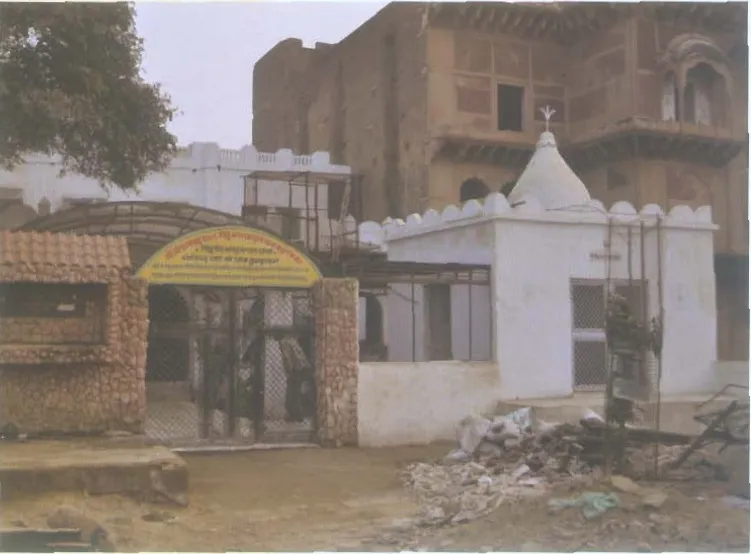
Śrī Vraja-maṇḍala Parikramā places the well-known Jhāḍū-maṇḍala near Cīra-ghāṭa, which lies on the Yamunā close to Keśī-ghāṭa, and marks it on its map of Vṛndāvana.[1 +7] The photographs of 2007 and 2010 show the footprint stone in a marble-floored shrine, and the 2010 book also shows the entrance gateway. The Color Guide (2000) said that people from all over Vṛndāvana still came to see the footprint.[1 +4]
Location
| Where it is | map key 9; no location in text[35] |
|---|
Places at Jhāḍū-maṇḍala
1 places
Nearby places
Cīra-ghāṭa (Vṛndāvana)
Pictures
2 pictures
Where the sources differ
How the anklet story is told at this place: Śrī Vraja-maṇḍala Parikramā says that Śrīla Śyāmānanda Paṇḍita, sweeping here before dawn, found a golden anklet, would not give it to two young girls, and tied it on the foot of their friend; the book says that the three were Śrīmatī Rādhikā with Lalitā and Viśākhā; Lalitā stamped the anklet on his forehead, and his line still wears tilaka in the shape of an anklet.[5 +1] The Bengali Vṛndāvana-kathā (1920) puts the find in Nikuñjavana, the garden called Sevā-kuñja, and the Prema-vilāsa at a place of the rāsa that it does not name, after what may have been a vision in a dream. None of these places is certain; the accounts are set side by side on the page of Sevā-kuñja.[25 +3]
Accounts differ Who came for the anklet, who marked Śyāmānanda's forehead and who gave him his name.
- Śrī Vraja-maṇḍala Parikramā (2007)Two girls (Lalitā and Viśākhā) came, then brought Rādhikā, on whose foot he tied the anklet; his name became Śyāmānanda by Śrīmatī's mercy; Lalitā stamped the anklet on his forehead.
- Vṛndāvana, the Playground of God (2010)Lalitā, disguised as an old woman, took him to Lalitā-kuṇḍa, where he became Kanaka Mañjarī; Rādhārāṇī pressed the anklet to his forehead; Lalitā gave the name Śyāmānanda; Śrīla Jīva Gosvāmī rejoiced when told.
- The Color Guide to Vṛndāvana (2000)Lalitā came first; he refused to give her the anklet; Lalitā had him bathe in Lalitā-kuṇḍa, where he became a mañjarī, and took him to 'gupta Vṛndāvana', where he put the anklet back on Rādhārāṇī's foot; Rādhārāṇī touched the anklet to his forehead, had Lalitā give him a Deity of Śyāmasundara, and he 'was also given' the name Śyāmānanda.
- the undated parikramā notes VṛndāvanaLalitā came first; he refused; Rādhārāṇī Herself then came there, touched the anklet to his forehead, leaving the tilaka mark, and gave him the name Śyāmānanda (no Lalitā-kuṇḍa bath).
The guidebooks' placing of Kṛṣṇa's leaving Rādhā here, at an old tree (2010) or a very ancient jamun tree (2000), is shown in the block under "Divine pastimes"; it is not certain.[1 +3] The footprint story, which all three guidebooks tell, may be no older than they are: it rests on them alone.[1 +3]
References
35 references
- Vṛndāvana, the Playground of God (2010), Bhakti Caitanya Svāmī, PDF p. 166
- The Color Guide to Vṛndāvana (2000), Written and Photographed by Rājaśekhara dāsa Brahmacārī, PDF p. 95
- Śrī Vraja-maṇḍala Parikramā (2007), PDF p. 343
- Śrī Vraja-maṇḍala Parikramā (2007), PDF p. 298
- Śrī Vraja-maṇḍala Parikramā (2007), PDF p. 310
- Vṛndāvana, the Playground of God (2010), Bhakti Caitanya Svāmī, PDF p. 168
- Śrīmad-Bhāgavatam 10.30.35–36, GRETIL
- Śrīmad-Bhāgavatam 10.30.30, GRETIL
- Śrīmad-Bhāgavatam 10.30.31, GRETIL
- Śrīla Prabhupāda, Kṛṣṇa, the Supreme Personality of Godhead (Kṛṣṇa book), Chapter 30, 'Kṛṣṇa’s Hiding from the Gopīs' · vedabase.io
- Śrīmad-Bhāgavatam ŚB 10.30.37, GRETIL
- Śrīmad-Bhāgavatam ŚB 10.30.38, GRETIL
- Śrīmad-Bhāgavatam ŚB 10.30.40, GRETIL
- Śrīmad-Bhāgavatam 10.30.41, GRETIL
- Śrīla Prabhupāda, Kṛṣṇa, the Supreme Personality of Godhead, Chapter 30 (Kṛṣṇa’s Hiding from the Gopīs) · vedabase.io
- Śrīla Viśvanātha Cakravartī Ṭhākura: commentary on ŚB 10.30.37
- Śrīla Viśvanātha Cakravartī Ṭhākura: commentary on ŚB 10.30.38
- Śrīla Nārāyaṇa Bhaṭṭa: commentary on ŚB 10.30.40
- Śrīla Jīva Gosvāmī: commentary on ŚB 10.32.21
- Śrīmad-Bhāgavatam 10.32.21, GRETIL
Show all 35 references
- Śrīla Prabhupāda, Kṛṣṇa, the Supreme Personality of Godhead (Kṛṣṇa book), Chapter 32, 'Kṛṣṇa Returns to the Gopīs' · vedabase.io
- Śrī Vraja-maṇḍala Parikramā (2007), PDF p. 309
- Śrīla Narahari Cakravartī, Bhakti-ratnākara, Sixth Wave (ṣaṣṭha taraṅga), 1912 ed. p. 457, 2nd ed., 1912
- Śrīla Prabhupāda, Śrī Caitanya-caritāmṛta, Ādi-līlā 10.85, purport · vedabase.io
- Prema-vilāsa, 12th vilāsa (dvādaśa vilāsa, as this edition numbers it), printed p. 87, Kolkata, 1913
- Vṛndāvana-kathā, account of Śyāmānanda (Kṛṣṇadāsa), printed p. 112; Nikuñjavana: p. 196
- Śrīla Narahari Cakravartī, Bhakti-ratnākara, Fifteenth Wave (pañcadaśa taraṅga), 1912 ed. p. 1060, song in rāga Suhai ('punaḥ suhai'), 2nd ed., 1912
- Śrī Vraja-maṇḍala Parikramā (2007), PDF p. 312
- Vṛndāvana, the Playground of God (2010), Bhakti Caitanya Svāmī, PDF p. 177
- Vṛndāvana, the Playground of God (2010), Bhakti Caitanya Svāmī, PDF p. 178
- The Color Guide to Vṛndāvana (2000), Written and Photographed by Rājaśekhara dāsa Brahmacārī, PDF p. 102
- Vṛndāvana, the Playground of God (2010), Bhakti Caitanya Svāmī, PDF p. 167
- Vṛndāvana-kathā, ch. 8 (aṣṭama pariccheda), on the Śyāmasundara temple, printed p. 113
- Prema-vilāsa, 12th vilāsa (dvādaśa vilāsa, as this edition numbers it), printed p. 86, right-hand column, Kolkata, 1913
- Śrī Vraja-maṇḍala Parikramā (2007), p. 592-593