Lalitā-vivāha-maṇḍapa
ललिता-विवाह-मण्डप Hindi name proposed
On this page
In short
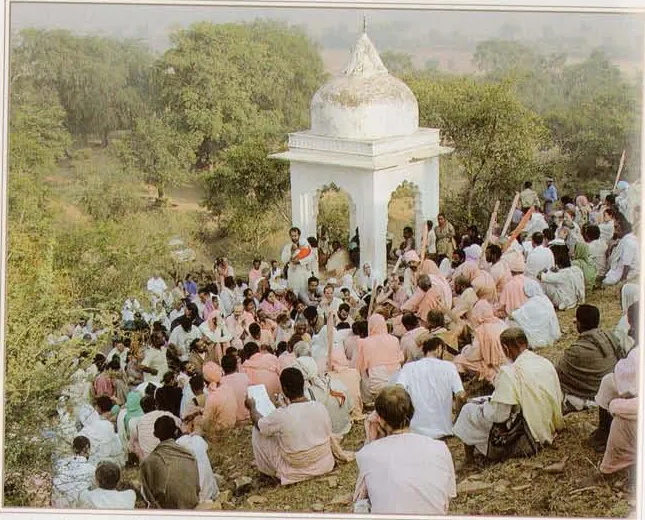
Lalitā-vivāha-maṇḍapa, the pavilion of Lalitā's wedding, marks a place on Sakhīgiri-parvata, the hill of the sakhīs near Ūñcāgaon, beside the sliding stone, the Phisalanī-śilā.[1 +1] The place remembers a wedding in play: Śrīla Nārāyaṇa Bhaṭṭa Gosvāmī's Vraja-bhakti-vilāsa says that here Kṛṣṇa, as a boy of seven, chose Lalitā, Śrī Rādhā's foremost sakhī, and gives a prayer for the place.[1 +1] The guidebook Śrī Vraja-maṇḍala Parikramā (2007) tells it as a game that the sakhīs arranged.[3]
Key facts
| Kind | maṇḍapa |
|---|---|
| Region · area | Kāmyavana · Sakhīgiri-parvata |
| Ācāryas | Śrīla Nārāyaṇa Bhaṭṭa Gosvāmī |
Traditional accounts
The Vraja-bhakti-vilāsa, listing the places of Lalitā-grāma, names the Sakhīgiri hill, the Khisilinī stone beside it and, right there, the place of Lalitā's wedding.[1] In its walk through the village it says that here Hari, as a boy of seven, chose Lalitā, and gives a prayer that honours Kṛṣṇa, the joy of Vraja, and Lalitā, who delights in the play of Vraja (summarised here, not translated). It does not tell how this came about.[1 +1]
According to Śrī Vraja-maṇḍala Parikramā (2007), the sakhīs held this wedding of Lalitā and the seven-year-old Kṛṣṇa as a game, at Rādhikā's hint, and the place was named after it.[3]
Śrīla Rūpa Gosvāmī describes Lalitā as the first and best of Śrī Rādhā's eight sakhīs, older than Her by twenty-seven days; he names no village for her. Her village, and the name of her father, are discussed on the page of Lalitā-sthala.[4]
History
In 1987 the historian A. W. Entwistle described a small chatrī, a canopied pavilion, representing the wedding canopy, on top of the village mound in front of a temple in which Lalitā was enshrined next to Kṛṣṇa and Rādhā. He gave no builder or date.[5] This places the pavilion on the village mound, while the guidebook and the Vraja-bhakti-vilāsa put the wedding place on Sakhīgiri beside the sliding stone; the accounts are shown below.
Where the sources differ
Accounts differ Where the wedding place of Lalitā and the slide are: on Sakhīgiri together, or the wedding canopy on the village mound
- Śrī Vraja-maṇḍala Parikramā (2007)the Phisalanī-śilā is on Sakhīgiri-parvata 'adjacent to Lalitā-vivāha-sthala'; the wedding pavilion is photographed on a wooded hillside
- Vraja-bhakti-vilāsa ch. 2 v.46beside Sakhīgirī the Khisilinī stone, right there (tatraiva) Lalitā's wedding place
- Entwistle (1987), p. 369the chatrī over the Khisalinī Śilā is on a low rocky hill west of Unchagaon across the canal; the small chatrī representing Lalitā's wedding canopy stands at the top of the village mound in front of a temple of Lalitā
The wording of these accounts is our summary of the sources, not a published translation.
Location
| Where it is | on Sakhīgiri-parvata[6] |
|---|
Nearby places
References
- Śrīla Nārāyaṇa Bhaṭṭa Gosvāmī, Vraja-bhakti-vilāsa, chapter 2 v.46, printed pp.45-46: the marks (liṅga) of Lalitā-grāma, 1st ed., publ. Bābā Kṛṣṇadāsa, Kusuma-sarovara, Saṁvat 2008
- Śrīla Nārāyaṇa Bhaṭṭa, Vraja-bhakti-vilāsa, Fourth chapter, v.38 (the wedding place and its prayer); printed p. 95, 1st ed., publ. Bābā Kṛṣṇadāsa, Kusuma-sarovara, Saṁvat 2008
- Śrī Vraja-maṇḍala Parikramā (2007), PDF p. 163
- Śrīla Rūpa Gosvāmī, Rādhā-Kṛṣṇa-gaṇoddeśa-dīpikā, part 1 vv.79–81: Lalitā
- A. W. Entwistle, printed p. 369, Egbert Forsten, Groningen, 1987
- Śrī Vraja-maṇḍala Parikramā (2007), p. 300-301