Luk-lukī-kuṇḍa
लुक-लुकी-कुण्ड Hindi name proposed
In short
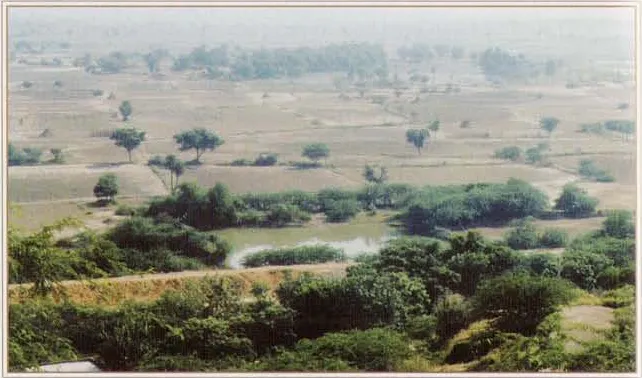
Luk-lukī-kuṇḍa, "the pond of hide-and-seek", is a kuṇḍa (sacred pond) of Kāmyavana. The Bhakti-ratnākara calls it the lukalukānī-micalī place, where the pastimes of Śrī Rādhā and Kṛṣṇa abound: a game played with closed eyes, at a kuṇḍa in a dense, dark forest.[1] Śrīla Nārāyaṇa Bhaṭṭa Gosvāmī and Śrīla Viśvanātha Cakravartī Ṭhākura also name the place or the game in Kāmyavana.[2 +1] The guidebooks add that Kṛṣṇa hid in a cave of a nearby hill, Luk-luka-kandarā, and that He also played in the water of this kuṇḍa with the gopīs.[4 +2]
Key facts
| Kind | kuṇḍa |
|---|---|
| Region · area | Kāmyavana |
| Ācāryas | Śrīla Narahari Cakravartī Ṭhākura, Śrīla Nārāyaṇa Bhaṭṭa Gosvāmī, Śrīla Viśvanātha Cakravartī Ṭhākura |
Divine pastimes
Hide-and-seek and water games in scripture
Śrīmad-Bhāgavatam tells that Kṛṣṇa and Balarāma passed Their childhood in Vraja playing hide-and-seek, building make-believe bridges and jumping about like monkeys. It tells this of the brothers and the cowherd boys, not of the gopīs, and names no place.[7]
evaṃ vihāraiḥ kaumāraiḥ kaumāraṃ jahatur vraje / nilāyanaiḥ setu-bandhair markaṭotplavanādibhiḥ
In this way Kṛṣṇa and Balarāma passed Their childhood age in Vrajabhūmi by engaging in activities of childish play, such as playing hide-and-seek, constructing a make-believe bridge on the ocean, and jumping here and there like monkeys.
Translation: Śrīla A.C. Bhaktivedanta Swami PrabhupādaAbout this place: The verse names no place. The Bhāgavatam's account of the childhood games: Kṛṣṇa and Balarāma passed Their childhood in Vraja playing hide-and-seek (nilāyana), building make-believe bridges (setu-bandha) and jumping like monkeys. The verse is repeated as ŚB 10.14.61, where the Gosvāmīs comment on it.
Śrīla Jīva Gosvāmī explains the bridge game as a copy of Śrī Rāma's pastime, and in his Gopāla-campū Kṛṣṇa Himself speaks of hide-and-seek and bridge-building as the boys' play of Śrī Rāma's pastime (summarised here, not translated).[8 +3]
The Bhāgavatam also tells of Kṛṣṇa's water games with the gopīs after the rāsa dance, but it sets them in the Yamunā and does not name this kuṇḍa; Śrīla Prabhupāda's Kṛṣṇa book tells the same.[12 +1]
General teaching (does not name the place)“Both the gopīs and Kṛṣṇa forgot their real identities, playing in the water, enjoying each other’s company and relieving the fatigue of rāsa dancing. The gopīs began to splash water on the body of Kṛṣṇa, all the while smiling, and Kṛṣṇa enjoyed this.”
Śrīla Prabhupāda, Kṛṣṇa, the Supreme Personality of Godhead, Chapter 33, 'Description of the Rāsa Dance' · vedabase.io
Traditional accounts
According to the Bhakti-ratnākara of Śrīla Narahari Cakravartī Ṭhākura, micalī means that the eyes are closed here, and in …
The place of hide-and-seek
According to the Bhakti-ratnākara of Śrīla Narahari Cakravartī Ṭhākura, micalī means that the eyes are closed here, and in lukalukānī, hide-and-seek, the joy grows by hiding; the kuṇḍa lies in a very dense forest, full of darkness (summarised here, not translated).[1] Śrīla Nārāyaṇa Bhaṭṭa Gosvāmī's Vraja-bhakti-vilāsa lists the place of hide-and-seek in Kāmyavana, then Govinda-kuṇḍa and, there itself, the place of closing the eyes.[2] In his Vraja-rīti-cintāmaṇi Śrīla Viśvanātha Cakravartī Ṭhākura names among the places of Kāmyavana the game of hide-and-seek in which Kṛṣṇa's sweetness showed itself with Śrī Rādhā; he does not name the kuṇḍa.[3]
The guidebooks' accounts
According to the local tradition recorded in Śrī Vraja-maṇḍala Parikramā (2007), Kṛṣṇa played hide-and-seek here with the girls of Vraja and hid in a cave of a nearby hill, while the gopīs, unable to find Him, meditated on Him at Dhyāna-kuṇḍa. The undated parikramā notes Kāmyavana add a diving game in which Kṛṣṇa stayed under the water. The Bhakti-ratnākara does not mention the cave.[1 +3]
The Bengali Bhaktamāla of Kṛṣṇadāsa Bābājī (1905) places the Lukāluki-kuṇḍa beside the hill Caraṇa-pahāḍī and says that Kṛṣṇa plays in its water with the gopīs. In its account the gopīs proposed a contest of staying under the water; when all dived a second time, Kṛṣṇa did not come up, but went away under the water and climbed the hill (summarised here, not translated).[14]
Śrīla Prabhupāda
Śrīla Prabhupāda does not speak of this kuṇḍa by name.
Śrīla Prabhupāda does not speak of this kuṇḍa by name. Where Śrī Caitanya Mahāprabhu visits Kāmyavana, he quotes the Bhakti-ratnākara on the many ponds and holy spots of the forest, in the passage that also leads to this place.[15]
General teaching (does not name the place)“In this Kāmyavana, Kṛṣṇa performed enchanting pastimes. Here you will be able to take darśana of many ponds and other transcendental spots. I cannot even describe in writing all the sacred tīrthas found at Kāmyavana.”
Śrīla Prabhupāda, Śrī Caitanya-caritāmṛta, Madhya-līlā 18.55, purport · vedabase.io
Location
| Where it is | Kāmyavana[17] visible from the footprint hill[18] |
|---|
Nearby places
Luk-luka-kandarā · Dhyāna-kuṇḍa · Prabodhānanda Sarasvatī's place of bhajana (Kāmyavana) · Caraṇa-pahāḍī (Kāmyavana)
Where the sources differ
Whether Luk-lukī-kuṇḍa is the same pond as Jal-krīḍā-kuṇḍa, "the pond of water games". Śrī Vraja-maṇḍala Parikramā (2007) says that Luk-lukī-kuṇḍa is another site of Kṛṣṇa's water games and is therefore also known as Jal-krīḍā-kuṇḍa; its own list of Kāmyavana's places, the Vraja-bhakti-vilāsa and the Bhakti-ratnākara name a separate pond of water games.[1 +3]
Accounts differ Whether Luk-lukī-kuṇḍa is the same pond as Jal-krīḍā-kuṇḍa.
- Śrī Vraja-maṇḍala Parikramā (2007)Luk-lukī-kuṇḍa is 'another site of Śrī Kṛṣṇa's water-sports (jal-krīḍā), and is therefore also known as Jal-krīḍā-kuṇḍa'.
- Śrī Vraja-maṇḍala Parikramā (2007)Its list of Kāmyavana's places names Jal-krīḍā-kuṇḍa (after Jal-vihāra-kuṇḍa) and Luk-lukī-kuṇḍa (after Vatsa-kuṇḍa) as separate items.
- Vraja-bhakti-vilāsa ch. 2 vv.19 and 44-45; ch. 6 v.21Lists Jalakrīḍā-kuṇḍa (v.19) and the place of hide-and-seek (v.44) separately, and gives Jalakrīḍā-kuṇḍa its own bathing prayer (6.21, printed p.155).
- Bhakti-ratnākara, Fifth Wave vv.852-854 and 857Shows the lukalukānī-micalī place (vv.852-854) and, separately, a krīḍā-kuṇḍa where Kṛṣṇa performs water-sports (v.857).
The wording of these accounts is our summary of the sources, not a published translation.
References
18 references
- Śrīla Narahari Cakravartī, Bhakti-ratnākara, Fifth Wave, 1912 ed. p. 216; Grantha Mandira text vv.852-854, 2nd ed., 1912
- Śrīla Nārāyaṇa Bhaṭṭa Gosvāmī, Vraja-bhakti-vilāsa, ch. 2, list of the marks of Kāmavana, vv.19-22 and 44-45, printed p.49, 1st ed., publ. Bābā Kṛṣṇadāsa, Kusuma-sarovara, Saṁvat 2008
- Śrīla Viśvanātha Cakravartī Ṭhākura, Vraja-rīti-cintāmaṇi, third sarga v.50 (in his description of Kāmyavana, vv.47-51)
- Śrī Vraja-maṇḍala Parikramā (2007), PDF p. 155
- the undated parikramā notes Kāmyavana, ¶17
- Vṛndāvana-Dhāma Ki Jaya! (c. 1986), by Dhruva Mahārāja dāsa, PDF p. 46
- Śrīmad-Bhāgavatam 10.11.59, GRETIL
- Śrīla Jīva Gosvāmī: commentary on ŚB 10.14.61, Bhagavata Vidya Pith edition, ed. Bhagavata Rishi and Krishna Shankar Shastri, 1996
- Gopāla-campū, Pūrva-campū, second pūraṇa, ¶[60]
- Śrīla Viśvanātha Cakravartī Ṭhākura: commentary on ŚB 10.14.61 (= 10.11.59), Bhagavata Vidya Pith edition, ed. Bhagavata Rishi and Krishna Shankar Shastri, 1996
- Śrīla Prabhupāda, Kṛṣṇa, the Supreme Personality of Godhead (Kṛṣṇa book), Chapter 11, 'Killing the Demons Vatsāsura and Bakāsura' · vedabase.io
- Śrīmad-Bhāgavatam 10.33.23, GRETIL
- Śrīla Prabhupāda, Kṛṣṇa, the Supreme Personality of Godhead, Chapter 33, 'Description of the Rāsa Dance' · vedabase.io
- Śrī Śrī Bhaktamāla grantha, ṣaḍviṁśa-mālā, heading 'অথ কাম্যবনে চরণপাহাড়-মহিমাবর্ণন' and its first two couplets (printed p. 322, foot of the left column), then the last couplet of the right column
- Śrīla Prabhupāda, Śrī Caitanya-caritāmṛta, Madhya-līlā 18.55, purport · vedabase.io
- Śrī Vraja-maṇḍala Parikramā (2007), PDF p. 145
- Śrī Vraja-maṇḍala Parikramā (2007), p. 284-285
- Vṛndāvana-Dhāma Ki Jaya! (c. 1986), by Dhruva Mahārāja dāsa, p. 28