Caraṇa-pahāḍī (Kāmyavana)
चरण-पहाड़ी (काम्यवन)
Also called Caraṇa-pahāḍī
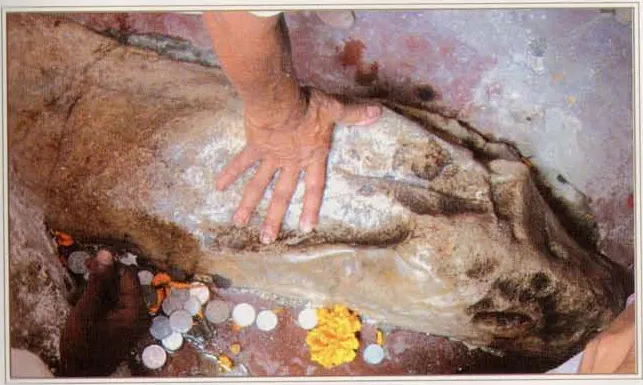
- What it is
- Caraṇa-pahāḍī, "the hill of the feet", is a hill outside the town of Kāmyavana.
- Places here
- Luk-luka-kandarā, Hill of the sakhās' and calves' footprints (near Caraṇa-pahāḍī), Matīlā-kuṇḍa, Raṅgīlā-kuṇḍa, Vihvala-kuṇḍa (Kāmyavana)
In short
Caraṇa-pahāḍī, "the hill of the feet", is a hill outside the town of Kāmyavana. The guidebook Śrī Vraja-maṇḍala Parikramā (2007) places it two miles south-west of the town, on the road from the Āmera Gate, and says that Kṛṣṇa's footprints can still be seen on it very clearly.[1 +2] The Garga-saṁhitā tells that Kṛṣṇa played His flute on a hill in Kāmavana, that the mountains melted at the sound, and that the hill came to bear His footprints, so that the mere sight of it fulfils the goal of life.[4 +2] The modern guides identify that hill with Caraṇa-pahāḍī, and the Bhakti-ratnākara shows footprints on a hill at this point of its round, probably the same one.[1 +3]
Key facts
| Kind | hill |
|---|---|
| Region · area | Kāmyavana |
| Ācāryas | Śrīla Narahari Cakravartī Ṭhākura, Śrīla Rāghava Paṇḍita Gosvāmī of Govardhana, Śrīla Śrīnivāsa Ācārya, Śrīla Narottama dāsa Ṭhākura |
Why it is glorified
In the Garga-saṁhitā, the hill in Kāmavana that kept Kṛṣṇa's footprints is itself a place of pilgrimage: simply by seeing it, a …
In the Garga-saṁhitā, the hill in Kāmavana that kept Kṛṣṇa's footprints is itself a place of pilgrimage: simply by seeing it, a person reaches the goal of life. The verse speaks of Kṛṣṇa's footprints only and does not give the hill a name.[4 +2]
तत्पादचिह्नसंयुक्तो गिरिः कामवनेऽभवत् । तस्य दर्शनमात्रेण नरो याति कृतार्थताम्
tatpādacihnasaṁyukto giriḥ kāmavane'bhavat
tasya darśanamātreṇa naro yāti kṛtārthatām
Divine pastimes
The flute that melts stone
The Garga-saṁhitā tells that Kṛṣṇa, wandering with the women of Vraja, came to Kāmavana and played His flute sweetly on a hill there. At the music the gopīs fainted, all beings were stunned, the rivers stood still and the mountains melted.[4 +2]
Śrīmad-Bhāgavatam tells the power of the flute without speaking of melting stone: when Kṛṣṇa plays as He leads the cows through the forest, the gopīs say, moving beings become stunned and the trees tremble with ecstasy.[10 +1]
My dear friends, as Kṛṣṇa and Balarāma pass through the forest with Their cowherd friends, leading Their cows, They carry ropes to bind the cows’ rear legs at the time of milking. When Lord Kṛṣṇa plays on His flute, the sweet music causes the moving living entities to become stunned and the nonmoving trees to tremble with ecstasy. These things are certainly very wonderful.
Translation: Śrīla Prabhupāda's disciples (BBT)The Gauḍīya ācāryas describe stones melting at the flute or under Kṛṣṇa's feet, without naming any hill (summarised here, not translated). In Śrīla Rūpa Gosvāmī's play Vidagdha-mādhava, Balarāma marvels that stones melt and become soft when Kṛṣṇa kisses the flute. Śrīla Kṛṣṇadāsa Kavirāja Gosvāmī's Govinda-līlāmṛta describes mountain peaks melting at the flute at midday, and Śrīla Jīva Gosvāmī, commenting on the Bhāgavatam, says that stones melt when Kṛṣṇa plays such a song. Śrīla Viśvanātha Cakravartī Ṭhākura explains that the stones of Govardhana become soft at the touch of the feet of Rāma and Kṛṣṇa and keep footprints marked with the flag, thunderbolt and goad.[13 +3] Read more: The hills that melted at Kṛṣṇa's flute: the three Caraṇa-pahāḍīs →
Traditional accounts
According to the Bhakti-ratnākara of Śrīla Narahari Cakravartī Ṭhākura, Śrīla Rāghava Paṇḍita Gosvāmī of Govardhana showed Śrīla …
According to the Bhakti-ratnākara of Śrīla Narahari Cakravartī Ṭhākura, Śrīla Rāghava Paṇḍita Gosvāmī of Govardhana showed Śrīla Śrīnivāsa Ācārya and Śrīla Narottama dāsa Ṭhākura the marks of Kṛṣṇa's holy feet on a hill, just after Dhyāna-kuṇḍa and the place of the hide-and-seek game. The line does not name the hill; that it is Caraṇa-pahāḍī is an identification by the order of the places only.[1 +3]
শ্রীচরণচিহ্ন দেখ পর্ব্বত উপরে।
śrīcaraṇacihna dekha parbbata upare|
Kāmyavana has a second footprint hill, the Viṣṇu-cihna-pāda-parvata, so the identification of the Garga-saṁhitā's hill with Caraṇa-pahāḍī rests on what the guides say, not on the verse.[1 +3]
Śrīla Prabhupāda
Śrīla Prabhupāda's Kṛṣṇa book (chapter 21) tells the flute's power over moving and non-moving nature; it does not speak of …
Śrīla Prabhupāda's Kṛṣṇa book (chapter 21) tells the flute's power over moving and non-moving nature; it does not speak of melting stone or name this place:[10 +1]
General teaching (does not name the place)“When Kṛṣṇa and Balarāma play on Their transcendental flutes, the moving creatures become stunned and stop their activities, and the nonmoving living creatures, like trees and plants, begin to shiver with ecstasy.”
Śrīla Prabhupāda, Kṛṣṇa, the Supreme Personality of Godhead (Kṛṣṇa book), Chapter 21, The Gopīs Attracted by the Flute · vedabase.io
Location
| Where it is | outside the town of Kāmya-vana[21] |
|---|
Places at Caraṇa-pahāḍī (Kāmyavana)
5 places
Nearby places
Bilonda · Kāmyavana · Āmera Gate (Kāmyavana) · Luk-lukī-kuṇḍa
Where the sources differ
Accounts differ Whose footprints the hill at Caraṇa-pahāḍī bears.
- Garga-saṁhitā, Vṛndāvana-khaṇḍa 21.8The hill in Kāmavana became marked with His (Kṛṣṇa's) footprints (tat-pāda-cihna).
- Śrī Vraja-maṇḍala Parikramā (2007)Kṛṣṇa's footprints on this hill; the stones of a nearby hill, where the sakhās played and the calves grazed, keep the impressions of their feet and hooves.
- the undated parikramā notes Kāmyavana"finally there were footprints of all Krishna, cowherd boys, gopis & the cows" on this hill.
- Vṛndāvana-Dhāma Ki Jaya! (c. 1986)Upon a large hill "His footprints are imbedded within the stones".
On what occasion Kṛṣṇa played the flute that melted the hill: the Garga-saṁhitā sets it in the rāsa pastimes, the guidebooks after a game of hide-and-seek, and the Bengali Bhaktamāla of Kṛṣṇadāsa Bābājī (1905), which names the hill Caraṇa-pāhāḍi, after a water game with the gopīs in the kuṇḍa beside the hill.[1 +4]
Accounts differ On what occasion Kṛṣṇa played the flute that melted the hill.
- Garga-saṁhitā, Vṛndāvana-khaṇḍa 21.4-8Wandering with the women of Vraja in the course of the rāsa pastimes, Kṛṣṇa came to Kāmavana and played the flute on a hill; the Vraja women fainted, the mountains melted.
- Śrī Vraja-maṇḍala Parikramā (2007)During hide-and-seek, after hiding in the cave Luk-luka-kandarā, Kṛṣṇa appeared on top of the hill and played the flute; it broke the sakhīs' meditation, they ran to Him, and the hill melted.
- the undated parikramā notes KāmyavanaKṛṣṇa played the flute here and the hill began to melt; hearing it, the gopīs, cowherd boys and cows climbed the hill.
- the Bengali Bhaktamāla of Kṛṣṇadāsa Bābājī (1905) (Bengali verse, Kolkata 1905; the Bengali Bhaktamāla of Kṛṣṇadāsa Bābājī (1905))During a water game with the gopīs in the Lukāluki-kuṇḍa beside the hill they held a diving contest; in the second round Kṛṣṇa stayed under, went away through the water and climbed the hill; seeing the gopīs searching and weeping, He played His flute from the summit; the stone melted and the mark of His lotus feet appeared on it.
The Bhakti-ratnākara tells the melting of a hill at the flute at another Caraṇa-pahāḍī, near Baiṭhāna; the sources that differ on which hill it was are shown on the Caraṇa-pahāḍī near Choṭī-baiṭhāna page.[4 +2]
More on this place
The hills that melted at Kṛṣṇa's flute: the three Caraṇa-pahāḍīs
References
21 references
- Śrī Vraja-maṇḍala Parikramā (2007), PDF p. 155
- Śrī Vraja-maṇḍala Parikramā (2007), PDF p. 142
- Śrī Vraja-maṇḍala Parikramā (2007), PDF p. 160
- Garga-saṁhitā, Vṛndāvana-khaṇḍa (2) 21.4-5, Sanskrit Wikisource
- Garga-saṁhitā, Vṛndāvana-khaṇḍa (2) 21.7, Sanskrit Wikisource
- Garga-saṁhitā, Vṛndāvana-khaṇḍa (2) 21.8, Sanskrit Wikisource
- the undated parikramā notes Kāmyavana, ¶14
- Vṛndāvana-Dhāma Ki Jaya! (c. 1986), by Dhruva Mahārāja dāsa, PDF p. 46
- Śrīla Narahari Cakravartī, Bhakti-ratnākara, Fifth Wave, 1912 ed. p. 216; Grantha Mandira text v.857 (first line), 2nd ed., 1912
- Śrīmad-Bhāgavatam 10.21.19, Bhagavata Vidya Pith edition, ed. Bhagavata Rishi and Krishna Shankar Shastri, 1996
- Śrīla Prabhupāda, Kṛṣṇa, the Supreme Personality of Godhead (Kṛṣṇa book), Chapter 21, The Gopīs Attracted by the Flute · vedabase.io
- Śrīmad-Bhāgavatam 10.21.19, Bhagavata Vidya Pith edition, ed. Bhagavata Rishi and Krishna Shankar Shastri, 1996
- Śrīla Rūpa Gosvāmī, Vidagdha-mādhava 1.25 (Balarāma's speech)
- Śrīla Kṛṣṇadāsa Kavirāja Gosvāmī, Govinda-līlāmṛta 12.41, after the editions of Haridas Das and Haridas Shastri
- Śrīla Jīva Gosvāmī, Laghu-vaiṣṇava-toṣaṇī on Śrīmad-Bhāgavatam 10.21.15, Bhagavata Vidya Pith edition, ed. Bhagavata Rishi and Krishna Shankar Shastri, 1996
- Śrīla Viśvanātha Cakravartī Ṭhākura: commentary on ŚB 10.21.18, Bhagavata Vidya Pith edition, ed. Bhagavata Rishi and Krishna Shankar Shastri, 1996
- Śrīla Narahari Cakravartī, Bhakti-ratnākara, Fifth Wave, 1912 ed. p. 216; Grantha Mandira text v.857 (first line), 2nd ed., 1912
- Śrī Śrī Bhaktamāla grantha, ṣaḍviṁśa-mālā, list of the seven hills of Vraja, printed p. 319, right column, last two couplets
- Śrī Śrī Bhaktamāla grantha, ṣaḍviṁśa-mālā, heading 'অথ কাম্যবনে চরণপাহাড়-মহিমাবর্ণন' and its first two couplets (printed p. 322, foot of the left column), then the last couplet of the right column
- Śrī Śrī Bhaktamāla grantha, ṣaḍviṁśa-mālā, the Kāmyavana Caraṇa-pāhāḍa section continued, printed p. 323, left column, couplets 1-3 and 8
- Vṛndāvana-Dhāma Ki Jaya! (c. 1986), by Dhruva Mahārāja dāsa, p. 28