Mādhavendra Purī's baiṭhaka (Rādhā-kuṇḍa)
माधवेन्द्र पुरी की बैठक (राधा-कुण्ड) Hindi name proposed
Also called Mādhavendra Purī's Baiṭhāka
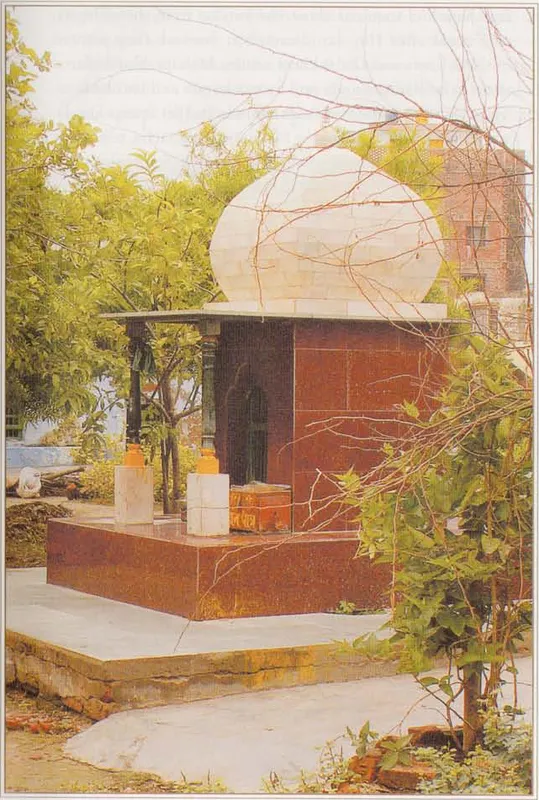
- What it is
- Śrīla Mādhavendra Purī's baiṭhaka, his sitting place, is a small domed shrine on the east side of Śyāma-kuṇḍa, near Gayā-ghāṭa and across the parikramā path from Gopī-kūpa.
- Visiting
- The Colour Guide (1999) shows the baiṭhaka as a small open pavilion with a white rounded dome on a raised plinth, and Śrī Vraja-maṇḍala Parikramā (2007) as a small shrine with an arched niche and a …
In short
Śrīla Mādhavendra Purī's baiṭhaka, his sitting place, is a small domed shrine on the east side of Śyāma-kuṇḍa, near Gayā-ghāṭa and across the parikramā path from Gopī-kūpa.[1 +5] The Caitanya-caritāmṛta tells that after his walk around Govardhana Hill he rested under a tree at Govinda-kuṇḍa.[7] According to the local tradition recorded in The Colour Guide to Rādhā-kuṇḍa (1999), he also sat and rested here during that walk, when the two kuṇḍas were still two paddy fields; no older book mentions this halt, so it is not certain.[1 +2]
Key facts
| Kind | baiṭhaka |
|---|---|
| Region · area | Rādhā-kuṇḍa |
| Also part of | Śyāma-kuṇḍa (Rādhā-kuṇḍa), Rādhā-kuṇḍa (village) |
| Ācāryas | Śrīla Mādhavendra Purī |
Traditional accounts
What the Caitanya-caritāmṛta tells
The Caitanya-caritāmṛta (Madhya 4) tells that Śrīla Mādhavendra Purī walked around the hill, then went to Govinda-kuṇḍa, bathed and sat beneath a tree for his evening rest. There an unknown cowherd boy brought him a pot of milk. It names no halt at the site of the two kuṇḍas.[7]
śaila parikramā kari’ govinda-kuṇḍe āsi’
snāna kari, vṛkṣa-tale āche sandhyāya vasi’
After circumambulating the hill, Mādhavendra Purī went to Govinda-kuṇḍa and took his bath. He then sat beneath a tree to take his evening rest.
Translation: Śrīla A.C. Bhaktivedanta Swami PrabhupādaThe Bhakti-ratnākara also puts the tree where he stayed on the Govinda-kuṇḍa side of the hill, where Gopāla showed Himself on the pretext of giving milk; its account of Rādhā-kuṇḍa does not mention him (summarised here, not translated).[9] For his rest after the walk, then, the Caitanya-caritāmṛta names Govinda-kuṇḍa; the halt at this spot is a later local tradition that neither book mentions (see below).[7] His place at Govinda-kuṇḍa has its own page.
The local tradition
According to the local tradition recorded in The Colour Guide to Rādhā-kuṇḍa (1999), this is the place on the bank of Śyāma-kuṇḍa where Śrīla Mādhavendra Purī sat down and rested during his parikramā (walk) around Govardhana. The book says that Rādhā-kuṇḍa and Śyāma-kuṇḍa had not yet been discovered then, and that he stopped next to the two paddy fields that Śrī Caitanya Mahāprabhu later revealed as the kuṇḍas. It names no source for this, so it is not certain.[1 +2]
The other guidebooks agree on the spot. The guidebook Vṛndāvana-Dhāma Ki Jaya! (c. 1986) says that across the parikramā path from Gopī-kūpa is the place where he sat "when he visited Rādhā-kuṇḍa", and Śrī Vraja-maṇḍala Parikramā (2007) names the baiṭhaka near Gayā-ghāṭa. The Colour Guide and Govardhana Hill (2001) say that the well of the tongue of Govardhana was dug just opposite it.[1 +3]
The two paddy fields
The two paddy fields themselves come from the Caitanya-caritāmṛta (Madhya 18): Śrī Caitanya Mahāprabhu found Rādhā-kuṇḍa and Śyāma-kuṇḍa, then lost to view, in two paddy fields with only a little water, and bathed there. Śrīla Prabhupāda's purport calls them two reservoirs of water in two paddy fields.[10 +1]
General teaching (does not name the place)“Śrī Caitanya Mahāprabhu could then understand that the holy places known as Rādhā-kuṇḍa and Śyāma-kuṇḍa were at that time lost to everyone’s vision. He therefore discovered Rādhā-kuṇḍa and Śyāma-kuṇḍa, which were two reservoirs of water in two paddy fields.”
Śrīla Prabhupāda, Śrī Caitanya-caritāmṛta, Madhya-līlā 18.3, purport · vedabase.io
Visiting today
The Colour Guide (1999) shows the baiṭhaka as a small open pavilion with a white rounded dome on a raised plinth, and Śrī Vraja-maṇḍala Parikramā (2007) as a small shrine with an arched niche and a white marble onion-shaped dome. Its map puts the shrine east of Śyāma-kuṇḍa on a path off the ring road, near Gopī-kūpa. No source dates the building or names its builder.[1 +2]
Location
| Where it is | Near Gayā-ghāṭa; map key 14 east of Śyāma-kuṇḍa on a dashed path off the ring road[12] On the banks of Śyāma-kuṇḍa, next to the two paddy fields; opposite the well.[13] |
|---|
Nearby places
Gayā-ghāṭa · Gopī-kūpa · Rādhā-kuṇḍa · Śyāma-kuṇḍa (Rādhā-kuṇḍa)
Where the sources differ
Where Śrīla Mādhavendra Purī rested during his Govardhana parikramā: at this spot by the paddy fields in The Colour Guide; at Rādhā-kuṇḍa, without the parikramā, in Vṛndāvana-Dhāma Ki Jaya!; under a tree at Govinda-kuṇḍa in the Caitanya-caritāmṛta and the Bhakti-ratnākara.
Accounts differ Where Śrīla Mādhavendra Purī sat to rest during his Govardhana parikramā.
- The Colour Guide to Rādhā-kuṇḍa (1999)On the bank of Śyāma-kuṇḍa, next to the two paddy fields later revealed as the kuṇḍas, where he 'sat down and rested during his famous parikramā around Govardhana Hill'.
- Vṛndāvana-Dhāma Ki Jaya! (c. 1986)Across the parikramā path from Gopī-kūpa is 'the place where Mādhavendra Purī sat when he visited Rādhā-kuṇḍa'.
- Śrī Caitanya-caritāmṛta, Madhya 4.23After circumambulating the hill he went to Govinda-kuṇḍa, bathed and sat beneath a tree for his evening rest, where a cowherd boy brought him milk; no halt at the site of the kuṇḍas is mentioned.
- Bhakti-ratnākara, Fifth Wave pp. 202-203He stayed under a tree on the Govinda-kuṇḍa side of the hill, where Gopāla showed Himself on the pretext of giving milk; its Rādhā-kuṇḍa section does not mention him.
References
13 references
- Śrī Vraja-maṇḍala Parikramā (2007), PDF p. 98
- Vṛndāvana-Dhāma Ki Jaya! (c. 1986), by Dhruva Mahārāja dāsa, PDF p. 33
- The Colour Guide to Rādhā-kuṇḍa (1999), Rājaśekhara dāsa Brahmacārī, PDF p. 97
- Govardhana Hill: India's Most Sacred Mountain (2001), Rajasekhara dasa Brahmacari, PDF p. 156
- The Colour Guide to Rādhā-kuṇḍa (1999), Rājaśekhara dāsa Brahmacārī, PDF p. 141
- Śrī Vraja-maṇḍala Parikramā (2007), PDF p. 101
- Śrīla Kṛṣṇadāsa Kavirāja Gosvāmī, Śrī Caitanya-caritāmṛta, CC Madhya-līlā 4.23, online edition · vedabase.io
- The Colour Guide to Rādhā-kuṇḍa (1999), Rājaśekhara dāsa Brahmacārī, PDF p. 140
- Śrīla Narahari Cakravartī, Bhakti-ratnākara, Fifth Wave, 1912 ed. pp. 202-203: last line of p. 202 and first line of p. 203, 2nd ed., 1912
- Śrīla Kṛṣṇadāsa Kavirāja Gosvāmī, Śrī Caitanya-caritāmṛta, Madhya-līlā 18.5, online edition · vedabase.io
- Śrīla Prabhupāda, Śrī Caitanya-caritāmṛta, Madhya-līlā 18.3, purport · vedabase.io
- Śrī Vraja-maṇḍala Parikramā (2007), p. 170-171
- The Colour Guide to Rādhā-kuṇḍa (1999), Rājaśekhara dāsa Brahmacārī, p. 136