Mādhavendra Purī's Bhajana Kuṭira (Govinda-kuṇḍa)
माधवेन्द्र पुरी की भजन-कुटीर (गोविन्द-कुण्ड) Hindi name proposed
Also called Mādhavendra Purī's Bhājana Kuṭira, Madhvendra Puri Goswami Bhajana Kutir
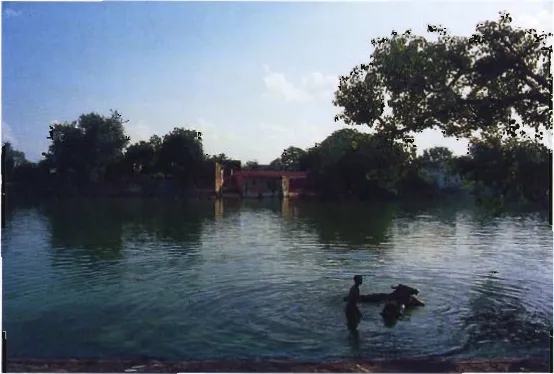
- What it is
- Śrīla Mādhavendra Purī's bhajana-kuṭīra, his hut for chanting and prayer, is a small shrine on the far bank of Govinda-kuṇḍa, beside the Gopāla Mandira, according to the guidebooks.
- Visiting
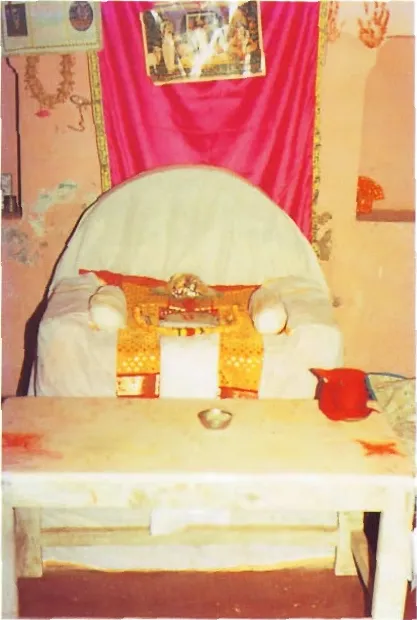
- The guidebooks describe the kuṭīra as a small room with a seat, on the far bank of Govinda-kuṇḍa next to the Gopāla Mandira.
In short
Śrīla Mādhavendra Purī's bhajana-kuṭīra, his hut for chanting and prayer, is a small shrine on the far bank of Govinda-kuṇḍa, beside the Gopāla Mandira, according to the guidebooks.[1 +3] They connect it with the evening that the Caitanya-caritāmṛta tells of: after walking around Govardhana, Śrīla Mādhavendra Purī bathed in Govinda-kuṇḍa and sat under a tree, and Gopāla, the Deity hidden in the forest, came to him as a cowherd boy with milk.[1 +7] The texts speak of a tree, not of a hut.[1 +3]
Key facts
| Kind | bhajana-kuṭīra |
|---|---|
| Region · area | Govardhana · Govinda-kuṇḍa (Govardhana) |
| Ācāryas | Śrīla Mādhavendra Purī, Śrīla Narahari Cakravartī Ṭhākura, Śrīla Kṛṣṇadāsa Kavirāja Gosvāmī, Śrīla Śrīnivāsa Ācārya |
The Gosvāmīs and ācāryas
Gopāla brings milk
The Caitanya-caritāmṛta (Madhya 4) tells that Śrīla Mādhavendra Purī, after walking around Govardhana Hill, came to Govinda-kuṇḍa, bathed, and sat beneath a tree for his evening rest:[6 +3]
śaila parikramā kari’ govinda-kuṇḍe āsi’
snāna kari, vṛkṣa-tale āche sandhyāya vasi’
After circumambulating the hill, Mādhavendra Purī went to Govinda-kuṇḍa and took his bath. He then sat beneath a tree to take his evening rest.
Translation: Śrīla A.C. Bhaktivedanta Swami PrabhupādaThe book tells that a cowherd boy brought him milk there, and that the same boy came to him in a dream that night:[6 +2]
svapne dekhe, sei bālaka sammukhe āsiñā
eka kuñje lañā gela hātete dhariñā
In a dream Mādhavendra Purī saw the very same boy. The boy came before him and, holding his hand, took him to a bush in the jungle.
Translation: Śrīla A.C. Bhaktivedanta Swami PrabhupādaThe boy said that He lived in that bush, named Himself Gopāla, whom Vajra had installed and His priest had hidden there out of fear of the Muslims, and asked to be taken out and installed on the hill. Next morning Śrīla Mādhavendra Purī gathered the people of the village, who cleared the bushes and found the Deity. The book does not say how far the bush was from Govinda-kuṇḍa.[6 +2]
According to the Bhakti-ratnākara, on his round of Govinda-kuṇḍa and the nearby Dāna-nivartana-kuṇḍa, Śrīla Śrīnivāsa Ācārya's guide showed him the dense forest near the kuṇḍa where Gopāla had stayed hidden, and the place where Śrīla Mādhavendra Purī stayed under a tree and Gopāla gave him darśana, letting Himself be seen, on the pretext of giving milk. From there the guide pointed to Gopāla's place on the hill and said that Gopāla sometimes stays at Gāṅṭholī (printed Gāṭhuli).[8 +1] Where Gopāla was found is told in several ways (see the accounts below).[6 +2]
Gopāla's service
After installing Gopāla on the hill, Śrīla Mādhavendra Purī initiated two renounced brāhmaṇas from Bengal and gave them the Deity's daily service. According to the Bhakti-ratnākara, they still held the service when Śrī Caitanya Mahāprabhu came; after their passing others served for some time, and then Śrīla Raghunātha dāsa Gosvāmī and others, after consulting together, made Śrī Viṭṭhaleśvara (Viṭṭhalanātha, the son of Śrī Vallabha Bhaṭṭa) the adhikārī, the one in charge, of the service.[18 +3] Read more: The Gopāla Deity of Govardhana →
Śrīla Prabhupāda
Śrīla Prabhupāda's translation of the verse shown above names Govinda-kuṇḍa and the tree, but not a kuṭīra.
Śrīla Prabhupāda's translation of the verse shown above names Govinda-kuṇḍa and the tree, but not a kuṭīra.[9] In a lecture of 1971 he told the finding of Gopāla in general terms:[22]
General teaching (does not name the place)“Mādhavendra Purī was a great devotee in this Gauḍīya-sampradāya, and in this Govardhana there was Gopāla, I mean to say, covered by dirty and jungles and trees. … So Mādhavendra Purī, with the help of villagers, he excavated the earth and found this Gopāla mūrti.”
Śrīla Prabhupāda, Lecture on Śrīmad-Bhāgavatam 4.14.14, Delhi, 16 November 1971 · vedabase.io
Visiting today
The guidebooks describe the kuṭīra as a small room with a seat, on the far bank of Govinda-kuṇḍa next to the Gopāla Mandira. The temple, they say, holds a pratibhū-mūrti, a replica, of Gopāla and is looked after by the Gosvāmīs of the Govindajī temple in Jaipur.[1 +3]
Location
| Where it is | 'on the far bank' of Govinda-kuṇḍa[23] |
|---|---|
| On the numbered Govardhana chart | 44 (printed as “Madavendra Puri’s Bhajan Kutir (Indra Tila)”)[24] |
Nearby places
Gopāla Mandira (Govinda-kuṇḍa) · Indra Tila
Pictures
1 pictures
History
No source says when or by whom the present kuṭīra was built.[1 +3] The Gopāla Deity whom Śrīla Mādhavendra Purī found, as told below, is now worshipped far from here. Śrīla Prabhupāda said in 1976 that Śrīnāthajī is the Gopāla whom Śrīla Mādhavendra Purī discovered at Govardhana.[10 +1] The undated parikramā notes Govardhana say that in the reign of the Mughal ruler Aurangzeb the Deity was moved to Rājasthān for safety, and that He is worshipped today at Nāthadvāra near Udaipur.[12 +3] The historian A. W. Entwistle (1987) dates the decision to remove the Deity from Govardhana to 1669, and Prabhudayāl Mītal (1966) gives the day of the removal in Saṁvat 1726; both say that He was installed at Siṁhāḍa in Mewar, the present Nāthadvāra.[14 +1] The Deity's history is told on the page of the Gopāla Rāya Mandira.[10 +1]
Where the sources differ
Where Gopāla was found by Śrīla Mādhavendra Purī
Accounts differ Where Gopāla was found by Śrīla Mādhavendra Purī
- Śrī Caitanya-caritāmṛta, Madhya 4.35-51in a bush in the jungle, reached from the village with choppers and spades; distance from Govinda-kuṇḍa not given
- Bhakti-ratnākara (1912 ed. p. 202)in the dense forest near Govinda-kuṇḍa (Gopāla stayed here, hidden)
- the undated parikramā notes Govardhana (Madhvendra Puri Goswami Bhajana Kutir)'At this place only Gopala ... guided him to find out His deity ... That famous pastime happened here only'
- the undated parikramā notes Govardhana'This is the appearance place of Lord Gopala ... The deity of Lord Gopala lay buried in the earth beneath some bushes at this very spot'
The wording of these accounts is our summary of the sources, not a published translation.
Accounts differ Where Śrīla Mādhavendra Purī lived and performed bhajana at Govardhana
- Govardhana Hill: India's Most Sacred Mountain (2001); the undated parikramā notes Govardhana; the key of the numbered Govardhana chartat the bhajana-kuṭīra on the far bank of Govinda-kuṇḍa
- Śrī Vraja-maṇḍala Parikramā (2007)'Jatīpurā is where Śrī Mādhavendra Purī lived and performed bhajana'; no kuṭīra at Govinda-kuṇḍa is mentioned
- Govardhana Hill: India's Most Sacred Mountain (2001) (Jetipura)Jetipura (from yati) was named after Śrīla Mādhavendra Purī, 'who stayed here during the time he was worshiping the Gopāla Deity'
- Śrī Caitanya-caritāmṛta, Madhya 4.23; Bhakti-ratnākara pp. 202-203after bathing in Govinda-kuṇḍa he sat under a tree for the evening ('stayed here under a tree'); no hut and no long stay at that spot
Whether the kuṭīra and Indra Tila are one site: the key of the numbered Govardhana chart lists them under one number, Govardhana Hill (2001) as two neighbouring places.
Accounts differ Is Indra Tila the same site as Śrīla Mādhavendra Purī's bhajana-kuṭīra?
- the key of the numbered Govardhana chart (numbered Govardhana chart, entry 44)'Madavendra Puri's Bhajan Kutir (Indra Tila)' — one entry with both names
- Govardhana Hill: India's Most Sacred Mountain (2001), nos. 33-35Śrīla Mādhavendra Purī's Bhajana Kuṭira (no. 33), the Gopāla Mandira 'next to' it (no. 34) and Indra Tila, 'this small hill at the side of Govinda-kuṇḍa' (no. 35), are separate entries
- the undated parikramā notes Govardhanaseparate headings: 'Madhvendra Puri Goswami Bhajana Kutir' and 'Indra Tila'
More on this place
The Gopāla Deity of Govardhana
References
24 references
- Govardhana Hill: India's Most Sacred Mountain (2001), Rajasekhara dasa Brahmacari, PDF p. 114
- Govardhana Hill: India's Most Sacred Mountain (2001), Rajasekhara dasa Brahmacari, PDF p. 113
- the undated parikramā notes Govardhana, ¶108
- the key of the numbered Govardhana chart, ¶47
- the undated parikramā notes Govardhana, ¶109
- Śrīla Kṛṣṇadāsa Kavirāja Gosvāmī, Śrī Caitanya-caritāmṛta, CC Madhya-līlā 4.23, online edition · vedabase.io
- Śrīla Kṛṣṇadāsa Kavirāja Gosvāmī, Śrī Caitanya-caritāmṛta, CC Madhya-līlā 4.35, online edition · vedabase.io
- Śrīla Narahari Cakravartī, Bhakti-ratnākara, Fifth Wave, 1912 ed. pp. 202-203, 2nd ed., 1912
- Śrīla Prabhupāda, Śrī Caitanya-caritāmṛta, Madhya-līlā 4.23, translation · vedabase.io
- Śrīla Prabhupāda, Room Conversation, New York, 17 July 1976 · vedabase.io
- Śrīla Prabhupāda, Morning Walk, Bombay, 15 August 1976 · vedabase.io
- the undated parikramā notes Govardhana, ¶103
- A. W. Entwistle, ch. 8 §22.7 'Shrinathji ka Mandir', printed p. 356, Egbert Forsten, Groningen, 1987
- A. W. Entwistle, ch. 5 §25 'The exodus of deities from Braj', printed p. 184, Egbert Forsten, Groningen, 1987
- Prabhudayāl Mītal, part 2 ('Braj kā itihās'), 'Mugal kāl': 'Dev-mūrtiyoṁ kā sthānāntaraṇ', printed p. 221
- Śrīla Kṛṣṇadāsa Kavirāja Gosvāmī, Śrī Caitanya-caritāmṛta, CC Madhya-līlā 4.48, online edition · vedabase.io
- Śrīla Narahari Cakravartī, Bhakti-ratnākara, Fifth Wave, 1912 ed. p. 202, 2nd ed., 1912
- Śrīla Kṛṣṇadāsa Kavirāja Gosvāmī, Śrī Caitanya-caritāmṛta, CC Madhya-līlā 4.104, online edition · vedabase.io
- Śrīla Narahari Cakravartī, Bhakti-ratnākara, Fifth Wave, 1912 ed. p. 213, 2nd ed., 1912
- Govardhana Hill: India's Most Sacred Mountain (2001), Rajasekhara dasa Brahmacari, PDF p. 140
- Śrī Vraja-maṇḍala Parikramā (2007), PDF p. 134
- Śrīla Prabhupāda, Lecture on Śrīmad-Bhāgavatam 4.14.14, Delhi, 16 November 1971 · vedabase.io
- Govardhana Hill: India's Most Sacred Mountain (2001), Rajasekhara dasa Brahmacari, p. 100
- Numbered list of the Govardhana sites (key of the Govardhana chart)