Phisalanī-śilā (Kāmyavana)
फिसलनी-शिला (काम्यवन) Hindi name proposed
Also called Phichalini Shila
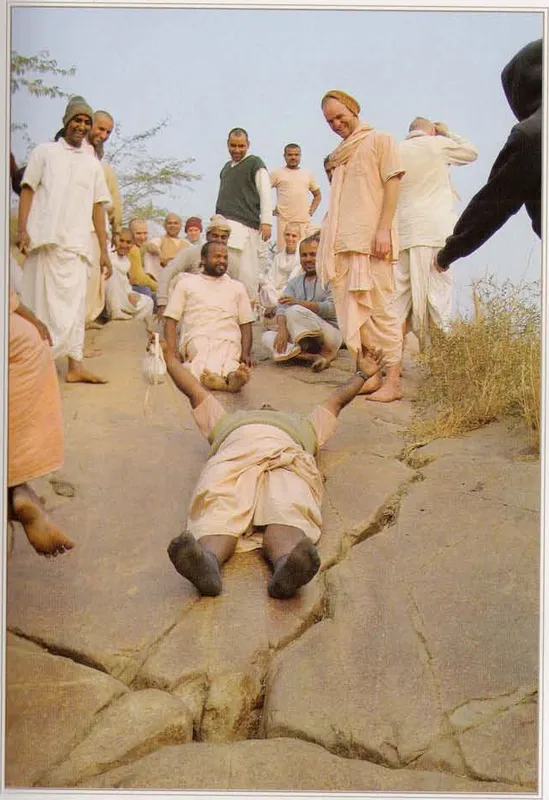
- What it is
- Phisalanī-śilā, the "slippery stone", is a sloping rock on a hill of Kāmyavana, down which Kṛṣṇa and His cowherd friends slid in play.
- Visiting
- Śrī Vraja-maṇḍala Parikramā (2007) says that village boys still slide down the rock while they graze their cows, and that pilgrims come to see it.
In short
Phisalanī-śilā, the "slippery stone", is a sloping rock on a hill of Kāmyavana, down which Kṛṣṇa and His cowherd friends slid in play. According to the Bhakti-ratnākara, the boys sat bent on the low hill and slid down again and again.[1 +1] Śrīla Nārāyaṇa Bhaṭṭa Gosvāmī's Vraja-bhakti-vilāsa counts the stone among the holy places of Kāmyavana and gives a prayer for it.[3 +1] The guidebook Śrī Vraja-maṇḍala Parikramā (2007) puts it on the Indrasena Hill near Kalāvatā-grāma, close to Vyomāsura's cave.[5 +1] Śrīmad-Bhāgavatam does not tell this game.[1 +3]
Key facts
| Kind | śilā |
|---|---|
| Region · area | Kāmyavana · Indrasena Hill |
| Ācāryas | Śrīla Narahari Cakravartī Ṭhākura, Śrīla Rāghava Paṇḍita Gosvāmī of Govardhana, Śrīla Śrīnivāsa Ācārya, Śrīla Nārāyaṇa Bhaṭṭa Gosvāmī |
Traditional accounts
According to the Bhakti-ratnākara of Śrīla Narahari Cakravartī Ṭhākura, Śrīla Rāghava Paṇḍita Gosvāmī, showing Śrīla Śrīnivāsa Ācārya the forest of Kāmyavana, said that the Pichalini-śilā is on Candrasena hill, and that here Kṛṣṇa plays this game with His friends: sitting bent on the low hill, they slide down again and again (summarised here, not translated).[1 +1]
Śrīla Nārāyaṇa Bhaṭṭa Gosvāmī's Vraja-bhakti-vilāsa lists "the tīrtha Khisilini-śilā" between the kuṇḍas of Kāmyavana and the place of Vyomāsura's cave, followed by Bhojana-sthala, the place of the meal. In its round of the forest it gives a prayer at the stone, which it ascribes to a Purāṇa-samuccaya: it bows to Kṛṣṇa in the form of a cowherd, beloved of Lalitā and delightful with the gopīs, who slides on this stone tīrtha. One who says it ten times with obeisances, the book adds, will always enjoy play as the head of the family (summarised here, not translated). The Purāṇa-samuccaya itself could not be checked.[3 +1]
Śrīla Locana dāsa Ṭhākura's Caitanya-maṅgala, telling Śrī Caitanya Mahāprabhu's journey through Vraja, has His guide point out Kāmyavana west of Nandīśvara and then a slippery stone where the cowherd boys play at sliding, morning and afternoon. It names no hill (summarised here, not translated). The only edition read lacks this line in one manuscript, and the passage still has to be checked in a printed edition.[7]
According to the local tradition recorded in Śrī Vraja-maṇḍala Parikramā (2007), Kṛṣṇa and His sakhās, His cowherd friends, slid here while grazing the cows, and Śrīmatī Rādhikā sometimes slid here with Her sakhīs too. No older source found says that Rādhikā slid here.[5 +1]
The older and newer books give the hill different names, Candrasena and Indrasena; they are shown below.[1 +3]
Śrīla Prabhupāda
Śrīla Prabhupāda does not speak of this stone by name.
Śrīla Prabhupāda does not speak of this stone by name. In his translation of the Caitanya-caritāmṛta he tells, in general, that Śrī Caitanya Mahāprabhu visited the places of Kṛṣṇa's pastimes at Kāmyavana and then went to Nandīśvara, where He was overwhelmed with ecstatic love.[8]
Visiting today
Śrī Vraja-maṇḍala Parikramā (2007) says that village boys still slide down the rock while they graze their cows, and that pilgrims come to see it. Vyomāsura's cave lies nearby, in the middle of the hill.[5 +1]
Location
| Where it is | on the Indrasena Hill near Kalāvatā-grāma[9] 'On Chandrasena Parvata is Phichalini shila' (Bhakti Ratnakar, quoted)[10] |
|---|
Nearby places
Kalāvatā-grāma · Vyomāsura's cave
Where the sources differ
Accounts differ The name of the hill on which the slide lies.
- Śrīla Narahari Cakravartī, Bhakti-ratnākara 5.867'Candrasena-parvata'.
- the undated parikramā notes Kāmyavana, quoting the Bhakti-ratnākara in English'Chandrasena Parvata'.
- Śrī Vraja-maṇḍala Parikramā (2007)'the Indrasena Hill near Kalāvatā-grāma'; 'Indrasena-parvata (a stone slide) – Kāmyavana'.
References
10 references
- Śrīla Narahari Cakravartī, Bhakti-ratnākara, Fifth Wave vv.867–868, printed p. 217, 2nd ed., 1912
- Śrīla Narahari Cakravartī, Bhakti-ratnākara, Fifth Wave (pañcama taraṅga) vv.818–819 and 833–834, printed p. 214, 2nd ed., 1912
- Śrīla Nārāyaṇa Bhaṭṭa, Vraja-bhakti-vilāsa, ch. 2, the same list, vv.33–35 and 46–47 (finding aid: '(2) [part 13] v.33–35, 46–47'), printed p. 49, 1st ed., publ. Bābā Kṛṣṇadāsa, Kusuma-sarovara, Saṁvat 2008
- Śrīla Nārāyaṇa Bhaṭṭa, Vraja-bhakti-vilāsa, ch. 9 vv.14–15, printed p. 192, 1st ed., publ. Bābā Kṛṣṇadāsa, Kusuma-sarovara, Saṁvat 2008
- Śrī Vraja-maṇḍala Parikramā (2007), PDF p. 157
- Śrī Vraja-maṇḍala Parikramā (2007), PDF p. 26
- Śrī Locana dāsa Ṭhākura, Caitanya-maṅgala, Śeṣa-khaṇḍa, printed p. 177, right column, lines 9-10
- Śrīla Prabhupāda, Śrī Caitanya-caritāmṛta, Madhya-līlā 18.57, translation · vedabase.io
- Śrī Vraja-maṇḍala Parikramā (2007), p. 288-289
- the undated parikramā notes Kāmyavana, ¶71