Vyomāsura's cave
व्योमासुर की गुफा Hindi name proposed
Also called Medhāvī Muni's cave, Vyomsura Gufa
- What it is
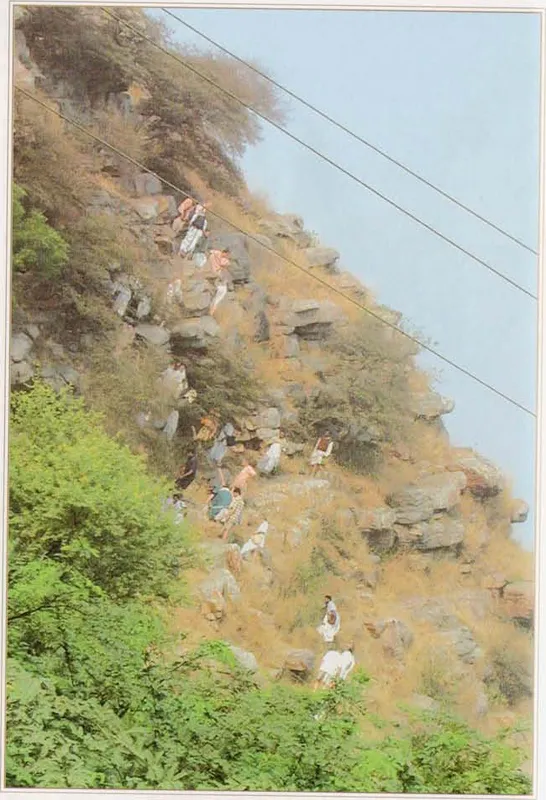
- Vyomāsura's cave is shown in the hill of Kāmyavana, near the stone slide called Phisalanī-śilā.
- Visiting
- The guidebooks describe the cave in the middle of the hill, Indrasena Hill, near the stone slide (Śrī Vraja-maṇḍala Parikramā, 2007), near the hill of Kṛṣṇa's footprints with Balarāma's footprint …
In short
Vyomāsura's cave is shown in the hill of Kāmyavana, near the stone slide called Phisalanī-śilā.[1 +3] Śrīmad-Bhāgavatam tells how the demon Vyoma hid the cowherd boys in a mountain cave during a game and how Kṛṣṇa killed him and freed them, but it names no hill.[5 +4] Śrīla Prabhupāda's Kṛṣṇa book sets the game on Govardhana Hill.[10 +1] The cave is honoured here after Śrīla Jīva Gosvāmī, who sets the pastime near the hill of the Kāmyaka forest, and the Bhakti-ratnākara, in which Śrīla Rāghava Paṇḍita Gosvāmī shows Śrīla Śrīnivāsa Ācārya the cave at whose door Kṛṣṇa killed Vyomāsura. The sources differ on where, and also when, it took place.[12 +5]
Key facts
Divine pastimes
The game of thieves and herders
Śrīmad-Bhāgavatam (10.37) tells that one day the cowherd boys, grazing their animals on the mountain slopes, played a game of stealing and hiding, some acting as thieves, some as herders and some as sheep. Vyoma, a magician and the son of the demon Maya, joined the game in the guise of a cowherd boy, carried off most of the "sheep" one by one and shut them in a mountain cave.[5 +4]
giri-daryāṃ vinikṣipya nītaṃ nītaṃ mahāsuraḥ / śilayā pidadhe dvāraṃ catuḥ-pañcāvaśeṣitāḥ
Gradually the great demon abducted more and more of the cowherd boys and cast them into a mountain cave, which he sealed shut with a boulder. Finally only four or five boys acting as sheep remained in the game.
Translation: Śrīla Prabhupāda's disciples (BBT)Kṛṣṇa saw what he was doing, seized him, threw him to the ground and killed him while the demigods looked on. Then He broke the boulder at the cave's mouth, led the boys out and returned to Gokula. The Bhāgavatam names neither the hill nor the cave.[5 +4]
guhā-pidhānaṃ nirbhidya gopān niḥsārya kṛcchrataḥ / stūyamānaḥ surair gopaiḥ praviveśa sva-gokulam
Kṛṣṇa then smashed the boulder blocking the cave’s entrance and led the trapped cowherd boys to safety. Thereafter, as the demigods and cowherd boys sang His glories, He returned to His cowherd village, Gokula.
Translation: Śrīla Prabhupāda's disciples (BBT)Śrīla Prabhupāda tells the pastime in his Kṛṣṇa book:[10]
General teaching (does not name the place)“Later that morning, Kṛṣṇa went to play with His cowherd boyfriends on the top of Govardhana Hill. They were imitating the play of thieves and police. … One after another he took away almost all the boys and put them in the caves of the mountain and sealed the mouths of the caves with stones.”
Śrīla Prabhupāda, Kṛṣṇa, the Supreme Personality of Godhead (Kṛṣṇa book), Chapter 37, 'Killing the Keśī Demon and Vyomāsura' · vedabase.io
The Garga-saṁhitā tells the same game "in the hill country", without naming a hill, and says that Kṛṣṇa played it and killed Vyomāsura together with Balarāma. It also tells Vyoma's previous birth: King Bhīmaratha of Kāśī, cursed by the sage Pulastya to become a demon, was promised liberation by Kṛṣṇa in Vraja at the end of Dvāpara-yuga, and was born as Maya's son (summarised here, not translated).[18 +3] Whether Balarāma was present is told differently in different works; the accounts are set side by side on the page of Baladeva Prabhu's footprint.[12 +2]
Where the pastime took place
Śrīla Prabhupāda, in his Kṛṣṇa book, sets the game on the top of Govardhana Hill, and Vaṁśīdhara, a commentator on the Bhāgavatam, explains its "mountain slopes" as the plateaus of Govardhana.[10 +1] Śrīla Prabhupāda writes:[11]
General teaching (does not name the place)“Nārada Muni did not mention Kṛṣṇa’s killing Vyomāsura, which means that he was killed on the same day as the Keśī demon. The Keśī demon was killed in the early morning, and after that the boys went to tend the cows on Govardhana Hill, and it was there that Vyomāsura was killed.”
Śrīla Prabhupāda, Kṛṣṇa, the Supreme Personality of Godhead (Kṛṣṇa book), Chapter 38, 'Akrūra's Arrival in Vṛndāvana' · vedabase.io
Śrīla Jīva Gosvāmī's Gopāla-campū says that Vyoma found Kṛṣṇa at play with very young boys near the hill of the Kāmyaka forest. Vyoma hid the boys in a mountain cave and closed its door with stones; after killing him, Kṛṣṇa followed the demon's footprints to the hidden door, broke it open and lit up the cave (summarised here, not translated).[12 +3] According to the Bhakti-ratnākara, Śrīla Rāghava Paṇḍita Gosvāmī told Śrīla Śrīnivāsa Ācārya in Kāmyavana that this hill is the place of the stealing game and that here, at the door of this cave, Kṛṣṇa playfully killed Vyomāsura.[16 +1] Śrīla Nārāyaṇa Bhaṭṭa Gosvāmī's Vraja-bhakti-vilāsa lists "the place of Vyomāsura's cave" among the marks of Kāmavana.[23 +1]
Other works give still other settings. Another section of the Vraja-bhakti-vilāsa tells of a Vyomāsura, an enemy of Baladeva, whom Baladeva killed in the forest named Gaḍha near Nandagrāma; that account names neither Kṛṣṇa nor a cave.[23 +3] Śrīla Murāri Gupta names Vyoma's death in his verses on a hill called Picchala in the Kāmya forest, without a cave or a game (summarised here, not translated).[27 +1] All the positions are shown below. Read more: Where and when Kṛṣṇa killed Vyomāsura →
When it took place
Śrīla Śrīdhara Svāmī gives two explanations of when Vyoma was killed: on the same day as the demon Keśī, after Nārada's visit that morning, or earlier, the Bhāgavatam telling it here because Vyoma too was a demon in disguise (summarised here, not translated).[29] Śrīla Prabhupāda's Kṛṣṇa book follows the first explanation, as quoted above.[11] Śrīla Jīva Gosvāmī gives reasons for the second: such play suits Kṛṣṇa's early childhood, and in the night of the rāsa dance the gopīs already thank Him for saving them from "the son of Maya".[30 +1] Śrīla Sanātana Gosvāmī, Śrīla Viśvanātha Cakravartī Ṭhākura and Śrīla Baladeva Vidyābhūṣaṇa explain those words of the gopīs as a killing still to come, spoken of as past because it had been foretold (summarised here, not translated).[32]
Traditional accounts
The Vraja-bhakti-vilāsa gives a prayer for the cave, which it ascribes to the Mahābhārata.
The Vraja-bhakti-vilāsa gives a prayer for the cave, which it ascribes to the Mahābhārata. It addresses the place of Vyomāsura as made fulfilled by Kṛṣṇa, the destroyer of terrible sin, and says that eleven obeisances bring the state of a Vaiṣṇava (summarised here, not translated). The verse has not been found in the Mahābhārata.[23 +1]
The guidebook Śrī Vraja-maṇḍala Parikramā (2007) also calls the cave Medhāvī Muni's cave, because, it says, the sage Medhāvī worshipped Kṛṣṇa here. No other source names this sage at Kāmyavana, so the name is not certain.[1]
The Gosvāmīs and ācāryas
Śrīla Jīva Gosvāmī tells the pastime in the tenth chapter of the first part of his Gopāla-campū, which Śrīla Prabhupāda …
Śrīla Jīva Gosvāmī tells the pastime in the tenth chapter of the first part of his Gopāla-campū, which Śrīla Prabhupāda, following Śrīla Bhaktisiddhānta Sarasvatī Ṭhākura, lists as the chapter of "the killing of Vatsāsura, Bakāsura and Vyomāsura".[12 +3] According to the Bhakti-ratnākara of Śrīla Narahari Cakravartī Ṭhākura, Śrīla Rāghava Paṇḍita Gosvāmī showed the cave to Śrīla Śrīnivāsa Ācārya on their round of Kāmyavana.[16 +1] Śrīla Nārāyaṇa Bhaṭṭa Gosvāmī lists the cave and gives its prayer.[23 +3]
Śrīla Prabhupāda
Śrīla Prabhupāda does not name this cave; his Kṛṣṇa book, quoted above, places the pastime on Govardhana Hill.
Śrīla Prabhupāda does not name this cave; his Kṛṣṇa book, quoted above, places the pastime on Govardhana Hill.[10 +1] In his translation of the Caitanya-caritāmṛta he says that Śrī Caitanya Mahāprabhu visited the places of Kṛṣṇa's pastimes at Kāmyavana before going on to Nandīśvara, without naming them.[33]
Songs
A verse of the Kṛṣṇa-līlā-stava in the song book praises Kṛṣṇa for seizing Vyoma, who had stolen His friends in a cowherd's …
A verse of the Kṛṣṇa-līlā-stava in the song book praises Kṛṣṇa for seizing Vyoma, who had stolen His friends in a cowherd's dress, and for freeing the boys locked in the cave; the song book's credit of the verse to Śrīla Sanātana Gosvāmī is its own inference.[34]
Visiting today
The guidebooks describe the cave in the middle of the hill, Indrasena Hill, near the stone slide (Śrī Vraja-maṇḍala Parikramā, 2007), near the hill of Kṛṣṇa's footprints with Balarāma's footprint across the road (Vṛndāvana-Dhāma Ki Jaya!, c. 1986), and across the road from Bhojana-thālī (the undated parikramā notes Kāmyavana).[1 +3] The marks on the hill that the notes connect with the fight have their own pages: Kṛṣṇa's footprints and handprints and the imprint of His Kaustubha necklace.[1 +3]
Location
| Where it is | near the slide, in the middle of the hill[35] near the footprint hill; across the road from Balarāma's footprints[36] |
|---|
Nearby places
Phisalanī-śilā (Kāmyavana) · Footprint of Baladeva Prabhu (Kāmyavana) · Bhojana-thālī (Kāmyavana) · Caraṇa-pahāḍī (Kāmyavana)
Where the sources differ
Where Kṛṣṇa killed Vyomāsura: the Bhāgavatam names no place, and the later works name Kāmyavana, Govardhana or other forests.
Accounts differ Where Kṛṣṇa killed Vyomāsura and played the game of thieves and herders with the boys
- Śrīmad-Bhāgavatam 10.37.26, 29, 33 (translation by Śrīla Prabhupāda's disciples)The boys were grazing their animals 'on the mountain slopes' (adri-sānuṣu); Vyoma hid them in 'a mountain cave' (giri-darī) sealed with a boulder; no hill or forest is named.
- Śrīla Prabhupāda, Kṛṣṇa book ch. 37 and ch. 38The game was played 'on the top of Govardhana Hill'; the boys were put 'in the caves of the mountain'; 'the boys went to tend the cows on Govardhana Hill, and it was there that Vyomāsura was killed'.
- Garga-saṁhitā, Mādhurya-khaṇḍa 24.1–2Once, in the hill country (śaila-deśeṣu); a mountain cave (adri-darī); no hill named.
- Vaṁśīdhara, Bhāvārtha-dīpikā-prakāśa on ŚB 10.37.26adri-sānuṣu = govardhana-prastheṣu, on the slopes of Govardhana.
The wording of these accounts is our summary of the sources, not a published translation.
Accounts differ Where Kṛṣṇa killed Vyomāsura, the pastime after which Śrī Vraja-maṇḍala Parikramā (2007) sets the bath at Kṣīrasāgara, the meal at Bhojana-thālī and the music on the Bajanī-śilā (the undated parikramā notes Kāmyavana: the meal and the music).
- Śrīmad-Bhāgavatam 10.37.26, 10.37.29The boys played the stealing game "on the mountain slopes" (adri-sānuṣu) and Vyoma hid them in "a mountain cave"; no hill is named.
- Śrīla Prabhupāda, Kṛṣṇa book chs. 37 and 38Kṛṣṇa went to play with His friends "on the top of Govardhana Hill" (ch. 37); after Keśī's killing that morning the boys tended the cows on Govardhana Hill, "and it was there that Vyomāsura was killed" (ch. 38).
- Vaṁśīdhara, Bhāvārtha-dīpikā-prakāśa on ŚB 10.37.26"adri-sānuṣu" means on the plateaus of Govardhana (govardhana-prastheṣu).
- Śrīla Jīva Gosvāmī, Gopāla-campū, Pūrva-campū 10Vyoma found Kṛṣṇa at play with the boys near the mountain of the Kāmyaka forest (kāmyakāraṇya-dharaṇī-dhara-sannidhānataḥ).
The wording of these accounts is our summary of the sources, not a published translation.
Accounts differ When Vyomāsura was killed: on the day Keśī was killed, after the rāsa dance, or earlier, in Kṛṣṇa's early childhood.
- Śrīmad-Bhāgavatam 10.37.25–33Tells the killing of Vyoma right after Keśī's killing and Nārada's visit, beginning 'one day' (ekadā); it fixes no day.
- Śrīla Śrīdhara Svāmī on ŚB 10.37.26–27Either the same morning, after Keśī and Nārada's words, or earlier (told here as another killing of a demon in disguise); some read the passage before Śaṅkhacūḍa's killing.
- Śrīla Prabhupāda, Kṛṣṇa book ch. 38Because Nārada did not mention it, Vyomāsura was killed on the same day as Keśī, when the boys were tending the cows on Govardhana Hill.
- Śrīla Jīva Gosvāmī, Laghu-vaiṣṇava-toṣaṇī on ŚB 10.37.26 and 10.31.3 (Vaṁśīdhara on 10.37.26 gives the same reasons)Earlier: such play suits the end of Kṛṣṇa's kaumāra age; the killing of Vyoma is a deed of very early childhood, so in the rāsa night (ŚB 10.31.3) the gopīs can say they were protected from Maya's son. Śrīla Jīva's Gopāla-campū tells it with the killing of Vatsa and Baka (Pūrva 10).
More on this place
Where and when Kṛṣṇa killed Vyomāsura
References
36 references
- Śrī Vraja-maṇḍala Parikramā (2007), PDF p. 157
- Vṛndāvana-Dhāma Ki Jaya! (c. 1986), by Dhruva Mahārāja dāsa, PDF p. 46
- the undated parikramā notes Kāmyavana, ¶74
- the undated parikramā notes Kāmyavana, ¶78
- Śrīmad-Bhāgavatam 10.37.26, GRETIL
- Śrīmad-Bhāgavatam 10.37.28, GRETIL
- Śrīmad-Bhāgavatam 10.37.29, GRETIL
- Śrīmad-Bhāgavatam 10.37.32, GRETIL
- Śrīmad-Bhāgavatam 10.37.33, GRETIL
- Śrīla Prabhupāda, Kṛṣṇa, the Supreme Personality of Godhead (Kṛṣṇa book), Chapter 37, 'Killing the Keśī Demon and Vyomāsura' · vedabase.io
- Śrīla Prabhupāda, Kṛṣṇa, the Supreme Personality of Godhead (Kṛṣṇa book), Chapter 38, 'Akrūra's Arrival in Vṛndāvana' · vedabase.io
- Gopāla-campū, Pūrva-campū (10) ¶[62]
- Gopāla-campū, Pūrva-campū 10 ¶[63], end
- Gopāla-campū, Pūrva-campū 10 ¶[64] v.23 and ¶[65] v.24
- Śrīla Prabhupāda, Śrī Caitanya-caritāmṛta, Madhya-līlā 1.44, purport · vedabase.io
- Śrīla Narahari Cakravartī, Bhakti-ratnākara, Fifth Wave vv.881 and 883, printed p. 217, 2nd ed., 1912
- Śrīla Narahari Cakravartī, Bhakti-ratnākara, Fifth Wave (pañcama taraṅga) vv.818–819 and 833–834, printed p. 214, 2nd ed., 1912
- Garga-saṁhitā, Mādhurya-khaṇḍa (4) 24.1–5 (chapter 'vyomāsura-ariṣṭa-vadham'), Sanskrit Wikisource
- Garga-saṁhitā, Balabhadra-khaṇḍa (8) 6.16 (prose), Sanskrit Wikisource
- Garga-saṁhitā, Mādhurya-khaṇḍa (4) 24.11–14, Sanskrit Wikisource
Show all 36 references
- the undated parikramā notes Kāmyavana, ¶80
- Vaṁśīdhara: commentary Vaṁśīdhara, Bhāvārtha-dīpikā-prakāśa, on ŚB 10.37.26, Bhagavata Vidya Pith edition, ed. Bhagavata Rishi and Krishna Shankar Shastri, 1996
- Śrīla Nārāyaṇa Bhaṭṭa, Vraja-bhakti-vilāsa, ch. 2, the same list, vv.33–35 and 46–47 (finding aid: '(2) [part 13] v.33–35, 46–47'), printed p. 49, 1st ed., publ. Bābā Kṛṣṇadāsa, Kusuma-sarovara, Saṁvat 2008
- Śrīla Nārāyaṇa Bhaṭṭa, Vraja-bhakti-vilāsa, ch. 9 vv.14–15, printed p. 192, 1st ed., publ. Bābā Kṛṣṇadāsa, Kusuma-sarovara, Saṁvat 2008
- Śrīla Nārāyaṇa Bhaṭṭa, Vraja-bhakti-vilāsa, ch. 4 v.29 (beginning), printed p. 92, 1st ed., publ. Bābā Kṛṣṇadāsa, Kusuma-sarovara, Saṁvat 2008
- Śrīla Nārāyaṇa Bhaṭṭa, Vraja-bhakti-vilāsa, ch. 4 vv.30 and 32, printed p. 93, 1st ed., publ. Bābā Kṛṣṇadāsa, Kusuma-sarovara, Saṁvat 2008
- Kṛṣṇa-caitanya-caritāmṛta, 4.10.16-17
- Kṛṣṇa-caitanya-caritāmṛta, 4.10.18
- Śrīmad-Bhāgavatam canto 10 with commentaries: Śrīdhara Svāmī: commentary Śrīla Śrīdhara Svāmī, Bhāvārtha-dīpikā, on ŚB 10.37.26-27, Bhagavata Vidya Pith edition, ed. Bhagavata Rishi and Krishna Shankar Shastri, 1996
- Śrīmad-Bhāgavatam canto 10 with commentaries: Śrīla Jīva Gosvāmī: commentary Śrīla Jīva Gosvāmī, Laghu-vaiṣṇava-toṣaṇī, on ŚB 10.37.26, Bhagavata Vidya Pith edition, ed. Bhagavata Rishi and Krishna Shankar Shastri, 1996
- Śrīmad-Bhāgavatam canto 10 with commentaries: Śrīla Jīva Gosvāmī: commentary Jīva Gosvāmī, Laghu-vaiṣṇava-toṣaṇī on ŚB 10.31.3
- Śrīmad-Bhāgavatam canto 10 with commentaries: Śrīla Viśvanātha Cakravartī Ṭhākura: commentary Viśvanātha Cakravartī Ṭhākura, Sārārtha-darśinī on ŚB 10.31.3
- Śrīla Prabhupāda, Śrī Caitanya-caritāmṛta, Madhya-līlā 18.57, translation · vedabase.io
- Obeisance 81 (Kṛṣṇa-līlā-stava; the song book's chapter 'Śrīmad Bhāgavatam Canto 10, Chapter 37') (Sanātana Gosvāmī (as the song book credits it; the credit is inferred from the book, author_inferred = 1)) · song book
- Śrī Vraja-maṇḍala Parikramā (2007), p. 288-289
- Vṛndāvana-Dhāma Ki Jaya! (c. 1986), by Dhruva Mahārāja dāsa, p. 28