Pīlī-pokhara
पीली-पोखर Hindi name proposed
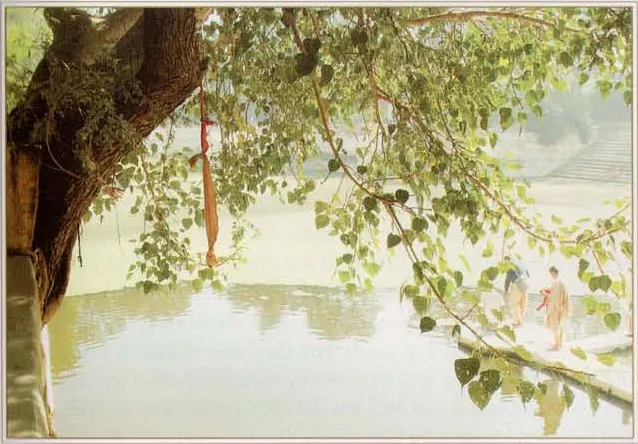
- What it is
- Pīlī-pokhara, the yellow pond, also called Pīrī-pokhara and Piyāla-kuṇḍa, lies on the north side of Varṣāṇā.
- Visiting
- The map of Varṣāṇā in Śrī Vraja-maṇḍala Parikramā (2007) shows Pīlī-pokhara north of the canal, at the top of the map; the text of the book gives no position.
In short
Pīlī-pokhara, the yellow pond, also called Pīrī-pokhara and Piyāla-kuṇḍa, lies on the north side of Varṣāṇā.[1 +1] The Bhakti-ratnākara names a Piyāla lake north of the village and a Pilukhora, where Rādhā and Kṛṣṇa play with the sakhīs, Rādhā's companions, on the pretext of picking pīlu fruits.[2] The guidebook Śrī Vraja-maṇḍala Parikramā (2007) explains the name Pīlī-pokhara by a story of Rādhikā's hands painted yellow by Yaśodā.[3 +2]
Key facts
| Kind | pokhara |
|---|---|
| Region · area | Varṣāṇā |
| Ācāryas | Śrīla Narahari Cakravartī Ṭhākura, Śrīla Rāghava Paṇḍita Gosvāmī of Govardhana, Śrīla Śrīnivāsa Ācārya, Śrīla Nārāyaṇa Bhaṭṭa Gosvāmī |
Traditional accounts
In the Bhakti-ratnākara
In the Fifth Wave of the Bhakti-ratnākara, Śrīla Rāghava Paṇḍita Gosvāmī of Govardhana shows Śrīla Śrīnivāsa Ācārya the places of Varṣāṇā.[2] He says (summarised here, not translated): see the Piyāla lake to the north of the village, where the Beloved and the Lover enjoy many pastimes in a dense forest of jiyāla trees; and this is Pilukhora, where Rāi and Kānu (Rādhā and Kṛṣṇa) play with the sakhīs on the pretext of pīlu fruits. People now say Pilukhora, but its old name was Pilu-sarovara. The text does not say whether the Piyāla lake and Pilukhora are one pond.[2]
দেখহ পিয়ালসরোবর গ্রামোত্তরে। প্রিয়া প্রিয় দোঁহে এথা নানাক্রীড়া করে ॥ জিয়াল বৃক্ষের বন এথা অতিশয়। শোভা দেখি সখীসহ দোঁহে হর্ষ হয় ॥ এই পিলুখোর এথা পিলুফল ছলে। সখী সহ রাই কাণুক্রীড়া কুতূহলে ॥ ভানুখোর পিলুখোর এবে লোকে কয়। ভানু পিলু সরোবর পূর্ব্বে নাম হয় ॥
dekhaha piẏālasarobara grāmottare| priẏā priẏa dom̐he ethā nānākrīṛā kare
jiẏāla bṛkṣera bana ethā atiśaẏa| śobhā dekhi sakhīsaha dom̐he harṣa haẏa
ei pilukhora ethā piluphala chale| sakhī saha rāi kāṇukrīṛā kutūhale
bhānukhora pilukhora ebe loke kaẏa| bhānu pilu sarobara pūrbbe nāma haẏa ||
The guidebook's stories
Śrī Vraja-maṇḍala Parikramā says that pīlu trees, heavy with fruit, surround the pond, and that Śrīmatī Rādhikā came here on the pretext of collecting pīlu fruits while Śrī Kṛṣṇa came from Nandagrāma to play with Her.[3 +1]
The same book tells why the pond is yellow. Yaśodā, who wished to have Rādhikā as her daughter-in-law, painted Her hands yellow at Nandagrāma. On the way home Rādhikā, embarrassed, scrubbed Her hands in this pond, and its water turned yellow. The book adds that the pond is called Piyāla-kuṇḍa because piyāla trees surround it.[3 +2] No scripture or Gosvāmī text has been found that tells this story.[3 +2]
The editor of the Hindi edition of the Vraja-bhakti-vilāsa lists Priyākuṇḍa (Pilūpokhar) among the holy places of Varṣāṇā that, he says, were brought to light by Śrīla Nārāyaṇa Bhaṭṭa Gosvāmī. This is the editor's report of a tradition, not Śrīla Nārāyaṇa Bhaṭṭa Gosvāmī's own words.[7]
Visiting today
The map of Varṣāṇā in Śrī Vraja-maṇḍala Parikramā (2007) shows Pīlī-pokhara north of the canal, at the top of the map; the text of the book gives no position.[1 +1] In 1987 the historian A. W. Entwistle recorded a boating festival here on the evening of Vāmana-dvādaśī, the twelfth day of the bright half of Bhādra.[11]
Location
History
The British historian Growse (1883) records that a brāhmaṇa family of Varṣāṇā, the Lavaniyās, faced the pond with stone; he calls it Priya-kuṇḍa or Piri-pokhar and gives no date.[8 +2]
Where the sources differ
The name of the pond and why it is so called.
The name of the pond and why it is so called.[2 +3]
Accounts differ The name of the pond and why it is so called.
- Bhakti-ratnākara, Fifth Wave, printed p. 220'Pilukhora', formerly 'Pilu-sarovara', where Rāi and Kānu play with the sakhīs on the pretext of pīlu fruits; separately a 'Piyāla lake' north of the village with a forest of jiyāla trees; no yellow hands
- Śrī Vraja-maṇḍala Parikramā (2007)Pīrī- or Pīlī-pokhara, 'the yellow pond', because its water turned yellow when Rādhikā washed off the yellow Yaśodā had painted on Her hands; also Piyāla-kuṇḍa 'because piyāla trees surround it'; pīlu trees surround the pond
- F. S. Growse, Mathurá (1883), a historian (repeated in the Muttra gazetteer, 1911)Growse names the sacred tank on the edge of the town Priya-kuṇḍa, also called Pīrī-pokhar.
- Vraja-bhakti-vilāsa, Hindi edition, editor's introduction'प्रियाकुण्ड, ( पिलूपोखर )' — Priyākuṇḍa, (Pilūpokhar), among the tīrthas at Barsānā manifested by Śrīla Nārāyaṇa Bhaṭṭa; no explanation of either name
References
11 references
- Śrī Vraja-maṇḍala Parikramā (2007), PDF p. 171
- Śrīla Narahari Cakravartī, Bhakti-ratnākara, Fifth Wave, 1912 ed. p. 220; Grantha Mandira text v.915–918, 2nd ed., 1912
- Śrī Vraja-maṇḍala Parikramā (2007), PDF p. 179
- Śrī Vraja-maṇḍala Parikramā (2007), PDF p. 180
- the undated parikramā notes Varṣāṇā, ¶34
- Śrīla Narahari Cakravartī, Bhakti-ratnākara, Fifth Wave, 1912 ed. p. 220; Grantha Mandira text v.915–918, 2nd ed., 1912
- Vraja-bhakti-vilāsa, introduction, 1st ed., publ. Bābā Kṛṣṇadāsa, Kusuma-sarovara, Saṁvat 2008
- Mathurá (1883), F. S. Growse, B.C.S., M.A. Oxon., C.I.E. (as the title page gives him, p. 313
- Muttra (1911), D. L. Drake-Brockman, I.C.S. (edited and compiled), p. 236
- A. W. Entwistle, §37 'Barsana', printed p. 371, Egbert Forsten, Groningen, 1987
- A. W. Entwistle, Calendar of festivals, Bhadon II (bright half of Bhādra), days 10 and 12, printed p. 487, Egbert Forsten, Groningen, 1987