Rādhā-Gopīnātha Mandira (Rādhā-kuṇḍa, by Jāhnavā's sitting place)
राधा-गोपीनाथ मन्दिर (राधा-कुण्ड, जाह्नवा की बैठक के पास) Hindi name proposed
Also called Rādhā Gopīnātha Maṇḍira, Gopīnātha Mandira (Rādhā-kuṇḍa)
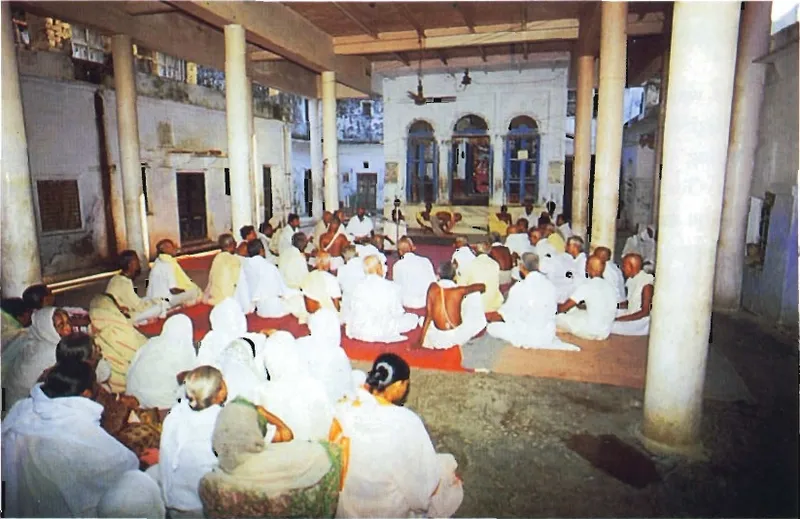
- What it is
- This temple of Śrī Gopīnātha stands in the northern part of Rādhā-kuṇḍa village, next to Śrīla Jāhnavā-devī's sitting place and near her ghāṭa, the bathing steps.
- Places here
- Raghunātha dāsa Gosvāmī's samādhi (Rādhā-kuṇḍa)
In short
This temple of Śrī Gopīnātha stands in the northern part of Rādhā-kuṇḍa village, next to Śrīla Jāhnavā-devī's sitting place and near her ghāṭa, the bathing steps. Beside it are the place where Śrīla Raghunātha dāsa Gosvāmī lived and his samādhi, according to Śrī Vraja-maṇḍala Parikramā (2007).[1 +3] The Colour Guide to Rādhā-kuṇḍa (1999) shows Gopīnātha on the altar between Anaṅga-mañjarī and Śrīmatī Rādhārāṇī, and links the temple with a vision that Śrīla Jāhnavā-devī had on the bank of the kuṇḍa.[4] The Bhakti-ratnākara tells the vision but mentions no Deity here, and no source gives a date or a founder for the temple.[5 +1]
Key facts
| Kind | temple |
|---|---|
| Region · area | Rādhā-kuṇḍa |
| Also part of | Rādhā-kuṇḍa (village) |
| Ācāryas | Śrīla Jāhnavā Mātā (Jāhnavā-devī), Śrīla Raghunātha dāsa Gosvāmī |
Traditional accounts
Śrīla Jāhnavā-devī's vision
According to the Bhakti-ratnākara, Śrīla Jāhnavā-devī stayed three or four days at Rādhā-kuṇḍa. One midday on the bank of the kuṇḍa she heard Kṛṣṇa's flute, looked around and saw Him under a kadamba tree, surrounded by Śrī Rādhikā, Lalitā and the other sakhīs, Rādhā's companions. She fainted at the sight, and afterwards she told no one what she had seen.[5 +1]
The Colour Guide (1999) tells the vision under a tamāla tree and says that the Deity of Gopīnātha was installed next to her sitting place to remember it. The two accounts differ.[5 +1]
Accounts differ Jāhnavā's vision at Rādhā-kuṇḍa: under which tree, and was a Deity installed to commemorate it?
- Bhakti-ratnākara, 11th wave (Śrīla Narahari Cakravartī)She saw Śyāma under a kadamba tree, surrounded by Śrī Rādhikā, Lalitā and the sakhīs; she fainted and afterwards revealed the scene to no one. No Deity at Rādhā-kuṇḍa is mentioned.
- The Colour Guide to Rādhā-kuṇḍa (1999)She saw Lord Gopīnātha standing under a tamāla tree playing the flute, with Rādhārāṇī and the gopīs; to commemorate the vision the Gopīnātha Deity was installed next to her sitting place.
Anaṅga-mañjarī
On this altar, The Colour Guide (1999) says, Anaṅga-mañjarī stands at Gopīnātha's side, and in the Rādhā-Gopīnātha temple of Vṛndāvana, Rādhā-Gopīnātha Mandira (Vṛndāvana), she stands on Gopīnātha's right, with Rādhārāṇī on the left.[4] In Śrīla Raghunātha dāsa Gosvāmī's Muktā-carita Kṛṣṇa calls Anaṅga-mañjarī the "life-sister" of Rādhikā, and the text then speaks of her elder sister watching her (summarised here, not translated). The guidebook calls her Rādhārāṇī's younger sister, which fits this passage.[4 +3]
The second consort of Gopīnātha in Vṛndāvana
The Colour Guide tells, under this temple, how a second consort came to stand beside Gopīnātha in Vṛndāvana. According to the Bhakti-ratnākara, Śrīla Jāhnavā-devī had a second Rādhikā made in Gauḍa at Gopīnātha's request in a dream, and She was seated at His left (summarised here, not translated).[10 +5] The full account, with the other ways in which it is told, belongs to the Deity's own temple, the Rādhā-Gopīnātha temple of Vṛndāvana.[10 +3]
Śrīla Prabhupāda
No statement of Śrīla Prabhupāda about this temple has been found in the works searched.
No statement of Śrīla Prabhupāda about this temple has been found in the works searched. In a purport on the followers of Śrī Nityānanda Prabhu he writes, in general:[16]
General teaching (does not name the place)“Jāhnavā-mātā is also within the list of Lord Nityānanda’s followers. She is described in the Gaura-gaṇoddeśa-dīpikā (66) as Anaṅga-mañjarī of Vṛndāvana.”
Śrīla Prabhupāda, Śrī Caitanya-caritāmṛta, Ādi-līlā 11.21, purport · vedabase.io
In another purport he writes that, according to the same book (verse 184), Śrī Gopāla Bhaṭṭa Gosvāmī was Anaṅga-mañjarī in Kṛṣṇa's pastimes, and that he is sometimes said to have been Guṇa-mañjarī.[17]
Location
| Where it is | Next to Mā Jāhnavā's sitting place on the bank of Rādhā-kuṇḍa.[21] Near Jāhnavā's ghāṭa; map key 7 at the gutter north-east of Rādhā-kuṇḍa[22] |
|---|
Places at Rādhā-Gopīnātha Mandira (Rādhā-kuṇḍa, by Jāhnavā's sitting place)
1 places
Nearby places
Jāhnavā-devī's baiṭhaka · Jāhnavā-ghāṭa · Rādhā-kuṇḍa
Where the sources differ
Who Anaṅga-mañjarī is in the pastimes of Śrī Caitanya Mahāprabhu: the sources name Śrīla Jāhnavā-devī or Śrī Gopāla Bhaṭṭa Gosvāmī, as Śrīla Prabhupāda's two purports above do; the accounts are set side by side on the page of Anaṅgamañjarī-ānandada-kuñja.[4 +5]
Accounts differ Is the shrine of Śrīla Raghunātha dāsa Gosvāmī at the Gopīnātha temple his samādhi (with his ashes) or a puṣpa-samādhi?
- The Colour Guide to Rādhā-kuṇḍa (1999)'The samādhī of Raghunātha dāsa Gosvāmī is situated in the compound of the Rādhā-Gopīnātha Maṇḍira'; after cremation at the Teen Gosvāmī Samādhī part of his ashes 'were placed in samādhī on the banks of Rādhā-kuṇḍa'.
- Śrī Vraja-maṇḍala Parikramā (2007)Adjacent to the Gopīnātha temple is his place of residence and his puṣpa-samādhi (map key 8); his samādhi is listed with those of Bhūgarbha and Śrīla Kṛṣṇadāsa Kavirāja on the detailed map north of Śyāma-kuṇḍa.
References
22 references
- Śrī Vraja-maṇḍala Parikramā (2007), PDF p. 90
- Śrī Vraja-maṇḍala Parikramā (2007), PDF p. 91
- Śrī Vraja-maṇḍala Parikramā (2007), PDF p. 101
- The Colour Guide to Rādhā-kuṇḍa (1999), Rājaśekhara dāsa Brahmacārī, PDF p. 84
- Śrīla Narahari Cakravartī, Bhakti-ratnākara, Ekādaśa-taraṅga (11th wave), printed page 668, 2nd ed., 1912
- Śrīla Narahari Cakravartī, Bhakti-ratnākara, Ekādaśa-taraṅga (11th wave), printed page 669, 2nd ed., 1912
- Śrīla Raghunātha dāsa Gosvāmī, Muktā-carita paras 333-335 (Kṛṣṇa's narration to Satyabhāmā, the dice episode), GRETIL
- Vṛndāvana, the Playground of God (2010), Bhakti Caitanya Svāmī, PDF p. 44
- the undated parikramā notes Yāvaṭa, Pastimes of Jatila by Srila Prabhupada (NOD), ¶74
- Śrīla Narahari Cakravartī, Bhakti-ratnākara, Ekādaśa-taraṅga (11th wave), printed page 672, 2nd ed., 1912
- Śrīla Narahari Cakravartī, Bhakti-ratnākara, Trayodaśa-taraṅga (13th wave), printed page 1014, 2nd ed., 1912
- Śrīla Narahari Cakravartī, Bhakti-ratnākara, Trayodaśa-taraṅga (13th wave), printed page 1015, 2nd ed., 1912
- Śrīla Narahari Cakravartī, Bhakti-ratnākara, Trayodaśa-taraṅga (13th wave), printed page 1017, with a verse quoted from Viśvanātha Cakravartī's Stavāmṛta-laharī, 2nd ed., 1912
- Śrīla Narahari Cakravartī, Bhakti-ratnākara, Ekādaśa-taraṅga (11th wave), printed pp. 672-673, 2nd ed., 1912
- The Colour Guide to Rādhā-kuṇḍa (1999), Rājaśekhara dāsa Brahmacārī, PDF p. 85
- Śrīla Prabhupāda, Śrī Caitanya-caritāmṛta, Ādi-līlā 11.21, purport · vedabase.io
- Śrīla Prabhupāda, Śrī Caitanya-caritāmṛta, Ādi-līlā 10.105, purport · vedabase.io
- The Colour Guide to Rādhā-kuṇḍa (1999), Rājaśekhara dāsa Brahmacārī, PDF p. 88
- Śrīla Narahari Cakravartī, Bhakti-ratnākara, Dvādaśa-taraṅga (12th wave), printed page 994; the Gaura-gaṇoddeśa-dīpikā verse is quoted without a number, 2nd ed., 1912
- Śrīla Narahari Cakravartī, Bhakti-ratnākara, Caturtha-taraṅga (4th wave), printed page 142; Gaura-gaṇoddeśa-dīpikā '১৮৪ শ্লোকঃ' (verse 184) as printed, 2nd ed., 1912
- The Colour Guide to Rādhā-kuṇḍa (1999), Rājaśekhara dāsa Brahmacārī, p. 80
- Śrī Vraja-maṇḍala Parikramā (2007), p. 154-155