Rādhākānta Mandira (Vṛndāvana)
राधाकान्त मन्दिर (वृन्दावन) Hindi name proposed
Also called Rādhā-kanta Temple, Rādhā Kanṭha
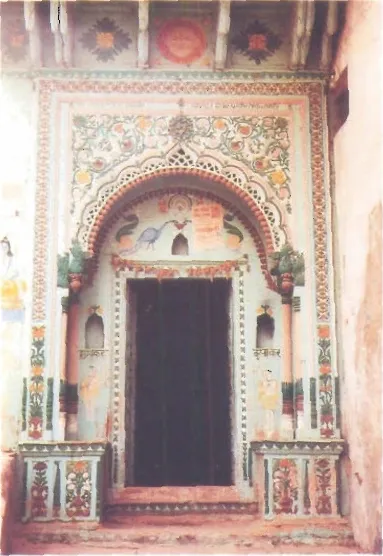
- What it is
- The Rādhākānta Mandira is a temple of Rādhā-Rādhākānta in Vṛndāvana.
- Visiting
- Vṛndāvana, the Playground of God (2010) places the Deity of Śrī Gopāla-guru Gosvāmī on the right side of the temple courtyard, with his tree to its left.
- Places here
- Gopāla Guru Samādhi, Pakuriya tree (Gopāla Guru Gosvāmī's sitting place)
In short
The Rādhākānta Mandira is a temple of Rādhā-Rādhākānta in Vṛndāvana. The Color Guide to Vṛndāvana (2000) says that Śrī Gopāla-guru Gosvāmī founded it and that the Deities are his.[1 +2] Śrīla Prabhupāda names him as a disciple of Śrī Vakreśvara Paṇḍita and the guru of Śrī Dhyānacandra Gosvāmī.[1 +5] In the courtyard are his samādhi and the tree under which, the guidebooks say, his followers saw him after he had left this world in Purī.[2 +2] No scripture names the temple, and no source gives its date or builder.[1 +2]
Key facts
| Kind | temple |
|---|---|
| Region · area | Vṛndāvana |
| Ācāryas | Gopāla Guru Gosvāmī, Śrī Vakreśvara Paṇḍita |
The Gosvāmīs and ācāryas
Śrī Gopāla-guru Gosvāmī
Śrīla Prabhupāda writes that Śrī Vakreśvara Paṇḍita had many disciples in Orissa, among them Śrī Gopāla-guru and his disciple Śrī Dhyānacandra Gosvāmī.[1 +5] The Bhakti-ratnākara also calls him the disciple of Śrī Vakreśvara Paṇḍita, and quotes Sanskrit verses of his that list the line of teachers from Nārāyaṇa and Brahmā down to Madhva (summarised here, not translated).[8] Śrīla Prabhupāda names him among the authorities who accept that the Gauḍīya line descends from Śrīla Madhvācārya:[9]
General teaching (does not name the place)“Therefore the Gauḍīya Vaiṣṇava-sampradāya is a disciplic succession from Madhvācārya. This fact has been accepted in the authorized books known as Gaura-gaṇoddeśa-dīpikā and Prameya-ratnāvalī, as well as by Gopāla Guru Gosvāmī.”
Śrīla Prabhupāda, Śrī Caitanya-caritāmṛta, Ādi-līlā 6.40, purport · vedabase.io
In Jagannātha Purī, Śrīla Prabhupāda writes, the house of Kāśī Miśra, where Śrī Caitanya Mahāprabhu lived, passed to Śrī Vakreśvara Paṇḍita and then to Śrī Gopāla-guru Gosvāmī, who established a Deity of Rādhākānta there.[5]
Other sources call Rādhā-Rādhākānta Śrī Vakreśvara Paṇḍita's own Deities, and one guidebook calls the Deities in Vṛndāvana their pratibhū forms, representative Deities. The sources differ:
Accounts differ Whose Deities Rādhā-Rādhākānta are and who established them.
- Vṛndāvana, the Playground of God (2010)Rādhā-Rādhākānta were Śrī Vakreśvara Paṇḍita's Deities in Purī; after Vakreśvara's departure Śrī Gopāla Guru took charge of them and of the Gambhīrā; the Vṛndāvana Deities are their pratibhū forms.
- Śrīla Prabhupāda, CC Ādi 10.131 purportKāśī Miśra's house passed to Śrī Vakreśvara Paṇḍita and then to his disciple Gopālaguru Gosvāmī, 'who established a Deity of Rādhākānta there'.
- the undated parikramā notes Vṛndāvana; The Color Guide to Vṛndāvana (2000)'These are the Deities of Gopāla Guru Gosvāmī'; the (Vṛndāvana) temple was established by him.
- Song book (Nandgram Dham Vaiṣṇava song book (nandgramdham.org/songs/) (2026)), 'Jaya Rādhā-Mādhava', verse 13Rādhā-kānta is 'the treasure of Vakreśvara Paṇḍita's heart' (vakreśvarer prāṇa-dhana).
According to the local tradition recorded in the undated parikramā notes Vṛndāvana and The Color Guide, Śrī Caitanya Mahāprabhu jokingly called the boy Gopāla "guru", and the name stayed. Vṛndāvana, the Playground of God says that the five-year-old boy quoted scripture to the Lord on chanting the holy names, and that the Lord then called him His guru. These stories are known only from the modern guidebooks, so they are not certain.[1 +2]
His samādhi and the tree
According to the guidebooks, Śrī Gopāla-guru Gosvāmī left his body in Jagannātha Purī; Vṛndāvana, the Playground of God adds, without a source, that Śrī Dhyānacandra Gosvāmī buried him near Śrīla Haridāsa Ṭhākura's samādhi by the sea, which is not certain.[2 +3] The guidebooks then tell that his followers saw him again in Vṛndāvana, but they differ on where: under the tree in this courtyard, under a Pakuriya tree near Vaṁśīvaṭa, or at Dhīra-samīra (his place of bhajana); one version has no appearance in Vṛndāvana at all. No source older than the guidebooks has been found for the story.[2 +3]
Accounts differ Where, if anywhere, Śrī Gopāla Guru Gosvāmī was seen after his passing in Purī
- the undated parikramā notes Vṛndāvana; The Color Guide to Vṛndāvana (2000)his followers found him sitting under the tree in the courtyard of the Rādhākānta temple; he met the Vṛndāvana devotees and disappeared under the same tree
- Vṛndāvana, the Playground of God (2010), second versiondevotees back from the Rathayātrā found him chanting japa under a Pakuriya tree near Vaṁśīvaṭa; Dhyānacandra came and begged him to return; the tree is beside his Deity in the temple courtyard
- Vṛndāvana, the Playground of God (2010), first versionhe revived during his own samādhi rites in Purī, settled the transfer of the Gambhīrā to Dhyānacandra and lived a few months more (no appearance in Vṛndāvana)
- Śrī Vraja-maṇḍala Parikramā (2007)when government officials troubled the Rādhā-Kānta Maṭha in Purī, a Vaiṣṇava from Vṛndāvana told Dhyānacanda Gosvāmī that they had seen Gopāla-guru performing bhajana at Dhīra-samīra; Dhyānacanda walked to Vṛndāvana and saw him there chanting, but Gopāla-guru would not return; his place of bhajana is within Dhīra-samīra (no tree and no Rādhākānta temple named)
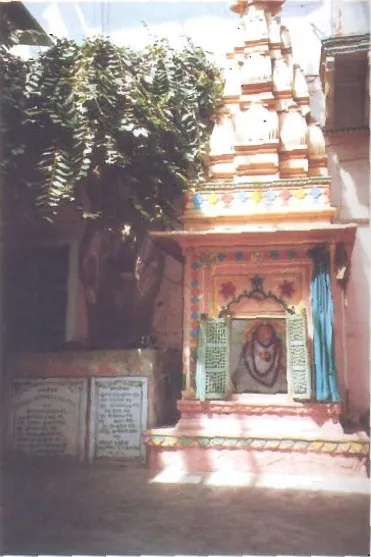
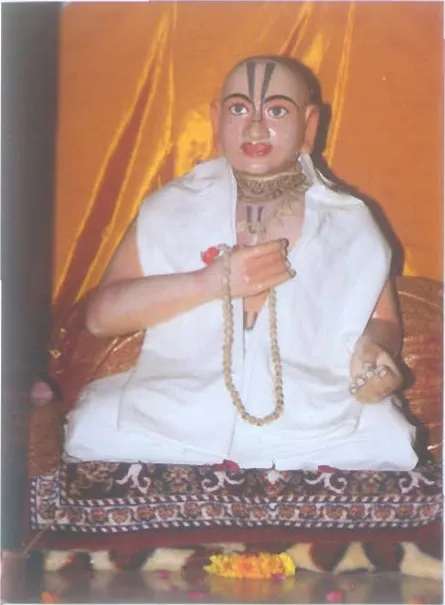
The samādhi is a small white shrine with a tiered spire beside a large tree, with a garlanded, seated mūrti (image) of Śrī Gopāla-guru Gosvāmī in its niche. The Color Guide and the notes call it his puṣpa-samādhi, a memorial without bodily remains; Vṛndāvana, the Playground of God calls the figure his "samādhi Deity".[2 +2]
The tree stands to the left of his Deity. Only Vṛndāvana, the Playground of God names its kind, a Pakuriya, and places it "near Vaṁśīvaṭa"; whether it is the tree of the story is not certain.[7] At its base, behind a low carved platform with a pair of carved footprints, stands a stone slab with an inscription in Devanāgarī that has not yet been read.[3 +1]
Visiting today
Vṛndāvana, the Playground of God (2010) places the Deity of Śrī Gopāla-guru Gosvāmī on the right side of the temple courtyard, with his tree to its left. The Color Guide (2000) and the notes place his puṣpa-samādhi in the courtyard; the notes say that his followers built it next to the tree.[2 +2]
Location
Places at Rādhākānta Mandira (Vṛndāvana)
2 places
Nearby places
Vaṁśīvaṭa (Vṛndāvana)
Pictures
2 pictures
History
The undated parikramā notes Vṛndāvana and The Color Guide to Vṛndāvana (2000) say that these are the Deities of Śrī Gopāla-guru Gosvāmī and that he established the temple; neither gives a year.[1 +2] Vṛndāvana, the Playground of God (2010) does not say who built the temple in Vṛndāvana, and the sources differ on whose Deities Rādhā-Rādhākānta first were (see below).[1 +2]
Where the sources differ
What memorial of Śrī Gopāla Guru stands in the courtyard
Accounts differ What memorial of Śrī Gopāla Guru stands in the courtyard
- The Color Guide to Vṛndāvana (2000)his puṣpa-samādhi is in the temple courtyard, and his followers 'constructed another samādhi next to this tree'; photograph caption 'Samadhi Mandir of Gopala Guru' with his mūrti
- the undated parikramā notes Vṛndāvanahis puṣpa-samādhi is in the courtyard; his followers 'constructed a samādhi next to the tree' (one memorial, or the wording of The Color Guide to Vṛndāvana (2000) without 'another')
- Vṛndāvana, the Playground of God (2010)no samādhi named; 'a Deity of Gopāla Guru' on the right side of the courtyard (caption 'The samādhi Deity of Gopāla Guru Gosvāmī') with the tree to its left, made at his own request
References
10 references
- the undated parikramā notes Vṛndāvana, ¶259
- the undated parikramā notes Vṛndāvana, ¶263
- The Color Guide to Vṛndāvana (2000), Written and Photographed by Rājaśekhara dāsa Brahmacārī, PDF p. 128
- Śrīla Prabhupāda, Śrī Caitanya-caritāmṛta, Ādi-līlā 10.17, purport · vedabase.io
- Śrīla Prabhupāda, Śrī Caitanya-caritāmṛta, Ādi-līlā 10.131, purport · vedabase.io
- Vṛndāvana, the Playground of God (2010), Bhakti Caitanya Svāmī, PDF p. 208
- Vṛndāvana, the Playground of God (2010), Bhakti Caitanya Svāmī, PDF p. 209
- Śrīla Narahari Cakravartī, Bhakti-ratnākara, Fifth Wave (pañcama taraṅga), 1912 ed. p. 312, 2nd ed., 1912
- Śrīla Prabhupāda, Śrī Caitanya-caritāmṛta, Ādi-līlā 6.40, purport · vedabase.io
- Śrī Vraja-maṇḍala Parikramā (2007), PDF p. 317