Dhīra-samīra
धीर-समीर
Also called Dhīra Samīra-ghāṭa, Dhīra-samīra-kuñja
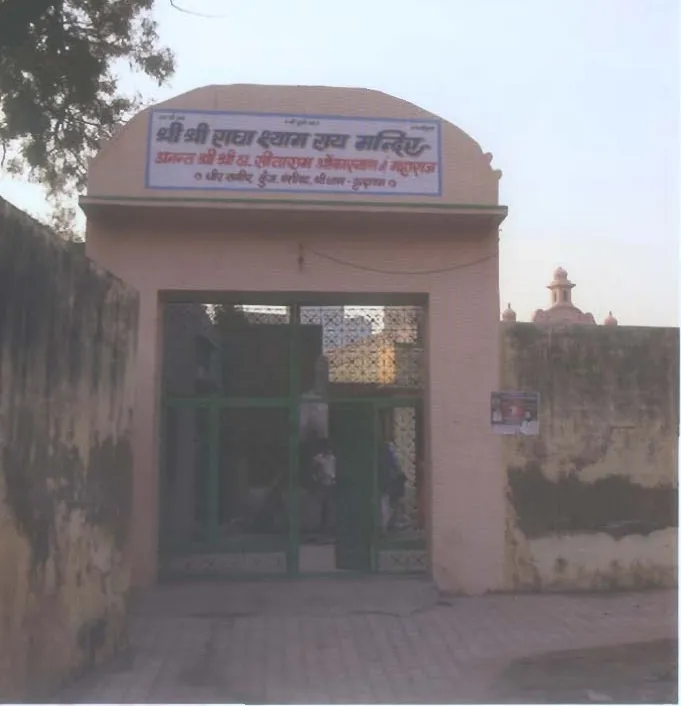
- What it is
- Dhīra-samīra, "the gentle breeze", is a kuñja (grove) and ghāṭa on the bank of the Yamunā in Vṛndāvana, near Vaṁśīvaṭa and Keśī-ghāṭa.
- Visiting
- Vṛndāvana, the Playground of God (2010) calls the area around the Śyāmarāya temple and its grounds Dhīra Samīra-ghāṭa.
- Places here
- Rādhā-Śyāmarāya Mandira, Gaurīdāsa Paṇḍita's place of bhajana, Gopāla-guru Gosvāmī's place of bhajana, Māna-bhañjana-sthala, Gaurīdāsa Paṇḍita's samādhi
In short
Dhīra-samīra, "the gentle breeze", is a kuñja (grove) and ghāṭa on the bank of the Yamunā in Vṛndāvana, near Vaṁśīvaṭa and Keśī-ghāṭa.[1 +4] Śrīla Viśvanātha Cakravartī Ṭhākura writes that the place is named after the wind that stood still when Kṛṣṇa played His flute at Vaṁśīvaṭa, and the Bhakti-ratnākara calls it a place of Rādhā and Kṛṣṇa's pastimes in the groves.[6 +1] The guidebooks say that Śrīla Gaurīdāsa Paṇḍita founded the kuñja and the temple of Śrī Śyāmarāya here, and that his samādhi is here.[1 +4]
Key facts
| Kind | kuñja (with ghāṭa) |
|---|---|
| Region · area | Vṛndāvana |
| Also part of | Yamunā |
| Ācāryas | Śrīla Gaurīdāsa Paṇḍita, Śrīla Jayadeva Gosvāmī, Gopāla-guru Gosvāmī, Śrīla Śrīnivāsa Ācārya, Śrīla Rāmacandra Kavirāja |
Why it is glorified
Śrīla Viśvanātha Cakravartī Ṭhākura's Vraja-rīti-cintāmaṇi says that when Kṛṣṇa, standing at Vaṁśīvaṭa, played His flute, even …
The name
Śrīla Viśvanātha Cakravartī Ṭhākura's Vraja-rīti-cintāmaṇi says that when Kṛṣṇa, standing at Vaṁśīvaṭa, played His flute, even the wind at once became still (dhīra), and so the place is called Dhīra-samīra (summarised here, not translated).[6] The guidebooks explain the name differently: the breeze grew still, or blew gently, to serve Rādhā and Kṛṣṇa in the riverside gardens.[1 +4]
The words also recall the refrain of a song in Śrīla Jayadeva Gosvāmī's Gīta-govinda: on the bank of the Yamunā, where the breeze is gentle, Kṛṣṇa, wearing His forest garland, waits in the forest. The poem itself names no place.[1 +6]
rati-sukha-sāre gatam abhisāre madana-manohara-veśam / na kuru nitambini gamana-vilambanam anusara tam hṛdaya-īśam // dhīra-samīre yamunā-tīre vasati vane vanamālī // GG_5.8
In the Bhakti-ratnākara
According to the Bhakti-ratnākara, on Śrīla Śrīnivāsa Ācārya's walk through Vṛndāvana he is told that at Śrī Dhīra-samīra Kṛṣṇa's pastimes in the groves go on in countless ways, and that Rādhā and Kṛṣṇa meet here (summarised here, not translated). The book quotes the Gīta-govinda song here and adds that Śrī Rādhā's māna-bhañjana, the breaking of Her loving anger, took place here.[7 +4]
Divine pastimes
The rāsa and the gentle breeze
Śrīmad-Bhāgavatam (10.29–10.33) tells the rāsa dance on autumn nights on the bank of the Yamunā. On the bank of cool sand a breeze, made joyful by the river's waves, carried the fragrance of lotuses; later Kṛṣṇa took the gopīs to the Yamunā's bank, where the breeze bore the scent of kunda and mandāra flowers, and there He began the rāsa. The Bhāgavatam names no particular place on the bank.[15 +5]
nadyāḥ pulinam āviśya gopībhir hima-vālukam / juṣṭaṃ tat-taralānandi kumudāmoda-vāyunā
Śrī Kṛṣṇa went with the gopīs to the bank of the Yamunā, where the sand was cooling and the wind, enlivened by the river’s waves, bore the fragrance of lotuses. … In this way the Lord enjoyed His pastimes.
Translation: Śrīla Prabhupāda's disciples (BBT)About this place: Does not name the place; it tells where the Bhāgavatam sets the rāsa pastime that Śrī Vraja-maṇḍala Parikramā (2007) connects with Sakhīgiri-parvata, and the Vraja-bhakti-vilāsa with the Triveṇī-kūpa: on the sandy bank of the river, which the translation names the Yamunā. ŚB 10.29–10.33 tell the rāsa.
In their commentaries Śrīla Sanātana Gosvāmī, Śrīla Jīva Gosvāmī and Śrīla Baladeva Vidyābhūṣaṇa describe that breeze as gentle, fragrant and cool (summarised here, not translated), but none of them names Dhīra-samīra.[15 +3] In another chapter (10.35) the gopīs sing that a gentle breeze honours Kṛṣṇa with the fragrance of sandal as He plays along the Yamunā; this verse too names no place.[23]
Śrī Vraja-maṇḍala Parikramā (2007) calls Dhīra-samīra the place of the rāsa, where the breeze became so calm at the sight of the pastimes that it could not move, though the same book sets the autumn rāsa of the Bhāgavatam at neighbouring Vaṁśīvaṭa.[1 +1] The Bengali Vṛndāvana-kathā (1920) reports "another opinion", without saying whose, that Kṛṣṇa appeared again before the searching gopīs in this kuñja. The Bhāgavatam tells only that they came back to the sandy bank of the Yamunā and that He appeared before them there, so this may not be certain.[25 +3]
Śrī Rādhā's loving anger
The Bhakti-ratnākara places Śrī Rādhā's māna-bhañjana at Dhīra-samīra without naming a separate spot.[7] Śrī Vraja-maṇḍala Parikramā (2007), following an older book called Vraja Parikramā, places it at the Māna-bhañjana-sthala within Dhīra-samīra, and links it with a song of the Gīta-govinda. The older book is not available, so this is not certain; the accounts are compared on the page of Māna-bhañjana-sthala.[7 +4]
The Gosvāmīs and ācāryas
Śrīla Gaurīdāsa Paṇḍita, an associate of Śrī Caitanya Mahāprabhu and Śrī Nityānanda Prabhu, was the younger brother of Sūryadāsa …
Śrīla Gaurīdāsa Paṇḍita's place of bhajana
Śrīla Gaurīdāsa Paṇḍita, an associate of Śrī Caitanya Mahāprabhu and Śrī Nityānanda Prabhu, was the younger brother of Sūryadāsa Sarakhela, as Śrīla Prabhupāda's purport confirms.[1 +2] Śrī Vraja-maṇḍala Parikramā (2007) says that he came to Vṛndāvana at the end of his life, founded the kuñja and temple and served his Deity, Śrī Śyāmarāya, here, and that his place of bhajana and his samādhi are also here; The Color Guide to Vṛndāvana (2000) also says that he did his bhajana here and founded the Rādhā-Śyāmarāya temple. Neither book marks a separate spot for the place of bhajana.[1 +4] Śrīla Prabhupāda's purport names his homes in Bengal, Śāligrāma and later Ambikā-kālanā, and says nothing about Vṛndāvana.[35]
According to the Bhakti-ratnākara, his disciple Baḍu Gaṅgādāsa came to Vṛndāvana after his master's passing, at his master's order in a dream, and lived alone at Śrī Dhīra-samīra, serving "his own prabhu" there; the book does not say whether this means his master's samādhi or a Deity.[14] The Narottama-vilāsa, by the same author, tells the same episode without naming Dhīra-samīra and says that Gaṅgādāsa was always wandering, so the two accounts differ.[34]
Accounts differ Where Śrīla Gaurīdāsa Paṇḍita's disciple Baḍu Gaṅgādāsa lived in Vṛndāvana (the only textual link found between the Paṇḍita's circle and Dhīra-samīra).
- Bhakti-ratnākara (Śrīla Narahari Cakravartī), Eleventh Wave, printed p. 674After his master's disappearance he came to Vṛndāvana on the Paṇḍita's order in a dream and lived in solitude at Śrī Dhīra-samīra, serving in the presence of his own prabhu; the next couplet on the same page has him touring Govardhana and other places when Jāhnavā arrives.
- Narottama-vilāsa (Śrīla Narahari Cakravartī), Ninth Vilāsa, printed p. 80He had come to Vṛndāvana earlier and was never settled, always wandering; Dhīra-samīra is not named.
The wording of these accounts is our summary of the sources, not a published translation.
According to The Color Guide to Vṛndāvana (2000), there is also a memorial of Śrīla Gaurīdāsa Paṇḍita in the garden of the sixty-four samādhis.[36]
Śrī Gopāla-guru Gosvāmī's place of bhajana
Śrīla Prabhupāda writes that Śrī Gopāla-guru Gosvāmī was a disciple in the line of Śrī Vakreśvara Paṇḍita, that Śrī Dhyānacandra Gosvāmī was his disciple, and that he inherited Kāśī Miśra's house in Jagannātha Purī and installed the Deity of Rādhākānta there.[8 +2] Śrī Vraja-maṇḍala Parikramā (2007) says that his place of bhajana is within Dhīra-samīra; it gives no source and describes no spot, so this is not certain.[8 +1]
Under that heading the same book tells a story that is not certain, since no older source has been found for it. After Śrī Gopāla-guru Gosvāmī had left this world, officials in Purī harassed the Rādhākānta Maṭha. A Vaiṣṇava from Vṛndāvana told Śrī Dhyānacandra Gosvāmī that he had seen his guru chanting at Dhīra-samīra. Dhyānacandra walked to Vṛndāvana, found his guru there chanting on his beads in tears, and was sent back to Purī, where the officials apologised. Other guidebooks tell the appearance differently, at a tree in the courtyard of the Rādhākānta temple.[8]
Accounts differ Where Śrī Gopāla-guru Gosvāmī was seen after he left this world in Purī, and what marks the spot in Vṛndāvana.
- Śrī Vraja-maṇḍala Parikramā (2007)At Dhīra-samīra, told under the heading of his place of bhajana within Dhīra-samīra: a Vṛndāvana Vaiṣṇava had seen him performing bhajana at Dhīra-samīra, and Dhyānacanda came on foot and, entering Dhīra-samīra, found him chanting; no tree or temple is named.
- The Color Guide to Vṛndāvana (2000); the undated parikramā notes VṛndāvanaHis followers found him sitting under the tree in the courtyard of the Rādhākānta temple; he disappeared again under the same tree and a samādhi was built next to it.
- Vṛndāvana, the Playground of God (2010)One version: devotees found him chanting under a Pakuriya tree near Vaṁśīvaṭa, and Dhyānacandra came to beg him to return; another version: he revived in Purī and lived a few months more (no appearance in Vṛndāvana).
Samādhis nearby
Śrī Vraja-maṇḍala Parikramā (2007) places the samādhis of Śrīla Śrīnivāsa Ācārya and Śrīla Rāmacandra Kavirāja near Dhīra-samīra. Vṛndāvana, the Playground of God (2010) describes them in one small room of Śrīla Śrīnivāsa Ācārya's temple, with a puṣpa-samādhi of his daughter Śrīmatī Hemalatā Ṭhākurāṇī.[9 +2]
Songs
Śrīla Bhaktivinoda Ṭhākura names Dhīra-samīra among the places of Vraja that he will never leave, because they awaken the …
Śrīla Bhaktivinoda Ṭhākura names Dhīra-samīra among the places of Vraja that he will never leave, because they awaken the remembrance of Rādhā and Kṛṣṇa's pastimes.[41]
vaṁśī-vaṭa, gokula, dhīra-samīr
bṛndābana-taru-latikā-bānīr
Visiting today
Vṛndāvana, the Playground of God (2010) calls the area around the Śyāmarāya temple and its grounds Dhīra Samīra-ghāṭa. The Color Guide to Vṛndāvana (2000) says that the old gardens and the ghāṭa have disappeared, because the river has moved away.[1 +4] Already in 1920 the Vṛndāvana-kathā reported that the Yamunā had carried away several rooms of Dhīra-samīra and that the building was old and decayed.[25]
Cīra-kadamba
Cīra-kadamba, "the kadamba of the clothes", is one of three kadamba trees of Vṛndāvana that Śrī Vraja-maṇḍala Parikramā (2007) lists, with the Keli-kadamba and the Dolā-kadamba. It places the tree on the bank of the Yamunā near Dhīra-samīra and gives no description.[42] The name recalls the kadamba that Kṛṣṇa climbed with the gopīs' clothes, but the list does not say so, and no other source uses the name.[42 +2]
Śrīmad-Bhāgavatam (10.22) tells that Kṛṣṇa took the clothes of the unmarried gopīs, who were bathing in the Yamunā at the end of their vow to the goddess Kātyāyanī, and quickly climbed a kadamba tree. It does not say where the tree stood, and in his Kṛṣṇa book Śrīla Prabhupāda says only "a nearby tree".[43 +6]
tāsāṃ vāsāṃsy upādāya nīpam āruhya satvaraḥ / hasadbhiḥ prahasan bālaiḥ parihāsam uvāca ha
Taking the girls’ garments, He quickly climbed to the top of a kadamba tree. Then, as He laughed loudly and His companions also laughed, He addressed the girls jokingly.
Translation: Śrīla Prabhupāda's disciples (BBT)About this place: Kṛṣṇa took the girls' garments and quickly climbed a nīpa (kadamba) tree, then joked with them while His companions laughed. This is the pastime that the kadamba trees remembered at Cīra-ghāṭa commemorate; the Bhāgavatam does not say where the tree stood or name a ghāṭa.
In their commentaries Śrīla Viśvanātha Cakravartī Ṭhākura and Śrīla Baladeva Vidyābhūṣaṇa speak of the kadamba as the tree of the goddess Durgā, whom the girls came to this lonely place to worship (summarised here, not translated). They name no ghāṭa.[50] The same commentators say that this happened on the full-moon day that ended the vow, when the girls had invited Śrī Rādhā and others dear to them.[47 +1] The Brahma-vaivarta Purāṇa tells it differently: there Kṛṣṇa hangs the clothes on the branches of the kadamba, so that the tree shines with clothes of many kinds. No source connects this picture with any tree in Vṛndāvana today.[52]
The Kṛṣṇa-līlā-stava, which the song book credits to Śrīla Sanātana Gosvāmī, bows to Kṛṣṇa seated on the kadamba.[53]
Śrī Vraja-maṇḍala Parikramā puts the kadamba of the pastime in two places in Vṛndāvana: at Cīra-ghāṭa, and near Dhīra-samīra. Which kadamba, at which Cīra-ghāṭa, is the tree of the pastime, the sources answer differently; their accounts are set side by side on the page of the ancient kadamba tree at Cīra-ghāṭa.[54 +2] Read more: The Kātyāyanī vow and the gopīs' clothes: the pastime and its places →
Location
| Where it is | on the Yamunā bank just near Vaṁśīvaṭa; map key 11 and label 'Dhīra-samīra-ghāṭa'[57] Dhīra-samīra-ghāṭa: in the northern part of Śrī Vṛndāvana and near Keśī-ghāṭa, to the east[58] |
|---|
Places at Dhīra-samīra
6 places
- ↳Rādhā-Śyāmarāya Mandiratemple›
- ↳Gaurīdāsa Paṇḍita's place of bhajanabhajana place›
- ↳Gopāla-guru Gosvāmī's place of bhajanabhajana place›
- ↳Māna-bhañjana-sthalapastime site›
- ↳Gaurīdāsa Paṇḍita's samādhisamādhi›
Also described on this page
- Cīra-kadamba tree
Nearby places
Vaṁśīvaṭa (Vṛndāvana) · Keśī-ghāṭa · Śrīnivāsa Ācārya Samādhi
Pictures
1 pictures
History
Three works speak of a temple built here by Badan Singh, the Jāṭ ruler of Bharatpur, and none gives a date or a document. The Vṛndāvana-kathā (1920) describes a very large temple beside Dhīra-samīra, with halls for the rājā and the queens; the historian Prabhudayāl Mītal (1966) writes of a temple at the Dhīra-samīra ghāṭa; and the historian A. W. Entwistle (1987) credits him with the kuñja and temple of that name.[30 +2] This differs from the tradition that Śrīla Gaurīdāsa Paṇḍita founded the kuñja.[1 +7]
Where the sources differ
Why the place is called Dhīra-samīra ('gentle' or 'still breeze'): the sources give different pastimes.
Accounts differ Why the place is called Dhīra-samīra ('gentle' or 'still breeze'): the sources give different pastimes.
- Śrīla Viśvanātha Cakravartī, Vraja-rīti-cintāmaṇi 2.83When Kṛṣṇa, standing at Vaṁśīvaṭa, played His flute, even the wind became still (dhīra) there; hence the name.
- Śrī Vraja-maṇḍala Parikramā (2007)It is the place of rāsa-līlā and of the Divine Couple's nikuñja pastimes; on beholding them the breeze became so gentle and calm that it could not move; on witnessing the Divine Couple's pastime it became very cool and moved very slowly to serve Them.
- Vṛndāvana, the Playground of God (2010) and The Color Guide to Vṛndāvana (2000)The ghāṭa of very pleasant, gentle breezes, where Rādhā and Kṛṣṇa enjoyed pastimes in riverside gardens (Vṛndāvana, the Playground of God (2010)); the breeze blows very gently and gives pleasure to Rādhā and Kṛṣṇa (The Color Guide to Vṛndāvana (2000)).
- Bhakti-ratnākara, Fifth Wave, printed p. 326; Śrī Vraja-maṇḍala Parikramā (2007)The place of the Gīta-govinda song with the refrain 'dhīra-samīre yamunā-tīre vasati vane vanamālī' (Bhakti-ratnākara quotes it here; Śrī Vraja-maṇḍala Parikramā (2007) identifies its kuñja with this one).
Accounts differ Who founded the kuñja and temple called Dhīra-samīra.
- Śrī Vraja-maṇḍala Parikramā (2007), Vṛndāvana, the Playground of God (2010), The Color Guide to Vṛndāvana (2000) (guidebooks)Śrīla Gaurīdāsa Paṇḍita established the kuñja and temple at the end of his life and served Śrī Śyāmarāya there; his samādhi is there.
- Vṛndāvana-kathā (1920), printed pp. 193–194The 'Dhīrasamīra' kuñja or temple was founded by Śrīla Gaurīdāsa Paṇḍita, who at the end of his life established the deity Śyāmarāya and the Dhīra-samīra kuñja; his samādhi is here.
- A. W. Entwistle (1987), a historianEntwistle says that the house (kuñja) and temple called Dhīra-samīra were built by Badan Singh, who made a residence there with a temple.
- Vṛndāvana-kathā (1920) and Prabhudayāl Mītal (1966), a historianBoth say that Badan Singh founded a very large temple there: the Vṛndāvana-kathā puts it 'beside Dhīra-samīra', and Mītal puts it on the ghāṭ of Dhīra-samīra. Neither says that he founded the kuñja.
The wording of these accounts is our summary of the sources, not a published translation.
More on this place
The Kātyāyanī vow and the gopīs' clothes: the pastime and its places
References
58 references
- Śrī Vraja-maṇḍala Parikramā (2007), PDF p. 316
- Śrī Vraja-maṇḍala Parikramā (2007), PDF p. 343
- Vṛndāvana, the Playground of God (2010), Bhakti Caitanya Svāmī, PDF p. 220
- The Color Guide to Vṛndāvana (2000), Written and Photographed by Rājaśekhara dāsa Brahmacārī, PDF p. 130
- The Color Guide to Vṛndāvana (2000), Written and Photographed by Rājaśekhara dāsa Brahmacārī, PDF p. 31
- Śrīla Viśvanātha Cakravartī, Vraja-rīti-cintāmaṇi, sarga 2 (dvitīyaḥ sargaḥ), v. 83
- Śrīla Narahari Cakravartī, Bhakti-ratnākara, Fifth Wave, printed p. 326 (1912 edition), 2nd ed., 1912
- Śrī Vraja-maṇḍala Parikramā (2007), PDF p. 317
- Vṛndāvana, the Playground of God (2010), Bhakti Caitanya Svāmī, PDF p. 214
- The Color Guide to Vṛndāvana (2000), Written and Photographed by Rājaśekhara dāsa Brahmacārī, PDF p. 129
- Pulinbihārī Datta, ch. 17 (saptadaśa pariccheda), section 1 'Dhīrasamīra', printed pp. 193–194
- Śrīla Jayadeva Gosvāmī, Gīta-govinda, sarga 5, verse 8 (first stanza of Song 11) with its refrain, GRETIL
- Śrīla Jayadeva Gosvāmī, Gīta-govinda, sarga 5, verse 7, GRETIL
- Śrīla Narahari Cakravartī, Bhakti-ratnākara, Eleventh Wave (ekādaśa taraṅga), printed p. 674 (1912 edition), 2nd ed., 1912
- Śrīmad-Bhāgavatam 10.29.21, GRETIL
- Śrīmad-Bhāgavatam 10.29.45, GRETIL
- Śrīmad-Bhāgavatam 10.32.11–12
- Śrīmad-Bhāgavatam 10.33.2, GRETIL
- Śrīmad-Bhāgavatam 10.33.3
- Śrīla Prabhupāda, Kṛṣṇa, the Supreme Personality of Godhead (Kṛṣṇa book), Chapter 29, 'The Rāsa Dance: Introduction' · vedabase.io
Show all 58 references
- Śrīla Jīva Gosvāmī: commentary on ŚB 10.29.45
- Śrīla Viśvanātha Cakravartī Ṭhākura: commentary on ŚB 10.35.20–21, Bhagavata Vidya Pith edition, ed. Bhagavata Rishi and Krishna Shankar Shastri, 1996
- Śrīmad-Bhāgavatam 10.35.20–21, Bhagavata Vidya Pith edition, ed. Bhagavata Rishi and Krishna Shankar Shastri, 1996
- Śrī Vraja-maṇḍala Parikramā (2007), PDF p. 318
- Pulinbihārī Datta, ch. 17, section 1 'Dhīrasamīra', printed p. 195
- Śrīmad-Bhāgavatam 10.30.44, GRETIL
- Śrīmad-Bhāgavatam 10.32.2, GRETIL
- Śrīla Prabhupāda, Kṛṣṇa, the Supreme Personality of Godhead (Kṛṣṇa book), Chapter 32, 'Kṛṣṇa Returns to the Gopīs' (opening) · vedabase.io
- Śrīla Jayadeva Gosvāmī, Gīta-govinda, sarga 10, verse 8 (seventh stanza of Song 19), GRETIL
- Pulinbihārī Datta, ch. 19, section 'the works of the rājās of Bharatpur', on Badan Singh, printed p. 229
- Prabhudayāl Mītal, Jāṭ-Marahaṭhā kāl, section 'Badanasiṁh', printed p. 233
- A. W. Entwistle, ch. 8 §35 'Bansi Bat' (paragraph on Dhir Samir), printed p. 414, Egbert Forsten, Groningen, 1987
- Śrīla Prabhupāda, Śrī Caitanya-caritāmṛta, Ādi-līlā 11.26, purport (quoting Śrīla Bhaktisiddhānta Sarasvatī's Anubhāṣya) · vedabase.io
- Śrīla Narahari Cakravartī, Narottama-vilāsa, Ninth Vilāsa (navama vilāsa), printed p. 80 (1st ed., ed. Kiśorī dāsa Bābājī, c. 1907), verses numbered 66-67, 1st ed., Baṅgābda 1314
- Śrīla Prabhupāda, Śrī Caitanya-caritāmṛta, Ādi-līlā 11.26, purport (quoting Bhaktisiddhānta Sarasvatī's Anubhāṣya) · vedabase.io
- The Color Guide to Vṛndāvana (2000), Written and Photographed by Rājaśekhara dāsa Brahmacārī, PDF p. 166
- Śrīla Prabhupāda, Śrī Caitanya-caritāmṛta, Ādi-līlā 10.17, purport · vedabase.io
- Śrīla Prabhupāda, Śrī Caitanya-caritāmṛta, Ādi-līlā 10.131, purport · vedabase.io
- Śrī Vraja-maṇḍala Parikramā (2007), PDF p. 345
- Vṛndāvana, the Playground of God (2010), Bhakti Caitanya Svāmī, PDF p. 211
- Rādhā-kuṇḍa-taṭa-kuñja-kuṭīr (Śaraṇāgati) (Bhaktivinoda Ṭhākura (as the song book credits it)) · song book
- Śrī Vraja-maṇḍala Parikramā (2007), PDF p. 346
- Śrīmad-Bhāgavatam 10.22.9, GRETIL
- Śrīla Prabhupāda, Kṛṣṇa, the Supreme Personality of Godhead, Chapter 22, 'Stealing the Garments of the Unmarried Gopī Girls' · vedabase.io
- Śrīmad-Bhāgavatam 10.22.1, GRETIL
- Śrīmad-Bhāgavatam 10.22.2, GRETIL
- Śrīmad-Bhāgavatam 10.22.7, GRETIL
- Śrīmad-Bhāgavatam 10.22.27, GRETIL
- Śrīmad-Bhāgavatam 10.22.4, GRETIL
- Śrīla Viśvanātha Cakravartī Ṭhākura: commentary on ŚB 10.22.9, Bhagavata Vidya Pith edition, ed. Bhagavata Rishi and Krishna Shankar Shastri, 1996
- Śrīla Viśvanātha Cakravartī Ṭhākura: commentary on ŚB 10.22.7, Bhagavata Vidya Pith edition, ed. Bhagavata Rishi and Krishna Shankar Shastri, 1996
- Brahma-vaivarta Purāṇa, Kṛṣṇa-janma-khaṇḍa (4) 27.88–89, Sanskrit Wikisource
- Obeisance 55 (Śrī Kṛṣṇa-līlā-stava) (Sanātana Gosvāmī (as the song book credits it; the credit is marked inferred in the song book data)) · song book
- Śrīla Raghunātha dāsa Gosvāmī, Vraja-vilāsa-stava, verse 84
- Śrīla Narahari Cakravartī, Bhakti-ratnākara, Fifth Wave, printed p. 269 (1912 edition), 2nd ed., 1912
- Śrīla Narahari Cakravartī, Bhakti-ratnākara, Fifth Wave, printed p. 325 (1912 edition), 2nd ed., 1912
- Śrī Vraja-maṇḍala Parikramā (2007), p. 606-607
- Śrī Vraja-maṇḍala Parikramā (2007), p. 660-661