Vaṁśīvaṭa (Vṛndāvana)
वंशीवट (वृन्दावन) Hindi name proposed
Also called Vaṁśī-vaṭa
- What it is
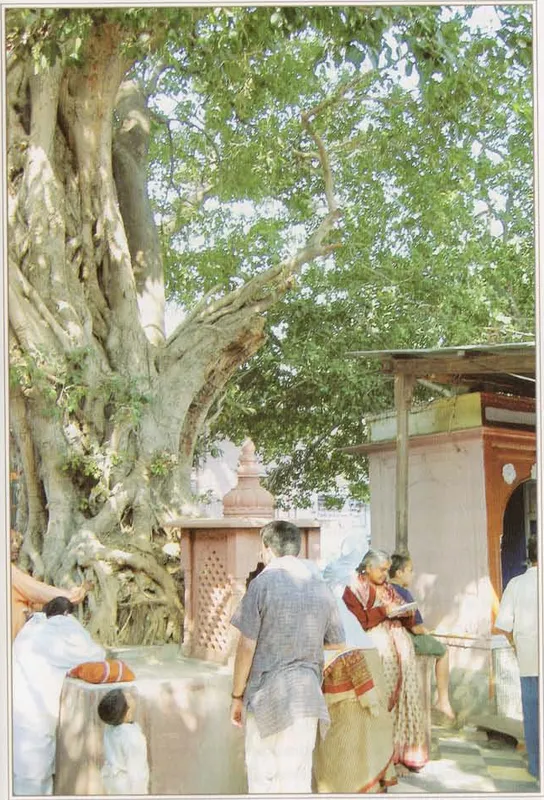
- Vaṁśīvaṭa, "the banyan of the flute", stands on the bank of the Yamunā in Vṛndāvana, near the Gopīśvara Mahādeva temple.
- Visiting
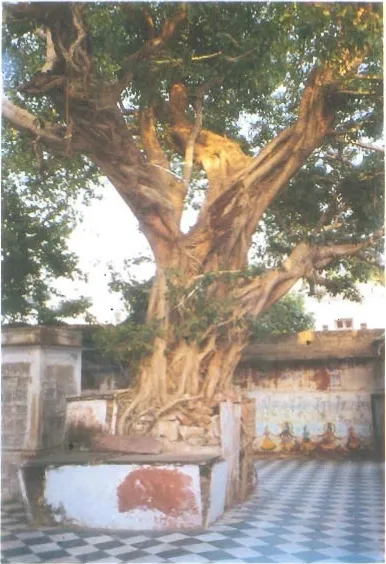
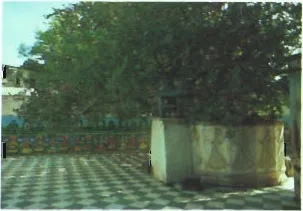
- The guidebooks of 2000 and 2010 describe a huge old banyan on a raised, whitewashed platform in a walled courtyard, with a separate platform for the rāsa.
- Places here
- Rāsa-sthalī (Vaṁśīvaṭa), Gopīśvara Mahādeva mūrti (Vaṁśīvaṭa)
In short
Vaṁśīvaṭa, "the banyan of the flute", stands on the bank of the Yamunā in Vṛndāvana, near the Gopīśvara Mahādeva temple.[1 +6] In the Caitanya-caritāmṛta, Gopīnātha, who began the rāsa dance, stands on the shore at Vaṁśīvaṭa and draws the gopīs with His flute, and Śrīla Prabhupāda's Kṛṣṇa book says that the gopīs ran to this place at the sound of the flute.[4 +5] Śrīmad-Bhāgavatam tells the flute call and the rāsa without naming any place.[13 +5] According to the Bhakti-ratnākara, the Deity Gopīnātha appeared here, and the old banyan, lost in a flood of the Yamunā, was planted again from one of its branches.[19 +2]
Key facts
| Kind | tree |
|---|---|
| Region · area | Vṛndāvana |
| Also part of | Yamunā |
| Ācāryas | Madhu Paṇḍita, Śrīla Narahari Cakravartī Ṭhākura, Śrīla Nārāyaṇa Bhaṭṭa Gosvāmī, Śrīla Rūpa Gosvāmī, Śrīla Kṛṣṇadāsa Kavirāja Gosvāmī |
Why it is glorified
The verse that names Vaṁśīvaṭa best opens the Caitanya-caritāmṛta, and Śrīla Prabhupāda recited it among the opening prayers of …
The verse that names Vaṁśīvaṭa best opens the Caitanya-caritāmṛta, and Śrīla Prabhupāda recited it among the opening prayers of many of his recorded lectures:[4 +3]
শ্রীমান্ রাসরসারম্ভী বংশীবটতটস্থিতঃ ।
কর্ষন্ বেণুস্বনৈর্গোপীর্গোপীনাথঃ শ্রিয়েঽস্তু নঃ ॥ ১৭ ॥
śrīmān rāsa-rasārambhī
vaṁśīvaṭa-taṭa-sthitaḥ
karṣan veṇu-svanair gopīr
gopī-nāthaḥ śriye ’stu naḥ
Śrī Śrīla Gopīnātha, who originated the transcendental mellow of the rāsa dance, stands on the shore in Vaṁśīvaṭa and attracts the attention of the cowherd damsels with the sound of His celebrated flute. May they all confer upon us their benediction.
Translation: Śrīla A.C. Bhaktivedanta Swami PrabhupādaŚrīla Rūpa Gosvāmī's Ujjvala-nīlamaṇi counts the place of the rāsa among the things that awaken love, and his example verse speaks of that ground together with the Vaṁśīvaṭa (summarised here, not translated).[23]
The Garga-saṁhitā describes the Vṛndāvana of the spiritual world, Goloka, as made splendid by the Vaṁśīvaṭa, and counts the Vaṁśīvaṭa among the places where reciting Kṛṣṇa's thousand names takes a devotee to Goloka.[3 +1] The thousand names of Rādhā and Kṛṣṇa in the Nārada Purāṇa call Him the one who always stays at the Vaṁśīvaṭa, and Her the one whose dear place it is.[25 +1] Like several Garga verses, these names do not say which Vaṁśīvaṭa is meant, for Vraja has a second one, the Vaṁśīvaṭa of Bhāṇḍīravana.[27 +6]
Śrīla Nārāyaṇa Bhaṭṭa Gosvāmī's Vraja-bhakti-vilāsa lists sixteen vaṭas, banyan sites, in Vraja. It counts the Vaṁśīvaṭa as the fifth, one of the eight on the south bank of the Yamunā, and names its presiding Deity Vaṁśīdhara, "the holder of the flute". The Purāṇa verses that it quotes for these lists have not been found in the available texts of those Purāṇas.[34 +3] On the Vṛndāvana circuit, after Cīra-ghāṭa, the pilgrim greets the tree with a prayer:[34 +4]
ततो कृष्णपादचिन्हान्वितवंशीवटप्रार्थनमन्त्रः— दशाब्दकृष्णपादांकलांछिताय नमो नमः । वंशीरवसमाकीर्ण वंशीवट नमोऽस्तु ते ॥
tato kṛṣṇapādacinhānvitavaṁśīvaṭaprārthanamantraḥ— daśābdakṛṣṇapādāṁkalāṁchitāya namo namaḥ
vaṁśīravasamākīrṇa vaṁśīvaṭa namo'stu te ||
A verse of an unnamed poet, which the commentator Vaṁśīdhara quotes, says that in the Lord's city the cowherds missed the Yamunā, Govardhana, the flute and "the banyan called Vaṁśīvaṭa" (summarised here, not translated).[40] In a song by Śrīla Govinda Ghoṣa that the Bhakti-ratnākara quotes, Śrī Caitanya Mahāprabhu, absorbed in Rādhā's mood, cries out for the bank of the Yamunā and for "My Vaṁśīvaṭa".[41]
Divine pastimes
The flute call and the rāsa in the Bhāgavatam
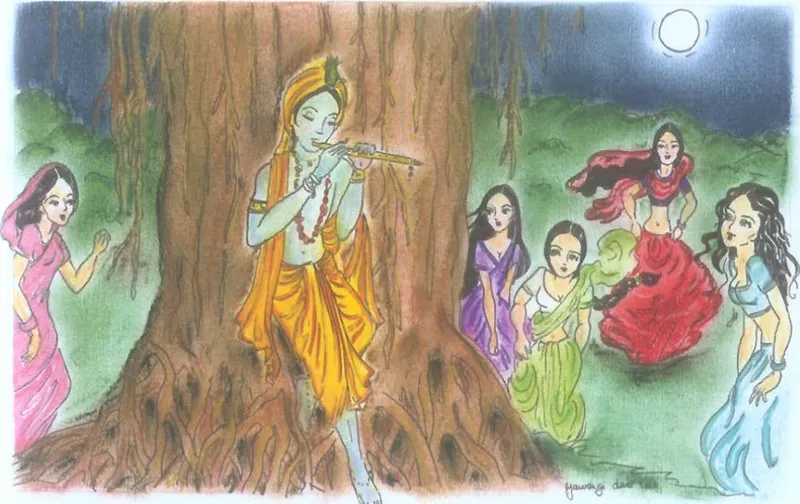
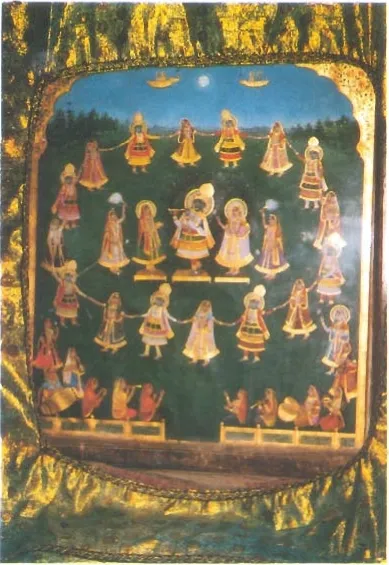
Śrīmad-Bhāgavatam (10.29–10.33) tells the night of the rāsa. On the autumn full moon Kṛṣṇa saw the forest lit by the moon and played sweetly on His flute, and the gopīs came to Him. He told them to go home, took them to the cool sandy bank of the river and then disappeared. After their song of separation He appeared again, and "there", on the bank of the Kālindī, He began the rāsa dance. The Bhāgavatam names the river, but no tree and not the Vaṁśīvaṭa.[13 +5]
dṛṣṭvā kumudvantam akhaṇḍa-maṇḍalaṃ
ramānanābhaṃ nava-kuṅkumāruṇam … vanaṃ ca tat-komala-gobhī rañjitaṃ
jagau kalaṃ vāma-dṛśāṃ manoharam
Lord Kṛṣṇa saw the unbroken disk of the full moon glowing with the red effulgence of newly applied vermilion, as if it were the face of the goddess of fortune. He also saw the kumuda lotuses opening in response to the moon’s presence and the forest gently illumined by its rays. Thus the Lord began to play sweetly on His flute, attracting the minds of the beautiful-eyed gopīs.
Translation: Śrīla Prabhupāda's disciples (BBT)The commentators also name no place for these scenes (summarised here, not translated). Śrīla Sanātana Gosvāmī says that the river and the forest are not named because they are well known there, and Śrīla Viśvanātha Cakravartī Ṭhākura says that the gopīs sang their song at the very place where they had been with Kṛṣṇa.[42 +3] Śrīla Jīva Gosvāmī sets the flute call at a part of the Yamunā's bank that he says was still known as Rāsaulī, a village square set up by Vajra; he does not say whether this is the Vaṁśīvaṭa.[46]
Where the ācāryas place it
The Gopīnātha verse above and Śrīla Prabhupāda's Kṛṣṇa book set the flute call at Vaṁśīvaṭa (his words are given below).[4 +5] Śrīla Kṛṣṇadāsa Kavirāja Gosvāmī's Govinda-līlāmṛta, a poem of Rādhā and Kṛṣṇa's eternal daily pastimes, puts the tree on the Yamunā's bank north of the Śiva called Gopīśvara. Standing on its platform, Kṛṣṇa calls the gopīs with His flute. On the poem's rāsa night He comes to the platform with them and sits looking at the Yamunā, and then He crosses with them to the sandbanks on the far side for the dance (summarised here, not translated).[4 +3]
Śrīla Viśvanātha Cakravartī Ṭhākura's Vraja-rīti-cintāmaṇi says that at the foot of the Vaṁśīvaṭa Kṛṣṇa plays His flute for His beloveds. North of it lies Nidhuvana, where, the book says, He went with His dearest beloved after disappearing from the gopīs.[49] The same book says that the wind at nearby Dhīra-samīra stood still when Kṛṣṇa played His flute at the Vaṁśīvaṭa.[50]
The Bhakti-ratnākara tells how the place was shown to Śrīla Śrīnivāsa Ācārya (summarised here, not translated). Here, it says, the gopīs came at the sound of the flute; here Kṛṣṇa tested their love and told them to go home; at the start of the rāsa He disappeared with Rādhā and listened to their lament; and here He appeared to them again, and they seated Him and talked with Him. The sandbank of the Yamunā shown there is where "Kṛṣṇa began the great rāsa".[21 +2] Other books set some of these scenes at other places (see below).[13 +5] Read more: Where the autumn rāsa took place →
দেখ শ্রীনিবাস এ পরম রম্যস্থল। সদা মন্দ মন্দ বহে সমীর শীতল ॥ বংশীরবে সব ছাড়ি অধৈর্য্য হিয়ায়। গোপীগণ আসি কৃষ্ণে মিলয়ে এথায় ॥ … কৃষ্ণ এথা কৈলা গোপী প্রেমের পরীক্ষা। পুনঃ গৃহে যাইতে দিলেন বহু শিক্ষা ॥ রাসারম্ভে অসমতা দেখি গোপীগণে। রাধাসহ অন্তর্হিত হৈতে হৈল মনে ॥ এই খানে কৃষ্ণচন্দ্র হৈয়া অদর্শন। গোপিকাবিলাপ সুখে করিলা শ্রবণ ॥ … সবে এক হৈয়া কৃষ্ণদর্শনলালসে। গাইল কৃষ্ণের গুণ অশেষ বিশেষে ॥ এই খানে শ্রীকৃষ্ণ দিলেন দরশন। পরম আনন্দে মগ্ন হৈলা গোপীগণ ॥ … এই খানে পরস্পর হৈল বহু কথা ॥
dekha śrīnibāsa e parama ramyasthala| sadā manda manda bahe samīra śītala
baṁśīrabe saba chāṛi adhairyya hiẏāẏa| gopīgaṇa āsi kṛṣṇe milaẏe ethāẏa
… kṛṣṇa ethā kailā gopī premera parīkṣā| punaḥ gṛhe yāite dilena bahu śikṣā
rāsārambhe asamatā dekhi gopīgaṇe| rādhāsaha antarhita haite haila mane
ei khāne kṛṣṇacandra haiẏā adarśana| gopikābilāpa sukhe karilā śrabaṇa
… sabe eka haiẏā kṛṣṇadarśanalālase| gāila kṛṣṇera guṇa aśeṣa biśeṣe
ei khāne śrīkṛṣṇa dilena daraśana| parama ānande magna hailā gopīgaṇa
… ei khāne paraspara haila bahu kathā ||
In the Garga-saṁhitā
The Garga-saṁhitā ties its own account of the rāsa to the Vaṁśīvaṭa. Tired from the dance, Rādhā and Kṛṣṇa rested on the Yamunā's sandbank made splendid by the Vaṁśīvaṭa:[54 +2]
कालिन्दनन्दिनीतीरे कदंबाच्छादिते शुभे । त्रिविधेन समीरेण सर्वतः सुरभीकृते ॥ 4 ॥ विलसत्पुलिने रम्ये वंशीवटविराजिते । स्थितोऽभूद्राधया सार्धं रासश्रमसमन्वितः ॥ 5 ॥
kālindanandinītīre kadaṁbācchādite śubhe
trividhena samīreṇa sarvataḥ surabhīkṛte vilasatpuline ramye vaṁśīvaṭavirājite
sthito'bhūdrādhayā sārdhaṁ rāsaśramasamanvitaḥ
In other verses Kṛṣṇa tells Rādhā that He ran to Her from the Vaṁśīvaṭa by the Yamunā, and in the evening the gopīs see the cows' dust "along the path of Śrī Vaṁśīvaṭa" as He comes home. The Bhāgavatam (10.15.42) tells that evening return without naming a place, and these Garga verses do not say which Vaṁśīvaṭa they mean.[31 +3] Its Aśvamedha-khaṇḍa tells a later rāsa, on a winter full moon. There Kṛṣṇa stays at the foot of the Vaṁśīvaṭa with His beloved and leaves Her when She asks to be carried, and the gopīs hurry to Her on the bank. This is not the Bhāgavatam's autumn night.[58 +6] Read more: Śrī Rādhā's māna at the autumn rāsa and how it was broken →
Śrī Caitanya Mahāprabhu
The Caitanya-caritāmṛta tells that Śrī Caitanya Mahāprabhu came from Dvādaśāditya to Keśī-tīrtha and, seeing the place of the rāsa, fainted in ecstatic love. It does not name the Vaṁśīvaṭa.[65]
‘দ্বাদশ-আদিত্য’ হৈতে ‘কেশীতীর্থে’ আইলা ।
রাস-স্থলী দেখি’ প্রেমে মূর্চ্ছিত হইলা ॥ ৭২ ॥
‘dvādaśa-āditya’ haite ‘keśī-tīrthe’ āilā
rāsa-sthalī dekhi’ preme mūrcchita ha-ilā
After seeing the holy place called Praskandana, Śrī Caitanya Mahāprabhu went to Dvādaśāditya. From there He went to Keśī-tīrtha, and when He saw the place where the rāsa dance had taken place, He immediately lost consciousness due to ecstatic love.
Translation: Śrīla A.C. Bhaktivedanta Swami PrabhupādaIn Śrīla Murāri Gupta's account of the same journey, the brāhmaṇa guiding Mahāprabhu shows Him the place near the Vaṁśīvaṭa where Govinda stood and sang the song that drew the gopīs, and where He also danced the rāsa (summarised here, not translated).[66 +1]
Traditional accounts
According to the Bhakti-ratnākara, which quotes the older Sādhana-dīpikā, the Deity Gopīnātha appeared on the bank at Vaṁśīvaṭa …
Gopīnātha
According to the Bhakti-ratnākara, which quotes the older Sādhana-dīpikā, the Deity Gopīnātha appeared on the bank at Vaṁśīvaṭa beside the Yamunā, and Śrī Madhu Paṇḍita received His service; Śrī Paramānanda Bhaṭṭācārya is named with him.[19 +7] The Sādhana-dīpikā itself, by Śrī Rādhā-kṛṣṇa Gosvāmī, says that Gopīnātha was manifested here by Paramānanda, a student of Śrī Gadādhara Paṇḍita, who then gave His service to Śrī Madhu Paṇḍita (summarised here, not translated).[19 +3] Śrīla Prabhupāda writes that Śrī Madhu Paṇḍita built the temple of Gopīnātha in Vṛndāvana, the Rādhā-Gopīnātha Mandira.[74]
The Bhaktamāla traditions tell it as a meeting. According to Śrī Priyādāsa and Śrī Rūpakalā in the Hindi Bhaktamāla (1904), Śrī Madhu Paṇḍita searched the forests to see Kṛṣṇa, and near the Vaṁśīvaṭa, where the swollen Yamunā was cutting its banks, the Lord gave him darśana and stayed there as the Deity Gopīnātha.[75 +1] According to the Bengali Bhaktamāla of Kṛṣṇadāsa Bābājī (1905), Gopīnātha appeared to him as he lay fasting under the tree, and he carried the Deity away and began His service near Keśī-ghāṭa.[77]
According to the local tradition recorded in the guidebooks, Vajranābha, Kṛṣṇa's descendant, planted a tree here in memory of the rāsa or installed the first Gopīnātha. The Skanda Purāṇa's Bhāgavata-māhātmya says only in general that Vajra found and marked the places of Kṛṣṇa's pastimes, and names neither this tree nor Gopīnātha.[2 +5] According to Śrī Vraja-maṇḍala Parikramā (2007), the place became forest and was lost after Kṛṣṇa's pastimes; Vajranābha recovered it with the sage Śāṇḍilya and others, and when it was lost again Śrī Caitanya Mahāprabhu revealed it once more, Himself and through Śrīla Rūpa Gosvāmī and Śrīla Sanātana Gosvāmī.[78 +2] The Bengali Vṛndāvana-kathā (1920) reports an unnamed opinion that Śrī Hita Harivaṁśa, the founder of the Rādhāvallabha line, may have been the first to reveal the place; it gives no source.[82]
The banyan lost and planted again
According to the Bhakti-ratnākara, the Yamunā flooded the site and the old banyan vanished into the river; "the gosvāmī himself" brought one of its branches and planted it near the old spot. It names no gosvāmī and gives no date.[21] The Vṛndāvana-kathā (1920) says that the pūjārīs planted the branch and that the present tree grew from it. The guidebooks name other persons and dates (see below).[83] Read more: Gopīnātha and the banyan of Vaṁśīvaṭa →
Śrīla Prabhupāda
In his Kṛṣṇa book, retelling the Bhāgavatam's chapter on the flute call, Śrīla Prabhupāda names the place to which the gopīs ran …
In his Kṛṣṇa book, retelling the Bhāgavatam's chapter on the flute call, Śrīla Prabhupāda names the place to which the gopīs ran:[11 +1]
Names this place“Immediately upon hearing the vibration of the flute, they all left their respective engagements and proceeded to the spot where Kṛṣṇa was standing. While they ran very swiftly, their earrings swung back and forth. They all rushed toward the place known as Vaṁśīvaṭa.”
Śrīla Prabhupāda, Kṛṣṇa, the Supreme Personality of Godhead, Chapter 29, 'The Rāsa Dance: Introduction' · vedabase.io
In his translation of the same Gopīnātha verse where it opens the Madhya-līlā, he places the beginning of the rāsa dance at Vaṁśīvaṭa:[8 +1]
Names this place“May Gopīnāthajī, who attracts all the gopīs with the song of His flute and who has begun the most melodious rāsa dance on the bank of the Yamunā in Vaṁśīvaṭa, be merciful upon us.”
Śrīla Prabhupāda, Śrī Caitanya-caritāmṛta, Madhya-līlā 1.5, translation · vedabase.io
The later chapters of the Kṛṣṇa book tell the gopīs' search, Kṛṣṇa's return and the rāsa dance on the bank of the Yamunā without naming a place.[85 +2]
Songs
Śrīla Narottama dāsa Ṭhākura longs to rest in the cool shade of Vaṁśīvaṭa after wandering through the forests of Vraja.
Śrīla Narottama dāsa Ṭhākura longs to rest in the cool shade of Vaṁśīvaṭa after wandering through the forests of Vraja.[88 +1]
tāpa dūra kariba śītala vaṁśīvaṭe
kabe kuñje baiṭhaba hāma vaiṣṇava-nikaṭe
The Ṣaḍ-gosvāmy-aṣṭaka, which the song book credits to Śrīla Śrīnivāsa Ācārya, remembers the Six Gosvāmīs on the bank of Rādhā-kuṇḍa, on the shore of the Yamunā and at Vaṁśīvaṭa, overwhelmed by ecstatic love.[21 +2]
rādhā-kuṇḍa-taṭe kalinda-tanayā-tīre ca vaṁśīvaṭe
premonmāda-vaśād aśeṣa-daśayā grastau pramattau sadā
gāyantau ca kadā harer guṇa-varaṁ bhāvābhibhūtau mudā
vande rūpa-sanātanau raghu-yugau śrī-jīva-gopālakau
Visiting today
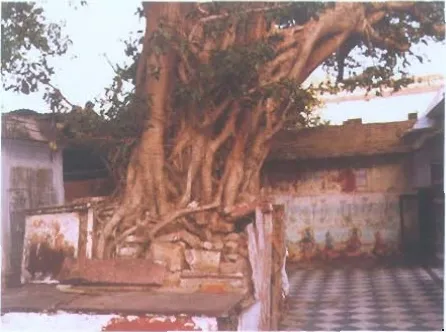
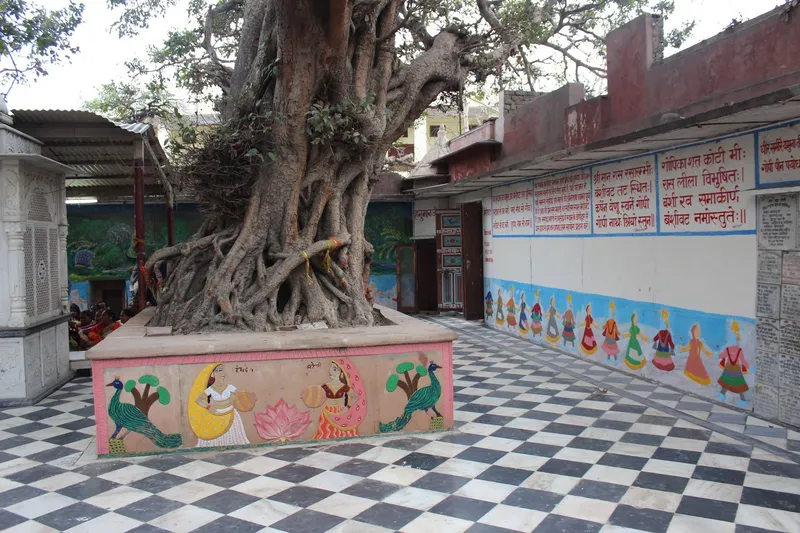
The guidebooks of 2000 and 2010 describe a huge old banyan on a raised, whitewashed platform in a walled courtyard, with a separate platform for the rāsa. The Color Guide to Vṛndāvana (2000) gives darśana in summer from 6 to 11 am and 5 to 9 pm, and in winter from 8 am to 1 pm and 4 to 7.30 pm; the times may have changed.[1 +3] The Gopīśvara Mahādeva temple is near it, Nidhuvana lies to the north, and Dhīra-samīra is close by on the river bank.[1 +9]
The rāsa-sthalī
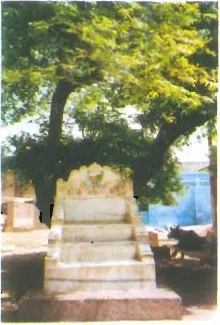
The Color Guide to Vṛndāvana (2000) photographs a stepped white stone platform with a carved, arched back panel under the tree and calls it the rāsa-sthalī of Vaṁśīvaṭa, the place of the rāsa; no source gives its builder or date.[2] The Govinda-līlāmṛta speaks of a raised platform at the tree where Kṛṣṇa stands to call the gopīs, but no source says that this stone platform stands for it.[47] According to the Vṛndāvana-kathā (1920), the Vrajavāsīs of its day pointed out a sandy ground called Yamunā-pulina, beside the small temple of Jñāna-gudaḍī, as the rāsa-sthalī. This may be the sandbank of the Bhakti-ratnākara, but no source says so.[98]
The image of Gopīśvara
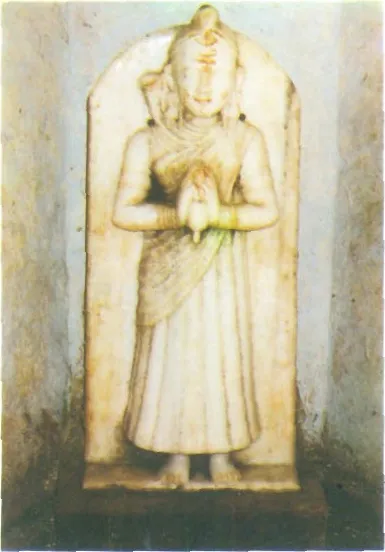
A separate image of Gopīśvara, Lord Śiva as "the lord of the gopīs", stands in a corner of the compound, with an image of Āsuri Muni in another corner. It is a standing figure with joined palms, not the liṅga of the Gopīśvara temple, and no source says who installed it or when.[1 +2] The Garga-saṁhitā tells that Śiva and Āsuri Muni bathed in the Māna-sarovara, became gopīs and entered the rāsa, and that afterwards, by Kṛṣṇa's leave, they made their home on the sandbank near the Vaṁśīvaṭa. The Bhāgavatam says only that the demigods and their wives watched the rāsa from the sky.[100 +4] Read more: Lakṣmī, Lord Śiva and the rāsa dance: who could enter it →
Location
| Where it is | on the Yamunā bank; Dhīra-samīra just near; map key 12[105] in Rāsa-sthalī (Banyan trees list)[106] |
|---|
Places at Vaṁśīvaṭa (Vṛndāvana)
2 places
Nearby places
Dhīra-samīra · Gopīśvara Mahādeva Mandira (Vṛndāvana) · Nidhuvana · Yamunā
Pictures
8 pictures
History
In 1920 the Vṛndāvana-kathā found a temple near the tree, built by an unnamed old devotee, with a Deity called Vaṁśīvaṭa-vihārī. Four small temples at the corners of the courtyard held images of the founders of the four sampradāyas: Śrī Rāmānujācārya, Śrīla Madhvācārya, Śrī Viṣṇusvāmī and Śrī Nimbāditya.[83] Śrī Vraja-maṇḍala Parikramā (2007) says that the corner temples by then held other deities. It also says that Gauḍīya Vaiṣṇavas served here until a Brahmacārījī, the guru of a king of Gwalior, bought the place, which has since been in the care of the Nimbārka sampradāya; it gives no date or document, so this is not certain.[69] The historian A. W. Entwistle (1987) records that Giridharisharan, known as Brahmachariji, a teacher of the Nimbārka line in the nineteenth century, first settled in Vṛndāvana at the Vaṁśīvaṭa and died in 1889 (1891 according to Mītal); he does not mention a purchase.[84]
Where the sources differ
Where Kṛṣṇa's flute call and the rāsa told in Śrīmad-Bhāgavatam 10.29–10.33 took place
Accounts differ Where Kṛṣṇa's flute call and the rāsa told in Śrīmad-Bhāgavatam 10.29–10.33 took place
- Śrīmad-Bhāgavatam 10.29.3, 10.29.21–22, 10.29.45, 10.30.44, 10.32.11–12, 10.33.2the flute song in 'the forest' lit by the moon; a flowering forest stirred by the breeze from the Yamunā; the sandy bank of 'the river', the Kālindī; the rāsa dance begun 'there' (10.33.2); no tree, no Vaṁśīvaṭa and no other place named
- Śrīla Jīva Gosvāmī, Laghu-vaiṣṇava-toṣaṇī on ŚB 10.29.3Kṛṣṇa sang with the attracting flute at the part of the Yamunā's bank still famous as Rāsaulī, a village square established by Śrī Vajra
- Śrī Caitanya-caritāmṛta Ādi 1.17 = Madhya 1.5 (Śrīla Kṛṣṇadāsa Kavirāja; Śrīla Prabhupāda's translations)Gopīnātha, who began the rāsa, stands on the shore at Vaṁśīvaṭa and draws the gopīs with His flute; Madhya 1.5: He 'has begun the most melodious rāsa dance on the bank of the Yamunā in Vaṁśīvaṭa'
- Govinda-līlāmṛta 21.86, 22.46–49 (Śrīla Kṛṣṇadāsa Kavirāja Gosvāmī)standing on the platform of the Vaṁśīvaṭa, north of Gopīśvara on the bank, Kṛṣṇa calls the women with His flute; on the rāsa night He comes there with the gopīs and then crosses with them to the sandbanks on the far shore for the dance
The wording of these accounts is our summary of the sources, not a published translation.
Accounts differ Whether the rāsa dance with Kṛṣṇa between each two gopīs came before or after His disappearance
- Śrīmad-Bhāgavatam 10.29.45–48, 10.33.2–3before the disappearance Kṛṣṇa took the gopīs to the sandy bank of the river and sported with them (10.29.45–46); they became proud and He disappeared (10.29.47–48); the rāsa dance in which He entered between each pair of gopīs began after His reappearance and His words to them (10.33.2–3)
- Śrī Vraja-maṇḍala Parikramā (2007)Kṛṣṇa's autumnal (śāradīya) rāsa took place here, 'One Kṛṣṇa danced between two gopīs or one gopī was dancing between two Kṛṣṇas'; then the gopīs became proud, Śrīmatī Rādhikā entered māna and Kṛṣṇa disappeared; after the gopīs' song He reappeared and spoke His words of gratitude here
- Bhakti-ratnākara, Fifth Wave (1912 ed. pp. 327–328)at the start of the rāsa (rāsārambhe), seeing inequality among the gopīs, Kṛṣṇa decided to disappear with Rādhā; after His reappearance the text shows Śrīnivāsa the Yamunā's sandbank where Kṛṣṇa began the great rāsa and quotes ŚB 10.33.2 onward there
The wording of these accounts is our summary of the sources, not a published translation.
Where Kṛṣṇa disappeared from the gopīs: the Bhakti-ratnākara sets it here at the Vaṁśīvaṭa, while in the Vraja-rīti-cintāmaṇi He goes with His dearest beloved to Nidhuvana, north of the Vaṁśīvaṭa, after disappearing from the gopīs. The accounts are set side by side on the Nidhuvana page.[49 +1]
Accounts differ Where Kṛṣṇa left His beloved after she asked to be carried
- Śrīmad-Bhāgavatam 10.30.37–38in 'one part of the forest' (vanoddeśa); no place and no gopī named
- Canto 10 commentators on ŚB 10.30.37a part of the forest (Sanātana, Jīva, Śrīla Nārāyaṇa Bhaṭṭa), an excellent part of the forest (Viśvanātha), a high part from where all the gopīs could be seen (the comment printed as Baladeva's); no place named
- Kṛṣṇa book ch. 30 (Śrīla Prabhupāda)in the gopīs' words, Rādhārāṇī 'must have taken Kṛṣṇa into the deep forest' and asked to be carried; He told Her to get on His shoulder and disappeared
- Bhakti-ratnākara, Fifth Wave (1912 ed. p. 327)'here', at the Vaṁśīvaṭa site, He left Rādhā and disappeared
Accounts differ Where Kṛṣṇa reappeared to the gopīs and thanked them after the disappearance in the rāsa.
- Śrī Vraja-maṇḍala Parikramā (2007) (Vaṁśīvaṭa)Hearing the gopīs' song, Kṛṣṇa appeared again 'and at this place' (Vaṁśīvaṭa) thanked them.
- Śrī Vraja-maṇḍala Parikramā (2007) (Govinda-ghāṭa)After Kṛṣṇa disappeared from the rāsa arena, He reappeared before the gopīs at Govinda-ghāṭa.
- Vṛndāvana, the Playground of God (2010)As described in the Bhāgavatam, Kṛṣṇa reappeared at Govinda-ghāṭa.
Accounts differ Who found the Deity of Gopīnātha at Vaṁśīvaṭa, and how
- Bhakti-ratnākara, Second Wave (quoting the Sādhana-dīpikā)Gopīnātha was manifested by him on the bank at Vaṁśīvaṭa and suddenly gave darśana; Śrī Madhu Paṇḍita became His servant (finder not named)
- Sādhana-dīpikā (Rādhā-kṛṣṇa Gosvāmī), part 1 v.20 and the prose after v.21Gopīnātha was quickly manifested on the bank at the Vaṁśīvaṭa by Paramānanda, a student of Rādhā-Gadādhara; Paramānanda Gosvāmī entrusted His service to Śrī Madhu Paṇḍita Gosvāmī (how He was found is not told)
- Śrī Vraja-maṇḍala Parikramā (2007)Mādhu Paṇḍita found Gopīnātha here while engaged in bhajana
- Śrī Vraja-maṇḍala Parikramā (2007)the Yamunā cut its bank and revealed the Deity; Paramānanda Bhaṭṭācārya found Him when he came to bathe and entrusted Him to Śrī Madhu Paṇḍita
The wording of these accounts is our summary of the sources, not a published translation.
Accounts differ Who replanted the Vaṁśīvaṭa after the Yamunā flood, and when
- Bhakti-ratnākara, Fifth Wave (1912 ed. p. 327)the gosvāmī himself brought one branch and planted it near the former spot (no name, no date)
- Śrī Vraja-maṇḍala Parikramā (2007)Vajranābha planted a tree; after the Yamunā flooded it, Mādhu Paṇḍita, disciple of Śrī Gadādhara Paṇḍita, planted one of its branches 'five hundred and fifty years ago'
- The Color Guide to Vṛndāvana (2000)the tree from Kṛṣṇa's time was washed away 'about 450 years ago'; Paramānanda Gosvāmī planted a branch at the same spot
- Vṛndāvana, the Playground of God (2010)the tree Lord Caitanya saw was washed away 'shortly after'; devotees found it washed up the next day, still partly alive, and planted a branch
The wording of these accounts is our summary of the sources, not a published translation.
How Vajranābha was related to Kṛṣṇa, and what he did here.
Accounts differ Vajranābha's relation to Kṛṣṇa and what he did at Vaṁśīvaṭa.
- Śrī Vraja-maṇḍala Parikramā (2007)Kṛṣṇa's great-grandson Vajranābha planted a tree here in remembrance of the rāsa.
- The Color Guide to Vṛndāvana (2000)The Gopīnātha Deity was installed 5,000 years ago by Vajranaba, 'the grandson of Lord Krishna'; the tree stood here from Kṛṣṇa's time.
Accounts differ Relation between Śrī Madhu Paṇḍita and Paramānanda Bhaṭṭācārya
- Vṛndāvana, the Playground of God (2010)close friends, both disciples of Śrī Gadādhara Paṇḍita
- Vṛndāvana-Dhāma Ki Jaya! (c. 1986)Śrī Madhu Paṇḍita was Paramānanda Bhaṭṭācārya's disciple
- CC Ādi 12.88 purport (Śākhā-nirṇaya)both are listed among the branches of Śrī Gadādhara Paṇḍita
- Bhakti-ratnākara, Second WaveParamānanda Bhaṭṭācārya had great affection (sneha) for Śrī Madhu Paṇḍita
How and where Śiva became a gopī to enter the rāsa: the accounts are set out on the page of the Gopīśvara Mahādeva temple.[100 +1]
More on this place
Where the autumn rāsa took place · Gopīnātha and the banyan of Vaṁśīvaṭa · Śrī Rādhā's māna at the autumn rāsa and how it was broken · Lakṣmī, Lord Śiva and the rāsa dance: who could enter it
References
106 references
- Vṛndāvana, the Playground of God (2010), Bhakti Caitanya Svāmī, PDF p. 204
- The Color Guide to Vṛndāvana (2000), Written and Photographed by Rājaśekhara dāsa Brahmacārī, PDF p. 131
- Garga-saṁhitā, Goloka-khaṇḍa (1), adhyāya 2 (description of Goloka), verse 35, Sanskrit Wikisource
- Śrīla Kṛṣṇadāsa Kavirāja Gosvāmī, Śrī Caitanya-caritāmṛta, Madhya-līlā 1.5, online edition · vedabase.io
- Śrī Vraja-maṇḍala Parikramā (2007), PDF p. 345
- Vṛndāvana, the Playground of God (2010), Bhakti Caitanya Svāmī, PDF p. 200
- The Color Guide to Vṛndāvana (2000), Written and Photographed by Rājaśekhara dāsa Brahmacārī, PDF p. 130
- Śrīla Kṛṣṇadāsa Kavirāja Gosvāmī, Śrī Caitanya-caritāmṛta, Ādi-līlā 1.17, online edition · vedabase.io
- Śrīla Prabhupāda, Śrī Caitanya-caritāmṛta, Ādi-līlā 1.17, translation (the same verse is Antya-līlā 1.7) · vedabase.io
- Śrīla Prabhupāda, Śrī Caitanya-caritāmṛta, Madhya-līlā 1.5, translation · vedabase.io
- Śrīla Prabhupāda, Kṛṣṇa, the Supreme Personality of Godhead, Chapter 29, 'The Rāsa Dance: Introduction' · vedabase.io
- Vṛndāvana-Dhāma Ki Jaya! (c. 1986), by Dhruva Mahārāja dāsa, PDF p. 83
- Śrīmad-Bhāgavatam 10.29.3, GRETIL
- Śrīmad-Bhāgavatam 10.29.4, GRETIL
- Śrīmad-Bhāgavatam 10.29.21–22 (vedabase prints them together), GRETIL
- Śrīmad-Bhāgavatam 10.29.45, GRETIL
- Śrīmad-Bhāgavatam 10.29.48, GRETIL
- Śrīmad-Bhāgavatam 10.30.44, GRETIL
- Śrīla Narahari Cakravartī, Bhakti-ratnākara, taraṅga 2, printed p. 94, 2nd ed., 1912
- Śrīla Narahari Cakravartī, Bhakti-ratnākara, taraṅga 6, printed p. 461, 2nd ed., 1912
Show all 106 references
- Śrīla Narahari Cakravartī, Bhakti-ratnākara, taraṅga 5, printed p. 326-327, 2nd ed., 1912
- Śrīla Kṛṣṇadāsa Kavirāja Gosvāmī, Śrī Caitanya-caritāmṛta, Ādi-līlā 1.17, online edition
- Śrīla Rūpa Gosvāmī, Ujjvala-nīlamaṇi, 10.99 (uddīpana section; example for rāsa-sthalī), GRETIL
- Garga-saṁhitā, Aśvamedha-khaṇḍa (10), adhyāya 59 (Śrī Kṛṣṇa-sahasranāma), verse 124 (phala-śruti), Sanskrit Wikisource
- Nārada Purāṇa, पूर्वार्धः/अध्यायः 82 v.82-120: Pūrva-bhāga, chapter 82 (rādhā-kṛṣṇa-sahasranāma-kathana), verse 120
- Nārada Purāṇa, पूर्वार्धः/अध्यायः 82 v.82-136: Pūrva-bhāga, chapter 82 (rādhā-kṛṣṇa-sahasranāma-kathana), verse 136
- Śrī Vraja-maṇḍala Parikramā (2007), PDF p. 25
- Śrī Vraja-maṇḍala Parikramā (2007), PDF p. 255
- the undated parikramā notes Bhāṇḍīravana, ¶22
- Śrī Vraja-maṇḍala Parikramā (2007), PDF p. 346
- Garga-saṁhitā, Vṛndāvana-khaṇḍa (2), adhyāya 18, verse 34 (Kṛṣṇa to Rādhā), Sanskrit Wikisource
- Garga-saṁhitā, Vṛndāvana-khaṇḍa (2), adhyāya 10 (Kṛṣṇa herding the cows), verses 24–25, Sanskrit Wikisource
- Garga-saṁhitā, Balabhadra-khaṇḍa (8), adhyāya 13 (thousand names of Balarāma), verse 104, Sanskrit Wikisource
- Śrīla Nārāyaṇa Bhaṭṭa, Vraja-bhakti-vilāsa, list of the sixteen vaṭas of Vraja, printed p. 32, item 8, quoting 'Pādme', 1st ed., publ. Bābā Kṛṣṇadāsa, Kusuma-sarovara, Saṁvat 2008
- Śrīla Nārāyaṇa Bhaṭṭa, Vraja-bhakti-vilāsa, presiding deities of the sixteen vaṭas, printed p. 34, quoting 'Skānde Bhūmikhaṇḍe', 1st ed., publ. Bābā Kṛṣṇadāsa, Kusuma-sarovara, Saṁvat 2008
- Śrīla Nārāyaṇa Bhaṭṭa, Vraja-bhakti-vilāsa, Vṛndāvana circuit (vana-yātrā), printed p. 227, item 74, 1st ed., publ. Bābā Kṛṣṇadāsa, Kusuma-sarovara, Saṁvat 2008
- Śrīla Nārāyaṇa Bhaṭṭa, Vraja-bhakti-vilāsa, sixteen vaṭas on the two banks of the Yamunā, printed p. 36, quoting the 'Bhaviṣyottara', 1st ed., publ. Bābā Kṛṣṇadāsa, Kusuma-sarovara, Saṁvat 2008
- Śrīla Nārāyaṇa Bhaṭṭa, Vraja-bhakti-vilāsa, printed p. 51, Hindi text after the section mark ॥ ५४ ॥, 1st ed., publ. Bābā Kṛṣṇadāsa, Kusuma-sarovara, Saṁvat 2008
- Śrīla Nārāyaṇa Bhaṭṭa, Vraja-bhakti-vilāsa, Vṛndāvana circuit (vana-yātrā), printed p. 227, item 74, 1st ed., publ. Bābā Kṛṣṇadāsa, Kusuma-sarovara, Saṁvat 2008
- Vaṁśīdhara: commentary on ŚB 10.28.16, Bhagavata Vidya Pith edition, ed. Bhagavata Rishi and Krishna Shankar Shastri, 1996
- Śrīla Narahari Cakravartī, Bhakti-ratnākara, taraṅga 12, printed p. 919, 2nd ed., 1912
- Śrīla Sanātana Gosvāmī: commentary on ŚB 10.29.45
- Śrīla Viśvanātha Cakravartī Ṭhākura: commentary on ŚB 10.30.44
- Śrīla Sanātana Gosvāmī: commentary on ŚB 10.32.11–12
- Śrīmad-Bhāgavatam 10.33.2, GRETIL
- Śrīla Jīva Gosvāmī: commentary on ŚB 10.29.3
- Śrīla Kṛṣṇadāsa Kavirāja Gosvāmī, Govinda-līlāmṛta, sarga 21 (ekaviṁśaḥ sargaḥ), v.86, after the editions of Haridas Das and Haridas Shastri
- Śrīla Kṛṣṇadāsa Kavirāja Gosvāmī, Govinda-līlāmṛta, 22.46–47, after the editions of Haridas Das and Haridas Shastri
- Śrīla Viśvanātha Cakravartī, Vraja-rīti-cintāmaṇi, sarga 2 (dvitīyaḥ sargaḥ), vv. 75–76
- Śrīla Viśvanātha Cakravartī, Vraja-rīti-cintāmaṇi, sarga 2 (dvitīyaḥ sargaḥ), v. 83
- Śrīla Narahari Cakravartī, Bhakti-ratnākara, taraṅga 5, printed pp. 327-328, 2nd ed., 1912
- Śrīla Narahari Cakravartī, Bhakti-ratnākara, Fifth Wave (pañcama taraṅga), 1912 ed. p. 328, 2nd ed., 1912
- Śrīla Narahari Cakravartī, Bhakti-ratnākara, taraṅga 5, printed pp. 327-328, 2nd ed., 1912
- Garga-saṁhitā, Vṛndāvana-khaṇḍa (2), adhyāya 24 (rāsa-krīḍā, story of Āsuri Muni), verses 4–5, Sanskrit Wikisource
- Garga-saṁhitā, Vṛndāvana-khaṇḍa (2), adhyāya 25 (rāsa-krīḍā), verses 31–32, Sanskrit Wikisource
- Garga-saṁhitā, Vṛndāvana-khaṇḍa (2), adhyāya 24 (rāsa-krīḍā, āsury-upākhyāna), verses 4–5, Sanskrit Wikisource
- Śrīmad-Bhāgavatam 10.15.42, GRETIL
- Garga-saṁhitā, Aśvamedha-khaṇḍa (10), adhyāya 44, verses 29–30, Sanskrit Wikisource
- Garga-saṁhitā, Aśvamedha-khaṇḍa (10), adhyāya 44, verses 41–42, Sanskrit Wikisource
- Garga-saṁhitā, Aśvamedha-khaṇḍa (10), adhyāya 42 (rāsa-krīḍā), verse 13, Sanskrit Wikisource
- Garga-saṁhitā, Aśvamedha-khaṇḍa (10), adhyāya 42, verse 47, Sanskrit Wikisource
- Garga-saṁhitā, Aśvamedha-khaṇḍa (10), adhyāya 42 (rāsa-krīḍā), verse 41, Sanskrit Wikisource
- Garga-saṁhitā, Aśvamedha-khaṇḍa (10), adhyāya 44 (rāsa-krīḍā), verses 30–31, Sanskrit Wikisource
- Garga-saṁhitā, Aśvamedha-khaṇḍa (10), adhyāya 44 (rāsa-krīḍā), verses 40–42, Sanskrit Wikisource
- Śrīla Kṛṣṇadāsa Kavirāja Gosvāmī, Śrī Caitanya-caritāmṛta, Madhya-līlā 18.72, online edition · vedabase.io
- Kṛṣṇa-caitanya-caritāmṛta of Murāri Gupta, prakrama 4, sarga 9, vv. 9–11
- Śrīla Locana dāsa Ṭhākura, Caitanya-maṅgala, Śeṣa-khaṇḍa, 1903 ed. p. 175, left column
- Śrīla Narahari Cakravartī, Bhakti-ratnākara, Second Wave (dvitīya taraṅga), 1912 ed. p. 94, quoting the Sādhana-dīpikā, 2nd ed., 1912
- Śrī Vraja-maṇḍala Parikramā (2007), PDF p. 319
- Vṛndāvana, the Playground of God (2010), Bhakti Caitanya Svāmī, PDF p. 42
- Vṛndāvana-Dhāma Ki Jaya! (c. 1986), by Dhruva Mahārāja dāsa, PDF p. 73
- Śrīla Rādhā-kṛṣṇa Gosvāmī, Sādhana-dīpikā, part 1 (prathama-kakṣā), v.20
- Śrīla Rādhā-kṛṣṇa Gosvāmī, Sādhana-dīpikā, part 1 (prathama-kakṣā), prose after v.21
- Śrīla Prabhupāda, Śrī Caitanya-caritāmṛta, Ādi-līlā 12.88, purport · vedabase.io
- Bhaktamāla of Nābhā dāsa with Priyādāsa's Bhakti-rasa-bodhinī kavittas and Rūpakalā's Bhakti-sudhā-svāda tilaka, Priyādāsa's kavitta 380 'श्री मधुगुसांई जी' (running no. 474 of the book), part 2, printed p. 899
- Bhaktamāla of Nābhā dāsa with Priyādāsa's Bhakti-rasa-bodhinī kavittas and Rūpakalā's Bhakti-sudhā-svāda tilaka, Rūpakalā's vārtika tilaka on Priyādāsa's kavitta 380, part 2, printed p. 900
- Śrī Śrī Bhaktamāla grantha, second mālā, 'চরিত্র শ্রীমধুপণ্ডিত ঠাকুরের', printed p. ২১ (21), right column
- Śrī Vraja-maṇḍala Parikramā (2007), PDF p. 295
- the undated parikramā notes Vṛndāvana, ¶232
- Śrī Vraja-maṇḍala Parikramā (2007), PDF p. 148
- the undated parikramā notes Kāmyavana, ¶9
- Pulinbihārī Datta, ch. 10 (daśama pariccheda) 'Rādhāvallabhajī', printed p. 136
- Vṛndāvana-kathā, chapter 16 (ষোড়শ পরিচ্ছেদ), no. 1 'বংশীবট', printed p. 181
- A. W. Entwistle, printed p. 220, Egbert Forsten, Groningen, 1987
- Śrīla Prabhupāda, Kṛṣṇa, the Supreme Personality of Godhead, Chapter 30, 'Kṛṣṇa’s Hiding from the Gopīs' · vedabase.io
- Śrīla Prabhupāda, Kṛṣṇa, the Supreme Personality of Godhead, Chapter 32, 'Kṛṣṇa Returns to the Gopīs' · vedabase.io
- Śrīla Prabhupāda, Kṛṣṇa, the Supreme Personality of Godhead, Chapter 33, 'Description of the Rāsa Dance' · vedabase.io
- Hari Hari! Kabe Haba Vṛndāvana-vāsī (Narottama dāsa Ṭhākura (as the song book credits it)) · song book
- Nandgram Dham Vaiṣṇava song book (nandgramdham.org/songs/) (2026), various ācāryas (lyrics)
- Kṛṣṇotkīrtana-gāna-nartana (Ṣaḍ-gosvāmy-aṣṭaka, v7) (Śrīnivāsa Ācārya (as the song book credits it)) · song book
- Vṛndāvana, the Playground of God (2010), Bhakti Caitanya Svāmī, PDF p. 205
- Śrī Vraja-maṇḍala Parikramā (2007), PDF p. 318
- Vṛndāvana, the Playground of God (2010), Bhakti Caitanya Svāmī, PDF p. 182
- Śrī Vraja-maṇḍala Parikramā (2007), PDF p. 316
- Śrī Vraja-maṇḍala Parikramā (2007), PDF p. 343
- Vṛndāvana, the Playground of God (2010), Bhakti Caitanya Svāmī, PDF p. 220
- The Color Guide to Vṛndāvana (2000), Written and Photographed by Rājaśekhara dāsa Brahmacārī, PDF p. 31
- Pulinbihārī Datta, ch. 18 (aṣṭādaśa pariccheda), entries 'Jñānagudarī' and 'Yamunā-pulina', printed pp. 208–209
- Pulinbihārī Datta, ch. 14 (caturdaśa pariccheda), entry on Gopīśvara, printed p. 168
- Garga-saṁhitā, Vṛndāvana-khaṇḍa (2), adhyāya 25 (rāsa-krīḍā: Śiva and Āsuri), verse 7, Sanskrit Wikisource
- Garga-saṁhitā, Vṛndāvana-khaṇḍa (2), adhyāya 25, verse 8, Sanskrit Wikisource
- Garga-saṁhitā, Vṛndāvana-khaṇḍa (2), adhyāya 25, verses 31–32, Sanskrit Wikisource
- Śrīmad-Bhāgavatam 10.33.3, GRETIL
- Śrīla Prabhupāda, Kṛṣṇa, the Supreme Personality of Godhead (Kṛṣṇa book), Chapter 33, 'Description of the Rāsa Dance' · vedabase.io
- Śrī Vraja-maṇḍala Parikramā (2007), p. 610-611
- Śrī Vraja-maṇḍala Parikramā (2007), p. 666-667