Rūpa Gosvāmī's bhajana-kuṭī (Ter-kadamba)
रूप गोस्वामी की भजन-कुटी (टेर-कदम्ब) Hindi name proposed
Also called Śrī Rūpa Gosvāmī's bhajana-kuṭī, Rupa Gosvami Bhajan Kutira
In short
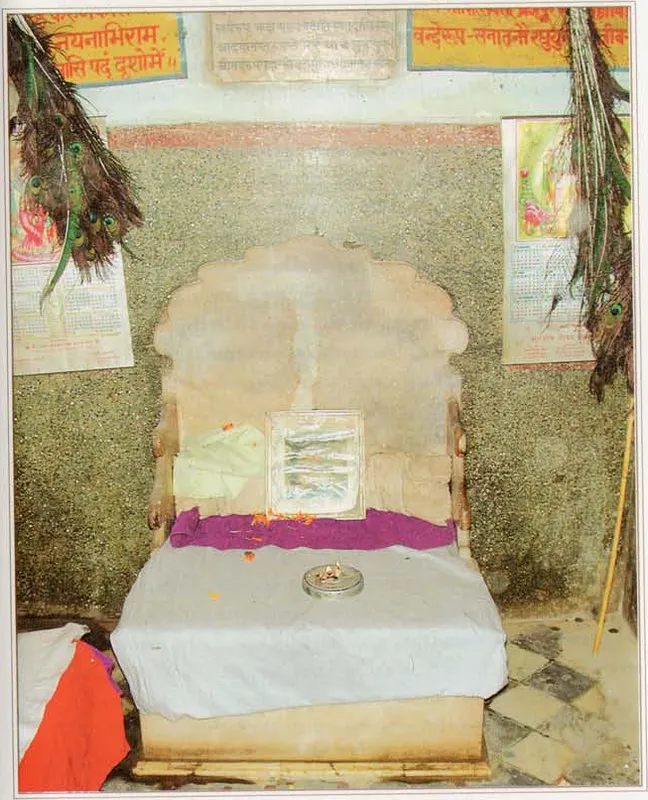
The guidebooks show Śrīla Rūpa Gosvāmī's bhajana-kuṭī, his hut for chanting and prayer, beside the kadamba tree of Ṭer-kadamba near Nandagrāma. Śrī Vraja-maṇḍala Parikramā (2007) places it just west of the tree and says that he performed his bhajana and wrote many of his books here.[1 +2] Śrīla Rūpa Gosvāmī himself writes that he composed the Dāna-keli-kaumudī while living at Nandīśvara, without naming a hut or a tree.[4] The older sources speak of him at Pāvana-sarovara, and they place the sweet rice that Śrī Rādhā provided for the two brothers in different places.[5 +4]
Key facts
| Kind | bhajana-kuṭīra |
|---|---|
| Region · area | Nandagrāma · Ter-kadamba |
| Ācāryas | Śrīla Rūpa Gosvāmī, Śrīla Sanātana Gosvāmī |
The Gosvāmīs and ācāryas
Writing at Nandīśvara
The guidebook Śrī Vraja-maṇḍala Parikramā (2007), the undated parikramā notes Nandagrāma and the pictorial guide Vṛndāvana-Dhāma Ki Jaya! (c. 1986) place Śrīla Rūpa Gosvāmī's kuṭī at Ṭer-kadamba. The first two add that he performed his bhajana and composed many of his books here.[1 +2] No older source has been found that names the kuṭī or Ṭer-kadamba.[1 +2]
In the closing verse of his Dāna-keli-kaumudī, a short play about Kṛṣṇa's toll pastime, Śrīla Rūpa Gosvāmī says that it was written by one living at Nandīśvara. The 1976 editor of the play reads the date in the verse as śaka 1471, that is 1549 CE.[4]
The fire of separation
The Bhakti-ratnākara tells a story of Śrīla Rūpa Gosvāmī at Nandīśvara (summarised here, not translated). One day, when the Vaiṣṇavas wept and fell unconscious at talk of Rādhā and Kṛṣṇa's separation, his heart burned like fire, yet nothing showed outside; where his breath touched a Vaiṣṇava's body, it blistered as if burnt. It names no hut and no kadamba.[10]
অহে শ্রীনিবাস যৈছে শ্রীরূপের ধৈর্য্য। বৈষ্ণবসমাজে ব্যক্ত হইল আশ্চর্য্য ॥ এক দিন রাধাকৃষ্ণ বিচ্ছেদ কথাতে। কান্দয়ে বৈষ্ণব মূর্চ্ছাগত পৃথিবীতে ॥ অগ্নিশিখা প্রায় জলে রূপের হৃদয়। তথাপি বাহিরে কিছু প্রকাশ না হয় ॥ কারু দেহে শ্রীরূপের নিশ্বাস স্পর্শিল। অগ্নি দগ্ধপ্রায় তার দেহে ব্রণ হৈল ॥
ahe śrīnibāsa yaiche śrīrūpera dhairyya| baiṣṇabasamāje byakta haila āścaryya
eka dina rādhākṛṣṇa biccheda kathāte| kāndaẏe baiṣṇaba mūrcchāgata pṛthibīte
agniśikhā prāẏa jale rūpera hṛdaẏa| tathāpi bāhire kichu prakāśa nā haẏa
kāru dehe śrīrūpera niśbāsa sparśila| agni dagdhaprāẏa tāra dehe braṇa haila ||
Śrī Vraja-maṇḍala Parikramā and the parikramā notes Nandagrāma record a different sign as a local tradition: when Śrīla Rūpa Gosvāmī wrote verses of the separation of Rādhā and Kṛṣṇa, the leaves of the kadamba at Ṭer-kadamba dried and fell, and they sprouted again with his verses of Their meeting. It has not been found in any older source, so it is not certain.[12 +1]
The sweet rice
The story of the sweet rice is told in several ways. According to the Bhakti-ratnākara, Śrīla Rūpa Gosvāmī stayed from time to time at his brother's hut by Pāvana-sarovara, and there Śrī Rādhā, as a cowherd girl, brought him what he needed to cook for Śrīla Sanātana Gosvāmī. The modern guidebooks set the story at this kuṭī. The accounts are set side by side on the page of Śrīla Sanātana Gosvāmī's bhajana-kuṭī.[9 +1] Read more: Śrīla Sanātana Gosvāmī at Nandagrāma →
Śrīla Prabhupāda
Śrīla Prabhupāda tells how Śrī Rādhā, as a girl of about twelve, brought Śrīla Rūpa Gosvāmī what he needed for a feast for his …
Śrīla Prabhupāda tells how Śrī Rādhā, as a girl of about twelve, brought Śrīla Rūpa Gosvāmī what he needed for a feast for his elder brother. He names no place; he says only that Śrīla Rūpa Gosvāmī was living in the forest in Vṛndāvana.[15]
General teaching (does not name the place)Then Sanātana said, “This nice girl is Rādhārāṇī. You have taken service from Rādhārāṇī, the Lord’s eternal consort. It is a great blunder.” That is their philosophy. They would not accept service from the Lord. They simply wanted to render service.
Śrīla Prabhupāda, The Science of Self-Realization, ch. 8 (Rūpa Gosvāmī's feast for Sanātana Gosvāmī) · vedabase.io
History
The historian F. S. Growse (1883) records the inscription of a small Bihārī temple on the bank of Pāvana-sarovara, dated Saṁvat 1805 (1748–49 CE). It says that a queen of the Burdwān family built the temple at the place of Śrī Sanātana and Rūpa; A. W. Entwistle (1987) dates the temple 1748.[5 +1] Prabhudayāl Mītal (1966) lists the bhajana-kuṭīs of Śrīla Sanātana Gosvāmī and Śrīla Rūpa Gosvāmī among the holy places around Nandagrāma.[6 +2]
Where the sources differ
The guidebooks, the historians and the Bhakti-ratnākara place the two brothers' kuṭīs and the sweet rice differently; their …
The guidebooks, the historians and the Bhakti-ratnākara place the two brothers' kuṭīs and the sweet rice differently; their accounts are set side by side on the page of Śrīla Sanātana Gosvāmī's bhajana-kuṭī.[1 +6]
More on this place
Śrīla Sanātana Gosvāmī at Nandagrāma
References
17 references
- Śrī Vraja-maṇḍala Parikramā (2007), PDF p. 205
- the undated parikramā notes Nandagrāma, ¶50
- Vṛndāvana-Dhāma Ki Jaya! (c. 1986), by Dhruva Mahārāja dāsa, PDF p. 55
- Śrīla Rūpa Gosvāmī, Dāna-keli-kaumudī, closing verse (v.101), after the undated edition published by Krishna Das of Kusum Sarovar
- Mathurá (1883), F. S. Growse, B.C.S., M.A. Oxon., C.I.E. (as the title page gives him, p. 315
- A. W. Entwistle, Entwistle 1987, printed p. 379, Egbert Forsten, Groningen, 1987
- Prabhudayāl Mītal, Mītal 1966, printed p. 123
- Prabhudayāl Mītal, Mītal 1966, printed p. 124
- Śrīla Narahari Cakravartī, Bhakti-ratnākara, Fifth Wave, 1912 ed. p. 251; Grantha Mandira text v.1310–1313, 2nd ed., 1912
- Śrīla Narahari Cakravartī, Bhakti-ratnākara, Fifth Wave, 1912 ed. p. 252; Grantha Mandira text v.1325–1329, 2nd ed., 1912
- Śrīla Narahari Cakravartī, Bhakti-ratnākara, Fifth Wave, 1912 ed. p. 252; Grantha Mandira text v.1325–1329, 2nd ed., 1912
- Śrī Vraja-maṇḍala Parikramā (2007), PDF p. 206
- the undated parikramā notes Nandagrāma, ¶56
- Śrīla Narahari Cakravartī, Bhakti-ratnākara, Fifth Wave, 1912 ed. p. 251; Grantha Mandira text v.1314–1317, 2nd ed., 1912
- Śrīla Prabhupāda, The Science of Self-Realization, ch. 8 (Rūpa Gosvāmī's feast for Sanātana Gosvāmī) · vedabase.io
- Śrī Vraja-maṇḍala Parikramā (2007), p. 384-385
- Vṛndāvana-Dhāma Ki Jaya! (c. 1986), by Dhruva Mahārāja dāsa, p. 37