Ter-kadamba
टेर-कदम्ब Hindi name proposed
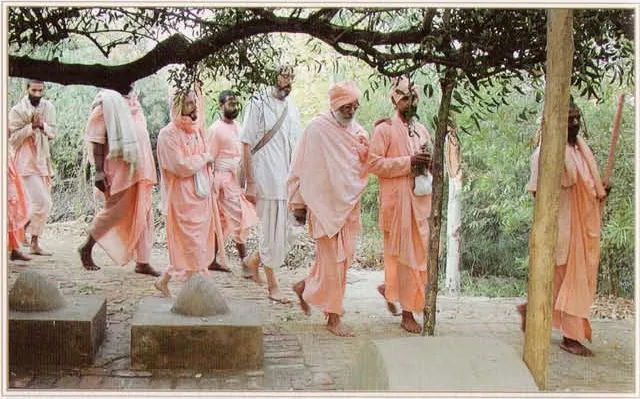
- What it is
- Ṭer-kadamba is a kadamba tree and grove near Nandagrāma.
- Visiting
- According to Śrī Vraja-maṇḍala Parikramā (2007), on Gopāṣṭamī, the festival of the cows, the Vrajavāsīs bring small boys dressed as Kṛṣṇa and Balarāma from Nandagrāma to Ṭer-kadamba.
- Places here
- Ter-kadamba-kuṇḍa, Rāsa-maṇḍala (Ter-kadamba), Rūpa Gosvāmī's bhajana-kuṭī (Ter-kadamba)
In short
Ṭer-kadamba is a kadamba tree and grove near Nandagrāma. The modern guidebooks say that Kṛṣṇa climbed the kadamba here and called His cows with His flute, and that the name means "the kadamba of the call" (ṭer).[1 +4] They also say that He called the gopīs from here to the rāsa dance, recalled by a rāsa-maṇḍala platform, and that Śrīla Rūpa Gosvāmī had his bhajana-kuṭī (a hut for chanting and prayer) beside the tree.[1 +8] Śrīmad-Bhāgavatam tells these pastimes of the cows and the flute without naming a place, and no scripture, Gosvāmī text or Bhakti-ratnākara passage naming Ṭer-kadamba has been found.[1 +8]
Key facts
| Kind | tree |
|---|---|
| Region · area | Nandagrāma |
| Ācāryas | Śrīla Rūpa Gosvāmī |
Divine pastimes
Calling and counting the cows
Śrīmad-Bhāgavatam tells how Kṛṣṇa called out, with a voice as deep as the rumbling of clouds, to the cows that had wandered far from the herd. It also tells how He stood counting His cows on a string of gems, and how at the end of the day He gathered them all and came home playing His flute. It names no place for these pastimes.[12 +3]
megha-gambhīrayā vācā nāmabhir dūra-gān paśūn / kvacid āhvayati prītyā go-gopāla-manojñayā
Sometimes, with a voice as deep as the rumbling of clouds, He would call out with great affection the names of the animals who had wandered far from the herd, thus enchanting the cows and the cowherd boys.
Translation: Śrīla Prabhupāda's disciples (BBT)maṇi-dharaḥ kvacid āgaṇayan gā mālayā dayita-gandha-tulasyāḥ
praṇayino’nucarasya kadāṁse prakṣipan bhujam agāyata yatra ||
Now Kṛṣṇa is standing somewhere counting His cows on a string of gems. He wears a garland of tulasī flowers that bear the fragrance of His beloved, and He has thrown His arm over the shoulder of an affectionate cowherd boyfriend.
Translation: Śrīla Prabhupāda's disciples (BBT)According to Śrī Vraja-maṇḍala Parikramā (2007), the undated parikramā notes Nandagrāma and the pictorial guide Vṛndāvana-Dhāma Ki Jaya! (c. 1986), Kṛṣṇa climbed the kadamba here at the end of the day and called His cows with His flute. He counted them on His jewelled necklace and called again for any that were missing before He took them home. The books explain the name from ṭer, Kṛṣṇa's call.[1 +4]
The call to the rāsa
According to Śrī Vraja-maṇḍala Parikramā and the parikramā notes Nandagrāma, on full-moon nights Kṛṣṇa also called the gopīs by name with His flute from this kadamba, for the rāsa dance. A platform, the rāsa-maṇḍala, recalls it; the notes place it by Ṭer-kadamba-kuṇḍa. The Bhāgavatam's own call to the rāsa (10.29) leads to the bank of the Yamunā, and the guidebooks do not say that this was the same rāsa.[1 +5] Read more: Where the autumn rāsa took place →
Ṭer-kadamba-kuṇḍa
Ṭer-kadamba-kuṇḍa is a pond at Ṭer-kadamba. According to the undated parikramā notes Nandagrāma, Kṛṣṇa called the gopīs with His flute from the kadamba tree here, and the rāsa dance took place at this kuṇḍa, where the rāsa-maṇḍala platform recalls it; this local tradition is not certain.[1 +3] These notes are the only source found so far that names the kuṇḍa; Śrī Vraja-maṇḍala Parikramā (2007) names no pond here, and neither book says when the platform was built or by whom.[1 +3]
Śrīmad-Bhāgavatam (10.29–10.33) tells the rāsa dance. On the full-moon night of autumn Kṛṣṇa's flute drew the gopīs to Him. He went with them to the bank of a river, and after He had disappeared and come back He took them to the bank of the Kālindī, the Yamunā, where the dance began. The Bhāgavatam names no place near Nandagrāma and does not name Ṭer-kadamba.[17 +5]
tatrārabhata govindo rāsa-krīḍām anuvrataiḥ
strī-ratnair anvitaḥ prītair anyonyābaddha-bāhubhiḥ
There on the Yamunā’s banks Lord Govinda then began the pastime of the rāsa dance in the company of those jewels among women, the faithful gopīs, who joyfully linked their arms together.
Translation: Śrīla Prabhupāda's disciples (BBT)About this place: Does not name the place. The rāsa dance begins with the gopīs linking arms; the verse's 'there' (tatra) is the bank of the Kālindī (Yamunā) to which Kṛṣṇa had taken the gopīs after His return (ŚB 10.32.11–14). The undated parikramā notes Nandagrama say that the rāsa was danced at Ṭer-kadamba-kuṇḍa, where a rāsa-maṇḍala platform recalls it, and Śrī Vraja-maṇḍala Parikramā (2007) mentions rāsa platforms at Ṭer-kadamba and at Viśākhā's kuñja.
Three commentators on these verses connect the flute-song with the gopīs' own names (summarised here, not translated). Śrīla Jīva Gosvāmī and Śrīla Śrīnātha Cakravartī say that the song was sweet and unclear, so that each gopī took it to be sung with her own name, and Śrīla Nārāyaṇa Bhaṭṭa Gosvāmī speaks of the flute's call marked with each one's name. None of them names Ṭer-kadamba.[22 +2]
The Garga-saṁhitā (Vṛndāvana-khaṇḍa 21.10) tells of a rāsa of Kṛṣṇa with the gopīs on the slope of Nandīśvara. No source links that rāsa to the kuṇḍa or the platform at Ṭer-kadamba.[26] In his Kṛṣṇa book Śrīla Prabhupāda tells the setting of the rāsa as the Bhāgavatam does; the passage is general and names no place near Nandagrāma.[17 +5]
General teaching (does not name the place)“In this way the Lord and the gopīs reached the cool, sandy bank of the Yamunā, where there were lilies and lotus flowers. In such a transcendental atmosphere, the gopīs and Kṛṣṇa began to enjoy one another.”
Śrīla Prabhupāda, Kṛṣṇa, the Supreme Personality of Godhead (Kṛṣṇa book), Chapter 29, 'The Rāsa Dance: Introduction' · vedabase.io
Where Kṛṣṇa danced the rāsa with the gopīs (the Bhāgavatam, the commentators, the Garga-saṁhitā and the guidebooks) is set out on the page of the rāsa-maṇḍala at Ṭer-kadamba.[17 +6]
The Gosvāmīs and ācāryas
The guidebooks place Śrīla Rūpa Gosvāmī's bhajana-kuṭī beside Ṭer-kadamba and say that he performed his bhajana and wrote many of …
The guidebooks place Śrīla Rūpa Gosvāmī's bhajana-kuṭī beside Ṭer-kadamba and say that he performed his bhajana and wrote many of his books there.[2 +4] Śrī Vraja-maṇḍala Parikramā and the parikramā notes add a local tradition, which no older source confirms and which is not certain: when Śrīla Rūpa Gosvāmī wrote of the separation of Rādhā and Kṛṣṇa, the leaves of the kadamba dried and fell, and they sprouted again with his verses of Their meeting.[27 +1]
The same two books set here the story of the sweet rice that Śrī Rādhā, as a village girl, provided for the two brothers. The Bhakti-ratnākara tells it at Śrīla Sanātana Gosvāmī's hut by Pāvana-sarovara, and Śrīla Prabhupāda tells it without naming a place; the accounts are set side by side on the page of Śrīla Sanātana Gosvāmī's bhajana-kuṭī.[2 +5] Read more: Śrīla Sanātana Gosvāmī at Nandagrāma →
Śrīla Prabhupāda
Śrīla Prabhupāda's Kṛṣṇa book tells the counting of the cows; the passage is general and names no place.
Śrīla Prabhupāda's Kṛṣṇa book tells the counting of the cows; the passage is general and names no place.[12 +3]
General teaching (does not name the place)“When He would prepare to return from the pasturing ground, He would gather all the cows. As Vaiṣṇavas count 108 beads, which represent the 108 individual gopīs, so Kṛṣṇa would also count on 108 beads to count the different groups of cows.”
Śrīla Prabhupāda, Kṛṣṇa, the Supreme Personality of Godhead, ch. 35 'The Gopīs' Feelings of Separation' · vedabase.io
Visiting today
According to Śrī Vraja-maṇḍala Parikramā (2007), on Gopāṣṭamī, the festival of the cows, the Vrajavāsīs bring small boys dressed as Kṛṣṇa and Balarāma from Nandagrāma to Ṭer-kadamba. They sing together in a samāja, worship the cows and feed them grass and jaggery.[2]
Location
| Where it is | exactly half-way between Nandagaon and Jāvaṭa (map: far east, below the Kosī & Jāvaṭa road)[34] “A short distance from the village of Nandagrāma, across the fields toward Javat”[35] |
|---|
Places at Ter-kadamba
3 places
Nearby places
Nandagrāma · Jāvaṭa
Where the sources differ
What the name Ṭer-kadamba means.[2 +4]
Accounts differ What the name Ṭer-kadamba means.
- Śrī Vraja-maṇḍala Parikramā (2007)Kṛṣṇa climbed the kadamba and with His call (ṭer) gathered the cows and gopīs; hence Ṭer-kadamba.
- the undated parikramā notes Nandagrāma'The word ter or tera means to call.'
- A. W. Entwistle (1987), a historianEntwistle calls the tree the Ter Kadamb and takes the name to mean a bent kadamba.
- Mītal (1966), p. 123Spells it 'टेढ कदव' (Ṭeḍh kadamb; ṭeḍh = bent), without explanation.
Where Śrīla Rūpa Gosvāmī's sweet rice for Śrīla Sanātana Gosvāmī was made, and who cooked it: the guidebooks set it at Śrīla Rūpa's kuṭī here, the Bhakti-ratnākara at Śrīla Sanātana's dwelling by Pāvana-sarovara. The accounts are set side by side on the page Śrīla Sanātana Gosvāmī's bhajana-kuṭī.[2 +4]
Accounts differ What is left of the kadamba trees at Ṭer-kadamba (dated guidebooks).
- Śrī Vraja-maṇḍala Parikramā (2007)The many kadamba trees 'have all disappeared on account of stagnant rainwater'; great souls periodically plant new ones.
- the undated parikramā notes NandagrāmaOnly a few kadamba trees remain.
- Vṛndāvana-Dhāma Ki Jaya! (c. 1986)'a small forest of kadamba trees'.
More on this place
Śrīla Sanātana Gosvāmī at Nandagrāma · Where the autumn rāsa took place
References
35 references
- Śrī Vraja-maṇḍala Parikramā (2007), PDF p. 204
- Śrī Vraja-maṇḍala Parikramā (2007), PDF p. 205
- the undated parikramā notes Nandagrāma, ¶43
- the undated parikramā notes Nandagrāma, ¶45
- Vṛndāvana-Dhāma Ki Jaya! (c. 1986), by Dhruva Mahārāja dāsa, PDF p. 55
- the undated parikramā notes Nandagrāma, ¶46
- the undated parikramā notes Nandagrāma, ¶47
- Śrīmad-Bhāgavatam ŚB 10.29.3–4, GRETIL
- Śrīla Prabhupāda, Kṛṣṇa, the Supreme Personality of Godhead, ch. 29 'The Rāsa Dance: Introduction' · vedabase.io
- the undated parikramā notes Nandagrāma, ¶50
- Śrīla Rūpa Gosvāmī, Dāna-keli-kaumudī, closing verse (v.101), after the undated edition published by Krishna Das of Kusum Sarovar
- Śrīmad-Bhāgavatam 10.15.12, GRETIL
- Śrīmad-Bhāgavatam 10.35.18, Bhagavata Vidya Pith edition, ed. Bhagavata Rishi and Krishna Shankar Shastri, 1996
- Śrīmad-Bhāgavatam 10.35.22, Bhagavata Vidya Pith edition, ed. Bhagavata Rishi and Krishna Shankar Shastri, 1996
- Śrīla Prabhupāda, Kṛṣṇa, the Supreme Personality of Godhead, ch. 35 'The Gopīs' Feelings of Separation' · vedabase.io
- Śrīmad-Bhāgavatam 10.35.18, Bhagavata Vidya Pith edition, ed. Bhagavata Rishi and Krishna Shankar Shastri, 1996
- Śrīmad-Bhāgavatam ŚB 10.29.3, GRETIL
- Śrīmad-Bhāgavatam 10.29.4
- Śrīmad-Bhāgavatam ŚB 10.29.45–46, GRETIL
- Śrīmad-Bhāgavatam 10.32.11–12
Show all 35 references
- Śrīmad-Bhāgavatam 10.33.2
- Śrīla Jīva Gosvāmī, Laghu-vaiṣṇava-toṣaṇī on Śrīmad-Bhāgavatam 10.29.3
- Śrīmad-Bhāgavatam 10.33.2
- Śrīla Śrīnātha Cakravartī, Caitanya-mata-mañjuṣā on Śrīmad-Bhāgavatam 10.29.3
- Śrīla Nārāyaṇa Bhaṭṭa, Śrī-rasikāhlādinī on Śrīmad-Bhāgavatam 10.29.4
- Garga-saṁhitā, Vṛndāvana-khaṇḍa (2) 21.10, first half, Sanskrit Wikisource
- Śrī Vraja-maṇḍala Parikramā (2007), PDF p. 206
- the undated parikramā notes Nandagrāma, ¶56
- Śrīla Narahari Cakravartī, Bhakti-ratnākara, Fifth Wave, 1912 ed. p. 251; Grantha Mandira text v.1310–1313, 2nd ed., 1912
- Śrīla Prabhupāda, The Science of Self-Realization, ch. 8 (Rūpa Gosvāmī's feast) · vedabase.io
- A. W. Entwistle, Entwistle 1987, printed p. 380, Egbert Forsten, Groningen, 1987
- Prabhudayāl Mītal, Mītal 1966, printed p. 123
- Prabhudayāl Mītal, Mītal 1966, printed p. 124
- Śrī Vraja-maṇḍala Parikramā (2007), p. 382-383
- Vṛndāvana-Dhāma Ki Jaya! (c. 1986), by Dhruva Mahārāja dāsa, p. 37