Ṣaḍbhuja Mahāprabhu Mandira
षड्भुज महाप्रभु मन्दिर Hindi name proposed
Also called Sad-bhuja Mahaprabhu Temple, Sad-bhuj Mahāprabhu Temple (Gopāla Mandir), Sah-bhuj Mahāprabhu
- What it is
- The Ṣaḍbhuja Mahāprabhu Mandira is a small temple next to Nidhuvana in Vṛndāvana town.
- Visiting
- Vṛndāvana, the Playground of God describes the Deity on the altar: Mahāprabhu's own two arms hold His sannyāsa-daṇḍa (staff) and kamaṇḍalu (waterpot), the two arms of Kṛṣṇa hold the flute, and the …
In short
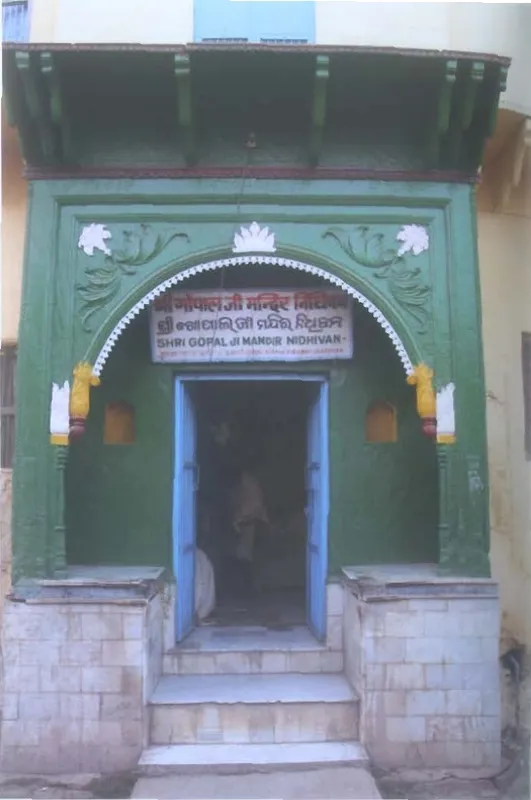
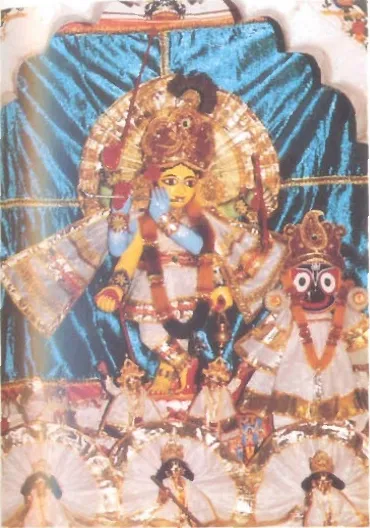
The Ṣaḍbhuja Mahāprabhu Mandira is a small temple next to Nidhuvana in Vṛndāvana town. Its Deity is Ṣaḍbhuja Mahāprabhu, Śrī Caitanya Mahāprabhu with six arms: two of His own, two of Kṛṣṇa and two of Rāma.[1 +4] Two guidebooks say that this is the Deity whom Śrīla Jagannātha dāsa Bābājī worshipped, and that He came to Vṛndāvana town when the Bābājī went to Bengal.[1 +3] The sign over the entrance reads "Shri Gopal Ji Mandir".[1 +1] No scripture or statement of Śrīla Prabhupāda that mentions the temple has been found in the works searched, and no source gives the year it was built.[1 +4]
Key facts
| Kind | temple |
|---|---|
| Region · area | Vṛndāvana |
| Ācāryas | Śrīla Jagannātha dāsa Bābājī |
Divine pastimes
The six-armed form
The scriptures do not speak of this temple, but they tell of the form of its Deity. The Caitanya-caritāmṛta says that when Śrī Nityānanda Prabhu met Śrī Caitanya Mahāprabhu, He saw the Lord's six-armed form.[8 +1]
তবে নিত্যানন্দ–স্বরূপের আগমন ।
প্রভুকে মিলিয়া পাইল ষড়্ভুজ–দর্শন ॥ ১২ ॥
tabe nityānanda-svarūpera āgamana
prabhuke miliyā pāila ṣaḍ-bhuja-darśana
After this function at the house of Śrīvāsa Ṭhākura, Nityānanda Prabhu appeared, and when He met with Lord Caitanya He got the opportunity to see Him in His six-armed form.
Translation: Śrīla A.C. Bhaktivedanta Swami PrabhupādaThe next verse of the Caitanya-caritāmṛta lists what the six hands held, and its list is not the one given for this Deity (see below).[9] The Bhakti-ratnākara places Śrī Nityānanda Prabhu's vision in Śrīvāsa's courtyard in Navadvīpa (summarised here, not translated): there, it says, the son of Padmāvatī joyfully saw Śrī Gauracandra's six-armed form. In this account the vision took place in Bengal, not in Vraja.[10] Read more: The six-armed form of Śrī Caitanya Mahāprabhu →
Traditional accounts
Vṛndāvana, the Playground of God (2010) and The Color Guide to Vṛndāvana (2000) say that Śrīla Jagannātha dāsa Bābājī worshipped …
How the Deity came to Vṛndāvana
Vṛndāvana, the Playground of God (2010) and The Color Guide to Vṛndāvana (2000) say that Śrīla Jagannātha dāsa Bābājī worshipped this Deity himself, and the profile of the Bābājī on this website tells the same. None of them cites a document.[1 +3] The books tell that he looked for a new Deity after he had parted with the Soṇā Gaurāṅga Deities he had worshipped before, but they tell differently how he parted with Them (see below).[1 +3]
They also tell three different stories of how the Deity was found, and it is not certain which is right (see below). Vṛndāvana, the Playground of God sets the find at Rādhā-kuṇḍa, and the website's profile near Rādhā-kuṇḍa.[1 +3]
According to Vṛndāvana, the Playground of God, the Bābājī then worshipped the Deity for about ten years at Sūrya-kuṇḍa, between Govardhana and Chātā, where he was living.[2 +1] When he moved to Bengal, the book says, the Deity was given to Narottama dāsa Bābājī, the leader of the line of Śrī Gopāla-guru Gosvāmī at that time, and He is worshipped in his temple in Vṛndāvana town. The Color Guide says only that the Deity was moved to His present place next to Nidhuvana.[2 +1] No source gives a year for any of these events.[2 +1]
The Gosvāmīs and ācāryas
Śrīla Prabhupāda names Śrīla Jagannātha dāsa Bābājī in the disciplic succession after Śrīla Viśvanātha Cakravartī Ṭhākura, as the …
Śrīla Prabhupāda names Śrīla Jagannātha dāsa Bābājī in the disciplic succession after Śrīla Viśvanātha Cakravartī Ṭhākura, as the spiritual master of Śrīla Bhaktivinoda Ṭhākura. Vṛndāvana, the Playground of God says the same on its page about this temple.[1 +2]
General teaching (does not name the place)“Śrīla Viśvanātha Cakravartī Ṭhākura accepted Śrīla Jagannātha dāsa Bābājī, the spiritual master of Śrīla Bhaktivinoda Ṭhākura, who in turn accepted Śrīla Gaurakiśora dāsa Bābājī”
Śrīla Prabhupāda, Śrī Caitanya-caritāmṛta, Ādi-līlā, Chapter 1, introductory summary (before Text 1) · vedabase.io
The guidebooks do not say that the Bābājī lived at this temple; they connect him with its Deity.[1 +2]
Śrīla Prabhupāda
No statement of Śrīla Prabhupāda about this temple has been found in the works searched.
No statement of Śrīla Prabhupāda about this temple has been found in the works searched. In general, he explains the six-armed form as three incarnations in one: Śrī Rāmacandra with bow and arrow, Śrī Kṛṣṇa with stick and flute, and Śrī Caitanya Mahāprabhu with the sannyāsī's staff and waterpot. Vṛndāvana, the Playground of God describes this Deity in the same way.[1 +3]
General teaching (does not name the place)“The form of Ṣaḍ-bhuja, the six-armed Lord Gaurasundara, is a representation of three incarnations. The form of Śrī Rāmacandra is symbolized by a bow in one hand and an arrow in another, the form of Lord Śrī Kṛṣṇa is symbolized by a stick and a flute … and Lord Caitanya Mahāprabhu is symbolized by a sannyāsa-daṇḍa and a kamaṇḍalu”
Śrīla Prabhupāda, Śrī Caitanya-caritāmṛta, Ādi-līlā 17.12, purport · vedabase.io
According to Śrīla Prabhupāda, again in general, the best purpose of human life can be fulfilled by worshipping this six-armed form.[1 +3]
General teaching (does not name the place)“Śrī Caitanya Mahāprabhu is therefore represented in the six-armed form of ṣaḍ-bhūja-mūrti, which is a combination of Lord Rāmacandra, Lord Kṛṣṇa and Lord Śrī Caitanya Mahāprabhu. The best purpose of human life can be fulfilled by worshiping the ṣaḍ-bhūja-mūrti, the form of the Lord with six arms”
Śrīla Prabhupāda, Śrīmad-Bhāgavatam, 5.19.8, purport · vedabase.io
Songs
Among the hundred and eight names of Śrī Caitanya Mahāprabhu in a hymn that the song book credits to Śrīla Sārvabhauma …
Among the hundred and eight names of Śrī Caitanya Mahāprabhu in a hymn that the song book credits to Śrīla Sārvabhauma Bhaṭṭācārya (a credit not yet checked against another edition), He is called ṣaḍ-bhuja, the six-armed.[16]
Visiting today
Vṛndāvana, the Playground of God describes the Deity on the altar: Mahāprabhu's own two arms hold His sannyāsa-daṇḍa (staff) and kamaṇḍalu (waterpot), the two arms of Kṛṣṇa hold the flute, and the two arms of Rāma the bow and arrow.[1 +1] The entrance it photographs has a signboard that reads "Shri Gopal Ji Mandir Nidhivan" in English, with lines in Devanāgarī and Odia script above it; The Color Guide also calls the temple Gopāla Mandira. No source explains this second name.[1 +4]
The temple stands next to Nidhuvana: the website's profile places it in a lane of Nidhuvana. No source prints darśana times or directions.[2 +1]
Location
| Where it is | the temple of Narottama dāsa Babajī in Vṛndāvana town: the Deity 'is being worshiped in his temple in Vṛndāvana town to this day'[17] |
|---|
Nearby places
Nidhuvana
Pictures
1 pictures
History
The oldest dated record of the temple found so far is a list of the temples of Vṛndāvana by the historian Prabhudayāl Mītal (1966), which names the temple of Ṣaḍbhuja Mahāprabhu. He gives no place, date or founder.[7]
Where the sources differ
How the Ṣaḍbhuja Mahāprabhu Deity was found.
Accounts differ How the Ṣaḍbhuja Mahāprabhu Deity was found.
- Vṛndāvana, the Playground of God (2010), entry 46Jagannātha dāsa sent his disciple Bihārī dāsa to Rādhā-kuṇḍa to acquire new Deities; there Bihārī dāsa and his friend Dhenu dāsa Bābājī 'are said to have found Ṣaḍbhuja Mahāprabhu in a haystack' and brought Him to Śrīla Jagannātha dāsa Bābājī at Sūrya-kuṇḍa.
- The Color Guide to Vṛndāvana (2000), entry 47His (unnamed) disciple came upon a farmer who had just received wheat bran for his cows; as the cows ate, the Deity 'was discovered in the pile of wheat bran', and at the disciple's request the farmer gave Him to Śrīla Jagannātha dāsa Bābājī. No place is named.
How Śrīla Jagannātha dāsa Bābājī parted with the Soṇā Gaurāṅga Deities: to a Gosvāmī family after the failed theft, or to a local brāhmaṇa when he returned to Bengal, or, in the website's profile, to a Gosvāmī mother of Gayespur.
Accounts differ How Śrīla Jagannātha dāsa Bābājī had parted with his earlier Soṇā Gaurāṅga Deities, which the sources give as the reason for seeking this Deity.
- Vṛndāvana, the Playground of God (2010), this temple's entryThe Soṇā Gaurāṅga Deities 'were later given to one of the Gosvāmī families in Vṛndāvana. After some time, Jagannātha dāsa felt he needed some new Deities to worship'.
- Vṛndāvana, the Playground of God (2010), Soṇā Gaurāṅga entryAt Sūrya-kuṇḍa dacoits tried to steal the Deities; disturbed by the risk, he had Bihārī donate Them to a Gosvāmī family in Vṛndāvana town.
- The Color Guide to Vṛndāvana (2000), this temple's entryDuring his first stay in Vṛndāvana he worshipped the Soṇā Gaurāṅga Deities; 'when he went to Bengal the Deities were given to a brāhmaṇa in Vṛndāvana to worship'; on his return he felt separation from Them and asked his disciple to find another Deity of Gaurāṅga.
- The Color Guide to Vṛndāvana (2000), Soṇā Gaurāṅga entryWorshipped at Surya-kunda; moved to Vṛndāvana after thieves tried to steal Them; when he returned to Bengal a local brāhmaṇa looked after Them.
Accounts differ What the six arms of Lord Caitanya's six-armed form hold.
- Śrī Caitanya-caritāmṛta Ādi-līlā 17.13 (verse and translation)The six-armed form first shown to Śrī Nityānanda Prabhu bore 'a conchshell, disc, club, lotus flower, bow and flute'.
- Śrīla Prabhupāda, purport to Caitanya-caritāmṛta Ādi-līlā 17.12; also ŚB 5.19.8 purport and letter of 3 May 1970The Ṣaḍ-bhuja form represents three incarnations: Rāma (bow and arrow), Kṛṣṇa (stick and flute) and Caitanya (sannyāsa-daṇḍa and waterpot); two arms each of Rāmacandra, Kṛṣṇa and Caitanya.
- Vṛndāvana, the Playground of God (2010) on this temple's DeityMahāprabhu's own two arms hold His sannyāsa daṇḍa and kamaṇḍalu, Kṛṣṇa's two arms the flute, Rāma's two arms the bow and arrow.
Whether the six-armed form was shown to Śrīla Sārvabhauma Bhaṭṭācārya: Śrīla Prabhupāda says so in several places, while the Caitanya-caritāmṛta's account of their meeting names the four-handed form and then the Lord's own form of Kṛṣṇa.
Accounts differ Whether Lord Caitanya showed the six-armed form to Sārvabhauma Bhaṭṭācārya.
- Śrī Caitanya-caritāmṛta Madhya-līlā 6.202-203To show him mercy, the Lord showed Sārvabhauma His Viṣṇu form with four hands, and then His original form of Kṛṣṇa, blackish, with a flute to His lips. No six-armed form is named.
- Śrīla Prabhupāda, purport to Caitanya-caritāmṛta Ādi-līlā 10.130'Sārvabhauma Bhaṭṭācārya was so fortunate as to see the six-armed form of Lord Caitanya known as Ṣaḍbhuja.' The same purport refers the reader to Madhya-līlā chapter six for the meeting.
- Śrīla Prabhupāda, Teachings of Lord Caitanya, chapter 26The Lord showed him His form 'first with four hands, and then with six hands (ṣaḍ-bhuja)'.
- Śrīla Prabhupāda, letters of 29 July 1968 (Madhusudana) and 3 May 1970 (Ekayani)The six-armed form was shown (disclosed) to Sārvabhauma Bhaṭṭācārya.
The dates of Śrīla Jagannātha dāsa Bābājī, the only time marks for the Deity's story: no source dates the find, the years at Sūrya-kuṇḍa, the move to Vṛndāvana town or the building.
Accounts differ The dates of Śrīla Jagannātha dāsa Bābājī, the only time marks for this Deity's history.
- Vṛndāvana, the Playground of God (2010), on this temple's pageHe 'appeared in this world around the second half of the 18th century, in the Mayaman Singh district', first met Śrīla Bhaktivinoda Ṭhākura in Vṛndāvana around 1880, and 'left this world in Navadvīpa in 1894'.
More on this place
The six-armed form of Śrī Caitanya Mahāprabhu
References
17 references
- Vṛndāvana, the Playground of God (2010), Bhakti Caitanya Svāmī, PDF p. 174
- The Color Guide to Vṛndāvana (2000), Written and Photographed by Rājaśekhara dāsa Brahmacārī, PDF p. 105
- The Color Guide to Vṛndāvana (2000), Written and Photographed by Rājaśekhara dāsa Brahmacārī, PDF p. 12
- The Color Guide to Vṛndāvana (2000), Written and Photographed by Rājaśekhara dāsa Brahmacārī, PDF p. 163
- Vṛndāvana, the Playground of God (2010), Bhakti Caitanya Svāmī, PDF p. 175
- Nandgram Dham Ācāryas, Śrīla Jagannātha dāsa Bābājī, section ‘Sonara Gaura and the Six-Armed Deity’
- Prabhudayāl Mītal, part 1 ('ब्रज-संस्कृति की भूमिका'), 'Braj-yātrā', Vṛndāvana: 'Anya mandir-devālaya', printed p. 140
- Śrīla Kṛṣṇadāsa Kavirāja Gosvāmī, Śrī Caitanya-caritāmṛta, Ādi-līlā 17.12, online edition · vedabase.io
- Śrīla Kṛṣṇadāsa Kavirāja Gosvāmī, Śrī Caitanya-caritāmṛta, Ādi-līlā 17.13, online edition · vedabase.io
- Śrīla Narahari Cakravartī, Bhakti-ratnākara, Taraṅga 12 (dvādaśa taraṅga), Navadvīpa parikramā at Śrīvāsa-aṅgana; 2nd ed. 1912, printed p. 875, 2nd ed., 1912
- Śrīla Prabhupāda, Śrī Caitanya-caritāmṛta, Ādi-līlā, Chapter 1, introductory summary (before Text 1) · vedabase.io
- Śrīla Prabhupāda, Bhagavad-gītā As It Is, Introduction, closing list 'The Disciplic Succession' · vedabase.io
- Śrīla Prabhupāda, Śrī Caitanya-caritāmṛta, Ādi-līlā 17.12, purport · vedabase.io
- Śrīla Prabhupāda, Śrīmad-Bhāgavatam, 5.19.8, purport · vedabase.io
- Śrīla Prabhupāda, Letter to Ekayani, letter 70-05-03, 3 May 1970 · vedabase.io
- Namaskrtya Pravaksyami Deva Devam (Śrī Gaurāṅga-aṣṭottara-śata-nāma-stotram) (Sārvabhauma Bhaṭṭācārya (as the song book credits it, printed 'Sarvabhauma Bhattacarya')) · song book
- Vṛndāvana, the Playground of God (2010), Bhakti Caitanya Svāmī, p. 175