Sūrya-kuṇḍa (Choṭā Bharanā)
सूर्य-कुण्ड (छोटा भरना) Hindi name proposed
Also called Sūrya-kuṇḍa, Choṭā Bharanā
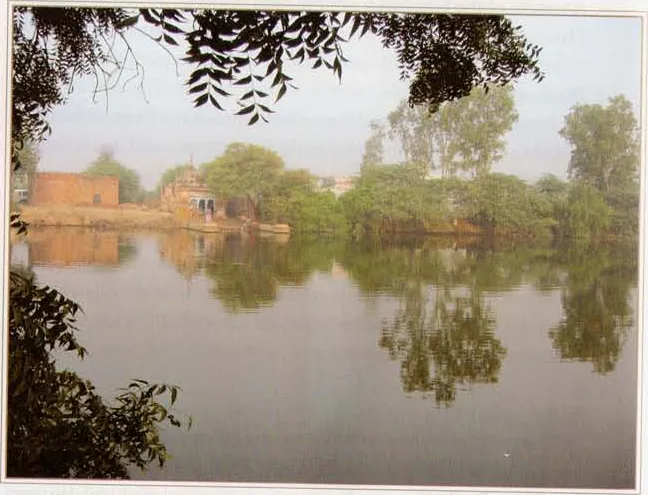
- What it is
- Sūrya-kuṇḍa, the kuṇḍa of the Sun, lies about four miles north of Rādhā-kuṇḍa and is today also called Choṭā Bharanā; a temple of Sūryadeva, the sun-god, stands there (Sūryadeva Mandira (Sūrya-kuṇḍa …
- Visiting
- Śrī Vraja-maṇḍala Parikramā (2007) places Sūrya-kuṇḍa about four miles north of Rādhā-kuṇḍa and describes a temple of Sūryadeva there; it says that the kuṇḍa is today also called Choṭā Bharanā.
- Places here
- Madana-raṇa-vāṭikā, Sūryadeva Mandira (Sūrya-kuṇḍa, Choṭā Bharanā)
In short
Sūrya-kuṇḍa, the kuṇḍa of the Sun, lies about four miles north of Rādhā-kuṇḍa and is today also called Choṭā Bharanā; a temple of Sūryadeva, the sun-god, stands there (Sūryadeva Mandira (Sūrya-kuṇḍa, Choṭā Bharanā)).[1 +1] According to the Bhakti-ratnākara, Śrī Rādhā worships the Sun here with Her sakhīs while Kṛṣṇa, who has become the priest, playfully conducts the worship.[3] Śrīla Kṛṣṇadāsa Kavirāja Gosvāmī and Śrīla Viśvanātha Cakravartī Ṭhākura tell this midday pastime at the Sun's image and temple without naming the kuṇḍa.[4 +2] Śrī Vraja-maṇḍala Parikramā (2007) says that Śrī Madhusūdana dāsa Bābājī and his disciple Śrīla Jagannātha dāsa Bābājī performed their bhajana here.[2 +1]
Key facts
| Kind | kuṇḍa |
|---|---|
| Region · area | Govardhana |
| Ācāryas | Śrīla Śrīnivāsa Ācārya, Śrīla Jagannātha dāsa Bābājī, Śrī Madhusūdana dāsa Bābājī, Śrīla Bhaktivinoda Ṭhākura, Śrīla Rāghava Paṇḍita Gosvāmī of Govardhana |
Divine pastimes
Rādhā's worship of the Sun
In the Bhakti-ratnākara, Śrīla Rāghava Paṇḍita shows Śrīla Śrīnivāsa Ācārya the village of Sūryakuṇḍa and the image of Sūrya in a Sun temple in the forest. Here, he says, Rāī (Śrī Rādhā) worships the Sun in great joy with Her sakhīs, and Kṛṣṇa, as the priest, playfully conducts the worship. This kind Sun gives love for Kṛṣṇa, and the book quotes a verse that calls him the giver of rati, attachment, for Kṛṣṇa (summarised here, not translated).[3 +1]
Śrīla Kṛṣṇadāsa Kavirāja Gosvāmī's Govinda-līlāmṛta tells the pastime twice among the pastimes of midday. In the eighth chapter Rādhā, walking through the forest with Her sakhīs, comes to the image of the Sun that stands in a kuñja in the middle of a flower garden called Madana-raṇa-vāṭikā. She bows to it and prays that Her meeting with Govinda may be free of obstacles, and two maidservants stay there with the things for the Sūrya-pūjā, the worship of the Sun.[2 +2] In the eighteenth chapter She goes to the Sun temple for Her worship, and Kṛṣṇa comes with Madhumaṅgala dressed as Viśvaśarmā, a brāhmaṇa student of Garga from Mathurā who is expert in the Sūrya-pūjā. At the request of Jaṭilā, Rādhā's mother-in-law, He conducts the worship, and Jaṭilā then chooses Him as Rādhā's guru for the Sun worship. Neither chapter names Sūrya-kuṇḍa (summarised here, not translated).[5]
Śrīla Viśvanātha Cakravartī Ṭhākura's Kṛṣṇa-bhāvanāmṛta tells the same pastime at the Sun temple: Jaṭilā asks the brāhmaṇa boy from Mathurā, Kṛṣṇa in disguise, to make her daughter-in-law worship Mitra. The commentary of Kṛṣṇadeva Sārvabhauma printed with the book explains that Mitra is the Sun and, in the other sense, Kṛṣṇa Himself, the friend.[6 +1] In another chapter the same commentary explains the Sūrya-tīrtha where the sage Garga comes to bathe as the Sūrya-kuṇḍa in the Madana-raṇa-vāṭikā; that is the commentator's reading, not the poem's words.[9] Read more: Śrī Rādhā's worship of the Sun (Sūrya-pūjā) →
At the kuṇḍa
Śrī Vraja-maṇḍala Parikramā (2007) tells the pastime at this kuṇḍa. Śrīmatī Rādhikā came here with Her sakhīs, especially on Sundays, on the pretext of worshipping Mitradeva, the Sun, and Kṛṣṇa, disguised as a priest, came with Madhumaṅgala to conduct the worship. Mitra means both the Sun and Her dearest friend, Kṛṣṇa, which Jaṭilā did not understand. The pastime takes place at midday, after which Rādhikā returns to Jāvaṭa and Kṛṣṇa to His friends.[1 +3] The book adds that the kuñja of the Sūrya-pūjā, next to Sūrya-kuṇḍa, is also called Madana-raṇa-vāṭikā.[2 +2]
The undated parikramā notes Govardhana tell that after the worship Kṛṣṇa and Madhumaṅgala went back to Gvāla-pokharā, where the cowherd boys snatched Madhumaṅgala's laḍḍūs (sweets).[10] In a note printed after verse 10 of Śrīla Raghunātha dāsa Gosvāmī's Dāna-keli-cintāmaṇi, the editor, Haridās Dās, tells that Jaṭilā once sent Rādhā on a Sunday to Sūrya-kuṇḍa to bathe and worship the Sun before Bhāguri's sacrifice; the verse itself says only that Rādhā worshipped the Sun and set out from Her own kuṇḍa.[11]
The sources do not agree on how often Rādhā comes for this worship:
Accounts differ How often Rādhā worships the Sun at Sūrya-kuṇḍa.
- Śrī Vraja-maṇḍala Parikramā (2007)Especially on Sundays.
- Vṛndāvana, the Playground of God (2010)Every day.
- Bhakti-ratnākara, Fifth Wave (1912 ed. p. 212)No frequency given.
- Kṛṣṇa-bhāvanāmṛta 15.66 (Śrīla Viśvanātha Cakravartī Ṭhākura)Jaṭilā says the brāhmaṇa boy (Kṛṣṇa in disguise) will make her daughter-in-law worship 'every day' (pratidinaṁ); the Sun temple is not located.
The Gosvāmīs and ācāryas
Śrī Vraja-maṇḍala Parikramā (2007) says that Śrī Madhusūdana dāsa Bābājī, a rasika Gauḍīya Vaiṣṇava (one who relishes the …
Śrī Vraja-maṇḍala Parikramā (2007) says that Śrī Madhusūdana dāsa Bābājī, a rasika Gauḍīya Vaiṣṇava (one who relishes the sweetness of Kṛṣṇa's pastimes), performed his bhajana on the west bank of the kuṇḍa and taught bhajana to Vaiṣṇavas who came from far away. His disciple Śrīla Jagannātha dāsa Bābājī also performed bhajana here for a long time before moving to Navadvīpa, where his bhajana-kuṭī and samādhi are, in Koladvīpa. The historian A. W. Entwistle (1987) also places both Vaiṣṇavas here, in the nineteenth century, but cites no dated document.[2 +5]
According to Vṛndāvana, the Playground of God (2010), Śrīla Jagannātha dāsa Bābājī worshipped here for about ten years the Ṣaḍbhuja (six-armed) Mahāprabhu Deity that his disciple Bihārī dāsa had brought from Rādhā-kuṇḍa; when he moved to Bengal, the Deity was given to Śrī Narottama dāsa Bābājī, in whose temple in Vṛndāvana He is worshipped.[12] The guidebooks also say that the brass Deities of Gaura and Nitāi later called Soṇā Gaurāṅga were installed for Śrīla Jagannātha dāsa Bābājī here; what became of them is told in different ways.[2 +5]
Visiting today
Śrī Vraja-maṇḍala Parikramā (2007) places Sūrya-kuṇḍa about four miles north of Rādhā-kuṇḍa and describes a temple of Sūryadeva there; it says that the kuṇḍa is today also called Choṭā Bharanā.[1 +1]
Places at Sūrya-kuṇḍa (Choṭā Bharanā)
2 places
Nearby places
Rādhā-kuṇḍa · Govardhana · Chatravana
Where the sources differ
Where Śrīla Bhaktivinoda Ṭhākura first met Śrīla Jagannātha dāsa Bābājī: one guidebook says here, while another and this site's own profile say in Vṛndāvana, about 1880; it is not certain.[2 +1]
Accounts differ Where Śrīla Bhaktivinoda Ṭhākura met (first met) Śrīla Jagannātha dāsa Bābājī.
- Śrī Vraja-maṇḍala Parikramā (2007)At Sūrya-kuṇḍa.
- Vṛndāvana, the Playground of God (2010)First met in Vṛndāvana, around 1880; shortly after that Śrīla Jagannātha dāsa Bābājī returned to Navadvīpa.
What became of the Soṇā Gaurāṅga Deities.[7 +3]
Accounts differ The Soṇā Gaurāṅga Deities: how the theft failed and what happened to the Deities.
- Vṛndāvana, the Playground of God (2010)Made when Śrīla Jagannātha dāsa Bābājī, living at Sūrya-kuṇḍa, asked his disciple Bihārī dāsa to install Deities; the dacoits broke in but could not lift Them; disturbed by the risk, he had Bihārī donate Them to a Gosvāmī family in Vṛndāvana town, where They still are.
- The Color Guide to Vṛndāvana (2000)Moved to Vṛndāvana when thieves tried to steal Them; when Śrīla Jagannātha dāsa Bābājī returned to Bengal They were looked after by a local brāhmaṇa.
- the undated parikramā notes VṛndāvanaSent to Vṛndāvana when thieves who thought They were gold tried to steal Them.
- Entwistle (1987), printed p. 358 (historian)The local people built a hut and a small temple for Siddha Jagannātha dāsa Bābā, in which images of Caitanya and Nityānanda were installed; no theft or move is mentioned.
More on this place
Śrī Rādhā's worship of the Sun (Sūrya-pūjā)
References
17 references
- Śrī Vraja-maṇḍala Parikramā (2007), PDF p. 136
- Śrī Vraja-maṇḍala Parikramā (2007), PDF p. 137
- Śrīla Narahari Cakravartī, Bhakti-ratnākara, Fifth Wave, 1912 ed. p. 212, 2nd ed., 1912
- Śrīla Kṛṣṇadāsa Kavirāja Gosvāmī, Govinda-līlāmṛta, 8.67-68 and 8.70, after the editions of Haridas Das and Haridas Shastri
- Śrīla Kṛṣṇadāsa Kavirāja Gosvāmī, Govinda-līlāmṛta, 18.56-58, after the editions of Haridas Das and Haridas Shastri
- Śrīla Viśvanātha Cakravartī Ṭhākura, Kṛṣṇa-bhāvanāmṛta, 15.58 with the ṭīkā, pañcadaśaḥ sargaḥ, mādhyāhnika-līlāsvādana; the index labels it '(15) caturdaśaḥ sargaḥ'), after the edition of Radhikanath Goswami, Vrindavan, 1906
- A. W. Entwistle, §25 'Nimgaon and other places in the vicinity of Govardhan', printed p. 358, Egbert Forsten, Groningen, 1987
- Śrīla Narahari Cakravartī, Bhakti-ratnākara, Fifth Wave, 1912 ed. p. 211, 2nd ed., 1912
- Śrīla Viśvanātha Cakravartī Ṭhākura, Kṛṣṇa-bhāvanāmṛta, 8.63 with the ṭīkā, aṣṭamaḥ sargaḥ, saṅgava-līlāsvādana; the index labels it '(8) saptamaḥ sargaḥ'), after the edition of Radhikanath Goswami, Vrindavan, 1906
- the undated parikramā notes Govardhana, ¶40
- Śrīla Raghunātha dāsa Gosvāmī, Dāna-keli-cintāmaṇi, v.10 and the note after it
- Vṛndāvana, the Playground of God (2010), Bhakti Caitanya Svāmī, PDF p. 175
- Vṛndāvana, the Playground of God (2010), Bhakti Caitanya Svāmī, PDF p. 187
- The Color Guide to Vṛndāvana (2000), Written and Photographed by Rājaśekhara dāsa Brahmacārī, PDF p. 124
- the undated parikramā notes Vṛndāvana, ¶241
- Śrī Vraja-maṇḍala Parikramā (2007), p. 246-247
- Śrī Vraja-maṇḍala Parikramā (2007), p. 176-177