The six-armed form of Śrī Caitanya Mahāprabhu
षड्भुज महाप्रभु: श्री चैतन्य महाप्रभु का छह भुजाओं वाला रूप
In short
Ṣaḍbhuja, "six-armed", is a form of Śrī Caitanya Mahāprabhu. As Śrīla Prabhupāda explains it, it has two arms of Śrī Rāmacandra, two of Śrī Kṛṣṇa and two of His own. The Caitanya-caritāmṛta says that He showed a six-armed form to Śrī Nityānanda Prabhu. According to the guidebooks, a temple of Ṣaḍbhuja Mahāprabhu stands beside Nidhuvana in Vṛndāvana.[1–8]
On this page
At a glance
- The scripture: Caitanya-caritāmṛta Ādi-līlā 17.12–13, the vision of Śrī Nityānanda Prabhu.[5, 6]
- The place of that vision: Śrīvāsa Ṭhākura's courtyard in Navadvīpa, according to the Bhakti-ratnākara.[9]
- The three pairs of arms, in Śrīla Prabhupāda's purport: the bow and arrow of Rāma, the stick and flute of Kṛṣṇa, and the staff and waterpot of Śrī Caitanya.[1]
- Another list: the verse after it names a conchshell, disc, club, lotus, bow and flute.[6]
- The worship: according to Śrīla Prabhupāda, the best purpose of human life can be fulfilled by worshipping this form.[2]
- At Purī: Śrīla Prabhupāda writes that a Ṣaḍbhuja Deity stands at one end of the Jagannātha temple.[10]
- In Vṛndāvana: the Ṣaḍbhuja Mahāprabhu Mandira (temple) next to Nidhuvana. The guidebooks say Śrīla Jagannātha dāsa Bābājī worshipped its Deity.[4 +3]
What is the six-armed form of Śrī Caitanya?
Śrīla Prabhupāda explains the form in his purport (his explanation of the verse) to Caitanya-caritāmṛta Ādi-līlā 17.12. He describes it as three incarnations in one:[1–4]
General teaching (does not name the place)“The form of Ṣaḍ-bhuja, the six-armed Lord Gaurasundara, is a representation of three incarnations. The form of Śrī Rāmacandra is symbolized by a bow in one hand and an arrow in another, the form of Lord Śrī Kṛṣṇa is symbolized by a stick and a flute … and Lord Caitanya Mahāprabhu is symbolized by a sannyāsa-daṇḍa and a kamaṇḍalu”
Śrīla Prabhupāda, Śrī Caitanya-caritāmṛta, Ādi-līlā 17.12, purport · vedabase.io
He gives the same explanation in a letter of May 1970, answering a disciple's question. The form had two hands of Lord Rāmacandra, two hands of Kṛṣṇa and two hands of Lord Caitanya.[3]
The guidebook Vṛndāvana, the Playground of God (2010) describes the Deity (the sacred form worshipped in the temple) of the Vṛndāvana temple in the same three pairs. Mahāprabhu's own two arms hold His sannyāsa-daṇḍa and kamaṇḍalu, the renunciant's staff and waterpot. Kṛṣṇa's two arms hold the flute, and Rāma's two arms the bow and arrow.[4, 7]
One hymn gives Śrī Caitanya Mahāprabhu a hundred and eight names: the Śrī Gaurāṅga-aṣṭottara-śata-nāma-stotra. One of His names there is ṣaḍ-bhuja, the six-armed, in the same verse as catur-bhuja, the four-handed. Another is nityānanda-ṣaḍ-bhuja-darśaka, the one who showed Śrī Nityānanda Prabhu His six-armed form. The song book credits the hymn to Śrīla Sārvabhauma Bhaṭṭācārya.[12]
To whom did He show it?
Śrī Nityānanda Prabhu
The Caitanya-caritāmṛta records the vision in its summary of Śrī Caitanya Mahāprabhu's early pastimes:[5, 6]
তবে নিত্যানন্দ–স্বরূপের আগমন ।
প্রভুকে মিলিয়া পাইল ষড়্ভুজ–দর্শন ॥ ১২ ॥
tabe nityānanda-svarūpera āgamana
prabhuke miliyā pāila ṣaḍ-bhuja-darśana
After this function at the house of Śrīvāsa Ṭhākura, Nityānanda Prabhu appeared, and when He met with Lord Caitanya He got the opportunity to see Him in His six-armed form.
Translation: Śrīla A.C. Bhaktivedanta Swami PrabhupādaŚrīla Prabhupāda's purport to that verse names Padmāvatī as Śrī Nityānanda Prabhu's mother.[9]
The Bhakti-ratnākara of Śrīla Narahari Cakravartī Ṭhākura places the vision in Navadvīpa. The book follows Śrīla Śrīnivāsa Ācārya on a tour of Navadvīpa. His guide, named Īśāna in the book, shows him the courtyard of Śrīvāsa Ṭhākura. There Gauracandra and Nityānanda danced in saṅkīrtana, the chanting of the holy names together. The guide tells him that here the son of Padmāvatī joyfully saw Śrī Gauracandra's six-armed form (summarised here, not translated).[9] So, by this account, the vision took place in Bengal, not in Vraja.[9]
Śrīla Sārvabhauma Bhaṭṭācārya
In several places Śrīla Prabhupāda writes that the six-armed form was also shown to Śrīla Sārvabhauma Bhaṭṭācārya at Purī. In his purport to Caitanya-caritāmṛta Ādi-līlā 10.130 he says:[10]
General teaching (does not name the place)“Sārvabhauma Bhaṭṭācārya was so fortunate as to see the six-armed form of Lord Caitanya known as Ṣaḍbhuja. A Ṣaḍbhuja Deity is still situated at one end of the Jagannātha temple. Daily saṅkīrtana performances take place in this part of the temple.”
Śrīla Prabhupāda, Śrī Caitanya-caritāmṛta, Ādi-līlā 10.130, purport · vedabase.io
In Teachings of Lord Caitanya he tells of the scholar's change of heart in the same way. The Lord valued his humility and showed His own form, first with four hands and then with six.[13]
A song says it too. The song book credits it to Gopāla dāsa, and its sixth verse carries his signature. In that verse Sārvabhauma, who knew all the scriptures and had argued with the Lord, is given darśana (the sight) of the six-armed form. His mind is awakened (summarised here, not translated).[14]
The Caitanya-caritāmṛta's own account of that meeting, in Madhya-līlā chapter 6, names other forms:[15]
নিজ-রূপ প্রভু তাঁরে করাইল দর্শন ।
চতুর্ভুজ-রূপ প্রভু হইলা তখন ॥ ২০২ ॥
nija-rūpa prabhu tāṅre karāila darśana
catur-bhuja-rūpa prabhu hā-ilā takhana
To show him mercy, Śrī Caitanya Mahāprabhu allowed him to see His Viṣṇu form. Thus He immediately assumed four hands.
Translation: Śrīla A.C. Bhaktivedanta Swami Prabhupādaদেখাইল তাঁরে আগে চতুর্ভুজ-রূপ ।
পাছে শ্যাম-বংশীমুখ স্বকীয় স্বরূপ ॥ ২০৩ ॥
dekhāila tāṅre āge catur-bhuja-rūpa
pāche śyāma-vaṁśī-mukha svakīya svarūpa
Śrī Caitanya Mahāprabhu first showed him the four-handed form and then appeared before him in His original form of Kṛṣṇa, with a blackish complexion and a flute to His lips.
Translation: Śrīla A.C. Bhaktivedanta Swami PrabhupādaThe statements differ. They are set side by side here, without trying to make them agree:
Accounts differ Whether Lord Caitanya showed the six-armed form to Sārvabhauma Bhaṭṭācārya.
- Śrī Caitanya-caritāmṛta Madhya-līlā 6.202-203To show him mercy, the Lord showed Sārvabhauma His Viṣṇu form with four hands, and then His original form of Kṛṣṇa, blackish, with a flute to His lips. No six-armed form is named.
- Śrīla Prabhupāda, purport to Caitanya-caritāmṛta Ādi-līlā 10.130'Sārvabhauma Bhaṭṭācārya was so fortunate as to see the six-armed form of Lord Caitanya known as Ṣaḍbhuja.' The same purport refers the reader to Madhya-līlā chapter six for the meeting.
- Śrīla Prabhupāda, Teachings of Lord Caitanya, chapter 26The Lord showed him His form 'first with four hands, and then with six hands (ṣaḍ-bhuja)'.
- Śrīla Prabhupāda, letters of 29 July 1968 (Madhusudana) and 3 May 1970 (Ekayani)The six-armed form was shown (disclosed) to Sārvabhauma Bhaṭṭācārya.
Śrī Rāmānanda Rāya
In a letter of July 1968 Śrīla Prabhupāda wrote that the form was shown to Rāmānanda Rāya as well. He wrote that the Ṣaḍbhuja-mūrti (the six-armed form) is worshipped by the devotees of Lord Caitanya, especially in the temple of Jagannātha at Purī.[17]
The Caitanya-caritāmṛta tells of Śrī Rāmānanda Rāya's meeting with the Lord in Madhya-līlā chapter 8, and there it tells of other visions. Śrī Rāmānanda Rāya first saw Him as a sannyāsī, a renunciant monk, then as Śyāmasundara, the cowherd boy. The Lord then showed him His own form, in which Kṛṣṇa and Śrīmatī Rādhārāṇī are combined as one.[18, 19] The two persons and their two meetings are kept apart here, each with its own sources, as the accounts differ:
Accounts differ Whether the six-armed form was shown to Rāmānanda Rāya.
- Śrīla Prabhupāda, letter to Madhusudana, Montreal, 29 July 1968'This form was shown to Ramananda Roy, and Sarvabhauma Bhattacarya.'
- Śrī Caitanya-caritāmṛta Madhya-līlā 8.268 and 8.282Rāmānanda Rāya first saw the Lord as a sannyāsī and then as Śyāmasundara, the cowherd boy; the Lord then showed him His form in which Rasa-rāja (Kṛṣṇa) and Mahābhāva (Rādhā) are combined. No six-armed form is named.
What do the six hands hold?
The verse that follows the vision of Śrī Nityānanda Prabhu gives a list of its own:[6]
One day Lord Caitanya Mahāprabhu exhibited to Lord Nityānanda Prabhu a six-armed form bearing a conchshell, disc, club, lotus flower, bow and flute.
Translation: Śrīla A.C. Bhaktivedanta Swami PrabhupādaThis set is a conchshell, disc, club, lotus flower, bow and flute. It is not the same as the Rāma-Kṛṣṇa-Caitanya set that Śrīla Prabhupāda's purport to the verse before it describes, and that the Vṛndāvana guidebook gives for the Deity there.[4, 6, 7] The two descriptions differ, and they are set side by side:
Accounts differ What the six arms of Lord Caitanya's six-armed form hold.
- Śrī Caitanya-caritāmṛta Ādi-līlā 17.13 (verse and translation)The six-armed form first shown to Śrī Nityānanda Prabhu bore 'a conchshell, disc, club, lotus flower, bow and flute'.
- Śrīla Prabhupāda, purport to Caitanya-caritāmṛta Ādi-līlā 17.12; also ŚB 5.19.8 purport and letter of 3 May 1970The Ṣaḍ-bhuja form represents three incarnations: Rāma (bow and arrow), Kṛṣṇa (stick and flute) and Caitanya (sannyāsa-daṇḍa and waterpot); two arms each of Rāmacandra, Kṛṣṇa and Caitanya.
- Vṛndāvana, the Playground of God (2010) on this temple's DeityMahāprabhu's own two arms hold His sannyāsa daṇḍa and kamaṇḍalu, Kṛṣṇa's two arms the flute, Rāma's two arms the bow and arrow.
What does Śrīla Prabhupāda say about worshipping this form?
The Fifth Canto of Śrīmad-Bhāgavatam speaks of the worship of Lord Rāmacandra. In a purport there, Śrīla Prabhupāda writes that Śrī Caitanya Mahāprabhu is represented in the six-armed form. Worship of it, he writes, fulfils the best purpose of human life:[1–4]
General teaching (does not name the place)“Śrī Caitanya Mahāprabhu is therefore represented in the six-armed form of ṣaḍ-bhūja-mūrti, which is a combination of Lord Rāmacandra, Lord Kṛṣṇa and Lord Śrī Caitanya Mahāprabhu. The best purpose of human life can be fulfilled by worshiping the ṣaḍ-bhūja-mūrti, the form of the Lord with six arms”
Śrīla Prabhupāda, Śrīmad-Bhāgavatam, 5.19.8, purport · vedabase.io
Śrīla Prabhupāda gives these as general teachings about the form; they do not mention the Vṛndāvana temple.[1–4] In his letter of 1968 he adds that the devotees of Lord Caitanya worship the Ṣaḍbhuja-mūrti. It is found, he says, especially in the Jagannātha temple at Purī.[17]
Is there a Ṣaḍbhuja Deity at Jagannātha Purī?
Yes, according to Śrīla Prabhupāda. In his purport to Caitanya-caritāmṛta Ādi-līlā 10.130, he writes that a Ṣaḍbhuja Deity is still situated at one end of the Jagannātha temple. Saṅkīrtana takes place there every day.[10] The places that the sources connect with the Vṛndāvana Deity are Rādhā-kuṇḍa, Sūrya-kuṇḍa, Nidhuvana and the Soṇā Gaurāṅga temple; Purī is not among them.[4 +3]
A song credited to Ananta Ācārya, whose fifth verse carries his signature, sings of the Lord in Utkala, Orissa. He went there and showed His six-armed form before He made His home at Nīlācala, Purī.[20]
Where is the Ṣaḍbhuja temple in Vṛndāvana?
The Ṣaḍbhuja Mahāprabhu Mandira is a small temple in Vṛndāvana town, next to Nidhuvana. This website's biography of Śrīla Jagannātha dāsa Bābājī places it in a lane of Nidhuvana. No source prints directions or darśana times.[7, 8] Read more: Nidhuvana: Śrī Rādhā's dream of the golden youth and the stolen flute →
The guidebooks name it after its Deity, and one adds a second name, Gopāla Mandira. In a photograph of 2010, the sign over the entrance reads "Shri Gopal Ji Mandir".[4 +4] The earliest known dated mention of the temple is a list of Vṛndāvana's temples by the historian Prabhudayāl Mītal (1966). It names the temple, but gives no place, date or founder.[23]
A six-armed Mahāprabhu at Imlītalā in 1905
An older book mentions a six-armed Mahāprabhu at another place in the town. In his Bengali Bhaktamāla (1905), Kṛṣṇadāsa Bābājī lists the holy places of Vṛndāvana in verse. He writes of Āmalitalā, where Śrī Gaurāṅga, the deliverer of the fallen, sat when He came to Vṛndāvana. The tamarind tree is present there to this day, he says. A most beautiful Mahāprabhu is beneath it, and a six-armed Mahāprabhu is present there (summarised here, not translated).[24]
The place is the Imlītalā of today. The book says no more about that Deity, and no source connects it with the Deity of the Ṣaḍbhuja temple.[4 +4] Pulinbihārī Datta's Bengali Vṛndāvana-kathā (1920) describes Āmalitalā. By then the old tamarind was gone. Beside the younger tree stood a temple built by the gosvāmīs of Śrī Nityānanda Prabhu's family. It was almost in ruins, with images of Nitāi and Caitanya.[25]
The Deity of the Ṣaḍbhuja temple
Two guidebooks and this website's biography of the Bābājī say that this is the Deity whom Śrīla Jagannātha dāsa Bābājī worshipped. None of them cites a document.[4 +3]
According to Vṛndāvana, the Playground of God (2010), he worshipped Him for about ten years at Sūrya-kuṇḍa, between Govardhana and Chātā. (A kuṇḍa is a sacred pond.) When he moved to Bengal, the Deity went to a temple in Vṛndāvana town.[7, 8] Read more: Śrī Rādhā's worship of the Sun (Sūrya-pūjā) → How the Deity was found is told in three ways, which are set out on the temple's page. No source gives a year for any of these events.[7, 8]
Śrīla Prabhupāda names Śrīla Jagannātha dāsa Bābājī in the disciplic succession, the line of teachers, after Śrīla Viśvanātha Cakravartī Ṭhākura. He names him as the spiritual master of Śrīla Bhaktivinoda Ṭhākura:[4 +2]
General teaching (does not name the place)“Śrīla Viśvanātha Cakravartī Ṭhākura accepted Śrīla Jagannātha dāsa Bābājī, the spiritual master of Śrīla Bhaktivinoda Ṭhākura, who in turn accepted Śrīla Gaurakiśora dāsa Bābājī”
Śrīla Prabhupāda, Śrī Caitanya-caritāmṛta, Ādi-līlā, Chapter 1, introductory summary (before Text 1) · vedabase.io
At the end of the Introduction to Bhagavad-gītā As It Is there is a list of the disciplic succession. There the same name stands between Śrīla Viśvanātha Cakravartī Ṭhākura and Śrīla Bhaktivinoda Ṭhākura.[27] The sources do not agree on the Bābājī's dates, which are the only time marks for the Deity's story in Vṛndāvana:[4 +2]
Accounts differ The dates of Śrīla Jagannātha dāsa Bābājī, the only time marks for this Deity's history.
- Vṛndāvana, the Playground of God (2010), on this temple's pageHe 'appeared in this world around the second half of the 18th century, in the Mayaman Singh district', first met Śrīla Bhaktivinoda Ṭhākura in Vṛndāvana around 1880, and 'left this world in Navadvīpa in 1894'.
Places in this article
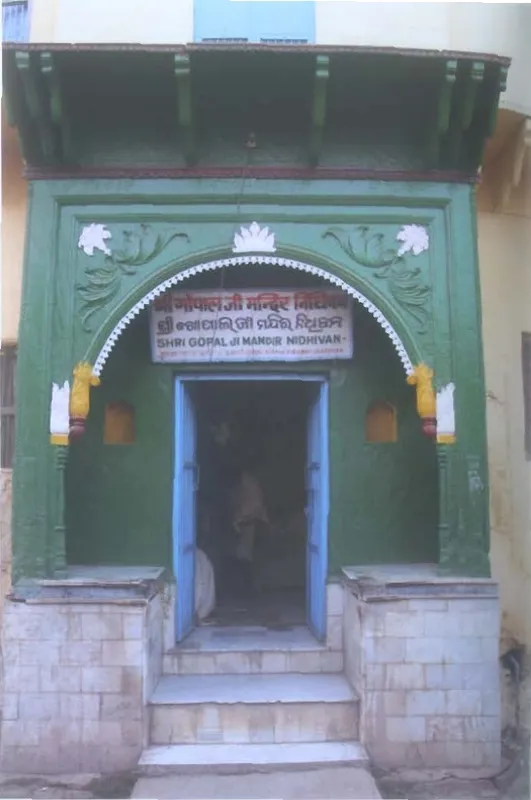
Ṣaḍbhuja Mahāprabhu Mandira
षड्भुज महाप्रभु मन्दिरThe Ṣaḍbhuja Mahāprabhu Mandira is a small temple next to Nidhuvana in Vṛndāvana town.
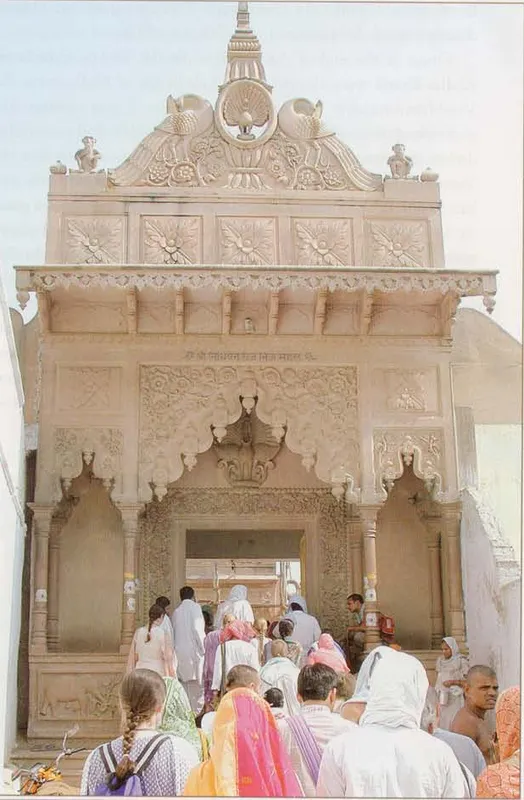
Nidhuvana
निधुवनNidhuvana is a walled grove in Vṛndāvana town, north of Sevā-kuñja.
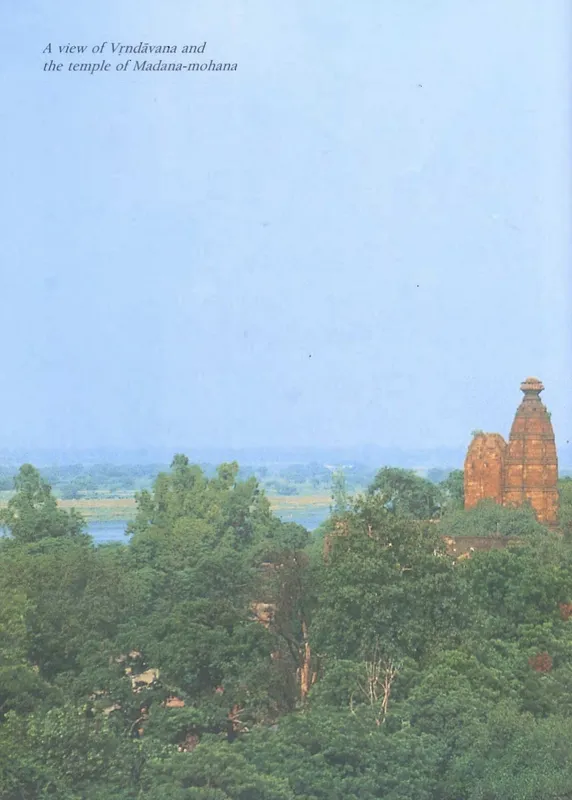
Vṛndāvana
वृन्दावनVṛndāvana is the forest on the bank of the Yamunā where Kṛṣṇa spent His childhood and youth, and the town of temples that stands in that forest today.
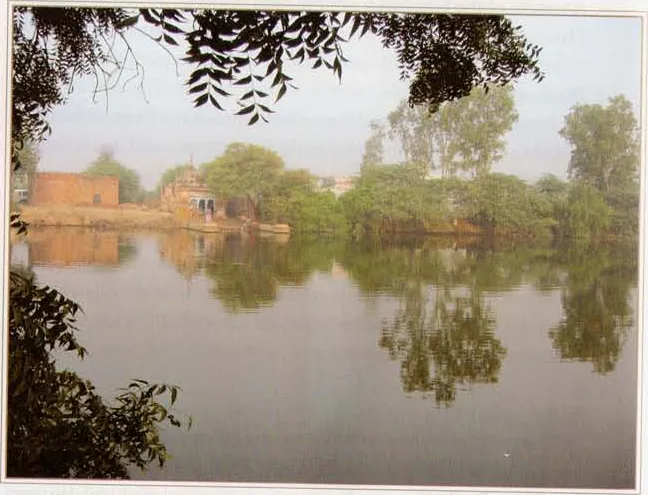
Sūrya-kuṇḍa (Choṭā Bharanā)
सूर्य-कुण्ड (छोटा भरना)Sūrya-kuṇḍa, the kuṇḍa of the Sun, lies about four miles north of Rādhā-kuṇḍa and is today also called Choṭā Bharanā; a temple of Sūryadeva, the sun-god, stands there.
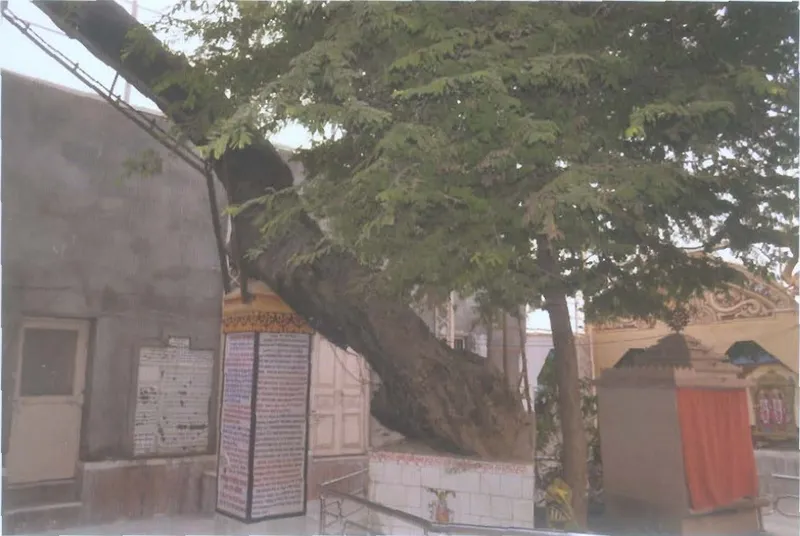
Imlītalā (Vṛndāvana)
इमलीतला (वृन्दावन)Imlītalā, "the foot of the tamarind tree", is a tamarind with a temple on the old bank of the Yamunā in Vṛndāvana, near Sevā-kuñja.
Questions and answers
It is the Ṣaḍbhuja form. Śrīla Prabhupāda explains it as three incarnations in one. Śrī Rāmacandra holds bow and arrow, Śrī Kṛṣṇa stick and flute, and Śrī Caitanya Mahāprabhu the sannyāsī's staff and waterpot.[1–4]
The Caitanya-caritāmṛta says that He showed a six-armed form to Śrī Nityānanda Prabhu. The Bhakti-ratnākara places that vision in Śrīvāsa's courtyard in Navadvīpa. Śrīla Prabhupāda also names Śrīla Sārvabhauma Bhaṭṭācārya and, in one letter, Śrī Rāmānanda Rāya.[5 +4]
In Śrīla Prabhupāda's purport: bow and arrow, stick and flute, and staff and waterpot. The verse after it, Caitanya-caritāmṛta Ādi 17.13, names a conchshell, disc, club, lotus flower, bow and flute for the form shown to Śrī Nityānanda Prabhu.[1, 6]
He writes that the best purpose of human life can be fulfilled by worshipping the six-armed form. This form combines Lord Rāmacandra, Lord Kṛṣṇa and Lord Śrī Caitanya Mahāprabhu.[2]
Yes. Śrīla Prabhupāda writes that a Ṣaḍbhuja Deity is still situated at one end of the Jagannātha temple, where saṅkīrtana takes place daily.[10]
According to the guidebooks, it is next to Nidhuvana in Vṛndāvana town. In a photograph of 2010, the sign at its entrance reads "Shri Gopal Ji Mandir".[4, 7, 8]
According to two guidebooks and this website's biography of him, Śrīla Jagannātha dāsa Bābājī worshipped Him, for about ten years at Sūrya-kuṇḍa. None of them cites a document.[4 +3]
Sources
- Śrīla Prabhupāda, Śrī Caitanya-caritāmṛta, Ādi-līlā 17.12, purport · vedabase.io
- Śrīla Prabhupāda, Śrīmad-Bhāgavatam, 5.19.8, purport · vedabase.io
- Śrīla Prabhupāda, Letter to Ekayani, letter 70-05-03, 3 May 1970 · vedabase.io
- Vṛndāvana, the Playground of God (2010), Bhakti Caitanya Svāmī, PDF p. 174
- Śrīla Kṛṣṇadāsa Kavirāja Gosvāmī, Śrī Caitanya-caritāmṛta, Ādi-līlā 17.12, online edition · vedabase.io
- Śrīla Kṛṣṇadāsa Kavirāja Gosvāmī, Śrī Caitanya-caritāmṛta, Ādi-līlā 17.13, online edition · vedabase.io
- The Color Guide to Vṛndāvana (2000), Written and Photographed by Rājaśekhara dāsa Brahmacārī, PDF p. 105
- Vṛndāvana, the Playground of God (2010), Bhakti Caitanya Svāmī, PDF p. 175
- Śrīla Narahari Cakravartī, Bhakti-ratnākara, Taraṅga 12 (dvādaśa taraṅga), Navadvīpa parikramā at Śrīvāsa-aṅgana; 2nd ed. 1912, printed p. 875, 2nd ed., 1912
- Śrīla Prabhupāda, Śrī Caitanya-caritāmṛta, Ādi-līlā 10.130, purport · vedabase.io
- Nandgram Dham Ācāryas, Śrīla Jagannātha dāsa Bābājī, section ‘Sonara Gaura and the Six-Armed Deity’
- Namaskrtya Pravaksyami Deva Devam (Śrī Gaurāṅga-aṣṭottara-śata-nāma-stotram) (Sārvabhauma Bhaṭṭācārya (as the song book credits it, printed 'Sarvabhauma Bhattacarya')) · song book
- Śrīla Prabhupāda, Teachings of Lord Caitanya, Chapter 26, 'The Bhaṭṭācārya is Converted' · vedabase.io
- Kara Yoḍe Nabadwīpe Bandiba Nimā I (Gopāla dāsa (as the song book credits it; verse 6 carries the signature 'gopāla bale')) · song book
- Śrīla Kṛṣṇadāsa Kavirāja Gosvāmī, Śrī Caitanya-caritāmṛta, Madhya-līlā 6.202, online edition · vedabase.io
- Śrīla Kṛṣṇadāsa Kavirāja Gosvāmī, Śrī Caitanya-caritāmṛta, Madhya-līlā 6.203, online edition
- Śrīla Prabhupāda, Letter to Madhusudana, letter 68-07-29, 29 July 1968 · vedabase.io
- Śrīla Kṛṣṇadāsa Kavirāja Gosvāmī, Śrī Caitanya-caritāmṛta, Madhya-līlā 8.268, online edition · vedabase.io
- Śrīla Kṛṣṇadāsa Kavirāja Gosvāmī, Śrī Caitanya-caritāmṛta, Madhya-līlā 8.282, online edition · vedabase.io
- Śacīra Nandana Jaga Jībana Sāra (Ananta Ācārya (as the song book credits it, printed 'Ananta Acārya'; verse 5 carries the signature 'ananta ācārye kaya')) · song book
Show all 27 references
- The Color Guide to Vṛndāvana (2000), Written and Photographed by Rājaśekhara dāsa Brahmacārī, PDF p. 12
- The Color Guide to Vṛndāvana (2000), Written and Photographed by Rājaśekhara dāsa Brahmacārī, PDF p. 163
- Prabhudayāl Mītal, part 1 ('ब्रज-संस्कृति की भूमिका'), 'Braj-yātrā', Vṛndāvana: 'Anya mandir-devālaya', printed p. 140
- Śrī Śrī Bhaktamāla grantha, pilgrimage list of Vṛndāvana's places, printed p. 351, right-hand column
- Vṛndāvana-kathā, ch. 16 (ṣoḍaśa pariccheda), item 6 'Āmalītalā', printed pp. 192-193; quoted from p. 193
- Śrīla Prabhupāda, Śrī Caitanya-caritāmṛta, Ādi-līlā, Chapter 1, introductory summary (before Text 1) · vedabase.io
- Śrīla Prabhupāda, Bhagavad-gītā As It Is, Introduction, closing list 'The Disciplic Succession' · vedabase.io
Further sources
- Śrī Caitanya-caritāmṛta, Ādi-līlā 10 and 17, Madhya-līlā 6 and 8, with Śrīla Prabhupāda's translation and purports (BBT); Śrīmad-Bhāgavatam 5.19.8 purport; Teachings of Lord Caitanya, chapter 26; Śrīla Prabhupāda's letters (vedabase.io).
- Bhakti-ratnākara, Twelfth Wave (Bengali, 1912): summarised, not translated. Songs named from the song book with their credits as printed.