Surabhi Vana
सुरभि वन Hindi name proposed
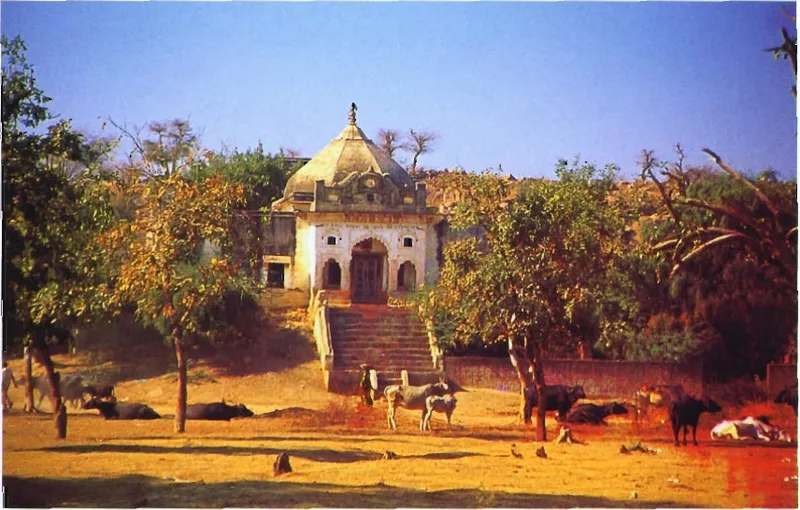
- What it is
- Surabhi Vana, the forest of the surabhi cows, lies at the side of Govardhana with Govinda-kuṇḍa.
- Visiting
- Govardhana Hill (2001) speaks of a forest that used to surround Govinda-kuṇḍa, named after the surabhi cows that grazed on its fresh grass.
- Places here
- Govinda-kuṇḍa (Govardhana)
In short
Surabhi Vana, the forest of the surabhi cows, lies at the side of Govardhana with Govinda-kuṇḍa. Śrīla Nārāyaṇa Bhaṭṭa Gosvāmī's Vraja-bhakti-vilāsa gives its circuit and its prayer and makes the forest and Govinda-kuṇḍa one station of the forest pilgrimage; the lists it quotes count Surabhīvana among the twelve upavanas, the smaller forests of Vraja.[1 +6] The guidebook Govardhana Hill (2001) says that a forest of this name used to surround Govinda-kuṇḍa and that Surabhi and Indra bathed Kṛṣṇa near this place.[1 +4] Śrīmad-Bhāgavatam tells that bath without naming any place.[11 +1]
Key facts
| Kind | forest |
|---|---|
| Region · area | Govardhana |
| Ācāryas | Śrīla Nārāyaṇa Bhaṭṭa Gosvāmī |
Why it is glorified
According to the Vraja-bhakti-vilāsa, which quotes a text it calls the Viṣṇu-yāmala, pilgrims on the forest pilgrimage should …
According to the Vraja-bhakti-vilāsa, which quotes a text it calls the Viṣṇu-yāmala, pilgrims on the forest pilgrimage should come to Surabhīvana on the fourteenth day of the dark fortnight of Bhādra and pray there; whoever does so attains the supreme abode. In summary, the prayer bows to the forest made delightful by the surabhi cows, adorned with rows of trees and full of fragrance.[1]
The same work quotes lists that praise the forest in other ways. A list given under the name of the Varāha Purāṇa counts Surabhīvana as the sixth of the twelve upavanas and says that it increases joy, and a list from a text it calls the Bṛhan-nāradīya names Govinda as its presiding deity, the name that Kṛṣṇa received at the bath given by Surabhi and Indra.[4 +1] Quoting the Bṛhad-gautamīya, it counts the forest, with Govardhana and Rādhā-kuṇḍa, among the places that are Śrī Rādhā's own domain; quoting the Viṣṇu-rahasya, which describes Vraja-maṇḍala as the Lord's body, it calls Surabhīvana the Lord's tongue.[6 +1]
Divine pastimes
The bath of Govinda
After Kṛṣṇa had lifted Govardhana, Surabhi, the mother of the cows, came to Him with Indra. Śrīmad-Bhāgavatam tells that she bathed Kṛṣṇa with her milk, and that Indra bathed Him with water of the heavenly Gaṅgā from the trunk of his elephant Airāvata and named Him Govinda. It names no place for the bath.[11 +5]
śṛī-śuka uvāca evaṃ kṛṣṇam upāmantrya surabhiḥ payasātmanaḥ / jalair ākāśa-gaṅgāyā airāvata-karoddhṛtaiḥ
indraḥ surarṣibhiḥ sākaṃ codito deva-mātṛbhiḥ / abhyasiñcata dāśārhaṃ govinda iti cābhyadhāt
Śukadeva Gosvāmī said: Having thus appealed to Lord Kṛṣṇa, mother Surabhi performed His bathing ceremony with her own milk, and Indra, ordered by Aditi and other mothers of the demigods, anointed the Lord with heavenly Gaṅgā water from the trunk of Indra’s elephant carrier, Airāvata. Thus, in the company of the demigods and great sages, Indra coronated Lord Kṛṣṇa, the descendant of Daśārha, and gave Him the name Govinda.
Translation: Śrīla Prabhupāda's disciples (BBT)The commentators place the bath on Govardhana. Śrīla Jīva Gosvāmī explains the word "there" in the next verse as the region of Govardhana known as Śakra-kuṇḍa from the Varāha Purāṇa and as Govinda-kuṇḍa from the Skanda Purāṇa, and Śrīla Sanātana Gosvāmī also names a place on Govardhana; neither mentions a forest (summarised here, not translated).[17 +1] For Indra's meeting with Kṛṣṇa, Śrīla Viśvanātha Cakravartī Ṭhākura takes the place from the Harivaṁśa: Kṛṣṇa was seated on a rock of Govardhana.[14 +1]
The Garga-saṁhitā also places the bath on Govardhana, and says that the streams of the surabhi's milk became Govinda-kuṇḍa.[9 +1]
अथ गोवर्धने रम्ये सुरभिर्गौः समुद्रजा । स्नापयामास गोपेशं दुग्धधाराभिरात्मनः ॥ 8 ॥
atha govardhane ramye surabhirgauḥ samudrajā
snāpayāmāsa gopeśaṁ dugdhadhārābhirātmanaḥ
No text found so far names the forest itself as the place of the bath. The link rests on the Vraja-bhakti-vilāsa, which joins Surabhīvana with Govinda-kuṇḍa, and on the guidebook.[1 +6] Read more: The lifting of Govardhana Hill, Indra's homage and the name Govinda →
Traditional accounts
In the Vraja-bhakti-vilāsa the bathing prayer for Govinda-kuṇḍa follows the forest's prayer directly.
In the Vraja-bhakti-vilāsa the bathing prayer for Govinda-kuṇḍa follows the forest's prayer directly. The round then goes on to the places of Govardhana-nātha on the hill: the place where Kṛṣṇa, as a boy of seven, ate yogurt, the mark of Gopāla's hand, and the darśana (sight) of Govardhana-nātha. It closes as the circumambulation of Surabhīvana, over three quarters of a krośa.[1 +3]
Śrīla Prabhupāda
Śrīla Prabhupāda does not speak of this forest by name.
Śrīla Prabhupāda does not speak of this forest by name. In his purport to Caitanya-caritāmṛta Madhya 18.37 he translates Śrīla Raghunātha dāsa Gosvāmī's verse on the bath at Govinda-kuṇḍa, in which Indra bathes Kṛṣṇa in the company of a surabhi cow.[10]
General teaching (does not name the place)“With humility caused by great fear, Indra took hold of the lotus feet of Lord Kṛṣṇa and, in the company of a surabhi cow, performed His coronation festival by bathing Him with the waters of the heavenly Ganges River. … I pray that Govinda-kuṇḍa, the lake created by that ceremonial bath, may eternally appear before my eyes.”
Śrīla Prabhupāda, Śrī Caitanya-caritāmṛta, Madhya-līlā 18.37, purport · vedabase.io
Songs
In the second verse of his Govardhanāśraya-daśaka, Śrīla Raghunātha dāsa Gosvāmī tells how the surabhi, followed by the humbled …
In the second verse of his Govardhanāśraya-daśaka, Śrīla Raghunātha dāsa Gosvāmī tells how the surabhi, followed by the humbled Indra with water of the heavenly river, bathed Hari, and how Govinda-kuṇḍa arose on the slope of the hill. The verse names Govinda-kuṇḍa, not the forest.[22]
indratve nibhṛtaṁ gavāṁ suranadī-toyena dīnātmanā
śakreṇānugatā cakāra surabhir yenābhiṣekaṁ hareḥ
yat-kacche 'jani tena nandita-janaṁ govinda-kuṇḍaṁ kṛtī
kas taṁ go-nikarendra-paṭṭa-śikharaṁ govardhanaṁ nāśrayet
Visiting today
Govardhana Hill (2001) speaks of a forest that used to surround Govinda-kuṇḍa, named after the surabhi cows that grazed on its fresh grass.[1 +4] The book also says that near Surabhi Vana there is a temple of Madana-mohana, which it calls very old, where the cowherds bring their herds to rest in the middle of the morning; it gives no date or founder, so the temple's age is not certain.[8]
Location
| Where it is | 'surrounding Govinda-kuṇḍa'[23] |
|---|
Places at Surabhi Vana
1 places
Nearby places
Rādhā-Madana-mohana Mandira (Vṛndāvana, old)
Where the sources differ
Where Surabhi and Indra came to Kṛṣṇa and bathed Him: on Govardhana, at Govinda-kuṇḍa, near Surabhi Vana, or in no place named.
Accounts differ Where Surabhi (with Indra) came to Kṛṣṇa and bathed Him, and where Indra gave Him a Surabhi cow
- Garga-saṁhitā 3.4.8, 3.4.16the surabhi bathed Kṛṣṇa 'on beautiful Govardhana'; the streams of her milk became Govinda-kuṇḍa on the hill
- Bhāgavatam 10.27.22-23; Kṛṣṇa book 27Surabhi and Indra bathed Kṛṣṇa; no place named
- Śrīla Prabhupāda, CC Madhya 18.37 purport (quoting Vraja-vilāsa-stava 74)Indra, in the company of a surabhi cow, bathed Kṛṣṇa; Govinda-kuṇḍa was created by that bath
- Vraja-bhakti-vilāsaSurabhīvana and Govinda-kuṇḍa form one station at the side of Govardhana (no bath is told there)
More on this place
The lifting of Govardhana Hill, Indra's homage and the name Govinda
References
23 references
- Śrīla Nārāyaṇa Bhaṭṭa, Vraja-bhakti-vilāsa, tenth chapter, Surabhīvana-pradakṣiṇā, printed p. 222, 1st ed., publ. Bābā Kṛṣṇadāsa, Kusuma-sarovara, Saṁvat 2008
- Śrīla Nārāyaṇa Bhaṭṭa, Vraja-bhakti-vilāsa, second chapter, list of the stations of the forest pilgrimage (vana-yātrā), section 54, printed p. 51, 1st ed., publ. Bābā Kṛṣṇadāsa, Kusuma-sarovara, Saṁvat 2008
- Śrīla Nārāyaṇa Bhaṭṭa, Vraja-bhakti-vilāsa, tenth chapter, end of the Surabhīvana round (section 54), printed p. 223, 1st ed., publ. Bābā Kṛṣṇadāsa, Kusuma-sarovara, Saṁvat 2008
- Śrīla Nārāyaṇa Bhaṭṭa, Vraja-bhakti-vilāsa, list of the twelve upavanas quoted under 'vārāhe', verse 19, printed p. 2, 1st ed., publ. Bābā Kṛṣṇadāsa, Kusuma-sarovara, Saṁvat 2008
- Śrīla Nārāyaṇa Bhaṭṭa, Vraja-bhakti-vilāsa, presiding deities of the twelve upavanas, quoted from the 'Bṛhan-nāradīya', item 6; printed p. 5, 1st ed., publ. Bābā Kṛṣṇadāsa, Kusuma-sarovara, Saṁvat 2008
- Śrīla Nārāyaṇa Bhaṭṭa, Vraja-bhakti-vilāsa, section 21, the domains (rājya) of Kṛṣṇa, Balarāma and Rādhā's friends, quoting the 'Bṛhad-gautamīya'; printed p. 36, 1st ed., publ. Bābā Kṛṣṇadāsa, Kusuma-sarovara, Saṁvat 2008
- Śrīla Nārāyaṇa Bhaṭṭa, Vraja-bhakti-vilāsa, section 63, Vraja-maṇḍala as the Lord's body, quoting the 'Viṣṇu-rahasya'; printed p. 14, 1st ed., publ. Bābā Kṛṣṇadāsa, Kusuma-sarovara, Saṁvat 2008
- Govardhana Hill: India's Most Sacred Mountain (2001), Rajasekhara dasa Brahmacari, PDF p. 107
- Garga-saṁhitā, Girirāja-khaṇḍa (3), adhyāya 4, verse 16, Sanskrit Wikisource
- Śrīla Prabhupāda, Śrī Caitanya-caritāmṛta, Madhya-līlā 18.37, purport · vedabase.io
- Śrīmad-Bhāgavatam 10.27.22-23, GRETIL
- Śrīla Prabhupāda, Kṛṣṇa, the Supreme Personality of Godhead (Kṛṣṇa book), Chapter 27, Prayers by Indra, the King of Heaven · vedabase.io
- Śrīmad-Bhāgavatam 10.27.1, GRETIL
- Śrīmad-Bhāgavatam 10.27.2, GRETIL
- Śrīmad-Bhāgavatam 10.27.28, GRETIL
- Śrīla Prabhupāda, Kṛṣṇa, the Supreme Personality of Godhead (Kṛṣṇa book), Chapter 27, 'Prayers by Indra, the King of Heaven' · vedabase.io
- Śrīmad-Bhāgavatam 10.27.24, GRETIL
- Śrīla Jīva Gosvāmī: commentary on ŚB 10.27.24, Bhagavata Vidya Pith edition, ed. Bhagavata Rishi and Krishna Shankar Shastri, 1996
- Śrīla Viśvanātha Cakravartī Ṭhākura: commentary on ŚB 10.27.2, Bhagavata Vidya Pith edition, ed. Bhagavata Rishi and Krishna Shankar Shastri, 1996
- Garga-saṁhitā, Girirāja-khaṇḍa (3), adhyāya 4, verse 8, Sanskrit Wikisource
- Śrīla Nārāyaṇa Bhaṭṭa, Vraja-bhakti-vilāsa, list of the circuit lengths of the forests (in krośa), printed p. 41, 1st ed., publ. Bābā Kṛṣṇadāsa, Kusuma-sarovara, Saṁvat 2008
- Saptaham Murajit Karambuja (Govardhanāśraya-daśaka) (Raghunātha dāsa Gosvāmī (as the song book credits it: 'Raghunatha Dasa Goswami')) · song book
- Govardhana Hill: India's Most Sacred Mountain (2001), Rajasekhara dasa Brahmacari, p. 93