Yugala-kiśora Mandira (Keśī-ghāṭa)
युगल-किशोर मन्दिर (केशी-घाट) Hindi name proposed
Also called Jugal Kiśore Temple, Jugal-kiśore
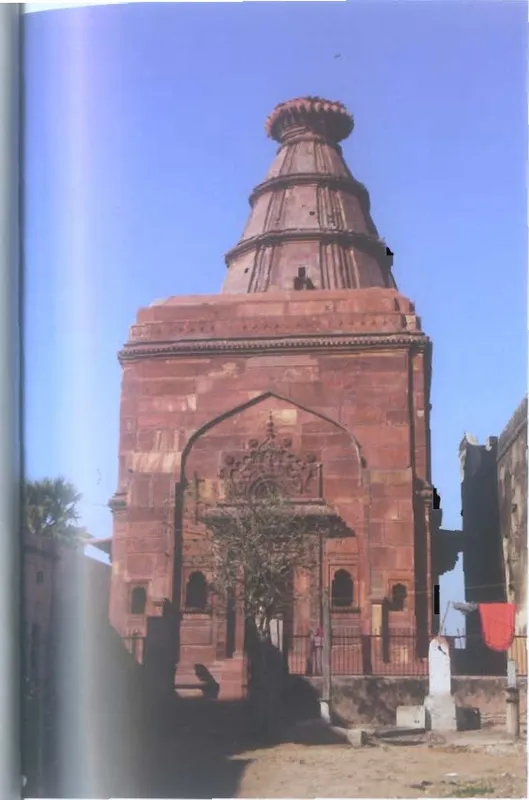
- What it is
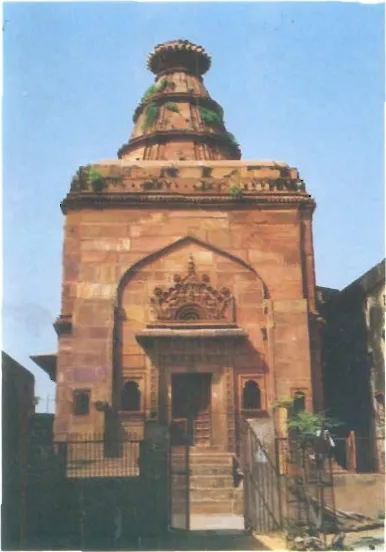
- The Yugala-kiśora Mandira, also written Jugal Kiśore, is a large old stone temple next to Keśī-ghāṭa in Vṛndāvana, just before the Yamunā; The Color Guide to Vṛndāvana (2000) says it is sometimes …
- Visiting
- Vṛndāvana, the Playground of God (2010) calls it a large, classical-looking temple and places it on the left, past Śrī Gadādhara Paṇḍita's danta-samādhi, just before one reaches the Yamunā; The Color …
In short
The Yugala-kiśora Mandira, also written Jugal Kiśore, is a large old stone temple next to Keśī-ghāṭa in Vṛndāvana, just before the Yamunā; The Color Guide to Vṛndāvana (2000) says it is sometimes called the Keśī-ghāṭa temple.[1 +2] The guidebooks say that it was completed in 1627 and that the soldiers of Emperor Aurangzeb defaced it in 1670, and that there has been no formal worship in it since.[1 +6] The sources differ on who founded it and on whether it was one of the temples allowed after Emperor Akbar's visit to Vṛndāvana. No scripture names the temple, and Śrīla Prabhupāda does not speak of it by name.[1 +2]
Key facts
| Kind | temple |
|---|---|
| Region · area | Vṛndāvana |
| Ācāryas | Śrīla Jīva Gosvāmī |
Śrīla Prabhupāda
Speaking in Vṛndāvana in 1976 about how Indian culture continued under Muslim rule, Śrīla Prabhupāda said that under Akbar, Jahangir and Shah Jahan there was no trouble and that the trouble began with Aurangzeb. It is a general remark that names no temple:[9]
General teaching (does not name the place)“Muhammadan did not touch the Indian culture. Sometimes by, what is called, fanaticism, there was fight. Not like this. The Arjuna... Aurangzeb began this.”
Śrīla Prabhupāda, Morning Walk, Vṛndāvana, 9 April 1976 · vedabase.io
Visiting today
Vṛndāvana, the Playground of God (2010) calls it a large, classical-looking temple and places it on the left, past Śrī Gadādhara Paṇḍita's danta-samādhi, just before one reaches the Yamunā; The Color Guide (2000) says it stands next to Keśī-ghāṭa.[1 +2] Since the guidebooks report no worship here since 1670, a pilgrim may find the building empty.[1 +4]
Location
| Where it is | 'on the left past the Gadādhara Dant Samādhī just before you reach the Yamunā'[10] next to Keśī Ghāṭa[11] |
|---|
Nearby places
Keśī-ghāṭa · Gadādhara Paṇḍita's danta-samādhi · Yamunā
Pictures
1 pictures
History
When it was built
Vṛndāvana, the Playground of God (2010) and The Color Guide (2000) say that the temple was completed in 1627. The Muttra district gazetteer of 1911 says that its building "is referred to" Saṁvat 1684, that is 1627, in the reign of Jahangir. No source quotes an inscription for this year.[1 +3]
The undated parikramā notes Vṛndāvana (in two copies) and The Color Guide tie the old temples of Vṛndāvana to Akbar's visit in 1570. According to the local tradition they record, Śrīla Jīva Gosvāmī led the emperor blindfolded into the kuñja (grove) of Nidhuvana, and to mark that experience permission was given to build temples, for which Akbar even supplied fine sandstone; they give no older source for it, so it is not certain. This is not an act of Śrīla Jīva Gosvāmī at this temple, and no farmān (order) of Akbar has been found.[3 +3] Whether this temple was one of the four, and who founded it, the sources tell differently (see below).
The building
F. S. Growse, the district officer who repaired several old temples of Vṛndāvana, described this one in 1883, and the gazetteer of 1911 repeats him in short. The choir is twenty-five feet square, a little larger than in the other old temples, with its main door on the east and small doors on the north and south under hoods resting on eight closely set brackets carved as elephants. The nave had already been completely destroyed. Over the arch of the choir he saw a fan-light of pierced stone and above it a carving of Kṛṣṇa holding up Govardhana Hill, the only image of a pastime recorded for this temple. Its present state has not been checked.[3 +1]
Growse also tells that he had the temple cleaned out, removing from the upper room of the tower pigeons' dung more than four feet deep, and that at his suggestion the town committee rented it for a rupee a month to keep it clean and empty for visitors. When he left the district his successor stopped this, and Growse supposed that it had become a cattle shed again.[4]
Aurangzeb's time
Vṛndāvana, the Playground of God says that the temple was defaced by Muslim soldiers in 1670 and has had no formal worship since; The Color Guide calls it completely abandoned, and Śrī Vraja-maṇḍala Parikramā (2007) says that a temple of Śrī Yugala-kiśora near Keśī-ghāṭa is in a dilapidated condition. The year 1670 rests on these modern guides.[1 +4]
Where the sources differ
The origin of the Yugala-Kiśora temple beside Keśī-ghāṭa: one of Akbar's four temples, a Jahangir-period building, or a temple …
Accounts differ The origin of the Yugala-Kiśora temple beside Keśī-ghāṭa: one of Akbar's four temples, a Jahangir-period building, or a temple founded by a Jhānnā-Pannā Rājā.
- Vṛndāvana, the Playground of God (2010) entry 48; The Color Guide to Vṛndāvana (2000) entry 52 and p. 10; the undated parikramā notes Vṛndāvana/the undated parikramā notes VṛndāvanaOne of the four temples permitted after Akbar's visit in 1570; completed in 1627.
- Muttra gazetteer (1911), pp. 192, 242, 246One of the four temples commenced by the attendant Rajas in honour of Akbar's visit (pp. 192, 242); its construction is referred to sambat 1684 or 1627 A.D., 'in the reign of Jahangir', founder Non Karan (p. 246).
- Śrī Vraja-maṇḍala Parikramā (2007), pp. 644-645The Yugala-Kiśorajī temple on a hillock near Keśī-ghāṭa was established by Jhānnā-Pannā Rājā; the temple built in Akbar's reign was a third Yugala-Kiśorajī, by the Tomara brothers Haridāsa and Govinda dāsa Ṭhākura (no location given).
- Prabhudayāl Mītal (1966), a historianAccording to Mītal, the second of Vṛndāvana's Yugala-kiśora temples stands at Keśī-ghāṭa; a Rājput chief named Naunakarana built it in Saṁvat 1684 (1627), in Jahāṅgīr's reign; it was damaged in later attacks and is in somewhat better repair than the other old temples.
Accounts differ Who founded the Yugala-Kiśora temple beside Keśī-ghāṭa.
- Muttra gazetteer (1911), p. 246; Growse (1883)Non Karan, said to be a Chauhan Rajput (Growse: Chauhan Thakur, perhaps the elder brother of Raesil, builder of the Gopīnātha temple).
- Śrī Vraja-maṇḍala Parikramā (2007), p. 645Jhānnā-Pannā Rājā.
- The Color Guide to Vṛndāvana (2000), entry 52Built by the Gauḍīya Vaiṣṇavas with Emperor Akbar's permission (no person named).
- Prabhudayāl Mītal (1966), part 1 p. 136 (historian)Naunakarana, a Rājput sardār. He is called a Cauhān Rājput, but Growse surmises that he was perhaps the elder brother of Rāyasena, builder of the Gopīnātha temple, and so a Kachavāhā Rājput.
References
11 references
- The Color Guide to Vṛndāvana (2000), Written and Photographed by Rājaśekhara dāsa Brahmacārī, PDF p. 118
- Vṛndāvana, the Playground of God (2010), Bhakti Caitanya Svāmī, PDF p. 177
- Muttra: A Gazetteer, District Gazetteers of the United Provinces of Agra and Oudh vol. VII
- F. S. Growse, Mathurá: A District Memoir
- The Color Guide to Vṛndāvana (2000), Written and Photographed by Rājaśekhara dāsa Brahmacārī, PDF p. 24
- the undated parikramā notes Vṛndāvana, ¶9
- Śrī Vraja-maṇḍala Parikramā (2007), PDF p. 342
- the undated parikramā notes Vṛndāvana, ¶9
- Śrīla Prabhupāda, Morning Walk, Vṛndāvana, 9 April 1976 · vedabase.io
- Vṛndāvana, the Playground of God (2010), Bhakti Caitanya Svāmī, p. 177
- The Color Guide to Vṛndāvana (2000), Written and Photographed by Rājaśekhara dāsa Brahmacārī, p. 104