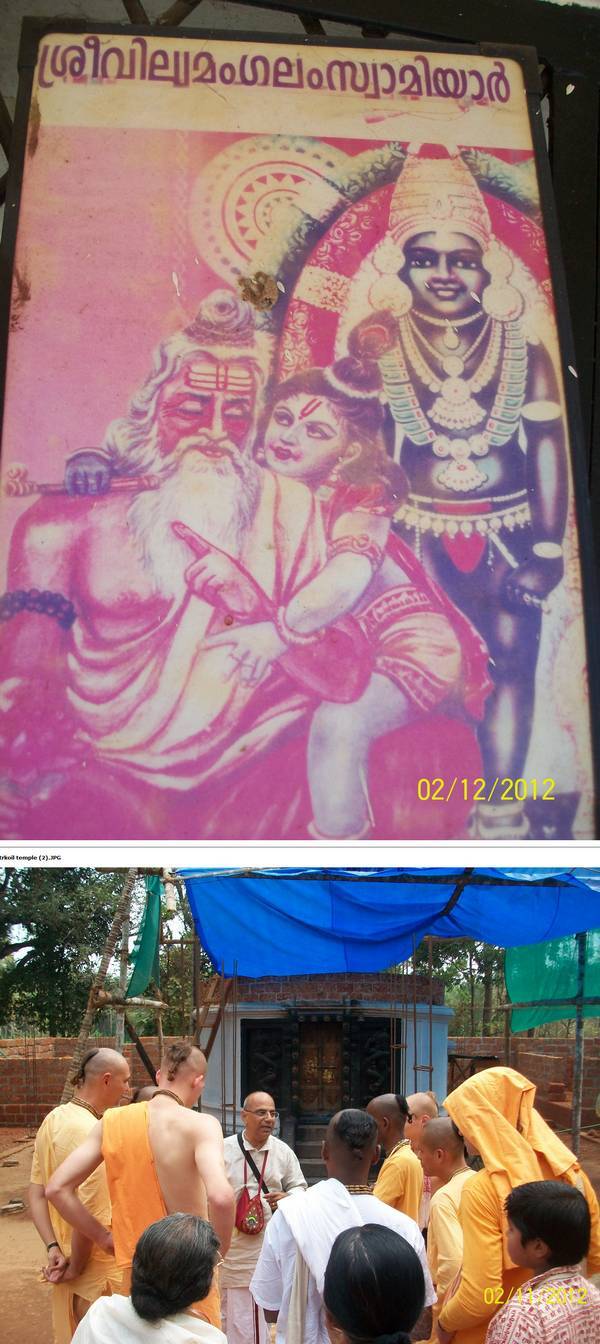
Where exactly Bilvamangala Thakura was born is not settled, and Vaishnavas have told the story more than one way. A tradition from Kerala's Thrissur district names a village called Puthencira as his birthplace. It says his family was known as Bilvamangalam Mana. This tradition still points today to a field, an old rock garden, and a small samadhi kept there in his honor. Srila Prabhupada, in a purport to Chaitanya-charitamrita, places Bilvamangala's home somewhere else, far to the northeast. He places it on the banks of the Krishna-venva river (also called locally the Vina, the Veni, the Sina, or the Bhima), near the pilgrimage town of Pandarapura. Yet another account calls him an acharya of the "Vishnu Svami" line, active generally in the Dravida country. None of these three can simply be dismissed, and none can simply be trusted over the others either. All the versions agree that he was born into a respected, educated brahmana family. They also agree that by the time he reached adulthood, he had already begun sliding into one of the most infamous obsessions in all of Vaishnava literature.
A Brahmana Family, A Ruinous Passion #
Bilvamangala had every advantage growing up. He had learning and position, and by most accounts his family was wealthy enough that he never lacked anything. At some point he became attached to a courtesan named Cintamani. His simple attraction slowly hardened into complete dependence on her. Night after night he went to see her, and he kept paying for it. Some accounts say he sold land. Others say he took his own wife's jewelry, or simply took whatever money and cloth he could find. Whatever the details, the pattern stayed the same. Everything in his life, family duties included, was made to serve this one attachment.
Indifferent Even at His Father's Funeral #
When Bilvamangala's father died, it became clear how far things had gone. He performed the funeral rites only outwardly. In one telling, he even quietly packed food from the ceremony to bring to Cintamani afterward. The whole time, his mind was fixed on when he could see her next. His father's death did not make him stop and reflect. He used the very night of the final funeral rites to slip away to her house.
A Corpse for a Raft, a Snake for a Rope #
That night the weather turned violent. There was heavy rain and thunder, and a river in flood stood between Bilvamangala and Cintamani's house. No boatman would risk the crossing. Desperate, he grabbed hold of something floating in the current and used it to cross. Once he reached the other side, he found that he had ridden across on a dead body. Soaked and shaken, he reached her house to find the doors shut for the night. He did not turn back. In the dark he felt along the outer wall and found what he took to be a hanging rope. He began to climb. Only after he had pulled himself up did he realize that he was gripping a live snake.
He fell. Some accounts say he landed unconscious in the courtyard with a loud crash. Cintamani's household came out to see what had happened. In the middle of the night, they found a brahmana of good family lying there, soaked, exhausted and injured. He was still burning with the same desire that had carried him across a flooded river on a corpse.
This sight, and not any sermon or scripture, finally moved Cintamani to speak. Her words ended Bilvamangala's old life and began a new one. What she said, and how it broke his attachment in an instant, is told on The Rebuke That Changed His Life.
A Question of Teachers #
Even before Cintamani enters the story, tradition already gives Bilvamangala a teacher named Somagiri. The Kerala account says that Somagiri was a sannyasi in the Advaita Vedanta line of Shankaracharya. He was two generations after Shankara, in the line through Padmapada. This fits a note Srila Prabhupada makes in his purport to Chaitanya-charitamrita (Madhya 10.177):
"In his early life, Bilvamangala Thakura was an impersonalistic monist, and he used to meditate upon the impersonal Brahman effulgence."
Only later did he become a devotee of Krishna. But a different tradition says that Bilvamangala was not a monist at all. It calls him an acharya of the Vishnu Svami Vaishnava line. It also says that Cintamani herself became, in a sense, the spiritual guide who turned him toward Krishna. Some accounts even say he later glorified her by name in his own verses as the one who showed him the right path. These two pictures of his early life do not fit neatly together, and we do not force one to fit the other.
