Srila Bilvamangala Thakura
Poet-Saint Who Composed Sri Krishna-karnamrita
The complete life, on one page: The main biography and every pastime page, in order, in one place
Introduction
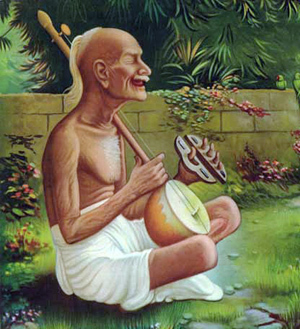
Śrīla Bilvamaṅgala Ṭhākura's story is one of the most striking examples of change in Vaiṣṇava history. He was a wealthy young brāhmaṇa who became deeply attached to a courtesan named Cintāmaṇi. Because of his strong lust for her, he lost everything. Then, in a single moment, her strong words broke his attachment completely. He immediately left his old life behind. On his way to Vṛndāvana, he put out his own eyes so that they could never again distract him from Kṛṣṇa. During the rest of his life, he composed Śrī Kṛṣṇa-karṇāmṛta, a collection of beautiful verses about Kṛṣṇa. Later, Śrī Caitanya Mahāprabhu brought a copy of this work from South India and took great pleasure in hearing its verses again and again.
No one knows exactly when Bilvamangala lived. Some scholars place the text of Krishna-karnamrita as early as the ninth century, others as late as the fifteenth. Even Śrīla Prabhupāda, while telling this story to a visitor in 1969, first said that the poet had lived "seven hundred years" earlier. He then corrected himself and said that Bilvamaṅgala lived "some time before" the fourteenth century. But whatever the exact date, no one has ever doubted the devotion in his verses, or the love that the Gaudiya Vaishnava tradition has always shown them.
| Detail | Description |
|---|---|
| Also called | Vilvamangala, Lilasuka (Lilashuka) |
| Lived | Disputed: estimates range from the 9th to the 14th century |
| Birthplace | South India (Kerala tradition and Srila Prabhupada's own purport point to different regions) |
| Teacher named in tradition | Somagiri |
| Chief work | Sri Krishna-karnamrita |
| Famous for | The Cintamani story, self-blinding, and Krishna's appearance to him as a cowherd guide |
Scriptural evidence for the introduction (1)
santv avatārā bahavaḥ paṅkaja-nābhasya sarvato-bhadrāḥ
kṛṣṇād anyaḥ ko vā latāsv api prema-do bhavati
Word for word
santu: let there be; avatārāḥ: incarnations; bahavaḥ: many; paṅkaja-nābhasya: of the Lord, from whose navel grows a lotus; sarvataḥ-bhadrāḥ: completely auspicious; kṛṣṇāt: than Lord Krishna; anyaḥ: other; kaḥ vā: who possibly; latāsu: on the surrendered souls; api: also; prema-daḥ: the bestower of love; bhavati: is
"There may be many all-auspicious incarnations of the Personality of Godhead, but who other than Lord Sri Krishna can bestow love of God upon the surrendered souls?"
From the purport: Purport excerpt: "This quotation from the writings of Bilvamangala Thakura is found in the Laghu-bhagavatamrita (1.5.37)."
Krishnadasa Kaviraja Goswami opens Chaitanya-charitamrita's praise of Krishna's supremacy with a line from Bilvamangala, a measure of how highly the tradition already regarded him.
Chapter 1
Early Life and Attachment to Cintamani
How a learned brahmana's obsession with a courtesan ruined him, and prepared the way for one of the most famous conversions in Vaishnava tradition.
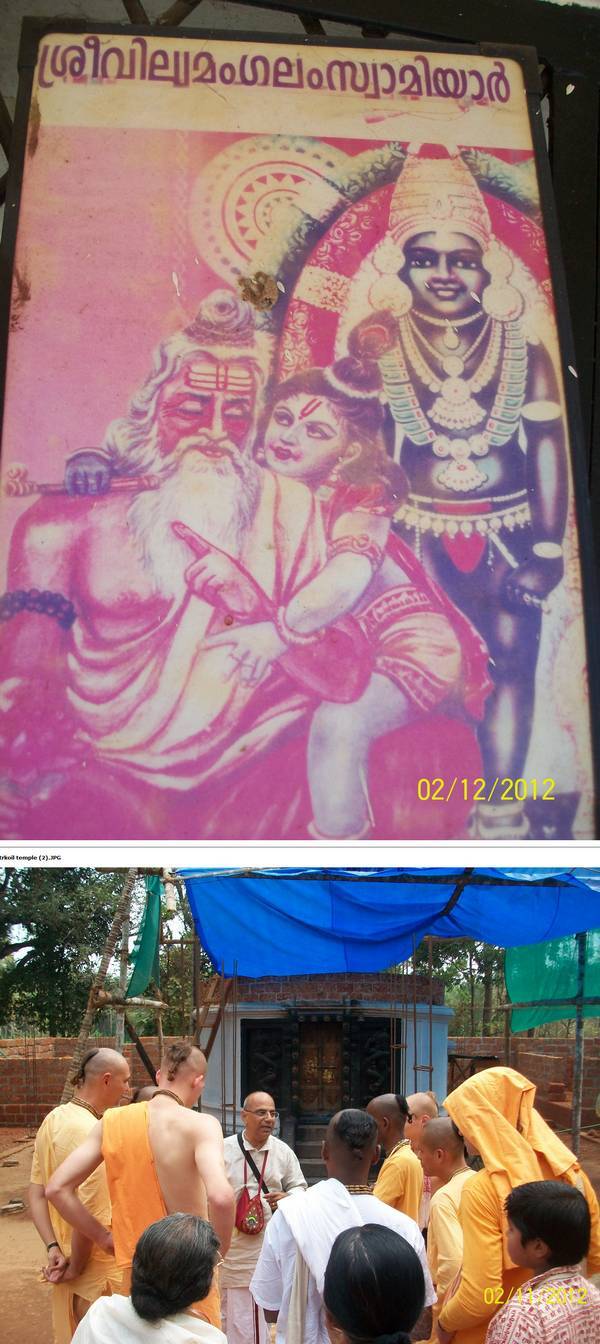
Where exactly Bilvamangala Thakura was born is not settled, and Vaishnavas have told the story more than one way. A tradition from Kerala's Thrissur district names a village called Puthencira as his birthplace. It says his family was known as Bilvamangalam Mana. This tradition still points today to a field, an old rock garden, and a small samadhi kept there in his honor. Srila Prabhupada, in a purport to Chaitanya-charitamrita, places Bilvamangala's home somewhere else, far to the northeast. He places it on the banks of the Krishna-venva river (also called locally the Vina, the Veni, the Sina, or the Bhima), near the pilgrimage town of Pandarapura. Yet another account calls him an acharya of the "Vishnu Svami" line, active generally in the Dravida country. None of these three can simply be dismissed, and none can simply be trusted over the others either. All the versions agree that he was born into a respected, educated brahmana family. They also agree that by the time he reached adulthood, he had already begun sliding into one of the most infamous obsessions in all of Vaishnava literature.
A Brahmana Family, A Ruinous Passion #
Bilvamangala had every advantage growing up. He had learning and position, and by most accounts his family was wealthy enough that he never lacked anything. At some point he became attached to a courtesan named Cintamani. His simple attraction slowly hardened into complete dependence on her. Night after night he went to see her, and he kept paying for it. Some accounts say he sold land. Others say he took his own wife's jewelry, or simply took whatever money and cloth he could find. Whatever the details, the pattern stayed the same. Everything in his life, family duties included, was made to serve this one attachment.
Indifferent Even at His Father's Funeral #
When Bilvamangala's father died, it became clear how far things had gone. He performed the funeral rites only outwardly. In one telling, he even quietly packed food from the ceremony to bring to Cintamani afterward. The whole time, his mind was fixed on when he could see her next. His father's death did not make him stop and reflect. He used the very night of the final funeral rites to slip away to her house.
A Corpse for a Raft, a Snake for a Rope #
That night the weather turned violent. There was heavy rain and thunder, and a river in flood stood between Bilvamangala and Cintamani's house. No boatman would risk the crossing. Desperate, he grabbed hold of something floating in the current and used it to cross. Once he reached the other side, he found that he had ridden across on a dead body. Soaked and shaken, he reached her house to find the doors shut for the night. He did not turn back. In the dark he felt along the outer wall and found what he took to be a hanging rope. He began to climb. Only after he had pulled himself up did he realize that he was gripping a live snake.
He fell. Some accounts say he landed unconscious in the courtyard with a loud crash. Cintamani's household came out to see what had happened. In the middle of the night, they found a brahmana of good family lying there, soaked, exhausted and injured. He was still burning with the same desire that had carried him across a flooded river on a corpse.
This sight, and not any sermon or scripture, finally moved Cintamani to speak. Her words ended Bilvamangala's old life and began a new one. What she said, and how it broke his attachment in an instant, is told on The Rebuke That Changed His Life.
A Question of Teachers #
Even before Cintamani enters the story, tradition already gives Bilvamangala a teacher named Somagiri. The Kerala account says that Somagiri was a sannyasi in the Advaita Vedanta line of Shankaracharya. He was two generations after Shankara, in the line through Padmapada. This fits a note Srila Prabhupada makes in his purport to Chaitanya-charitamrita (Madhya 10.177):
"In his early life, Bilvamangala Thakura was an impersonalistic monist, and he used to meditate upon the impersonal Brahman effulgence."
Only later did he become a devotee of Krishna. But a different tradition says that Bilvamangala was not a monist at all. It calls him an acharya of the Vishnu Svami Vaishnava line. It also says that Cintamani herself became, in a sense, the spiritual guide who turned him toward Krishna. Some accounts even say he later glorified her by name in his own verses as the one who showed him the right path. These two pictures of his early life do not fit neatly together, and we do not force one to fit the other.
Chapter 2
The Rebuke That Changed His Life
A courtesan's blunt words about a body that must die broke his lifelong obsession in a single night.
Every version of this story agrees on the essential moment. Cintamani looked at what her lover had become. He was soaked, exhausted and injured, and still consumed by desire after everything he had just survived to reach her. Instead of welcoming him, she rebuked him. Her exact words are not fixed. The story has been retold many times across the Vaishnava tradition. It appears in Sanskrit devotional biographies, in the memory of Bengali Vaishnavas, and in modern retellings. No two versions use quite the same sentences. What stays the same is the meaning.
What Cintamani Said #
Srila Prabhupada told this story very simply to a visitor in 1969. Cintamani saw the low state that Bilvamangala had brought himself to. She told him that if he felt even this much attraction for Krishna, his life would really be worth something. Other retellings add more. They say she told him that her own body, however beautiful, was made of the same blood, bone, and mucus as anyone else's. It was ageing and would die. It could never reward this kind of devotion the way Krishna could. A modern telling attributed to the Vaishnava teacher Srila Narayana Maharaja has her speak even more bluntly. In it she tells him that she could no longer love a man so lost to lust, and orders him to leave. Whatever wording is closest to what Cintamani actually said, the message that reached him was the same. He had spent everything on a body that would rot. The same devotion, turned toward Krishna, would have carried him somewhere permanent.
Words That Broke a Lifetime's Habit #
This rebuke is remarkable because of its effect, not because of its content. Teachers had already told Bilvamangala the same thing in other words. Srila Prabhupada's own account shows a change so sudden that it is almost startling: "immediately he came to his senses." Why could a courtesan's rebuke succeed where years of brahminical training apparently had not? Prabhupada explains that Bilvamangala had likely already reached an advanced stage of Krishna-prema in a previous life. The impressions carried over from that life let Cintamani's words strike so deep, so fast. Without that earlier preparation, Prabhupada notes elsewhere, the same words might have changed nothing at all.
A verse attributed to Bilvamangala himself, quoted centuries later in Chaitanya-charitamrita, captures what this reversal felt like from the inside. The sannyasi Brahmananda Bharati, comparing his own change of heart to Bilvamangala's, recites this verse:
"Although I was worshiped by those on the path of monism and initiated into self-realization through the yoga system, I have nonetheless been forcibly turned into a maidservant by some cunning boy who is always joking with the gopis."
This is an unusual way for a former philosopher to describe his own conversion. He does not describe it as something he achieved. He describes it as being overpowered.
Leaving Everything Behind #
Bilvamangala did not stay to think it over. Every account agrees that he left almost at once, on foot, alone, heading for Vrindavana, the place every version of his story treats as the goal of his new life. He did not travel there unchanged. On the road, his old weakness for feminine beauty came back one more time, with the consequences described on Renunciation and the Gouged Eyes. But the man who left Cintamani's courtyard that morning was not the man who had crossed the flooded river the night before. The earlier chapter of his life, on Early Life and Attachment to Cintamani, shows this clearly.
A Very Different Local Memory #
Not everyone tells this story the same way. The Kerala tradition, kept near Bilvamangala's traditional birthplace, describes Cintamani quite differently. In it she is not a courtesan rebuking a lustful stranger. She is a noble woman devoted to Krishna, who already treated the young Bilvamangala (called there by his other name, Lilasuka) with respect. In that telling, she showed him a vision of the child Krishna in her own home. After this, the two of them together composed the verses that became Krishna-karnamrita. Then Bilvamangala left peacefully for the sannyasa order. He did not flee after a rebuke. This is a very different story from the one told across the wider Gaudiya tradition and by Srila Prabhupada himself, with the corpse, the river and the rebuke. The two are kept here as separate accounts, not blended into one. But this much can be said with confidence. Cintamani, whoever she truly was, is remembered everywhere as the person through whom Bilvamangala found Krishna.
Scriptural evidence for this chapter (1)
Quoted in the text above:
- Madhya 10.178 Sri Chaitanya-charitamrita / Bhakti-rasamrita-sindhu
Chapter 3
Renunciation and the Gouged Eyes
When lust troubled him a second time on the road to Vrindavana, Bilvamangala blinded himself so that he would not risk a third time.
Freed from one attachment, Bilvamangala walked straight into a test of the same weakness. Somewhere on the road to Vrindavana, not long into his new life, his eyes settled on another woman's beauty, and his old habit of mind returned at once.
A Second Fall, Almost #
The accounts differ on the details. In one version he stopped at a well to ask a young, newly married woman for water. When he could not stop looking at her, he followed her home. In another version he simply noticed a beautiful woman on the road and followed her out of old habit. The fullest telling is attributed to Srila Narayana Maharaja. In it, the woman's husband mistook Bilvamangala for a genuine holy man and welcomed him as a guest. Before knowing what would be asked, the husband promised to grant whatever Bilvamangala requested. In every version, what Bilvamangala asked for was not the woman herself, but her hairpin.
"These Eyes Are My Enemy" #
Srila Prabhupada told this part of the story in the plainest terms:
"Mother, will you give me your hair pin? ... took the hair pin and pushed in the eyes: 'Oh, these eyes are my enemy.' Since then he became blind."
Other retellings add more details. They say he called her "Mother" to make clear that his purpose was not what it seemed. They say he asked for two hairpins, not one. And they say he explained himself aloud before acting. Just as a flute cannot sound without bamboo, he reasoned, his lust could not survive without the eyes that kept feeding it.
Most accounts agree that Bilvamangala blinded both eyes. But the story is old and has passed through many retellings, so other versions may exist elsewhere. What stays the same everywhere is his reason. It was not despair, and it was not punishment for its own sake. It was a deliberate and careful decision to remove the one sense that kept breaking his own resolve. He had taken vows of renunciation. So he judged that eyes which could not stop finding beautiful faces in strange women were of no further use to him.
Blindness as the End of an Old Life #
The self-blinding ends the story of Bilvamangala the brahmana householder, ruined by lust. It begins the story of Bilvamangala the blind devotee, whom Krishna Himself would not leave uncared for. Physically helpless on an unfamiliar road, he pressed on toward Vrindavana anyway, chanting as he went. What happened next is one of the most tender and often-painted pastimes connected with his name. It is told on Krishna as His Guide. The rebuke that pushed him this far is told in full on The Rebuke That Changed His Life.
Why This Story Endures #
Vaishnava teachers have never told this story as one about self-hatred. Instead, it is an extreme example of an ordinary teaching. If the senses are left unchecked, they will keep finding their way back to old habits, no matter how sincere a person's intentions are. Real vairagya, or renunciation, sometimes calls for firm and uncomfortable action, not just repeated good intentions. Srila Prabhupada took care to say that the real fruit was not in the blinding itself but in what came right after it:
"In that blindness he was worshiping Krishna, and Krishna was coming to him."
The act only matters because of where it led.
We should also say plainly how little in a story this vivid can be independently checked. No inscription, no dated manuscript, nothing outside the devotees' own memory confirms these details. The story has been kept alive because generation after generation of Vaishnavas found it worth telling, in words a little different each time. It has not been kept alive because it can be checked the way a modern biography can. That does not make it any less important to the tradition. As the next chapter of Bilvamangala's story shows, Sri Chaitanya Mahaprabhu Himself took this man's poetry seriously enough to carry it home from South India by hand.
Chapter 4
Krishna as His Guide
Blind and alone on the road, Bilvamangala found Krishna Himself walking beside him in the form of an ordinary cowherd boy.
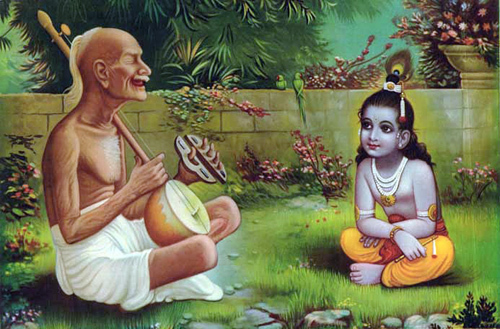
A blind man alone on the road to Vrindavana would normally have been in serious danger. Instead, Bilvamangala found the most wonderful travelling companion. Krishna Himself personally cared for the blind poet who had given up his own eyes for Him. This pastime is one of the most loved and most often painted episodes connected with Bilvamangala's name.
An Ordinary Cowherd Boy on the Road #
In one telling, attributed to Srila Narayana Maharaja, this pastime begins almost right after the self-blinding described on Renunciation and the Gouged Eyes. A boy with an unusually sweet voice came up to the newly blinded Bilvamangala and asked where he was going. When Bilvamangala said he was walking to Vrindavana, the boy said he was going there too. He offered his stick for Bilvamangala to hold and led him the rest of the way. In this telling, a journey that should have taken months took only days. Bilvamangala is remembered as composing verses in praise of Krishna as they walked together. Tradition later gathered these verses into Sri Krishna-karnamrita.
Milk, Song, and a Flute in Vrindavana #
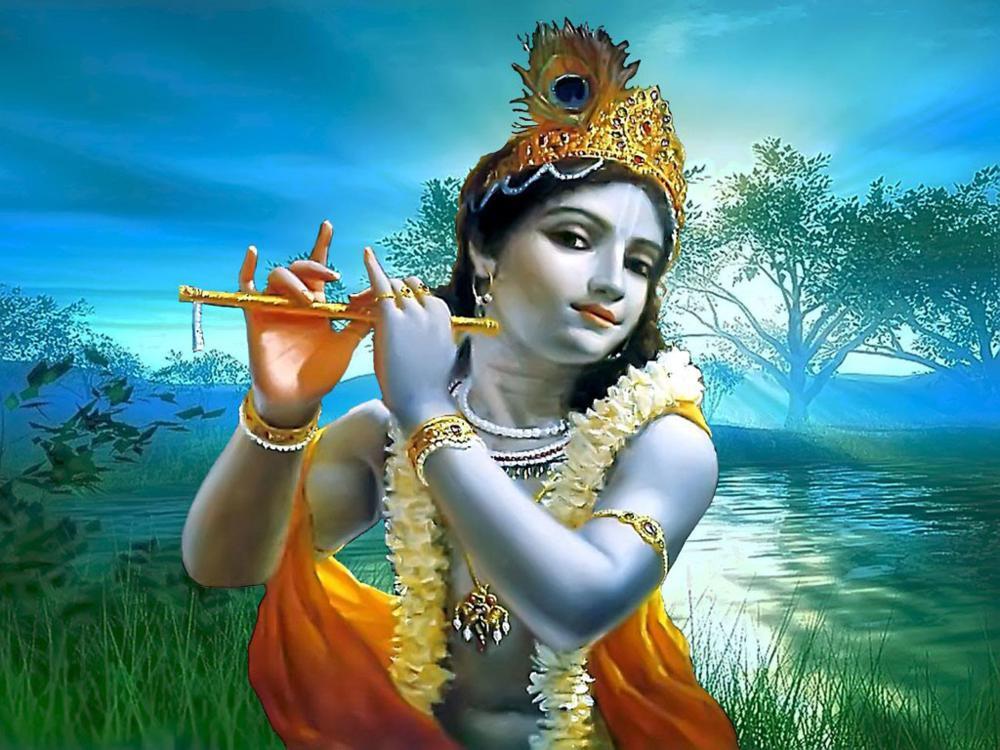
Other tellings, including the version Srila Prabhupada also recounted, place this companionship after Bilvamangala had already settled in Vrindavana, not on the road. Here, an unnamed cowherd boy became a regular presence in the blind devotee's life: bringing him prasadam, guiding him to safe places to rest, staying close as he sang. Bilvamangala did not at first know who this boy was. Then, one day, the boy played a flute, and something in the sound was unlike anything Bilvamangala had ever heard. Overcome, he reached out to touch its source, wanting to embrace the boy who played it.
In every version of this moment, Krishna slipped free of the embrace and ran off laughing, just as He does with the gopis in Vrindavana's pastimes. Bilvamangala's reply is one of the most quoted lines connected with him. The wording differs slightly in different sources, but the meaning is always the same: Krishna could run away from his hand, but never from his heart.
A Pastime Told, Not Verified #
Nothing in this story can be checked against an outside record. It lives on only in the memory of devotees. The details differ a little, depending on which teacher tells it and where in Bilvamangala's life they place it. That does not make the pastime any less loved. In fact, the many slightly different versions over the centuries show how dear this story has been to Vaishnavas in every generation. Its message is that a devotee who gave up his own eyes for Krishna's sake would never really be left to walk alone. What Bilvamangala wrote during this period, and what became of it, is described on Sri Krishna-karnamrita.
Not to Be Confused With Other Blind Poets #
In the same 1969 conversation, the poet Allen Ginsberg asked Srila Prabhupada whether Bilvamangala might be the same person as Suradasa, another famous blind poet-devotee of Krishna in North Indian tradition. Prabhupada answered carefully: "He may be different." This small moment tells us something. Srila Prabhupada was given an easy chance to join two famous blind Krishna-poets into one story. But he chose to leave the question open, instead of giving an answer he was not sure of. We should be just as careful today. Bilvamangala Thakura and Suradasa belong to different regional traditions of Krishna-devotional poetry, and nothing ties them together as the same person.
Why a Blind Devotee Needed No Eyes #
Gaudiya Vaishnava teachers often return to the point behind this pastime. Bilvamangala judged his material eyes too dangerous to keep. Yet these eyes turn out to be unnecessary for truly seeing Krishna. What guided Bilvamangala to Vrindavana and kept him there was not sight. It was bhakti, and also Krishna's own readiness to appear personally, in the humblest form, for a devotee who could no longer see Him with his eyes. This pastime shows a teaching found throughout Vaishnava literature. The goal is not to destroy the senses for their own sake. The goal is to turn them fully toward Krishna's service, however costly that may be.
Chapter 5
Sri Krishna-karnamrita
The collection of ecstatic Sanskrit verses for which Bilvamangala is remembered across the Vaishnava world.
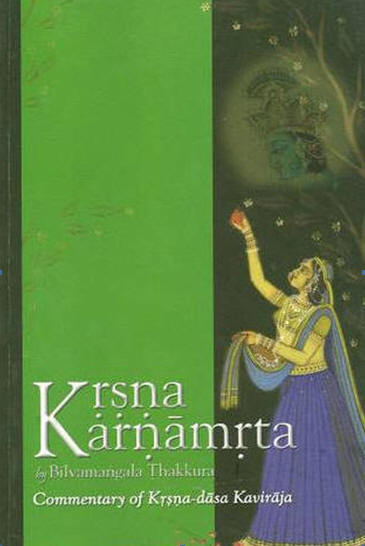
The title Sri Krishna-karnamrita means roughly "nectar for the ears about Krishna," and it is through this work that nearly the whole Vaishnava world remembers Bilvamangala Thakura. Even people who do not know in which century, region, or lineage he lived know him by it. It is a collection of short Sanskrit verses praising Krishna's beauty, His boyhood in Vrindavana, and the ache of separation from Him. The verses are written in a richly decorated style, full of intense feeling.
| Detail | Description |
|---|---|
| Title meaning | "Nectar for the ears, about Krishna" |
| Form | Short Sanskrit verses, mostly in shardulavikridita metre |
| Length | Two different versions: around 100 verses (southern/western manuscripts) or 112 verses (the Bengal version) |
| Known commentaries | By Krishnadasa Kaviraja Goswami (Sarangarangada) and by Chaitanya Dasa Goswami |
| Brought to Bengal by | Sri Chaitanya Mahaprabhu, during His South Indian pilgrimage |
Two Different Books Under One Name #
Even the text of Krishna-karnamrita is not fully settled. In a purport to Chaitanya-charitamrita, Srila Prabhupada notes that "there are two or three other books bearing the same name," and that the version studied in Bengal has 112 verses. This is the version on which Krishnadasa Kaviraja Goswami wrote his commentary Sarangarangada. Prabhupada also notes that manuscripts used in South India and western India divide the text into three sections of about a hundred verses each. Scholars have not settled whether these are one work that grew or shrank over time, or truly separate works that came to share a title and an author's name.
What the Verses Actually Say #
Again and again, the verses stay focused on Krishna's physical and personal beauty, and on the deep feeling of loving Him. One of the most quoted verses was later repeated by Sri Chaitanya Mahaprabhu Himself. It uses the word "sweet" four times in a single verse:
"O my Lord, the transcendental body of Krishna is very sweet, and His face is even sweeter than His body. But His soft smile, which has the fragrance of honey, is sweeter still."
Another describes Vrindavana's own transcendental wealth:
"The anklets on the damsels of Vraja-bhumi are made of cintamani stone. The trees are wish-fulfilling trees, and they produce flowers with which the gopis decorate themselves. There are also wish-fulfilling cows, which deliver unlimited quantities of milk. Thus Vrindavana's opulence is blissfully exhibited."
A third verse turns to the rasa dance itself, describing how Krishna expanded Himself to dance between each pair of gopis so that every one of them felt she alone had His attention:
"Lord Madhava was situated between each pair of gopis, and a gopi was situated between each pair of His manifestations. And Sri Krishna, the son of Devaki, also appeared in the middle of the circle, playing upon His flute and singing."
Srila Vishvanatha Chakravarti Thakura later commented on this verse to explain why only the demigods watching from above could see the true scale of what was happening. A fourth verse, quoted as much for its theology as its poetry, describes liberation itself standing at the devotee's door "with folded hands," ready to serve anyone who takes up pure devotional service:
"Liberation personally waits with folded hands to serve one who has taken to pure devotional service, and the results of religiosity, economic development and sense gratification stand by awaiting their opportunity to serve as well."
Srila Prabhupada used this verse again and again to make one point: liberation is a by-product of bhakti, never something a devotee needs to chase for its own sake.
A Second Work: Balagopala-stuti #
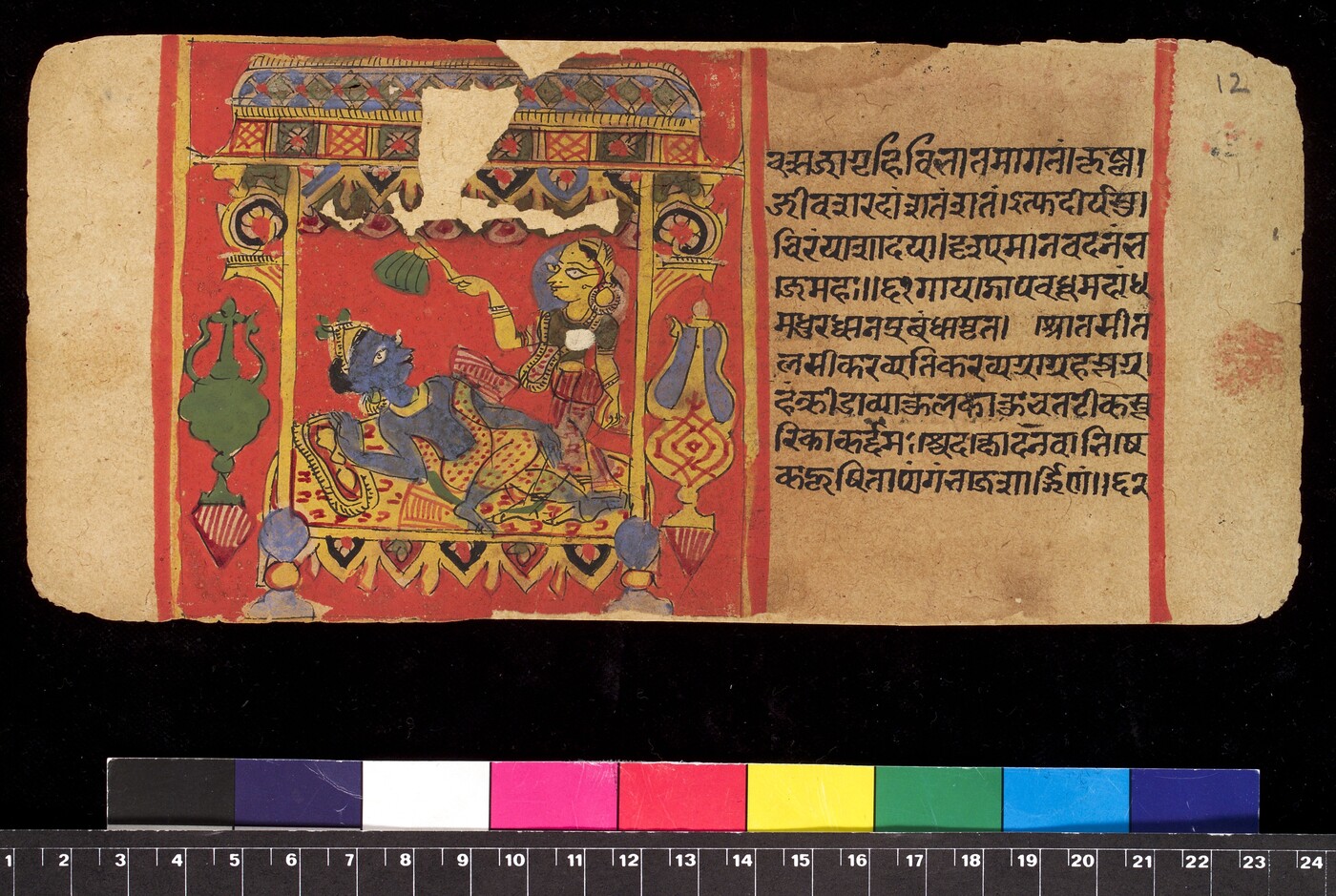
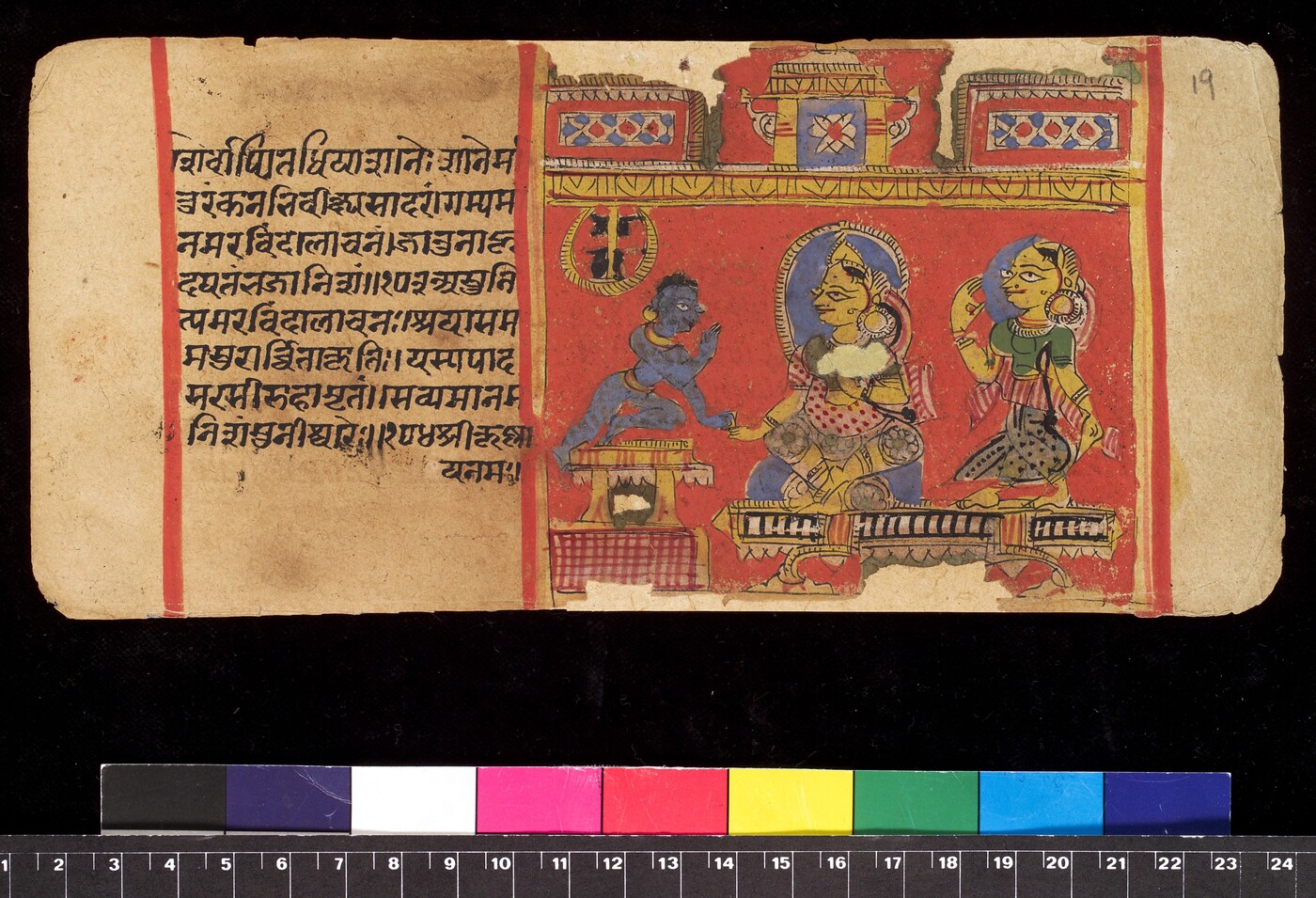
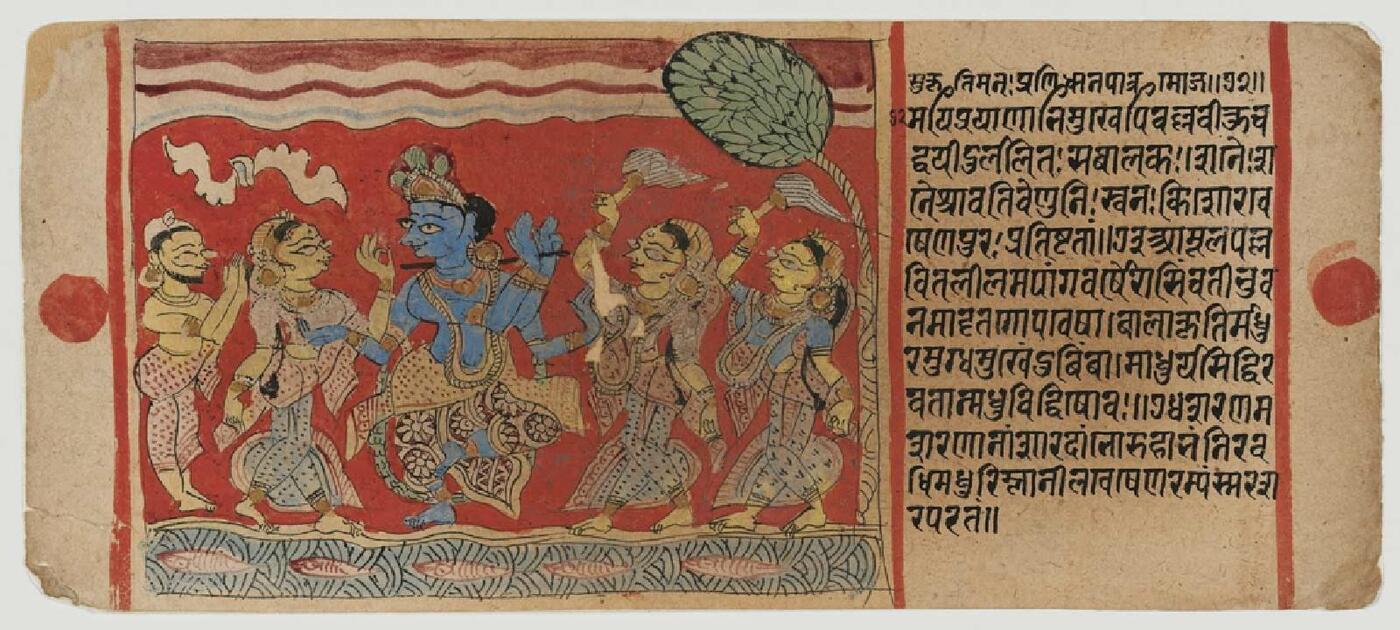
By most accounts, Krishna-karnamrita was not Bilvamangala's only work. Another devotional poem, the Balagopala-stuti, is also attributed to him. It is a hymn to Krishna as a small child. It survives today in old illustrated manuscripts. These include a fifteenth-century Western Indian copy held by the Museum of Fine Arts, Boston, and another set of illustrated pages in the Wellcome Collection in London. Library catalogues have long listed this second work under the name "Krishna-lilasuka-muni," and this is one more small clue that links the name Lilasuka to Bilvamangala's authorship. In this tradition, almost nothing about this poet can be said without some doubt attached.
Reputation Within the Tradition #
Some things about who wrote Krishna-karnamrita and when remain uncertain. But within Gaudiya Vaishnavism, no one has ever doubted its great value. Chaitanya-charitamrita records that the brahmana community who preserved and studied the text held that there was "nothing like the Krishna-karnamrita in the three worlds," because reading it carried a devotee directly into the beauty and sweetness of Krishna's pastimes. How Sri Chaitanya Mahaprabhu personally came across this book, and what He did with it afterward, is told on Legacy and Influence on Chaitanya Mahaprabhu.
An Early Voice for Radha's Supremacy #
Some later Gaudiya writers say that Krishna-karnamrita was one of the earliest widely-read Sanskrit works to show Srimati Radharani as supreme in Krishna's Vrindavana pastimes, not as a minor figure. The six Goswamis of Vrindavana, Vishvanatha Chakravarti Thakura, and later Bhaktivinoda Thakura would each take this idea much further in their own writings. It is hard to know for certain how original Bilvamangala's contribution to this idea truly was, compared with other devotional poets who wrote on the same theme. Still, this emphasis is part of why later Gaudiya Vaishnavas valued this text so highly, far beyond its poetry alone.
Scriptural evidence for this chapter (3)
Quoted in the text above:
- Madhya 21.136 Sri Krishna-karnamrita / Sri Chaitanya-charitamrita
- Madhya 14.228 Sri Krishna-karnamrita / Bhakti-rasamrita-sindhu
- SB 10.33.3 Sri Krishna-karnamrita / Srimad-Bhagavatam
Chapter 6
Legacy and Influence on Chaitanya Mahaprabhu
Centuries after his own life ended, Bilvamangala's verses reached Sri Chaitanya Mahaprabhu, who loved them enough to carry them home by hand.
Bilvamangala Thakura never met Sri Chaitanya Mahaprabhu. Whichever of the proposed dates is correct, he left this world generations, if not centuries, before Chaitanya appeared in 1486. And yet Chaitanya-charitamrita, the great biography of Chaitanya's life written by Krishnadasa Kaviraja Goswami, returns to Bilvamangala's verses again and again. It returns to them more than to any other single non-Gaudiya poet quoted in the book. This fact alone says a great deal about how the Gaudiya Vaishnava tradition came to see him.
Found on a South Indian Pilgrimage #
The clearest link between Bilvamangala and Chaitanya is a simple event recorded in biography, not a legend. Chaitanya-charitamrita records that during Sri Chaitanya Mahaprabhu's long pilgrimage through South India, He came across a handwritten manuscript of Krishna-karnamrita. A community of Vaishnava brahmanas was reading it near Pandarapura. This was on the bank of a river that Srila Prabhupada's purport identifies as the Krishna-venva, also called locally the Vina, the Veni, the Sina, or the Bhima. In the same purport, Prabhupada adds, "it is said that Thakura Bilvamangala resided on the banks of this river," and this is one more claim in the long list of disputed places where Bilvamangala may have lived. It does not agree well with the Kerala tradition told on Early Life and Attachment to Cintamani.
Chaitanya-charitamrita describes Chaitanya's reaction simply and directly. He was "very pleased to hear the book Krishna-karnamrita," and "with great eagerness He had it copied and took it with Him," after first getting the temple authorities' permission. At that time printing did not yet exist, and that community held the only copy. When He came back to Vidyanagara on the Godavari, on His way home to Jagannatha Puri, Chaitanya told Ramananda Raya the whole story of His travels and gave him both books He had found in the south, the Krishna-karnamrita and the Brahma-samhita.
A Book He Never Tired of Hearing #
Chaitanya-charitamrita records that in His later years at Puri, there were only a very few works that Chaitanya "especially liked to hear" recited. Bilvamangala's Krishna-karnamrita was one of them, along with the poetry of Vidyapati and Jayadeva Goswami's Sri Gita-govinda. The book also records that hearing its verses and songs "created happiness" in His heart. Later in the book, on at least two recorded occasions, Chaitanya was overwhelmed with ecstatic feeling and recited and explained single Krishna-karnamrita verses to His close associates. Once it was a verse where the poet cries out that his days without seeing Krishna are wasted. Another time it was a verse where Krishna's own devotee admits she cannot forget the sweetness of His smile. These are more than passing mentions. They show that Chaitanya had practically learned the text by heart.
Praised as Beyond Compare #
Chaitanya-charitamrita states plainly just how highly the devotees around Chaitanya regarded Krishna-karnamrita:
"There is no comparison to the Krishna-karnamrita within the three worlds. By studying this book, one is elevated to the knowledge of pure devotional service to Krishna."
This is a bold claim to make about any book outside scripture itself, and it was not made lightly. The same passage says that Krishna-karnamrita reveals "the beauty and melodious taste of the pastimes of Lord Krishna" to anyone who reads it constantly.
Still Quoted Today #
Centuries later, Srila Prabhupada carried this same regard for Bilvamangala's verses into his own teaching. He quoted Krishna-karnamrita in lectures, conversations, and purports. He used it to speak about Krishna's beauty and about the rasa dance. Again and again, he used it for one idea he returned to often: liberation comes and stands before a sincere devotee "with folded hands," waiting to serve. It is not something to be chased for its own sake. In a 1969 conversation recorded in Columbus, Ohio, Prabhupada told the whole Cintamani story from memory to the poet Allen Ginsberg. He called Bilvamangala "a great poet" and urged Ginsberg to read his verses directly, not only hear the story secondhand. Bilvamangala had written these verses many centuries before, at least five hundred years before and perhaps more than a thousand. Yet his verses about a boy playing a flute in Vrindavana were still doing exactly the work he wrote them to do.
No Recorded Ending #
One gap remains in this whole story. Nothing records when, where, or how Bilvamangala Thakura's life actually ended. Chaitanya-charitamrita quotes his verses so generously, but it says nothing about his passing. In 1969, Srila Prabhupada remarked that Bilvamangala "executed devotional service for seven hundred years" and "lived for seven hundred years in Vrindavana." These words should be recorded exactly, because Prabhupada said them. But they read as a devotional way of describing a very long life, not as a historical claim meant to be taken literally. No other source repeats them. In the end, Bilvamangala Thakura is remembered almost entirely through what he wrote and what happened to him, not through any settled account of how his life came to an end.
Scriptural evidence for this chapter (4)
muktiḥ svayaṁ mukulitāñjaliḥ sevate 'smān
dharmārtha-kāma-gatayaḥ samaya-pratīkṣāḥ
Word for word
muktiḥ: liberation; svayam: personally; mukulita-añjaliḥ: with folded hands; sevate: renders service; asmān: unto us; dharma-artha-kāma-gatayaḥ: the results of religiosity, economic development and sense gratification; samaya-pratīkṣāḥ: awaiting the opportunity
"Liberation personally waits with folded hands to serve one who has taken to pure devotional service, and the results of religiosity, economic development and sense gratification stand by awaiting their opportunity to serve as well."
From the purport: Purport excerpt: "The pure devotee automatically achieves liberation, even without desiring it."
One of the most often-quoted Krishna-karnamrita verses in Srila Prabhupada's own purports, used to teach that liberation is a by-product of devotion rather than something to be sought for itself.
amūny adhanyāni dināntarāṇi
hare tvad-ālokanam antareṇa
anātha-bandho karuṇaika-sindho
hā hanta hā hanta kathaṁ nayāmi
Word for word
amūni adhanyāni: all those inauspicious; dina-antarāṇi: other days; hare: O Lord; tvat-ālokanam antareṇa: without seeing You; anātha-bandho: O friend of the helpless; karuṇā-eka-sindho: O only ocean of mercy; kathaṁ nayāmi: how shall I pass
"O my Lord, O Supreme Personality of Godhead, O friend of the helpless! You are the only ocean of mercy! Because I have not met You, my inauspicious days and nights have become unbearable. I do not know how I shall pass the time."
One of the Krishna-karnamrita verses (verse 41) that Sri Chaitanya Mahaprabhu Himself recited in the ecstasy of separation from Krishna during His last twelve years at Puri.
tvac-chaiśavaṁ tri-bhuvanādbhutam ity avehi
mac-cāpalaṁ ca tava vā mama vādhigamyam
tat kiṁ karomi viralaṁ muralī-vilāsi
mugdhaṁ mukhāmbujam udīkṣitum īkṣaṇābhyām
Word for word
tvat-śaiśavam: Your early age; tri-bhuvana-adbhutam: wonderful within the three worlds; mat-cāpalam: My unsteadiness; muralī-vilāsi: O player of the flute; mugdham mukha-ambujam: attractive lotus face; udīkṣitum īkṣaṇābhyām: to see with these eyes
"O Krishna, O flute-player, the sweetness of Your early age is wonderful within these three worlds. You know My unsteadiness, and I know Yours. No one else knows about this. I want to see Your beautiful attractive face somewhere in a solitary place, but how can this be accomplished?"
Krishna-karnamrita verse 32, another verse Chaitanya-charitamrita records Sri Chaitanya Mahaprabhu quoting from memory in ecstasy.
karṇāmṛta, vidyāpati, śrī-gīta-govinda
ihāra śloka-gīte prabhura karāya ānanda
Word for word
karṇāmṛta: the book Krishna-karnamrita; vidyāpati: the poet Vidyapati; śrī-gīta-govinda: the book by Jayadeva Gosvami; ihāra śloka-gīte: by the verses and songs of these; prabhura: for Sri Chaitanya Mahaprabhu; ānanda karāya: creates happiness
"The Lord especially liked to hear Bilvamangala Thakura's Krishna-karnamrita, the poetry of Vidyapati, and Sri Gita-govinda, by Jayadeva Gosvami. Sri Chaitanya Mahaprabhu felt great pleasure in His heart when His associates chanted verses and sang songs from these books."
A direct statement in Chaitanya-charitamrita naming Krishna-karnamrita among the small handful of works Sri Chaitanya Mahaprabhu most loved to hear in His final years.
Closing
One Bilvamangala, or Two? #
Scholars are divided on whether "Bilvamangala" and "Lilasuka" are the names of one person or two. Some hold that Lilasuka Bilvamangala was a single person. They say his teacher Somagiri gave him the name Lilasuka for his skill in describing Krishna's madhurya-lila. Others say there were two different people. One was an earlier philosopher named Bilvamangala, writing perhaps as early as the ninth century. The other was a later Kerala-born poet of the twelfth or thirteenth century who took the name Lilasuka. In this view, the Krishna-karnamrita read today may be the later poet's work, or a blend of both. Scholars have not settled this question, and it remains open.
Songs in the Vaishnava Song Book #
The Vaishnava Song Book carries 3 songs attributed to Srila Bilvamangala Thakura. See the full author page here.
