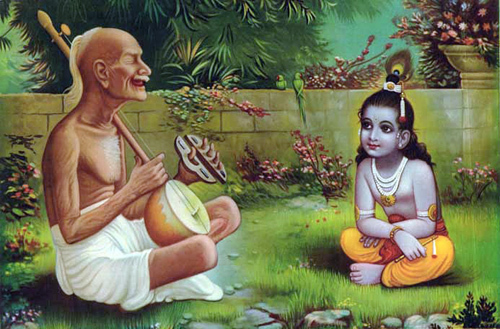
A blind man alone on the road to Vrindavana would normally have been in serious danger. Instead, Bilvamangala found the most wonderful travelling companion. Krishna Himself personally cared for the blind poet who had given up his own eyes for Him. This pastime is one of the most loved and most often painted episodes connected with Bilvamangala's name.
An Ordinary Cowherd Boy on the Road #
In one telling, attributed to Srila Narayana Maharaja, this pastime begins almost right after the self-blinding described on Renunciation and the Gouged Eyes. A boy with an unusually sweet voice came up to the newly blinded Bilvamangala and asked where he was going. When Bilvamangala said he was walking to Vrindavana, the boy said he was going there too. He offered his stick for Bilvamangala to hold and led him the rest of the way. In this telling, a journey that should have taken months took only days. Bilvamangala is remembered as composing verses in praise of Krishna as they walked together. Tradition later gathered these verses into Sri Krishna-karnamrita.
Milk, Song, and a Flute in Vrindavana #
Other tellings, including the version Srila Prabhupada also recounted, place this companionship after Bilvamangala had already settled in Vrindavana, not on the road. Here, an unnamed cowherd boy became a regular presence in the blind devotee's life: bringing him prasadam, guiding him to safe places to rest, staying close as he sang. Bilvamangala did not at first know who this boy was. Then, one day, the boy played a flute, and something in the sound was unlike anything Bilvamangala had ever heard. Overcome, he reached out to touch its source, wanting to embrace the boy who played it.
In every version of this moment, Krishna slipped free of the embrace and ran off laughing, just as He does with the gopis in Vrindavana's pastimes. Bilvamangala's reply is one of the most quoted lines connected with him. The wording differs slightly in different sources, but the meaning is always the same: Krishna could run away from his hand, but never from his heart.
A Pastime Told, Not Verified #
Nothing in this story can be checked against an outside record. It lives on only in the memory of devotees. The details differ a little, depending on which teacher tells it and where in Bilvamangala's life they place it. That does not make the pastime any less loved. In fact, the many slightly different versions over the centuries show how dear this story has been to Vaishnavas in every generation. Its message is that a devotee who gave up his own eyes for Krishna's sake would never really be left to walk alone. What Bilvamangala wrote during this period, and what became of it, is described on Sri Krishna-karnamrita.
Not to Be Confused With Other Blind Poets #
In the same 1969 conversation, the poet Allen Ginsberg asked Srila Prabhupada whether Bilvamangala might be the same person as Suradasa, another famous blind poet-devotee of Krishna in North Indian tradition. Prabhupada answered carefully: "He may be different." This small moment tells us something. Srila Prabhupada was given an easy chance to join two famous blind Krishna-poets into one story. But he chose to leave the question open, instead of giving an answer he was not sure of. We should be just as careful today. Bilvamangala Thakura and Suradasa belong to different regional traditions of Krishna-devotional poetry, and nothing ties them together as the same person.
Why a Blind Devotee Needed No Eyes #
Gaudiya Vaishnava teachers often return to the point behind this pastime. Bilvamangala judged his material eyes too dangerous to keep. Yet these eyes turn out to be unnecessary for truly seeing Krishna. What guided Bilvamangala to Vrindavana and kept him there was not sight. It was bhakti, and also Krishna's own readiness to appear personally, in the humblest form, for a devotee who could no longer see Him with his eyes. This pastime shows a teaching found throughout Vaishnava literature. The goal is not to destroy the senses for their own sake. The goal is to turn them fully toward Krishna's service, however costly that may be.