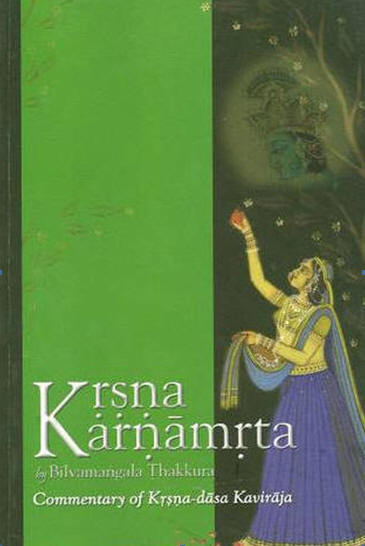
The title Sri Krishna-karnamrita means roughly "nectar for the ears about Krishna," and it is through this work that nearly the whole Vaishnava world remembers Bilvamangala Thakura. Even people who do not know in which century, region, or lineage he lived know him by it. It is a collection of short Sanskrit verses praising Krishna's beauty, His boyhood in Vrindavana, and the ache of separation from Him. The verses are written in a richly decorated style, full of intense feeling.
| Detail | Description |
|---|---|
| Title meaning | "Nectar for the ears, about Krishna" |
| Form | Short Sanskrit verses, mostly in shardulavikridita metre |
| Length | Two different versions: around 100 verses (southern/western manuscripts) or 112 verses (the Bengal version) |
| Known commentaries | By Krishnadasa Kaviraja Goswami (Sarangarangada) and by Chaitanya Dasa Goswami |
| Brought to Bengal by | Sri Chaitanya Mahaprabhu, during His South Indian pilgrimage |
Two Different Books Under One Name #
Even the text of Krishna-karnamrita is not fully settled. In a purport to Chaitanya-charitamrita, Srila Prabhupada notes that "there are two or three other books bearing the same name," and that the version studied in Bengal has 112 verses. This is the version on which Krishnadasa Kaviraja Goswami wrote his commentary Sarangarangada. Prabhupada also notes that manuscripts used in South India and western India divide the text into three sections of about a hundred verses each. Scholars have not settled whether these are one work that grew or shrank over time, or truly separate works that came to share a title and an author's name.
What the Verses Actually Say #
Again and again, the verses stay focused on Krishna's physical and personal beauty, and on the deep feeling of loving Him. One of the most quoted verses was later repeated by Sri Chaitanya Mahaprabhu Himself. It uses the word "sweet" four times in a single verse:
"O my Lord, the transcendental body of Krishna is very sweet, and His face is even sweeter than His body. But His soft smile, which has the fragrance of honey, is sweeter still."
Another describes Vrindavana's own transcendental wealth:
"The anklets on the damsels of Vraja-bhumi are made of cintamani stone. The trees are wish-fulfilling trees, and they produce flowers with which the gopis decorate themselves. There are also wish-fulfilling cows, which deliver unlimited quantities of milk. Thus Vrindavana's opulence is blissfully exhibited."
A third verse turns to the rasa dance itself, describing how Krishna expanded Himself to dance between each pair of gopis so that every one of them felt she alone had His attention:
"Lord Madhava was situated between each pair of gopis, and a gopi was situated between each pair of His manifestations. And Sri Krishna, the son of Devaki, also appeared in the middle of the circle, playing upon His flute and singing."
Srila Vishvanatha Chakravarti Thakura later commented on this verse to explain why only the demigods watching from above could see the true scale of what was happening. A fourth verse, quoted as much for its theology as its poetry, describes liberation itself standing at the devotee's door "with folded hands," ready to serve anyone who takes up pure devotional service:
"Liberation personally waits with folded hands to serve one who has taken to pure devotional service, and the results of religiosity, economic development and sense gratification stand by awaiting their opportunity to serve as well."
Srila Prabhupada used this verse again and again to make one point: liberation is a by-product of bhakti, never something a devotee needs to chase for its own sake.
A Second Work: Balagopala-stuti #
By most accounts, Krishna-karnamrita was not Bilvamangala's only work. Another devotional poem, the Balagopala-stuti, is also attributed to him. It is a hymn to Krishna as a small child. It survives today in old illustrated manuscripts. These include a fifteenth-century Western Indian copy held by the Museum of Fine Arts, Boston, and another set of illustrated pages in the Wellcome Collection in London. Library catalogues have long listed this second work under the name "Krishna-lilasuka-muni," and this is one more small clue that links the name Lilasuka to Bilvamangala's authorship. In this tradition, almost nothing about this poet can be said without some doubt attached.
Reputation Within the Tradition #
Some things about who wrote Krishna-karnamrita and when remain uncertain. But within Gaudiya Vaishnavism, no one has ever doubted its great value. Chaitanya-charitamrita records that the brahmana community who preserved and studied the text held that there was "nothing like the Krishna-karnamrita in the three worlds," because reading it carried a devotee directly into the beauty and sweetness of Krishna's pastimes. How Sri Chaitanya Mahaprabhu personally came across this book, and what He did with it afterward, is told on Legacy and Influence on Chaitanya Mahaprabhu.
An Early Voice for Radha's Supremacy #
Some later Gaudiya writers say that Krishna-karnamrita was one of the earliest widely-read Sanskrit works to show Srimati Radharani as supreme in Krishna's Vrindavana pastimes, not as a minor figure. The six Goswamis of Vrindavana, Vishvanatha Chakravarti Thakura, and later Bhaktivinoda Thakura would each take this idea much further in their own writings. It is hard to know for certain how original Bilvamangala's contribution to this idea truly was, compared with other devotional poets who wrote on the same theme. Still, this emphasis is part of why later Gaudiya Vaishnavas valued this text so highly, far beyond its poetry alone.
