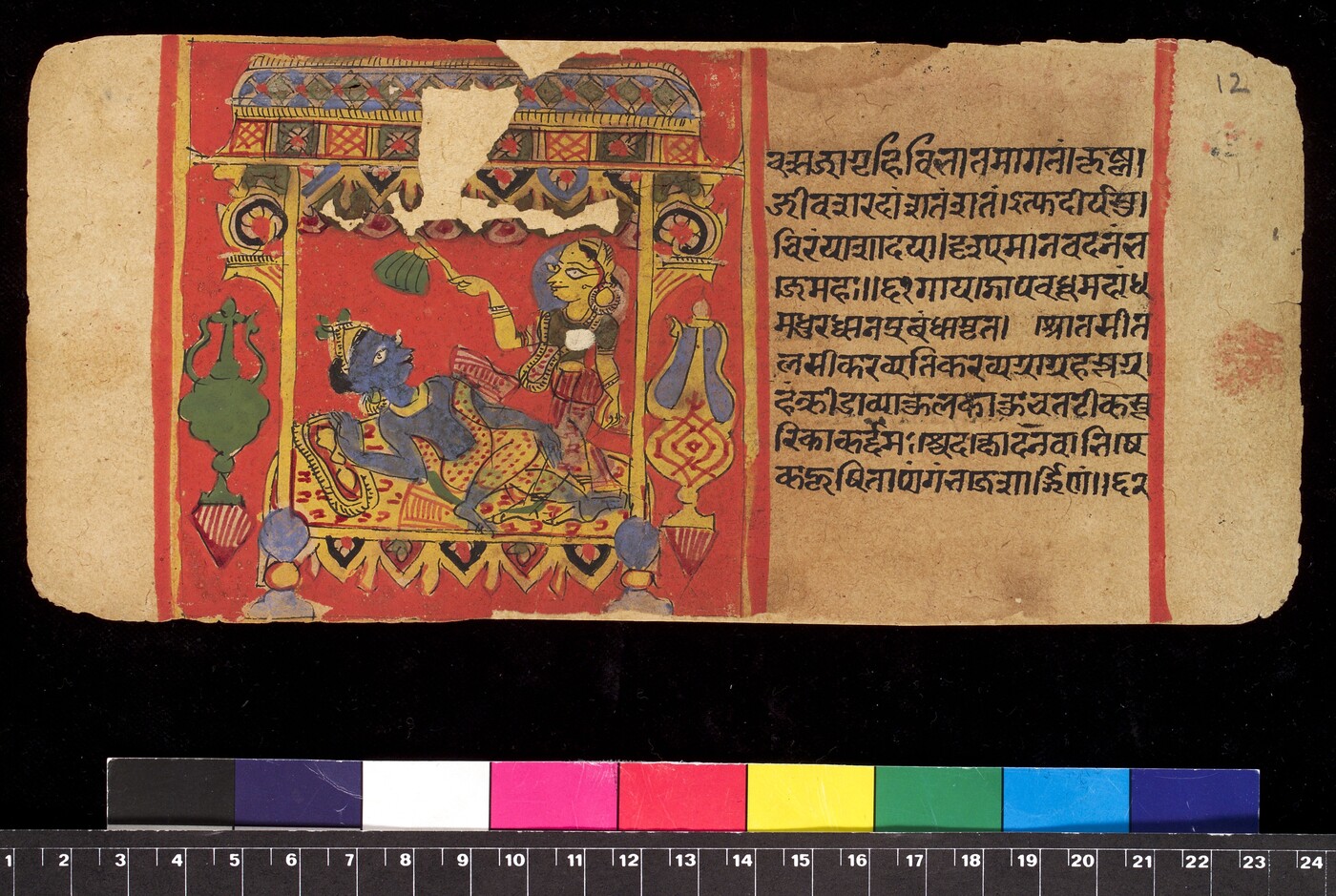
Every version of this story agrees on the essential moment. Cintamani looked at what her lover had become. He was soaked, exhausted and injured, and still consumed by desire after everything he had just survived to reach her. Instead of welcoming him, she rebuked him. Her exact words are not fixed. The story has been retold many times across the Vaishnava tradition. It appears in Sanskrit devotional biographies, in the memory of Bengali Vaishnavas, and in modern retellings. No two versions use quite the same sentences. What stays the same is the meaning.
What Cintamani Said #
Srila Prabhupada told this story very simply to a visitor in 1969. Cintamani saw the low state that Bilvamangala had brought himself to. She told him that if he felt even this much attraction for Krishna, his life would really be worth something. Other retellings add more. They say she told him that her own body, however beautiful, was made of the same blood, bone, and mucus as anyone else's. It was ageing and would die. It could never reward this kind of devotion the way Krishna could. A modern telling attributed to the Vaishnava teacher Srila Narayana Maharaja has her speak even more bluntly. In it she tells him that she could no longer love a man so lost to lust, and orders him to leave. Whatever wording is closest to what Cintamani actually said, the message that reached him was the same. He had spent everything on a body that would rot. The same devotion, turned toward Krishna, would have carried him somewhere permanent.
Words That Broke a Lifetime's Habit #
This rebuke is remarkable because of its effect, not because of its content. Teachers had already told Bilvamangala the same thing in other words. Srila Prabhupada's own account shows a change so sudden that it is almost startling: "immediately he came to his senses." Why could a courtesan's rebuke succeed where years of brahminical training apparently had not? Prabhupada explains that Bilvamangala had likely already reached an advanced stage of Krishna-prema in a previous life. The impressions carried over from that life let Cintamani's words strike so deep, so fast. Without that earlier preparation, Prabhupada notes elsewhere, the same words might have changed nothing at all.
A verse attributed to Bilvamangala himself, quoted centuries later in Chaitanya-charitamrita, captures what this reversal felt like from the inside. The sannyasi Brahmananda Bharati, comparing his own change of heart to Bilvamangala's, recites this verse:
"Although I was worshiped by those on the path of monism and initiated into self-realization through the yoga system, I have nonetheless been forcibly turned into a maidservant by some cunning boy who is always joking with the gopis."
This is an unusual way for a former philosopher to describe his own conversion. He does not describe it as something he achieved. He describes it as being overpowered.
Leaving Everything Behind #
Bilvamangala did not stay to think it over. Every account agrees that he left almost at once, on foot, alone, heading for Vrindavana, the place every version of his story treats as the goal of his new life. He did not travel there unchanged. On the road, his old weakness for feminine beauty came back one more time, with the consequences described on Renunciation and the Gouged Eyes. But the man who left Cintamani's courtyard that morning was not the man who had crossed the flooded river the night before. The earlier chapter of his life, on Early Life and Attachment to Cintamani, shows this clearly.
A Very Different Local Memory #
Not everyone tells this story the same way. The Kerala tradition, kept near Bilvamangala's traditional birthplace, describes Cintamani quite differently. In it she is not a courtesan rebuking a lustful stranger. She is a noble woman devoted to Krishna, who already treated the young Bilvamangala (called there by his other name, Lilasuka) with respect. In that telling, she showed him a vision of the child Krishna in her own home. After this, the two of them together composed the verses that became Krishna-karnamrita. Then Bilvamangala left peacefully for the sannyasa order. He did not flee after a rebuke. This is a very different story from the one told across the wider Gaudiya tradition and by Srila Prabhupada himself, with the corpse, the river and the rebuke. The two are kept here as separate accounts, not blended into one. But this much can be said with confidence. Cintamani, whoever she truly was, is remembered everywhere as the person through whom Bilvamangala found Krishna.
