Bilvamangala Thakura never met Sri Chaitanya Mahaprabhu. Whichever of the proposed dates is correct, he left this world generations, if not centuries, before Chaitanya appeared in 1486. And yet Chaitanya-charitamrita, the great biography of Chaitanya's life written by Krishnadasa Kaviraja Goswami, returns to Bilvamangala's verses again and again. It returns to them more than to any other single non-Gaudiya poet quoted in the book. This fact alone says a great deal about how the Gaudiya Vaishnava tradition came to see him.
Found on a South Indian Pilgrimage #
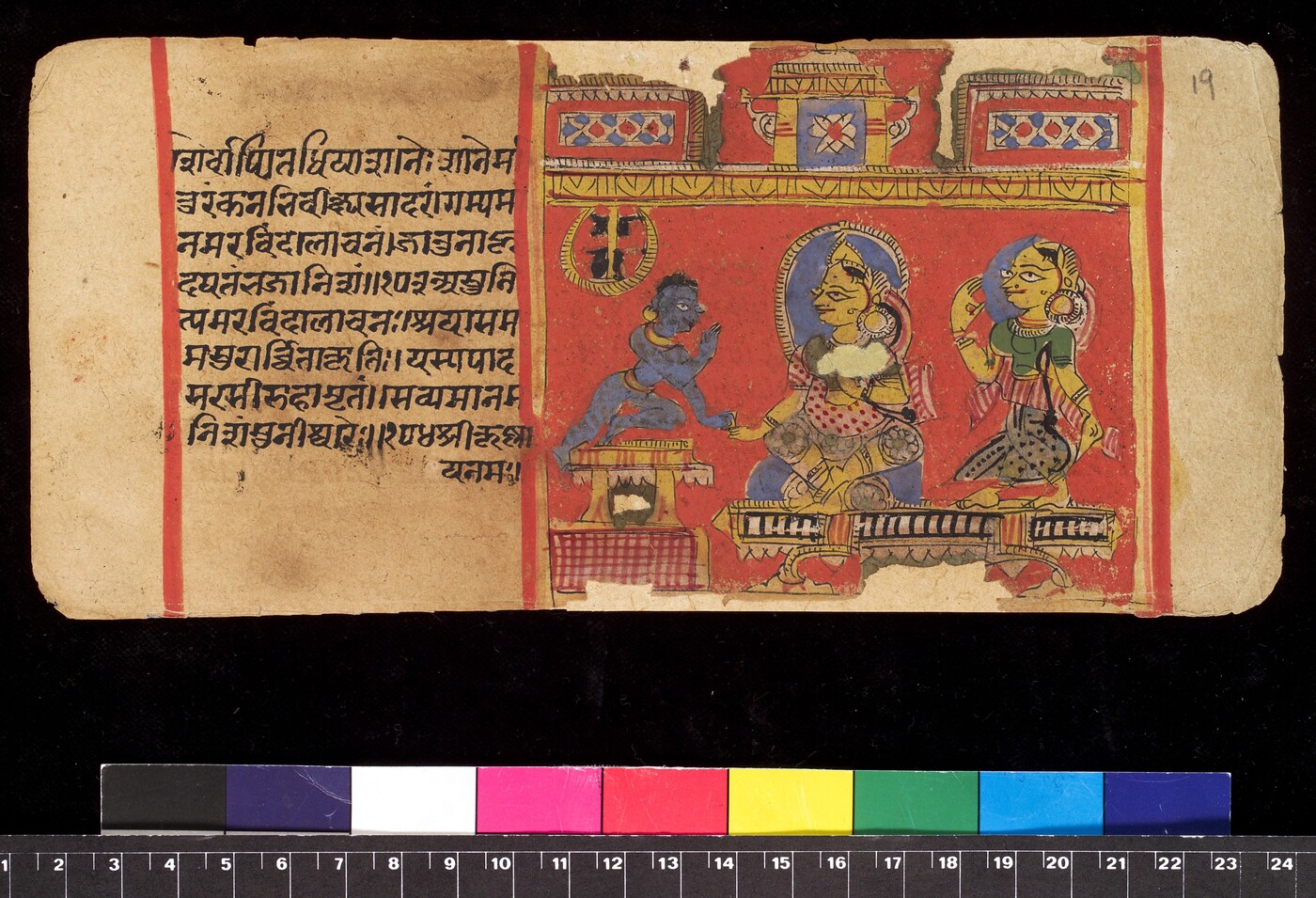
The clearest link between Bilvamangala and Chaitanya is a simple event recorded in biography, not a legend. Chaitanya-charitamrita records that during Sri Chaitanya Mahaprabhu's long pilgrimage through South India, He came across a handwritten manuscript of Krishna-karnamrita. A community of Vaishnava brahmanas was reading it near Pandarapura. This was on the bank of a river that Srila Prabhupada's purport identifies as the Krishna-venva, also called locally the Vina, the Veni, the Sina, or the Bhima. In the same purport, Prabhupada adds, "it is said that Thakura Bilvamangala resided on the banks of this river," and this is one more claim in the long list of disputed places where Bilvamangala may have lived. It does not agree well with the Kerala tradition told on Early Life and Attachment to Cintamani.
Chaitanya-charitamrita describes Chaitanya's reaction simply and directly. He was "very pleased to hear the book Krishna-karnamrita," and "with great eagerness He had it copied and took it with Him," after first getting the temple authorities' permission. At that time printing did not yet exist, and that community held the only copy. When He came back to Vidyanagara on the Godavari, on His way home to Jagannatha Puri, Chaitanya told Ramananda Raya the whole story of His travels and gave him both books He had found in the south, the Krishna-karnamrita and the Brahma-samhita.
A Book He Never Tired of Hearing #
Chaitanya-charitamrita records that in His later years at Puri, there were only a very few works that Chaitanya "especially liked to hear" recited. Bilvamangala's Krishna-karnamrita was one of them, along with the poetry of Vidyapati and Jayadeva Goswami's Sri Gita-govinda. The book also records that hearing its verses and songs "created happiness" in His heart. Later in the book, on at least two recorded occasions, Chaitanya was overwhelmed with ecstatic feeling and recited and explained single Krishna-karnamrita verses to His close associates. Once it was a verse where the poet cries out that his days without seeing Krishna are wasted. Another time it was a verse where Krishna's own devotee admits she cannot forget the sweetness of His smile. These are more than passing mentions. They show that Chaitanya had practically learned the text by heart.
Praised as Beyond Compare #
Chaitanya-charitamrita states plainly just how highly the devotees around Chaitanya regarded Krishna-karnamrita:
"There is no comparison to the Krishna-karnamrita within the three worlds. By studying this book, one is elevated to the knowledge of pure devotional service to Krishna."
This is a bold claim to make about any book outside scripture itself, and it was not made lightly. The same passage says that Krishna-karnamrita reveals "the beauty and melodious taste of the pastimes of Lord Krishna" to anyone who reads it constantly.
Still Quoted Today #
Centuries later, Srila Prabhupada carried this same regard for Bilvamangala's verses into his own teaching. He quoted Krishna-karnamrita in lectures, conversations, and purports. He used it to speak about Krishna's beauty and about the rasa dance. Again and again, he used it for one idea he returned to often: liberation comes and stands before a sincere devotee "with folded hands," waiting to serve. It is not something to be chased for its own sake. In a 1969 conversation recorded in Columbus, Ohio, Prabhupada told the whole Cintamani story from memory to the poet Allen Ginsberg. He called Bilvamangala "a great poet" and urged Ginsberg to read his verses directly, not only hear the story secondhand. Bilvamangala had written these verses many centuries before, at least five hundred years before and perhaps more than a thousand. Yet his verses about a boy playing a flute in Vrindavana were still doing exactly the work he wrote them to do.
No Recorded Ending #
One gap remains in this whole story. Nothing records when, where, or how Bilvamangala Thakura's life actually ended. Chaitanya-charitamrita quotes his verses so generously, but it says nothing about his passing. In 1969, Srila Prabhupada remarked that Bilvamangala "executed devotional service for seven hundred years" and "lived for seven hundred years in Vrindavana." These words should be recorded exactly, because Prabhupada said them. But they read as a devotional way of describing a very long life, not as a historical claim meant to be taken literally. No other source repeats them. In the end, Bilvamangala Thakura is remembered almost entirely through what he wrote and what happened to him, not through any settled account of how his life came to an end.
