In time, Nityananda Prabhu's sankirtana campaign in Bengal settled into a quieter, more established stage. Gadadhara Dasa's own life changed in a similar way. He moved from the road to a fixed home, and from active preaching to founding temples that would outlast him by centuries.
From Katwa to Endiyadaha #
Gadadhara Dasa's first settled home was Katwa, the town where Chaitanya Mahaprabhu Himself had accepted sannyasa from Keshava Bharati. There he established a temple to Sri Gaurasundara. In time he also took a disciple, Yadunandana Chakravarti, the only disciple of his recorded in the available sources. Some accounts also say that for a time he cared for Sachi Mata and Vishnupriya Devi, Mahaprabhu's mother and wife, in Navadwipa before their own disappearances. But this detail rests on a single source, so it should be read with care.
Eventually Gadadhara Dasa moved on once more, this time to Endiyadaha-grama. This village on the banks of the Ganges, some eight or ten miles from Calcutta, became his final and best-remembered home. There he installed a Bala Gopala deity for worship. Sri Chaitanya-charitamrita, quoting the Bhakti-ratnakara, traces this whole sequence plainly: Navadwipa, then Katwa after Mahaprabhu's disappearance, then Endiyadaha, where Gadadhara Dasa made his last home. When they speak of this settled, later part of his life, the sources most often add a title of respect and call him Gadadhara Dasa Thakura, not simply Gadadhara Dasa. The change in title marks a change in his life. He was no longer a travelling preacher, a wandering companion passing through with Nityananda Prabhu. He had become an established local acharya, a householder who founded a temple, whom the people of Endiyadaha would have known directly.
His Disappearance in Kartika #
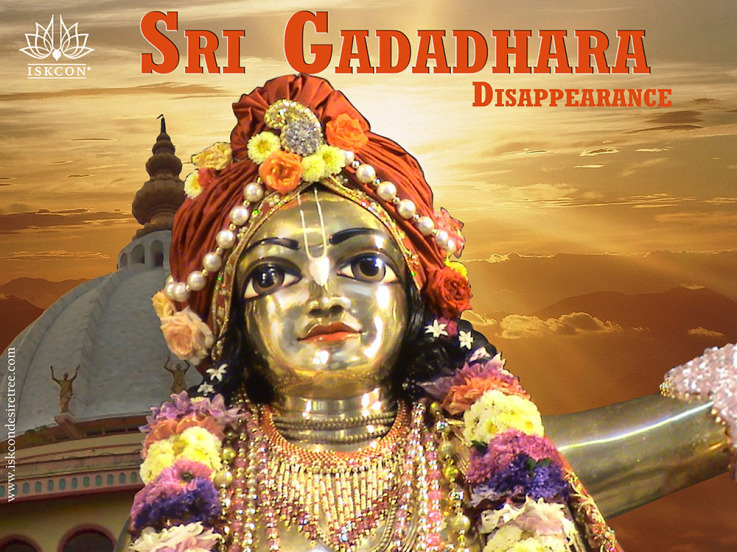
Gadadhara Dasa disappeared on Kartika-shukla-ashtami, the eighth day of the bright fortnight of the month of Kartika. The available sources give no year for this, and no year for his birth either. This is a real gap in a life that is otherwise unusually well recorded. We report the gap here and do not fill it with a guess.
The Temple That Outlived Him #
What happened at Endiyadaha after Gadadhara Dasa's disappearance is, in its own way, as remarkable as anything in his life. His tomb there passed first into the care of the Satyogi Vaishnavas, a Vaishnava community, and later came under the direction of Siddha Bhagavan Dasa Babaji of Kalna. This pattern repeats again and again in later Gaudiya Vaishnava history. A devotee's samadhi becomes the seed of a living temple, and a line of babajis and their followers look after it for generations. Readers will recognize it from the samadhi traditions of acharyas like Gaura Kishora Dasa Babaji as well. At Endiyadaha, on Siddha Bhagavan Dasa Babaji's order, Madhusudana Mullik built a small monastery on the site in the Bengali year 1256 (roughly the mid-nineteenth century). He was a member of the well-known Mullik family of Narikeladanga, Calcutta. He also arranged worship there for a Deity named Radhakanta. His son, Balaichandra Mullik, went further. In the Bengali year 1312 (roughly the early twentieth century) he installed Gaura-Nitai Deities alongside the existing ones. Ever since, the same altar at Endiyadaha has held both Gaura-Nityananda and Radha-Krishna together.
Why the Confusion with Gadadhara Pandit Still Matters #
As these pages said at the start, Gadadhara Dasa is not Gadadhara Pandit. They lived in the same generation, served the same Lord, and share the same first name. But the tradition is careful never to mix them up. Gadadhara Pandit is Radharani Herself in the Panca-tattva. Gadadhara Dasa is the luster of Her body. He served both Chaitanya Mahaprabhu and Nityananda Prabhu, and spent his later years quietly building a temple on the banks of the Ganges. Srila Prabhupada's own Chaitanya-charitamrita purports keep this difference exact, even while telling both of their stories with equal reverence. The same care has been kept here. For his years with Mahaprabhu before he ever came to Endiyadaha, see Companion of Mahaprabhu in Navadwipa and Puri. For the Bengal preaching years and the story of the Kazi, see Nityananda's Chief Assistant and the Kazi.
